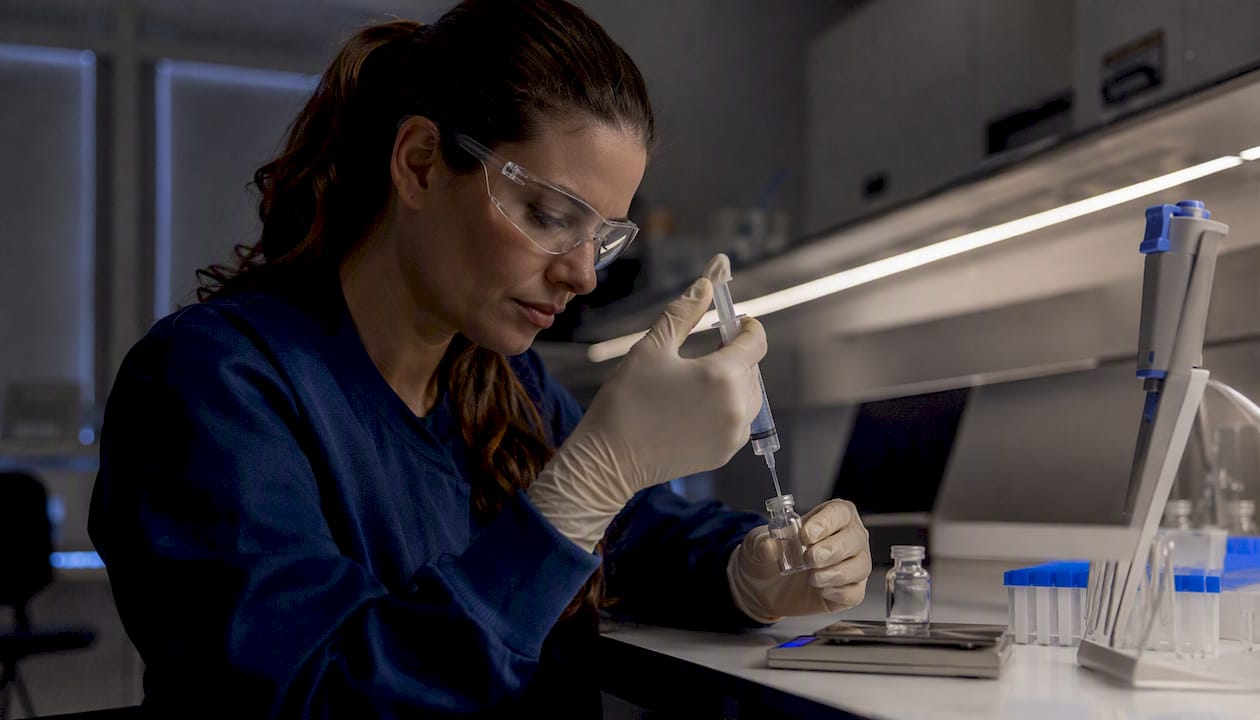
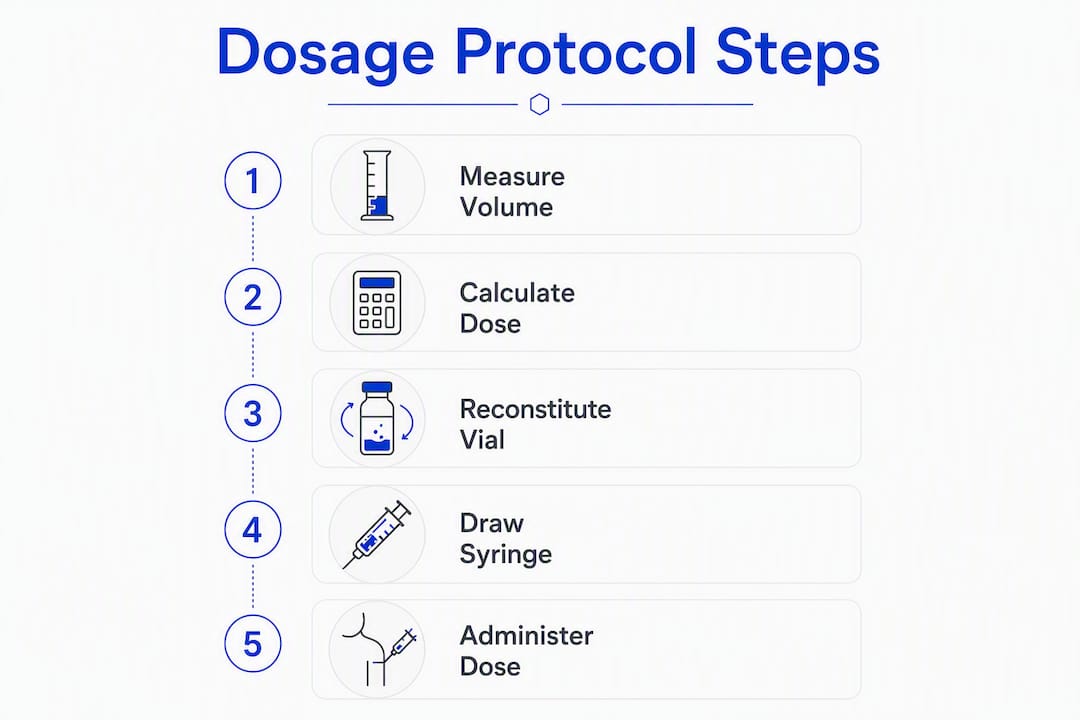
Reconstitute the Synthro Lab GLOW vial (50 mg GHK-Cu + 10 mg BPC-157 + 10 mg TB-500, 70 mg total) with 3.0 mL of bacteriostatic water, as recommended in standard protocols for the 70 mg GLOW vial. Anchor every dose calculation to the GHK-Cu component. The core formula:
- GHK-Cu mg/mL = 50 mg ÷ reconstitution volume (mL)
- BPC-157 mg/mL = 10 mg ÷ same volume
- TB-500 mg/mL = 10 mg ÷ same volume
At 3.0 mL: the GHK-Cu concentration is set by dividing 50 mg by the reconstitution volume, with BPC-157 and TB-500 each at one-fifth that amount. A 0.1 mL draw on a U-100 syringe (10 units) delivers 1.67 mg GHK-Cu, 0.33 mg BPC-157, and 0.33 mg TB-500. That is your microdose baseline.
This blend is for laboratory research use only. No component in this vial is approved by the FDA for human therapeutic use. All work must comply with applicable institutional protocols (IACUC, IRB, or equivalent), and researchers are responsible for obtaining required approvals before use.
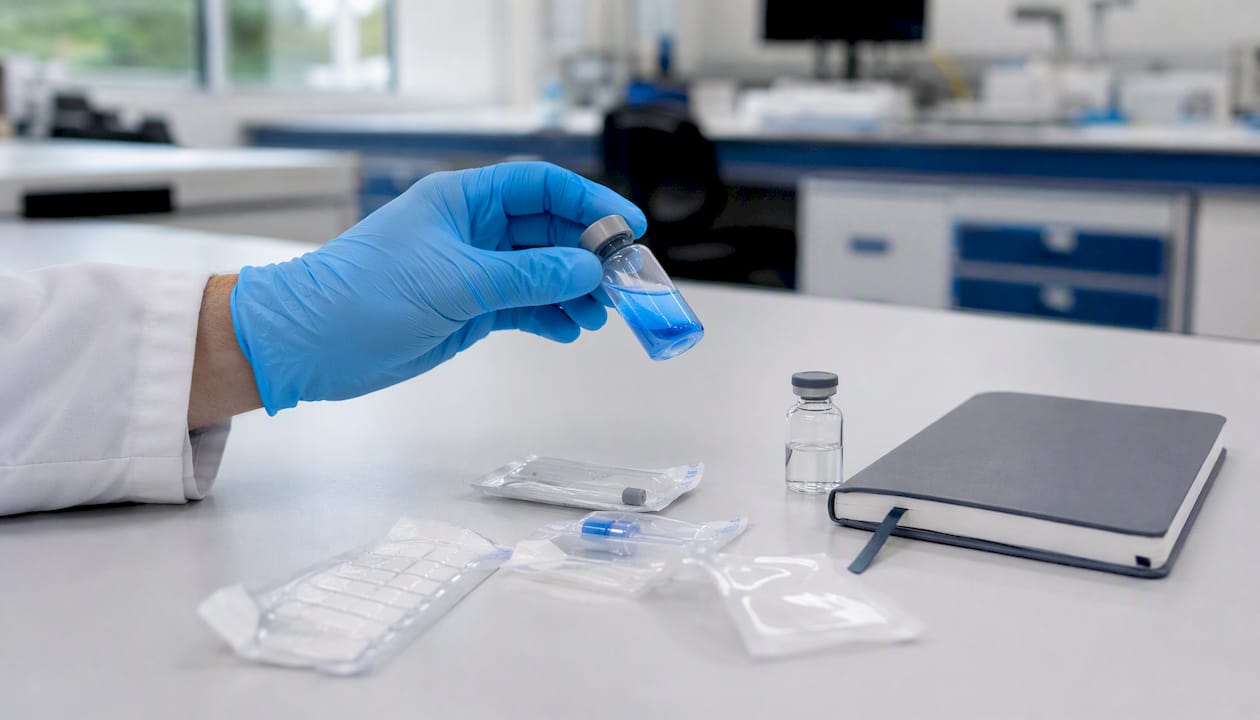
Table of Contents
What each peptide does in the GLOW 50/10/10 blend
The 50:10:10 ratio is not arbitrary. GHK-Cu anchors the blend at 50 mg because it carries the broadest preclinical evidence base and the most predictable dose-response curve. BPC-157 and TB-500 each contribute distinct mechanisms at 10 mg, a proportion that keeps the ratio consistent across every aliquot without requiring separate component mixing.
GHK-Cu (Copper Tripeptide-1) — 50 mg
- Mechanism: Copper-chelating tripeptide that activates collagen synthesis, antioxidant gene expression, and tissue remodeling pathways
- Evidence level: Substantial preclinical data; selected human data exist in wound healing and skin repair contexts
- Primary research applications: Skin repair, fibroblast activation, anti-inflammatory signaling, and cellular regeneration
- Role in GLOW: Anchor component; its 50 mg mass sets the ratio denominator for all dose calculations
BPC-157 (Body Protection Compound-157) — 10 mg
- Mechanism: Synthetic pentadecapeptide derived from a gastric protein; promotes angiogenesis and modulates nitric oxide pathways
- Evidence level: Predominantly preclinical (rodent models); limited human clinical data available
- Primary research applications: Gastrointestinal mucosal repair, tendon-to-bone healing, anti-inflammatory response
- Role in GLOW: Secondary regenerative component; its 10 mg mass tracks at a 1:5 ratio to GHK-Cu
TB-4/TB-500 (Thymosin Beta-4 fragment) — 10 mg
- Mechanism: Actin-sequestering peptide that promotes cell migration, reduces inflammation, and supports vascular repair
- Evidence level: Preclinical data strong; human data emerging but limited in scope
- Primary research applications: Wound healing, cardiac repair models, muscle cell migration
- Role in GLOW: Paired with BPC-157 at equal mass; together they represent the 20 mg regenerative support fraction
The fixed 50:10:10 ratio means a researcher drawing any volume from a properly reconstituted vial always delivers all three components at the intended proportion. Confirm the exact mg content printed on your vial before calculating, since batch labeling is the ground truth.
How to calculate doses from the 70 mg vial
Because GHK-Cu is the largest component, anchor all math to it. Once you know GHK-Cu mg per draw, multiply by 0.2 to get the corresponding BPC-157 or TB-500 amount (since each is 1/5 of GHK-Cu by mass).
Formula:
GHK-Cu per draw (mg) = [50 ÷ reconstitution volume (mL)] × draw volume (mL)
BPC-157 per draw = GHK-Cu per draw × 0.2
TB-500 per draw = GHK-Cu per draw × 0.2
The PeptideFox GLOW dosage calculator applies the same anchor logic and is worth cross-referencing for your target dose range.
Three worked examples (2.5 mL reconstitution)
| Example |
Draw volume |
U-100 units |
GHK-Cu |
BPC-157 |
TB-500 |
| Microdose |
— |
5 units |
— |
0.2 mg |
0.2 mg |
| Common research dose |
0.1 mL |
10 units |
2.0 mg |
0.4 mg |
0.4 mg |
| Higher research dose |
— |
25 units |
— |
— |
— |
At 3.0 mL total volume, the vial yields 30 draws at 0.1 mL (10 units) each. Each draw delivers 1.67 mg GHK-Cu, 0.33 mg BPC-157, and 0.33 mg TB-500. The tradeoff: 3.0 mL gives more doses per vial and is the commonly recommended protocol; the lower volume is sometimes used but does not match the primary standard.
Adapting for non-standard vials
If your lab receives a vial with a different total mass or a different ratio, rebuild the formula from scratch using the actual labeled mg values. Never assume the 50:10:10 ratio without confirming the vial label and COA. The anchor principle stays the same: divide each component’s mass by the reconstitution volume to get its concentration, then multiply by your draw volume.
Step-by-step aseptic reconstitution of the GLOW blend
A common protocol for the 70 mg GLOW vial calls for 3.0 mL of bacteriostatic water injected slowly down the vial wall. The steps below reflect that standard with added aseptic controls.
- Gather materials before opening anything: Synthro Lab BAC Water 10 mL, a sterile U-100 insulin syringe, alcohol prep wipes, gloves, and a clean work surface.
- Wipe the stopper of both the peptide vial and the BAC water vial with a fresh alcohol wipe. Allow 30 seconds to dry.
- Draw the BAC water into the syringe. For 2.5 mL, you will need two or three draws depending on syringe capacity.
- Inject slowly down the vial wall, not directly onto the lyophilized cake. This reduces foaming and mechanical stress on the peptide.
- Swirl gently for 15–20 seconds. Do not vortex or shake. Shaking denatures peptide bonds.
- Inspect the solution. A clear blue color is the expected result. GHK-Cu’s copper binding produces this hue and confirms successful dissolution.
- Label the vial immediately with concentration (mg/mL for each component), reconstitution date, lot number, and your initials.
Pro Tip: If the lyophilized cake does not dissolve fully after gentle swirling, let the vial sit refrigerated for 10–15 minutes and swirl again. Forcing dissolution by shaking risks peptide degradation.
Visual QC and troubleshooting
| Observation |
Likely cause |
Action |
| Clear blue solution |
Normal; GHK-Cu copper binding |
Proceed |
| Colorless clear solution |
Possible GHK-Cu degradation or wrong vial |
Check label and COA; contact vendor |
| Cloudy or milky |
Incomplete dissolution or contamination |
Do not use; document lot and contact vendor |
| Visible particulates |
Contamination or degradation |
Discard immediately; file lab incident report |
Cloudiness is a hard stop. Document the lot number and COA reference, then contact Synthro Lab for return or replacement. Never use a vial that does not pass visual inspection.
Syringe draws, unit conversions, and dose counts per vial
A U-100 syringe holds 100 units per mL, so 0.1 mL equals 10 units. That relationship is the conversion anchor for every draw.
U-100 unit reference table (3.0 mL reconstitution)
| U-100 units |
Volume (mL) |
GHK-Cu (mg) |
BPC-157 (mg) |
TB-500 (mg) |
| 10 units |
0.1 mL |
1.67 mg |
0.33 mg |
0.33 mg |
| 20 units |
0.2 mL |
3.33 mg |
0.67 mg |
0.67 mg |
| 30 units |
0.3 mL |
5.00 mg |
1.00 mg |
1.00 mg |
A vial reconstituted at 3.0 mL yields 30 draws at 10 units (0.1 mL) each. This volume is the standard protocol for a 70 mg GLOW vial and balances dose consistency with vial longevity.
For experimental designs requiring split dosing, draw each aliquot into a separate labeled tube rather than re-entering the vial repeatedly. Every needle insertion is a contamination risk. Single-use draws are the standard for sterile research preparations.
Storage and stability for lyophilized and reconstituted vials
Handling errors here are the most common source of assay variability. Get this right before anything else.
Lyophilized (unopened) vials:
- Store in a cool, dark location away from direct light and humidity
- Refrigeration is standard; avoid freezer cycling before reconstitution unless the COA specifies otherwise
- Check the expiry date and lot number on receipt; do not use a vial past its labeled date
Reconstituted solution:
- Refrigerate immediately after reconstitution; keep in the dark
- Use within the lab-validated stability window for the blend; if your COA or vendor documentation specifies a window, that figure governs
- Avoid repeated freeze-thaw cycles; each cycle degrades peptide integrity measurably
- The clear blue color of a properly stored GHK-Cu solution is a fast visual check before each draw; a color shift warrants re-inspection
COA check before use:
- Confirm purity percentage and assay results match the labeled batch
- Note the lot number in your experimental record before opening the vial
- Retain the COA with your experiment metadata; it is your chain-of-custody document
If the reconstituted solution shows any color change, cloudiness, or particulates on a subsequent inspection, do not use it. Discard, document, and reorder.
Safety precautions, PPE, disposal, and U.S. regulatory context
Lab safety and PPE
- Wear nitrile gloves and eye protection for all reconstitution and draw steps
- Work on a clean, disinfected surface; a biosafety cabinet is preferred for sterile preparations
- Use a new sterile syringe for every draw; never reuse needles
- Dispose of sharps in an approved sharps container immediately after use
- For spills, absorb with absorbent material, discard in appropriate chemical waste, and document the incident
Disposal of unused solution: Unused reconstituted peptide solution should be treated as laboratory chemical waste. Follow your institution’s chemical disposal SOP. Do not pour peptide solutions down the drain without confirming local regulations permit it.
Single-use vial disposal: Discard empty glass vials in a puncture-resistant sharps or glass waste container per your facility’s waste management protocol.
Institutional compliance
- All research use requires documented institutional approval (IACUC for animal studies, IRB for any human-subjects component)
- Maintain a written SOP for reconstitution, dosing, storage, and disposal
- Log lot numbers, COA references, reconstitution volumes, and draw records in your experimental notebook
U.S. regulatory context
The FDA Pharmacy Compounding Advisory Committee discussed possible listing implications for BPC-157 and TB-500 in July 2026. This is an advisory discussion, not a final rule. Researchers should monitor FDA guidance actively, as regulatory status for these compounds in the United States may change. Neither BPC-157 nor TB-500 is currently FDA-approved for therapeutic use.
This is general research information, not legal or medical advice. Confirm current regulatory status with the FDA or a qualified regulatory professional before initiating any new research protocol.
How Synthro Lab supports reproducible research
Reproducibility starts with verified source material. Synthro Lab provides independently batch-tested peptides with certificates of analysis available for every lot.
COA checklist — what to verify before use:
- Purity percentage (look for the assay result, not just a label claim)
- Identity confirmation (HPLC or MS data confirming the compound)
- Water content (relevant for lyophilized peptides; affects actual peptide mass per vial)
- Lot number and assay date (must match the vial in hand)
- Impurity data (any detected impurities and their levels)
Requesting a COA from Synthro Lab: Navigate to the product page for your specific lot, or visit the COA page directly. Lot numbers appear on the vial label. If your lot’s COA is not immediately visible, contact Synthro Lab support with the lot number.
Recommended supplies for this protocol:
- GHK-Cu 50mg + BPC157 10mg + TB-500 10mg — the GLOW blend vial
- Synthro Lab BAC Water 10 mL — the recommended reconstitution diluent
- BPC-157 10mg + TB-500 10mg — available separately for component-level cross-referencing
- U-100 insulin syringes (1 mL capacity)
- Sterile alcohol prep wipes
- Calibrated pipettes for higher-precision volume work
Lot numbers and expiry dates appear on each product label. Record both in your experimental log at the time of reconstitution.
Key Takeaways
The GLOW 50/10/10 blend requires anchoring all dose math to the 50 mg GHK-Cu component, reconstituting with 2.5–3.0 mL of bacteriostatic water, and confirming a clear blue solution before every draw.
| Point |
Details |
| Reconstitution volume |
Use 3.0 mL BAC water for the 70 mg vial; this matches established GLOW protocols and maximizes dose count per vial. |
| Anchor-dose rule |
Divide 50 mg GHK-Cu by reconstitution volume to set the concentration; BPC-157 and TB-500 each track at 1/5 of that value. |
| Syringe conversion |
On a U-100 syringe, 0.1 mL = 10 units; at 3.0 mL reconstitution, 10 units delivers 1.67 mg GHK-Cu. |
| Storage and stability |
Refrigerate reconstituted solution in the dark; avoid repeated freeze-thaw cycles; use within the COA-specified window. |
| Synthrolab COA verification |
Confirm purity, lot number, and assay date on the Synthro Lab COA page before every experimental run. |
The documentation gap most researchers miss
Most protocol errors with multi-component blends like the GLOW 50/10/10 are not calculation errors. They are documentation failures. A researcher draws the right volume, uses the right syringe, and gets a clean blue solution, then records nothing beyond “reconstituted vial.” Three weeks later, when a second researcher runs the same experiment with a new lot, the results diverge and nobody can explain why.
The fix is straightforward: log the reconstitution volume, lot number, COA reference, time of reconstitution, ambient temperature, and the draw volume for every aliquot. That record is what makes a result reproducible rather than just repeatable by one person on one day.
There is also a tendency to treat the visual blue color check as optional, a nice-to-have. It is not. GHK-Cu’s copper binding is what produces that hue, and a colorless or off-color solution after reconstitution is a signal worth stopping for. The color check takes five seconds and has caught degraded vials before they contaminated an entire experimental run.
For researchers newer to peptide handling, Synthro Lab’s safe-start guide for peptides covers foundational aseptic technique and documentation standards worth reviewing before the first reconstitution.
Source your GLOW blend and supplies from Synthro Lab
Synthro Lab’s GHK-Cu 50mg + BPC157 10mg + TB-500 10mg vial is independently batch-tested and ships with a downloadable COA for every lot. That means you can verify purity, identity, and water content before the vial ever enters your protocol.
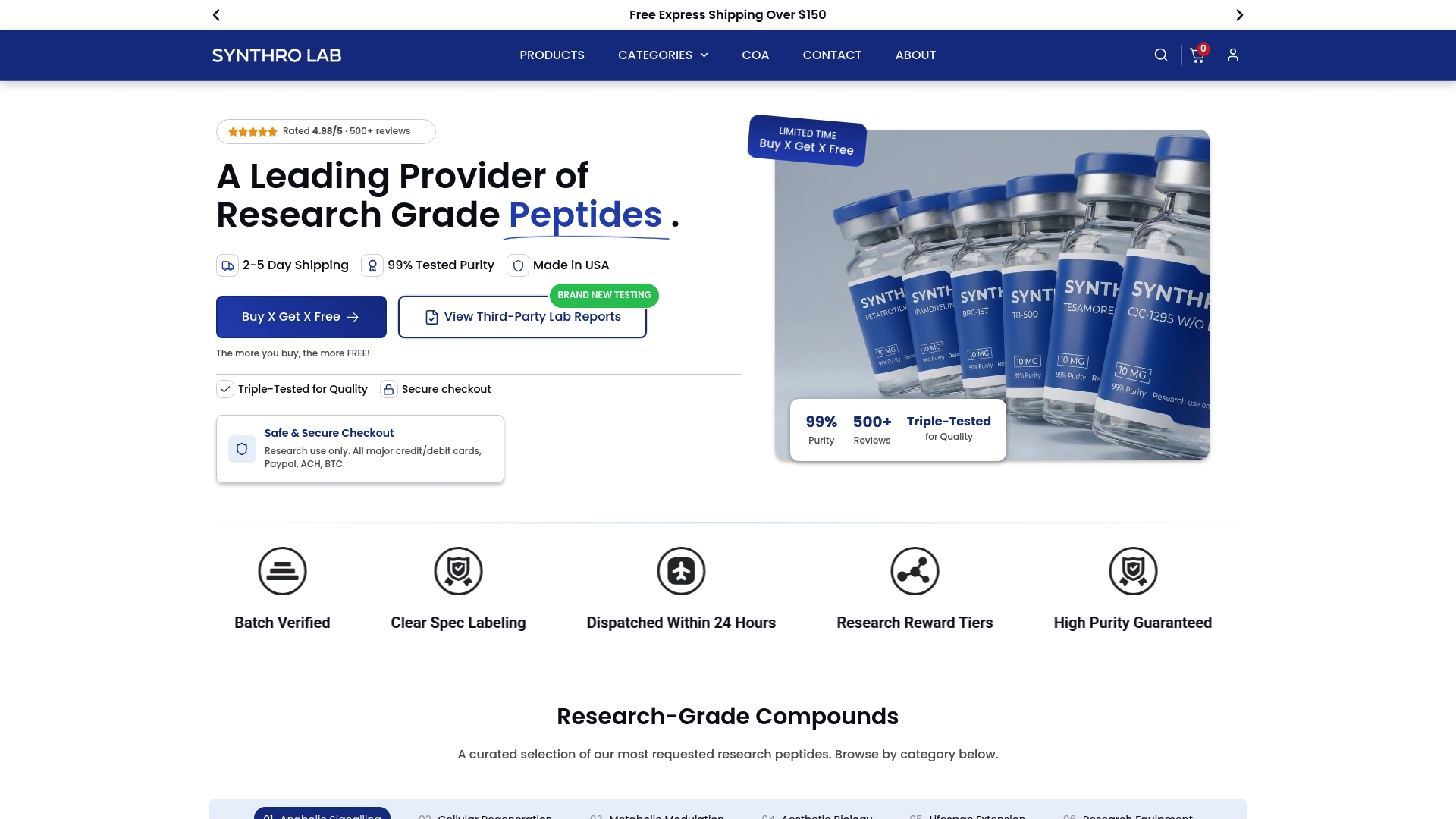
The full supply list for this protocol — GLOW blend, BAC Water 10 mL, and component-level vials for cross-referencing — is available directly on the Synthro Lab product pages. Every purchase is for laboratory research use only. Review the COA for your specific lot on the Synthro Lab COA page before beginning any experimental run, and retain it with your experimental records.
Authoritative sources for regulatory and scientific verification
Use these primary sources to verify regulatory status, interpret COA data, and cross-reference preclinical evidence.
How to read a COA: Look first at the assay percentage (purity by HPLC or MS), then check the impurities section for any detected off-target compounds. Confirm the lot number on the document matches the vial label exactly. The assay date tells you how fresh the testing is; a COA dated more than 12 months before your use warrants a retest request. Water content matters for lyophilized peptides because it affects the actual peptide mass delivered per vial.
Recommended
 21+ verification