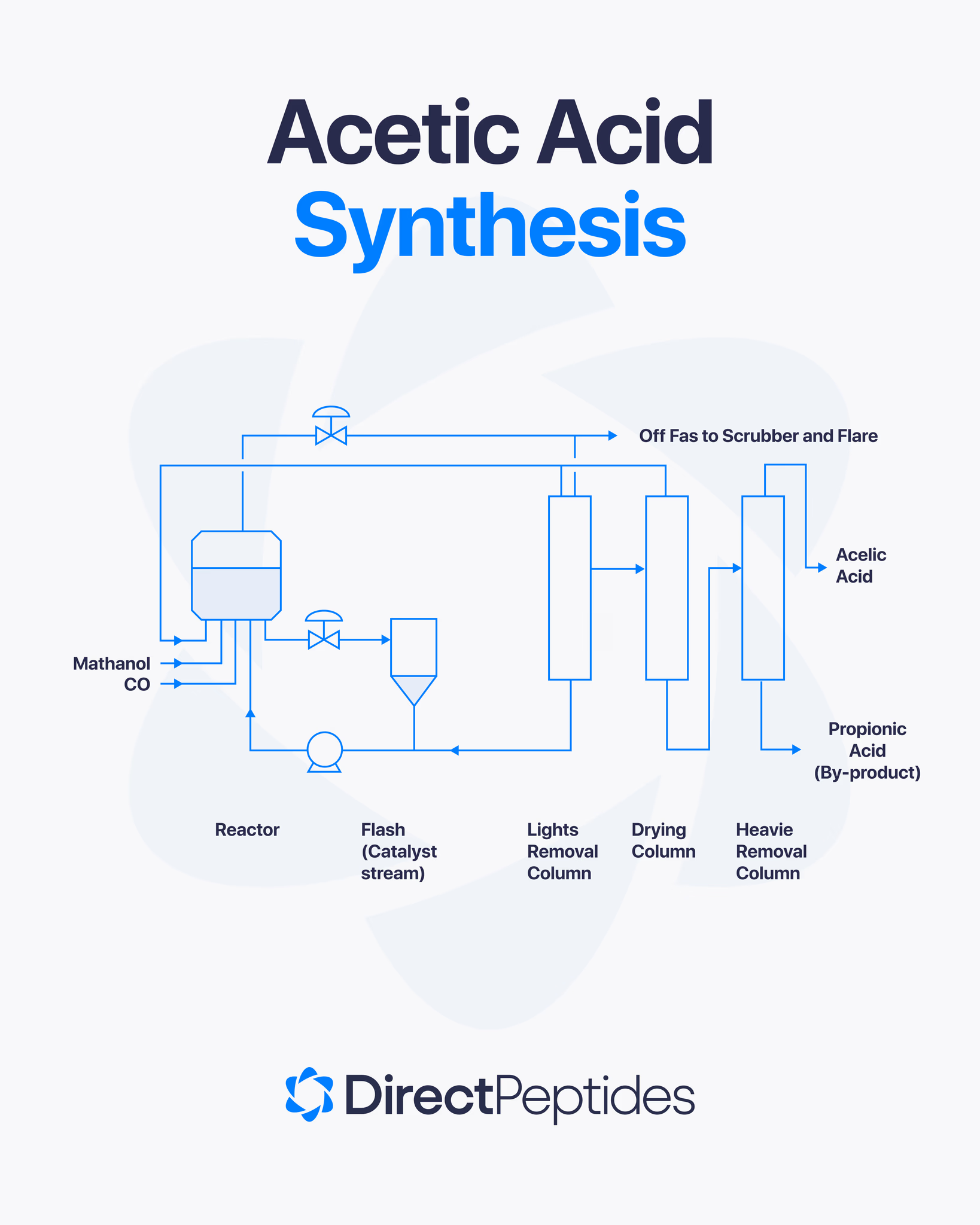
Why Revisit Acetic Acid Synthesis Today?
Acetic acid remains one of the most important industrial chemicals, serving as a key ingredient in the production of polymers, solvents, adhesives, and numerous chemical intermediates. While methanol carbonylation continues to be the dominant manufacturing route, increasing attention has shifted toward sustainability, energy efficiency, and carbon reduction. As a result, researchers and industry leaders are exploring innovative technologies that could reshape acetic acid production in the coming years.
(Reference: Medrano-García et al., 2025)
What Are the Recent Innovations?
Current research is focused on developing cleaner, more efficient, and carbon-conscious production methods. Several emerging trends are attracting significant attention:
-
Advanced Catalytic Technologies: Scientists are refining traditional carbonylation processes, including modern adaptations of the Monsanto and Cativa methods, to improve efficiency, lower waste generation, and reduce energy requirements. Recent process simulations have demonstrated opportunities to simplify purification stages while improving heat recovery throughout the production cycle. (Reference: Optimization of Acetic Acid Production paper, 2025)
-
Carbon Capture and Utilization (CCU): New approaches are combining captured industrial carbon dioxide with catalytic and biological conversion technologies to generate acetic acid. These strategies aim to transform waste carbon emissions into valuable chemical feedstocks. (Reference: Key Developments in Acetic Acid Industry, 2025)
-
Photocatalytic CO₂ Conversion: Emerging photocatalyst materials, including chiral mesostructured ZnIn₂S₄ systems, have demonstrated promising selectivity for converting carbon dioxide into acetic acid under light-driven conditions. These developments highlight the potential for low-temperature, solar-assisted production pathways. (Reference: Cui et al., 2025 preprint)
-
Process Intensification and Purity Optimization: Researchers are investigating methods to streamline manufacturing operations by combining process functions, reducing separation requirements, and enhancing product purity. Such approaches can improve operational efficiency while lowering overall energy demand. (Reference: Optimization of Acetic Acid Production paper, 2025)
What Recent Studies Reported
Recent scientific publications and industry analyses have highlighted several notable findings:
-
Research exploring more sustainable production routes suggests that biomass-derived feedstocks and waste-carbon integration can achieve competitive performance when catalyst efficiency is optimized and downstream processing requirements are minimized. (Reference: Medrano-García et al., 2025)
-
Process optimization studies based on the Cativa framework have demonstrated that reducing purification stages and integrating reactor heat into separation systems can substantially lower energy consumption while maintaining product quality. (Reference: Optimization paper, 2025)
-
Laboratory investigations involving ZnIn₂S₄ photocatalysts reported acetic acid production rates approaching 962 μmol·g⁻¹·h⁻¹ with selectivity levels near 97.3%, indicating significant advances in photocatalyst design and charge-transfer control. (Reference: Cui et al., 2025 preprint)
-
Industry reports suggest growing investment in carbon-capture-based production systems as manufacturers seek to reduce emissions and comply with evolving environmental standards. Collaborative projects involving companies such as BP and LanzaTech have been cited as examples of this trend. (Reference: Coherent Market Insights, 2025)
How These Innovations May Be Used in Research & Industry
-
Catalyst Development: Researchers can evaluate emerging catalyst systems against established carbonylation technologies to compare performance, selectivity, durability, and energy efficiency.
-
Hybrid Manufacturing Approaches: Combining carbon-capture technologies or photocatalytic systems with conventional production methods may provide practical transition strategies for industrial adoption.
-
Process Engineering Studies: Heat integration, simplified separation schemes, and process intensification strategies offer valuable models for future pilot-scale and commercial facility design.
-
Sustainability Assessment: Lifecycle analysis and carbon accounting can be applied to evaluate whether emerging production routes provide meaningful environmental advantages over traditional manufacturing methods.
References
All products sold by Direct Peptides are intended strictly for laboratory research use only. They are not approved for human or animal consumption, medical treatment, or therapeutic applications. The information provided in this blog post is for educational and informational purposes only.