What Is Lyophilization?
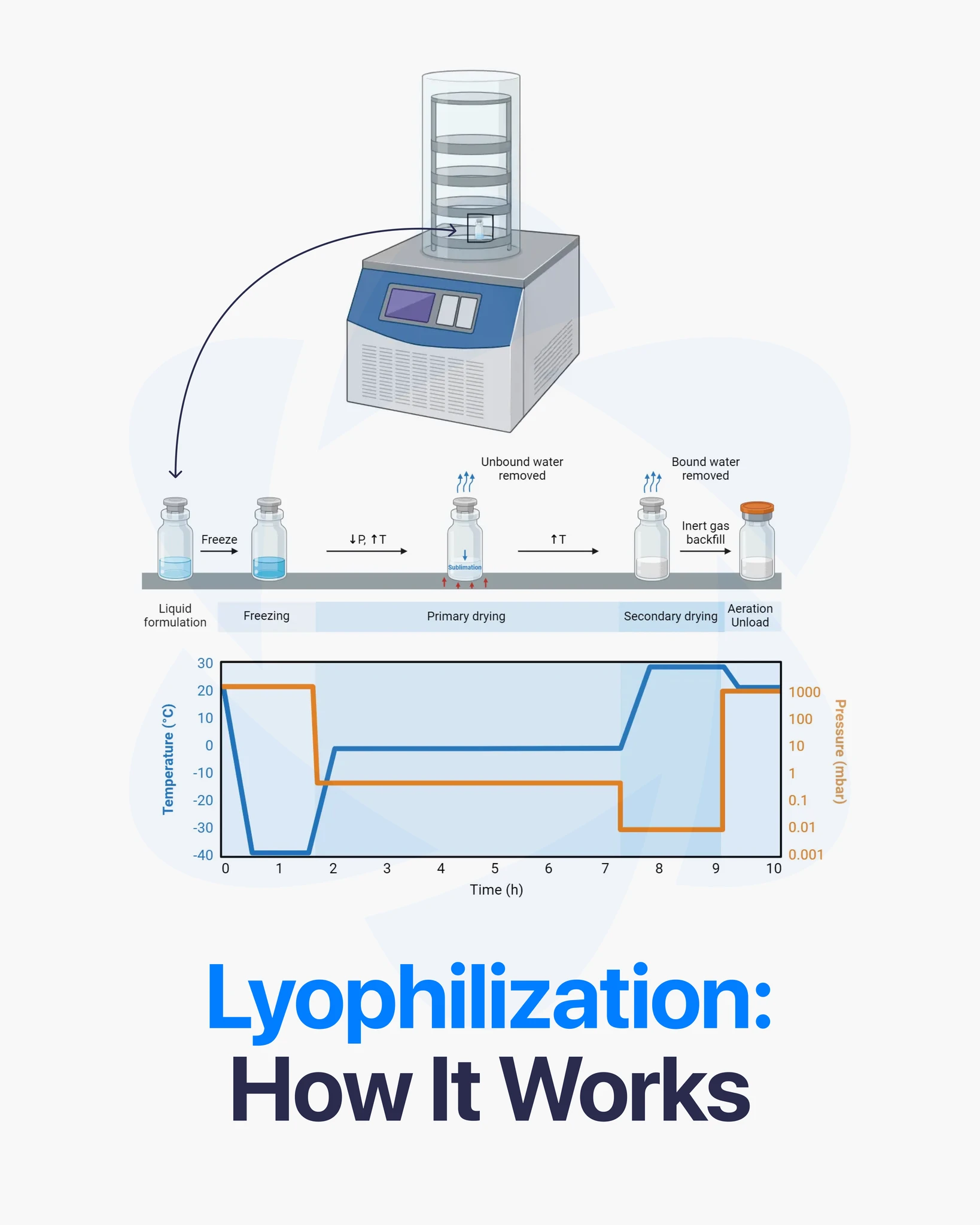
Lyophilization, commonly known as freeze-drying, is a preservation technique widely used in pharmaceutical and laboratory settings to remove water from sensitive biological materials. The process works by freezing a sample and then removing ice through sublimation, a physical process in which frozen water converts directly into vapor without becoming liquid. This approach helps preserve the structural integrity and stability of compounds such as peptides, proteins, antibodies, and vaccines.
(Reference: Tang & Pikal, 2004)
How Does Lyophilization Work?
The lyophilization process generally consists of three primary stages designed to remove water while minimizing damage to the material being preserved.
-
Freezing – The sample is cooled until water forms ice crystals, creating a stable frozen matrix around the material.
-
Primary Drying (Sublimation) – Pressure is reduced and controlled heat is applied, allowing ice to transition directly into water vapor without entering the liquid phase.
-
Secondary Drying (Desorption) – Residual moisture that remains bound to the material is removed, resulting in a highly stable, low-moisture product.
The final product is typically a dry powder or cake that can be reconstituted with a suitable solvent when needed for research applications.
(Reference: Franks, 1998)
Why Is Lyophilization Important?
Lyophilization is widely used because many biological compounds are unstable when stored in liquid form. By removing water, researchers can significantly reduce degradation reactions and improve long-term stability.
-
Improved Stability – Reduces hydrolysis and other moisture-related degradation processes.
-
Extended Shelf Life – Allows sensitive materials to be stored for longer periods under appropriate conditions.
-
Simplified Transport – Dry products are generally easier to package, transport, and handle than liquid formulations.
-
Reliable Reconstitution – Enables accurate preparation of solutions for laboratory experiments when required.
(Reference: Wang, 2000)
Common Research Applications
Lyophilization is routinely utilized in research and pharmaceutical laboratories for:
-
Preserving peptide and protein preparations for long-term storage.
-
Stabilizing vaccines, antibodies, and other biologically active compounds.
-
Producing analytical standards used in techniques such as HPLC and mass spectrometry.
-
Supporting controlled reconstitution for both in vitro and in vivo experimental studies.
-
Maintaining the stability of research materials during transportation and storage.
(Reference: Tang & Pikal, 2004)
References
-
Franks, F. (1998). Freeze-drying of bioproducts: Putting principles into practice. European Journal of Pharmaceutics and Biopharmaceutics, 45(3), 221–229.
-
Tang, X., & Pikal, M.J. (2004). Design of freeze-drying processes for pharmaceuticals: Practical advice. Pharmaceutical Research, 21(2), 191–200.
-
Wang, W. (2000). Lyophilization and development of solid protein pharmaceuticals. International Journal of Pharmaceutics, 203(1–2), 1–60.
All products sold by Direct Peptides are intended strictly for laboratory research use only. They are not approved for human or animal consumption, medical treatment, or therapeutic applications. The information provided on this website is for educational and informational purposes only.