PEG-MGF peptide is defined as the pegylated form of Mechano Growth Factor, a synthetic compound engineered to extend the naturally short biological half-life of native MGF and distribute it systemically through the body. Formally known as PEGylated IGF-1Ec, this peptide originates as a splice variant of the insulin-like growth factor 1 (IGF-1) gene. Researchers study it for its proposed role in muscle satellite cell activation and tissue repair. No human clinical trials have been completed as of 2026, and the compound carries no FDA approval. Understanding what PEG-MGF is, how it differs from native MGF, and where the science actually stands is the starting point for any serious researcher.
What is PEG-MGF peptide and how does PEGylation change it?
MGF, or Mechano Growth Factor, is a splice variant of the IGF-1 gene expressed locally in skeletal muscle in direct response to mechanical stress such as resistance exercise or injury. Its primary proposed role is activating quiescent muscle satellite cells, prompting them to proliferate and donate nuclei to damaged muscle fibers. This local, rapid signaling makes MGF a key player in the early phase of muscle repair.
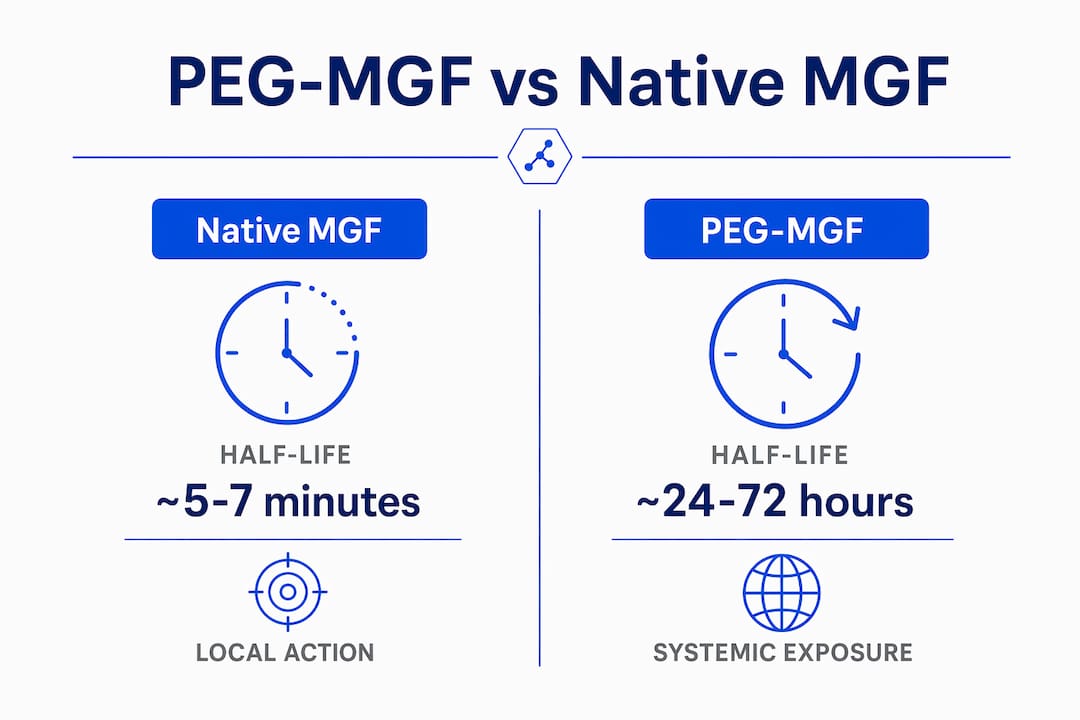
The problem with native MGF is its half-life. Native MGF has a half-life of approximately 5–7 minutes, which means it degrades almost immediately after release. That speed is intentional in physiology. The body uses a brief, localized pulse of MGF to trigger satellite cell activity, then clears it quickly to allow the repair process to progress naturally.

PEGylation changes that equation entirely. PEGylation is a pharmaceutical strategy that attaches a polyethylene glycol (PEG) chain to a peptide molecule, creating steric shielding that reduces renal clearance and slows enzymatic breakdown. Drugs like pegfilgrastim and peginterferon use this same approach to extend their systemic half-life. Applied to MGF, PEGylation extends the estimated half-life to somewhere in the range of 24–72 hours, allowing the compound to circulate throughout the body rather than acting only at the site of mechanical stress.
| Property |
Native MGF |
PEG-MGF |
| Half-life |
~5–7 minutes |
~24–72 hours (estimated) |
| Distribution |
Local, site-specific |
Systemic circulation |
| Clearance |
Rapid enzymatic degradation |
Reduced by PEG chain shielding |
| Satellite cell timing |
Physiological pulse |
Prolonged, non-physiological exposure |
| Human trial data |
None |
None |
Pro Tip: The extended half-life of PEG-MGF is a pharmacokinetic property, not a confirmed measure of biological effectiveness. A longer-lasting molecule is not automatically a more effective one.
How does PEG-MGF work biologically in muscle recovery?
The proposed mechanism centers on satellite cell biology. Satellite cells are muscle stem cells that sit dormant along muscle fibers until activated by injury or intense mechanical load. MGF is theorized to be one of the primary signals that wakes these cells up, pushing them into a proliferative state where they multiply and eventually fuse with damaged fibers to support repair and growth.
The research picture is more complicated than that summary suggests. Several key points define the current state of evidence:
- Satellite cell activation is proposed but demonstrated primarily in rodent models and in vitro studies, not in human subjects.
- Disputed biological activity: Experts question whether the synthetic MGF E-peptide has intrinsic biological activity independent of IGF-1 effects, making it difficult to isolate PEG-MGF’s standalone contribution.
- No human trials: Zero published human clinical trials or case reports exist for MGF or PEG-MGF as of 2026.
- Physiological timing disruption: Native MGF acts locally in minutes, and PEG-MGF’s systemic circulation for hours may alter the natural timing between proliferation and differentiation phases of muscle repair.
- Repair cycle theory: The theoretical model suggests a two-phase process where an MGF pulse triggers satellite cell proliferation, followed by IGF-1Ea signaling to drive differentiation. PEG-MGF’s sustained exposure may interfere with this sequence.
Prolonged systemic exposure from PEGylation may hinder the natural progression from muscle cell proliferation to differentiation, possibly impairing the very repair process it is intended to support. That is a significant concern that separates PEG-MGF from how the body naturally uses MGF signaling.
Pro Tip: When evaluating any peptide’s mechanism, ask whether the proposed action has been demonstrated in human tissue under controlled conditions. For PEG-MGF, the honest answer is no.
What are the benefits and limitations of PEG-MGF?
The most frequently cited benefit of PEG-MGF over native MGF is practical: its extended half-life makes it far more workable as a research compound. Native MGF’s extremely short half-life requires timely local administration immediately post-exercise, a logistical challenge that limits its research utility. PEG-MGF’s systemic circulation removes that constraint and allows for less frequent dosing in preclinical study designs.
Researchers also point to its potential for broader tissue distribution. Because PEG-MGF circulates systemically rather than acting only at the stressed muscle site, it theoretically reaches multiple muscle groups simultaneously. That property makes it interesting for studying generalized recovery pathways rather than localized repair.
The limitations, however, are substantial. The core issue is that a longer half-life does not confirm efficacy if the molecule lacks proven intrinsic biological activity. Several commonly misunderstood aspects of PEG-MGF deserve direct clarification:
- “Extended half-life means it works better” is false. Pharmacokinetics and pharmacodynamics are separate properties.
- “Animal study results translate to humans” is not established. Rodent muscle physiology differs meaningfully from human muscle biology.
- “Systemic distribution is an advantage” is debated. PEG-MGF circulates systemically, losing the native site-specific action that may be central to its physiological role.
- “It is legal for personal use” is incorrect in competitive sports contexts. WADA classifies MGF and its derivatives as prohibited peptide hormones under the S2 category.
- “It is safe because it is natural-derived” is unsupported. No human toxicology data exists for PEG-MGF.
The absence of FDA approval and human safety data is not a minor footnote. It is the defining limitation of PEG-MGF’s current status.
How is PEG-MGF used in research, and what is its regulatory status?
PEG-MGF is classified strictly as a research-grade chemical reagent. Its use is limited to preclinical investigation, meaning laboratory and animal studies only. The following points define its current research and regulatory standing:
- No approved therapeutic use. No FDA approval or published human clinical trials exist for PEG-MGF as of 2026. Any human use falls outside established medical practice.
- No standardized dosing protocol. PEG-MGF dosage recommendations circulating in fitness communities are derived from anecdotal reports and animal study extrapolations, not clinical evidence. There is no validated human dose.
- Prohibited in competitive sport. WADA’s S2 prohibited list includes MGF and all derivatives. Athletes subject to anti-doping rules face sanctions for use.
- Purity and batch variability are real concerns. PEG-MGF is supplied as a research-grade reagent without peer-reviewed commercial characterization, meaning batch-to-batch consistency and contamination risks are not systematically controlled across suppliers.
- Community use is anecdotal. The bodybuilding community uses synthetic MGF and PEG-MGF based on anecdotal reports, not clinical trials. This context does not constitute evidence of safety or efficacy.
For researchers working within cellular regeneration or anabolic signaling pathways, PEG-MGF remains a compound of genuine scientific interest. The key is approaching it with the rigor its preclinical status demands: controlled conditions, verified purity, and no extrapolation beyond what the data actually supports.
Key Takeaways
PEG-MGF is a pharmacokinetically modified research peptide with an extended half-life, but no human trial data confirms its biological activity or safety in therapeutic contexts.
| Point |
Details |
| Definition and origin |
PEG-MGF is a pegylated IGF-1Ec splice variant engineered to extend native MGF’s 5–7 minute half-life. |
| Half-life extension |
PEGylation extends estimated half-life to 24–72 hours, enabling systemic circulation instead of local action. |
| Biological activity disputed |
Synthetic MGF E-peptide’s independent activity is questioned; effects may not separate cleanly from IGF-1. |
| No human data |
Zero human clinical trials exist; all evidence comes from rodent models and in vitro studies. |
| Regulatory status |
WADA prohibits PEG-MGF under S2; no FDA approval exists for any therapeutic application. |
The gap between half-life and proof
I have spent years reading preclinical peptide literature, and PEG-MGF is one of the most instructive examples of how pharmacokinetic elegance can outrun biological proof. The PEGylation strategy is genuinely clever. It solves a real problem: native MGF degrades so fast it is almost impossible to study systematically. Extending the half-life to 24–72 hours gives researchers a workable window. That is a legitimate scientific contribution.
What I find consistently underappreciated is how often that pharmacokinetic win gets treated as evidence of clinical benefit. It is not. A molecule that stays in circulation longer is not automatically doing more useful work. In the case of PEG-MGF, systemic exposure differs fundamentally from natural MGF signaling, and that difference may actually work against the repair process the compound is supposed to support.
My honest read of the current evidence: PEG-MGF is worth studying, not worth assuming. The satellite cell activation hypothesis is biologically plausible and worth rigorous investigation. But anyone approaching this compound with expectations built on bodybuilding forums rather than peer-reviewed data is working from the wrong foundation. The absence of human trials is not a technicality. It means we do not know what this compound does in a human body at any dose.
If you are researching peptides for muscle recovery pathways, keep your expectations anchored to what the data actually shows. Preclinical interest is real. Clinical proof is not yet there.
— Mitch
Research-grade peptides from Synthrolab
Researchers investigating muscle repair signaling, satellite cell biology, and recovery pathways need compounds they can trust at the batch level.
Synthrolab supplies research-grade peptides including PEG-MGF for preclinical investigation, with documented quality control and batch consistency. Every compound ships with a certificate of analysis so your experimental conditions stay controlled. Synthrolab’s catalog covers cellular regeneration, anabolic signaling, and metabolic modulation compounds, giving research programs access to a range of peptides within a single verified supplier relationship. Review the full catalog and supporting documentation at Synthrolab before your next study phase.
FAQ
What is PEG-MGF peptide in simple terms?
PEG-MGF is a synthetic, chemically modified version of Mechano Growth Factor, engineered to last longer in the body by attaching a polyethylene glycol chain to the original peptide. It is studied for its proposed role in muscle satellite cell activation and tissue repair, but has no approved human use.
How does PEG-MGF differ from native MGF?
Native MGF has a half-life of approximately 5–7 minutes and acts locally at the site of muscle stress. PEG-MGF has an estimated half-life of 24–72 hours and circulates systemically, which changes both its distribution and its interaction with the natural muscle repair cycle.
Is PEG-MGF safe for human use?
No human clinical trials or toxicology studies have been published for PEG-MGF as of 2026. Its safety profile in humans is unknown, and it carries no FDA approval for any therapeutic application.
Is PEG-MGF banned in competitive sports?
Yes. WADA classifies MGF and all its derivatives, including PEG-MGF, as prohibited peptide hormones under the S2 category. Athletes subject to anti-doping rules cannot use it.
What are current PEG-MGF dosage recommendations for research?
No validated human dosing protocol exists for PEG-MGF. Dosage figures circulating in fitness communities are extrapolated from animal studies and anecdotal reports, not clinical trials, and should not be treated as established guidance.
Recommended
 21+ verification