What does MOTS-c peptide cost in the US research market?
MOTS-c pricing in the US research market varies depending on supplier and purity tier. Those ranges reflect the peptide’s higher synthesis complexity relative to simpler sequences like BPC-157, which you can find at Synthrolab for context on BPC-157 pricing. The spread within each size tier comes down to three things: purity certification, batch testing documentation, and whether the vendor absorbs shipping costs into the list price.
The US market currently has four well-established suppliers providing COA-backed MOTS-c: Synthrolab, Biolongevity Labs, Core Peptides, and Verified Peptides. All four offer batch-specific lab reports and third-party testing, though documentation depth and shipping terms vary.
Price-per-milligram normalization is the only reliable way to compare vials across sizes. A 5mg vial at $55 costs $11 per milligram, while a 10mg vial at $80 comes to $8 per milligram. This $3 per milligram difference can significantly impact total cost over the course of a multi-week protocol.

| Supplier |
Vial size |
Price (approx.) |
Price/mg |
Purity |
COA available |
Shipping |
| Synthrolab |
10mg |
Competitive |
Research-grade |
≥98% |
Yes, batch-specific |
US domestic |
| Biolongevity Labs |
10mg |
Mid-range |
Research-grade |
≥98% |
Yes |
US domestic |
| Core Peptides |
10mg |
Mid-range |
Research-grade |
— |
Yes |
US domestic |
| Verified Peptides |
10mg |
Variable |
Research-grade |
≥98% |
Yes |
US domestic |
Bulk orders and vendor promotions can reduce per-mg cost, and some suppliers include free shipping above certain order amounts, which affects the true cost of a purchase.
Why purity, COA documentation, and storage conditions shape real cost
MOTS-c is a mitochondria-derived peptide encoded by the 12S rRNA gene within the mitochondrial genome. Research published in Cell Metabolism identified it as a regulator of metabolic homeostasis, with downstream effects on insulin sensitivity and energy expenditure. Later work in PNAS extended those findings to stress response and cellular longevity pathways. For any lab working in these areas, compound integrity is not a secondary concern.

Purity standards and what COAs actually verify
Research-grade MOTS-c should carry a purity of at least 98% by HPLC analysis. A certificate of analysis from an independent third-party lab confirms identity, purity, and the absence of residual solvents or synthesis byproducts. Vendors lacking that independent verification introduce real risk: a mislabeled or degraded peptide does not just waste budget, it corrupts data.
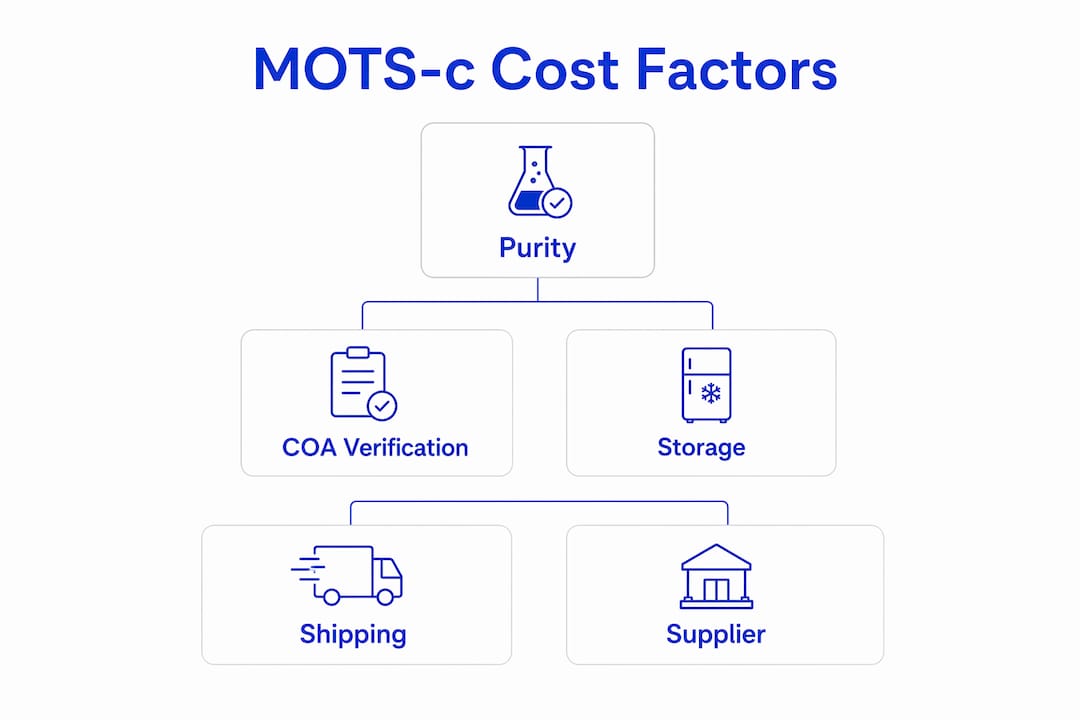
Batch-specific COAs matter more than a generic product-level certificate. Each synthesis run can differ, and a batch-level report ties the exact vial you receive to a specific analytical result. Ask for the batch number before ordering if it is not listed on the product page.
Storage conditions and their effect on cost-effectiveness
Lyophilized (freeze-dried) MOTS-c is stable for extended periods when stored at or below -20°C and kept away from moisture. Once reconstituted, the stability window is limited to a few weeks under refrigeration. Larger vials (20mg and above) carry a real degradation risk if the reconstituted volume is not used within that window.
| Parameter |
Lyophilized |
Post-reconstitution |
| Storage temp |
-20°C or below |
— |
| Stability |
Extended (months) |
~28 days |
| Light sensitivity |
Protect from light |
Protect from light |
| Recommended vial size |
10mg for weekly protocols |
Match to weekly dose |
Pro Tip: Aliquot reconstituted MOTS-c into single-use volumes immediately after preparation. This limits freeze-thaw cycling and extends usable shelf life across a multi-week protocol.
Standard research dosing commonly involves around a weekly administration, often divided into multiple doses. A 10mg vial maps cleanly onto that weekly cycle, allowing fresh reconstitution each week without leftover volume sitting in the refrigerator past the 28-day mark.
How to choose a MOTS-c supplier without overpaying or compromising quality
The single most common budgeting mistake in peptide procurement is comparing vial prices without normalizing to cost per milligram. A cheaper vial is often a worse deal. Run the math on every option before committing.
Beyond price, here is what separates a reliable supplier from a risky one:
- Independent COA, not self-reported purity. The lab performing the analysis should be a third party with no financial relationship to the vendor. HPLC and mass spectrometry results should both appear on the certificate.
- Batch-specific documentation. Generic product-level certificates do not confirm the lot you are actually receiving. Batch traceability is the standard in pharmaceutical-grade procurement and should be expected from research peptide suppliers too.
- Transparent pricing with no hidden fees. Shipping costs, handling fees, and minimum order requirements all affect the real cost per milligram. Factor them in before comparing list prices.
- Supplier reputation and reorder history. Forums, peer networks, and published lab reviews provide signal on consistency across batches. A supplier who delivers clean COAs on the first order but ships degraded product on the third is a liability.
- Shipping speed and cold-chain handling. Lyophilized peptides are relatively stable in transit, but delays in warm conditions can affect reconstituted samples if the vendor ships pre-dissolved. Confirm the form factor before ordering.
MOTS-c pricing can shift week to week based on batch availability and supplier competition. Monitoring live pricing tools helps labs track those fluctuations and time purchases to favorable windows, particularly for larger orders where a 10–15% discount has real budget impact.
Pro Tip: The 10mg vial is the optimal purchase size for most research protocols. It aligns with standard weekly dosing, keeps reconstituted volume within the 28-day stability window, and delivers a lower cost per milligram than 5mg options without the degradation risk of 20mg vials.
Shipping logistics deserve more attention than most procurement checklists give them. Free shipping thresholds, priority delivery options, and domestic versus international sourcing all affect total cost and supply reliability. US-based suppliers with domestic fulfillment centers typically offer faster turnaround and fewer customs complications than overseas vendors, which matters when a protocol is time-sensitive.
Total cost assessment should always include shipping fees, discount codes, and COA provision as line items, not afterthoughts. A vendor offering $5 less per vial but charging $15 for shipping and providing no independent COA is not the better deal.
Synthrolab: research-grade MOTS-c with verified documentation
Synthrolab supplies MOTS-c peptide at research-grade purity with batch-specific, third-party COA documentation included on every order. For US labs running metabolic, mitochondrial, or longevity-focused protocols, that documentation standard removes a significant variable from the procurement equation.
Pricing at Synthrolab is transparent and competitive within the US market, with no hidden handling fees. The MOTS-c 10mg product is sized to match standard weekly research protocols, and bundle options are available for labs managing multi-compound studies or longer-term supply needs. Domestic US fulfillment means fast delivery without the cold-chain uncertainty of international shipping. Researchers who want to see the full COA record before purchasing can review it directly at Synthrolab’s COA page. For labs new to peptide procurement or expanding into mitochondrial research, the peptide beginner guide covers sourcing fundamentals worth reviewing before placing a first order.
Key Takeaways
A cost-effective MOTS-c procurement strategy involves per-milligram price normalization, batch-specific COA verification, and vial sizing aligned with common dosing protocols.
| Point |
Details |
| Price ranges by vial size |
In the US market, 5mg vials range from $45 to $85, 10mg vials from $65 to $120, and 20mg vials from $125 to $220, depending on supplier and certification. |
| Cost per mg is the real metric |
Ten milligram vials are typically the most cost-effective for standard protocols, balancing price per milligram and manageable storage, as a 10mg vial at $80 ($8/mg) is more cost-effective than a 5mg vial at $55 ($11/mg), all else equal. |
| 10mg vials fit weekly protocols |
Standard research dosing of ~10mg per week aligns with fresh weekly reconstitution and the 28-day stability window. |
| COA and batch testing are non-negotiable |
Independent, batch-specific lab reports confirm purity and protect data integrity across the full study. |
| Synthrolab for US researchers |
Synthrolab offers batch-verified, research-grade MOTS-c with transparent pricing, domestic shipping, and full COA access. |
Recommended
 21+ verification