Understanding metabolic health compounds means knowing which research-grade peptides and small molecules act on which metabolic or mitochondrial mechanism, and being able to prove the vial in your freezer is what the label says it is. That second part trips up more researchers than the biochemistry does. Before you run a single assay, confirm four things: the compound’s mechanistic class and target pathway, a batch-specific certificate of analysis (COA) showing both HPLC and LC-MS results, an independently verifiable lab report ID, and the correct storage and reconstitution protocols for that specific molecule.
Here’s the checklist in practice:
- Mechanism first: know whether you’re studying an incretin pathway, a mitochondrial signaling peptide, or an energy-sensor modulator before you order anything.
- COA scrutiny: demand a report tied to your exact batch, not a “representative” document pulled from a different production run.
- Independent verification: confirm the issuing lab exists and will corroborate the report ID if you call.
- Storage protocol: lyophilized peptides and reconstituted solutions have different sensitivities to temperature, light, and freeze-thaw cycles.
Synthrolab supplies research-grade peptides with batch-specific documentation, and the guidance below, compiled with input from Synthrolab researcher Mitch, walks through how to apply that checklist to real purchasing decisions.
Key Takeaways
Reproducible metabolic research depends on matching compound class to hypothesis and verifying every batch with independent HPLC and LC-MS testing before it touches an assay.
| Point |
Details |
| Match class to hypothesis |
Choose incretin agonists, GH fragments, mitochondrial peptides, energy sensor modulators, or transcription factor agonists based on the specific pathway your study targets. |
| Demand batch-specific COAs |
Insist on documentation tied to your exact batch, not a representative report from an unrelated production run. |
| Verify purity and identity separately |
Confirm both HPLC purity data and LC-MS identity data appear on the same COA before use. |
| Handle storage with discipline |
Aliquot reconstituted peptides, refrigerate, and avoid repeated freeze-thaw cycles to prevent degradation-driven false negatives. |
| Source from documented suppliers |
Synthrolab provides batch-specific COAs with third-party HPLC and LC-MS results across its research-grade peptide catalog. |
Table of Contents
What Are the Main Classes of Metabolic Research Compounds?
Five mechanistic categories cover most of what shows up in metabolic and mitochondrial research today, according to a PMC review of metabolic signaling compounds. Each class gives you a different lever to pull, and picking the wrong one for your hypothesis wastes a lot of assay time.
- Incretin receptor agonists (GLP-1, GIP, glucagon receptor targets, including multi-receptor agonists in the retatrutide class) act on energy expenditure and hepatic lipid handling, and combined receptor activity makes them useful for comprehensive metabolic intervention studies rather than single-pathway work.
- Growth hormone pathway fragments, with AOD-9604 as the standard example, isolate the lipolytic fragment of GH activity from its growth-promoting effects, which makes it a clean comparator for separating peripheral fat metabolism from central appetite signaling.
- Mitochondrial-derived peptides, MOTS-c being the most studied, get used to probe cellular energy sensing and stress-response signaling directly at the mitochondrial level.
- Cellular energy sensor modulators, including AMPK activators and compounds like 5-Amino-1MQ, target the enzymatic switches that shift cells between energy storage and energy expenditure modes.
- Transcription factor agonists acting on ERR and PPAR pathways influence gene expression tied to mitochondrial biogenesis and lipid oxidation, useful when your endpoint is downstream of acute signaling.
Matching the class to the endpoint matters more than picking a trendy compound. If you’re measuring appetite suppression, an incretin agonist is the right tool. If your readout is peripheral lipolysis without central nervous system involvement, AOD-9604 is built for exactly that separation. Mitochondrial oxygen consumption rate studies call for MOTS-c or a comparable mitochondrial-derived peptide, not a GH fragment.
How Do You Verify a Peptide Is Actually Research-Grade?
A certificate of analysis only means something if it separates two distinct measurements: purity and identity. Purity, measured by HPLC, tells you how much of the sample is the intended compound versus degradation products or synthesis byproducts. Identity, measured by LC-MS, confirms the molecule is structurally what it claims to be. Both tests need to appear on the same batch-specific document, according to guidance on reading peptide COAs, which also notes that research-grade and GMP-grade material typically differ in process control and documentation rigor rather than in the underlying molecule.
Purity benchmarks at acceptable research material levels are commonly cited as the floor for usable research material. Below that, batch-to-batch variability can contaminate your results in ways that are hard to distinguish from a real experimental effect.
Verification steps worth building into your procurement routine:
- Locate the report ID printed on the COA and confirm it corresponds to your specific batch, not a generic template.
- Contact the issuing lab directly through its official portal, independent of the vendor, and ask them to confirm the report ID and results.
- Request the raw HPLC and LC-MS traces if only summary values are provided.
- Cross-check the stated molecular weight and sequence against published reference data for the compound.
Red flags include missing spectra, no working contact for the testing lab, and a COA that reads identically across multiple unrelated batches. Analysis of the peptide research market has found meaningful discrepancies between manufacturer-supplied COAs and independent lab results across a majority of tested products, which is exactly why a representative COA is not an acceptable substitute for batch-specific testing.
Pro Tip: Keep a spreadsheet mapping every compound you order to its report ID and issuing lab. When you write up results months later, you want to be able to answer “was this batch verified?” in ten seconds, not an afternoon of searching old emails.
Storage and Reconstitution: What Keeps a Peptide Usable?
Lyophilized peptides hold up far better in storage than reconstituted ones, which is why most research-grade material ships freeze-dried. Once you add solvent, the clock starts. Reconstituted solutions are sensitive to temperature swings, light exposure, and especially repeated freeze-thaw cycles, all of which degrade peptide structure faster than most researchers expect.
- Reconstitute only the volume you plan to use within a reasonable window, and aliquot the rest immediately to avoid repeated freeze-thaw on a single vial.
- Store reconstituted solutions refrigerated and shielded from light; don’t leave them on a bench between uses.
- Label every aliquot with reconstitution date and concentration so degradation timelines are traceable across an experiment.
- If your assay is sensitive to microbial contamination, sterility and endotoxin testing are separate from chemical purity testing and should be requested independently when the application calls for it.
Pro Tip: Treat every reconstituted vial like it has a shelf clock ticking the moment solvent hits the lyophilized powder. Date it, aliquot it, and don’t trust a vial that’s been thawed more than once.
Compound selection means nothing without a study design that can isolate cause from noise. Researchers treat these compounds as hypothesis-driven tools, and that framing should dictate every design choice you make before ordering material.
Start with the comparator, not the compound. A mechanistically distinct comparator, a molecule that acts through a different pathway but produces a superficially similar outcome, is what lets you attribute an effect to the specific mechanism you’re testing rather than to some downstream convergence. Pair that with a vehicle control run through identical handling conditions as your treatment arm; skipping this step is the single most common reason a promising pilot result fails to replicate.
Common endpoints in metabolic and mitochondrial studies include:
- Body composition changes (lean mass versus fat mass ratios)
- Glucose tolerance and insulin sensitivity markers
- Lipid panel shifts, particularly triglycerides and free fatty acids
- Energy expenditure measurements
- Oxygen consumption rate (OCR) in mitochondrial assays
- Molecular markers tied to the specific pathway under investigation (phosphorylation states, gene expression changes)
Before finalizing a dosing schedule, search the existing literature for model-specific references. Dosing that works in one cell line or animal model rarely transfers cleanly to another without adjustment.
- Document the compound source, batch ID, and COA alongside every dosing decision.
- Record reconstitution date, storage conditions, and time elapsed before use for each experimental run.
- Keep a running log connecting each data point back to its exact material provenance, not just “the MOTS-c batch from last month.”
How Should You Vet a Vendor Before Committing to a Compound Supply?
Vendor evaluation is where a lot of promising research plans quietly fall apart. A supplier who can’t produce a batch-specific COA on request, or who dodges questions about which lab ran the testing, is not someone whose material belongs in a reproducible study.
- Confirm batch-specific COA availability before ordering, not after.
- Verify the vendor uses independent third-party testing rather than in-house-only analysis.
- Ask for transparent synthesis details, including the route used and any known impurity profiles.
- Check that lab report IDs are accessible and that the issuing lab responds to direct inquiries.
- Gauge how responsive the vendor’s documentation support is when you ask a specific technical question.
For each compound you bring into a study, record the supplier, catalog and product code, batch ID, the full COA, storage and reconstitution logs, and assay run notes. That file is what makes your work reproducible when a reviewer or collaborator asks how you know the material was what you claim it was. When your experimental design calls for it, sterility or endotoxin testing sits on top of standard chemical verification, and it’s worth commissioning separately rather than assuming a purity COA covers it.
What Regulatory and Ethical Lines Apply to This Kind of Research?
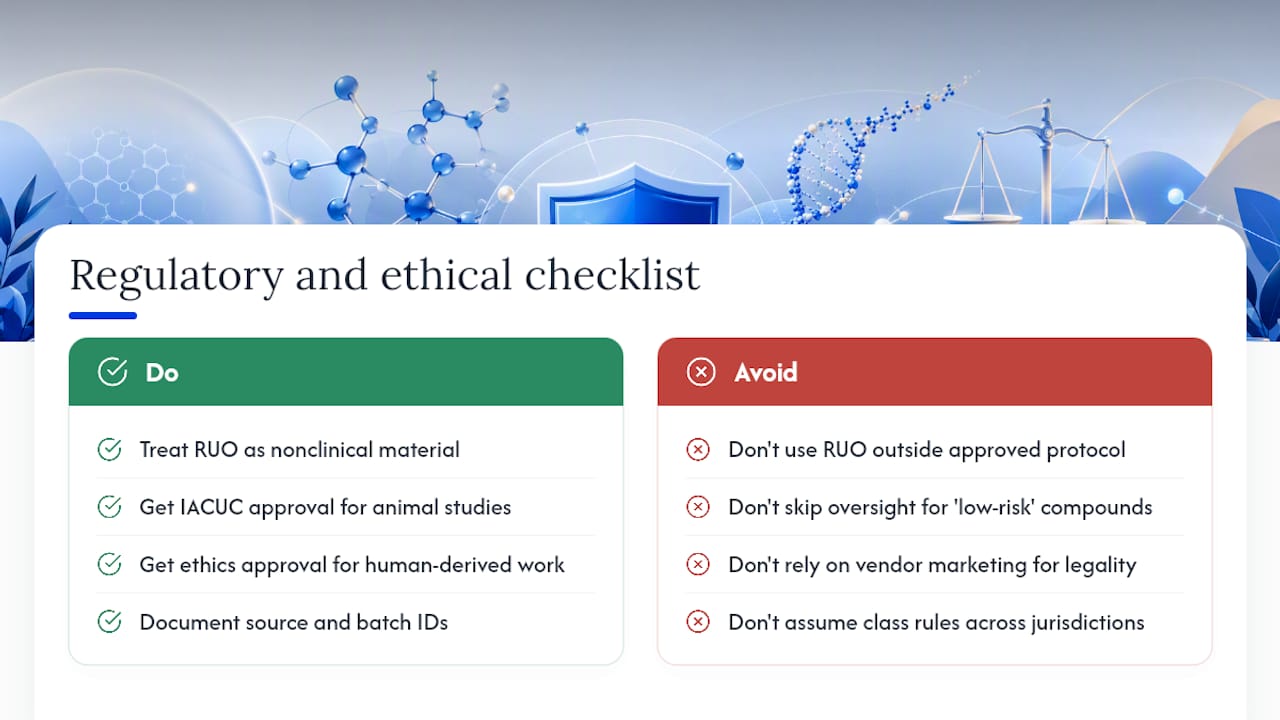
Research-grade peptides and small molecules sold for laboratory investigation carry a research-use-only designation, and that designation is a real regulatory boundary, not a marketing formality. Material sold this way has not gone through the clinical trial and manufacturing oversight that applies to approved pharmaceuticals, and it is not intended for human or animal consumption outside a controlled research protocol.
Institutional oversight still applies even when a compound isn’t a controlled substance. Studies involving animal models need institutional animal care and use committee approval, and any work touching human-derived samples or human subjects needs the corresponding ethics board sign-off. Skipping that step because a compound seems low-risk is a common shortcut that creates real liability.
Ethical sourcing matters beyond the legal minimum. Documenting where a compound came from, how it was tested, and how it was handled is part of the research record, not paperwork you file and forget. That transparency also protects the integrity of your published results: a reviewer or a lab replicating your work should be able to trace every material back to a verifiable batch.
Jurisdictions vary in how they classify specific peptides, and researchers ordering across state or international lines should confirm current status for their specific compound rather than assuming a class-wide rule applies uniformly. When in doubt, your institution’s research compliance office is the right first call, not a forum post or a vendor’s marketing copy.
What Benefits and Risks Do These Compounds Present in Study Design?
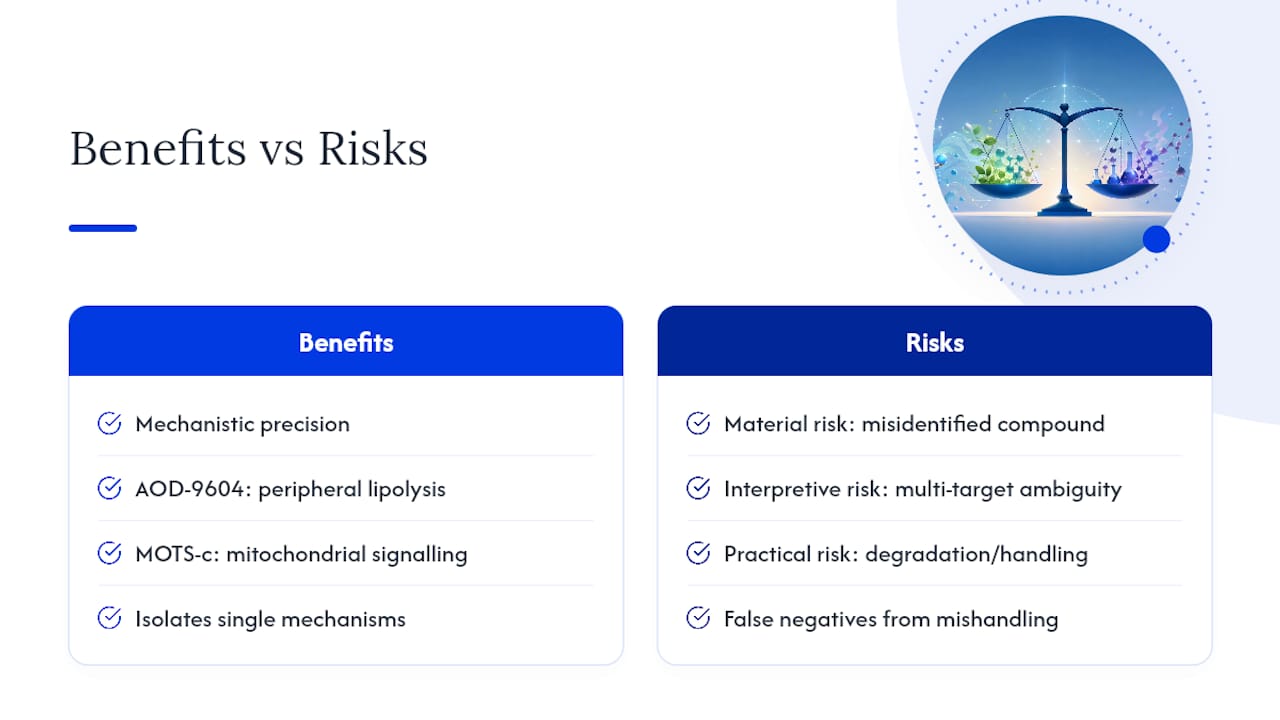
The research value of these compounds comes from precision: a well-characterized peptide lets you isolate a single mechanism in a way that a whole-food intervention or a broad pharmaceutical never could. AOD-9604 separates peripheral lipolysis from central appetite effects. MOTS-c gives you a direct handle on mitochondrial stress signaling. That specificity is the entire reason these tools exist in a research context.
The risks run in two directions. The first is material risk: an unverified or misidentified compound introduces variability that masquerades as a biological effect, and that’s the failure mode third-party testing exists to catch. The second is interpretive risk. Multi-receptor agonists in the retatrutide class affect several pathways simultaneously, which makes them powerful for comprehensive metabolic studies but harder to use if your hypothesis needs a single, isolated mechanism. Choosing a multi-target compound when your study design calls for a clean single-pathway readout will produce data that’s real but uninterpretable against your original question.
There’s also a practical risk tied to degradation and handling rather than biology: a peptide that’s been mishandled in storage can produce a false negative that looks like “no effect” when the real finding is “no intact compound.” That’s a data integrity problem dressed up as a null result, and it’s avoidable with the storage discipline covered earlier in this guide.
Which Pathways Do These Compounds Actually Target in Experiments?
Most experimental applications for these compound classes cluster around a handful of well-mapped pathways. Incretin receptor agonists act on GLP-1, GIP, and glucagon receptors, with downstream effects on insulin secretion, gastric emptying, and hepatic glucose output, making them the standard tool for studies modeling appetite regulation and glycemic control.
Mitochondrial-derived peptides like MOTS-c work through a different route entirely, engaging AMPK signaling and nuclear gene expression tied to metabolic stress response. That makes MOTS-c a fit for studies asking how cells sense and adapt to energy scarcity, rather than studies about appetite or food intake. Researchers pricing out procurement for a mitochondrial study often start with a MOTS-c peptide price guide built for exactly that use case.
Growth hormone pathway fragments target lipolytic signaling in adipose tissue while minimizing engagement with the broader GH axis, which is the whole point of using a fragment instead of full-length GH: you get the fat metabolism effect without the confounding growth signaling. Cellular energy sensor modulators, meanwhile, act directly on AMPK and related enzymatic switches, shifting cellular metabolism between catabolic and anabolic states, useful when your endpoint sits upstream of gene expression changes rather than downstream.
Transcription factor agonists targeting ERR and PPAR pathways operate on a slower timescale, influencing mitochondrial biogenesis and lipid oxidation gene programs. If your study design has a multi-day or multi-week observation window, this class fits better than a fast-acting signaling peptide.
What Should Researchers Take Away From Synthrolab’s Approach to Sourcing?
Synthrolab treats every compound as a research tool first, which means batch-specific COAs with both HPLC and LC-MS results are standard practice, not an upsell. Product pages for compounds like MOTS-c and GLP-3 RETA link directly to the documentation researchers actually need before they run an assay.
Mitch’s guide to how metabolism affects energy levels covers additional protocol-level context worth reading alongside this piece. If a batch’s documentation raises a question, researchers can request additional verification or testing before committing to a purchase rather than after the fact.
— Mitch
Where Can Researchers Source Verified Compounds and Documentation?
Sourcing research-grade peptides without a documentation trail is how reproducibility problems start before an experiment even begins. Synthrolab’s product pages exist specifically to close that gap: each listing, including the GHK-Cu, BPC-157, and TB-500 bundle, ships with batch-specific COA data covering both HPLC purity and LC-MS identity results, so you’re not stuck guessing what “tested” actually means.
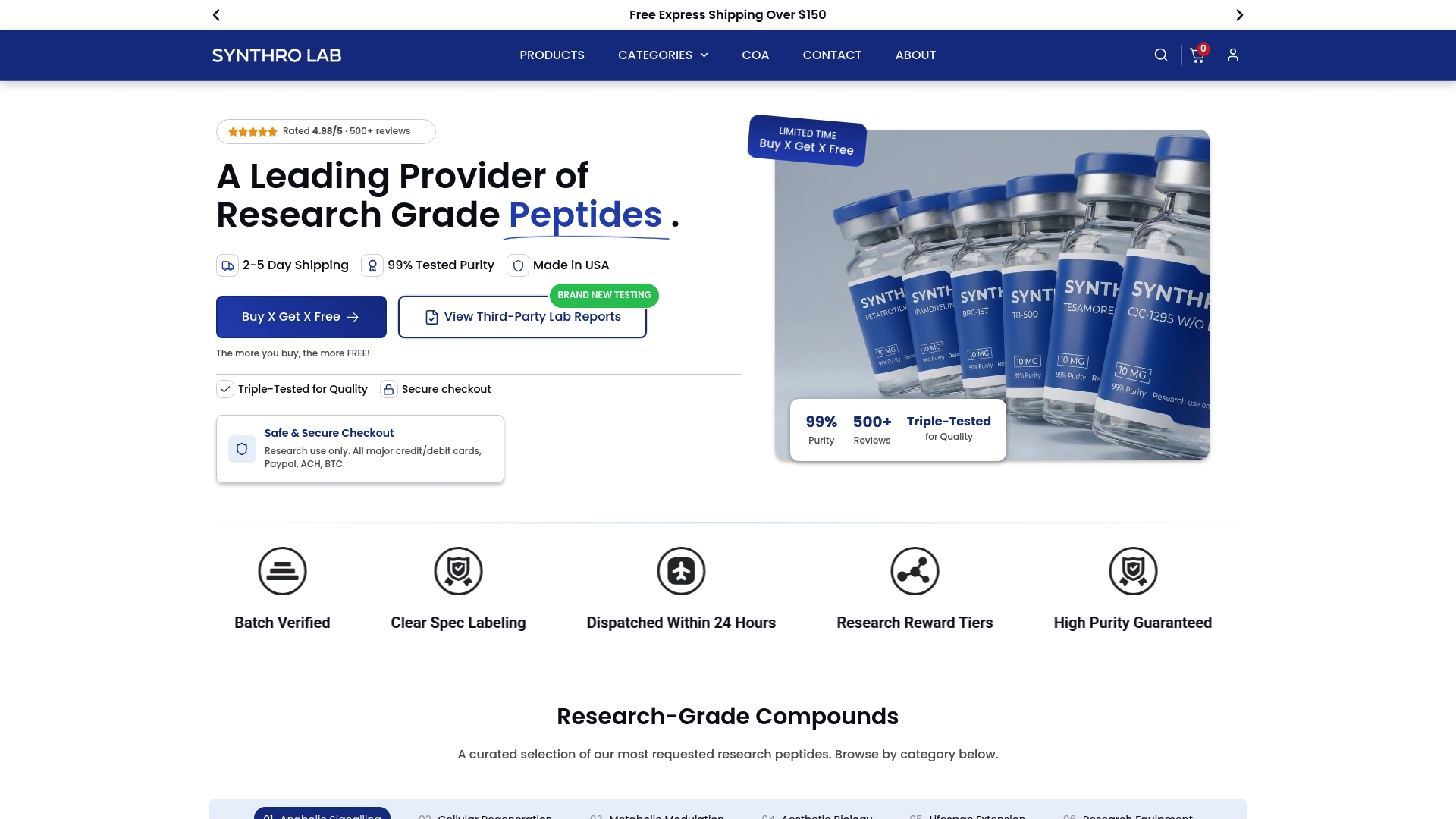
If you’re planning a mitochondrial or incretin-pathway study, start with the metabolic modulation category to see which compound class fits your endpoint, or go straight to a specific batch page if you already know what you need. Researchers who want documentation reviewed before committing to an order can reach out through Synthrolab’s contact page to request additional verification or a copy of the independent lab report tied to a specific batch. Keep every COA, batch ID, and reconstitution log in your own provenance file the moment material arrives. That habit costs a few minutes per shipment and saves you the much larger cost of an unreproducible result down the line.
Sources
Recommended
 21+ verification