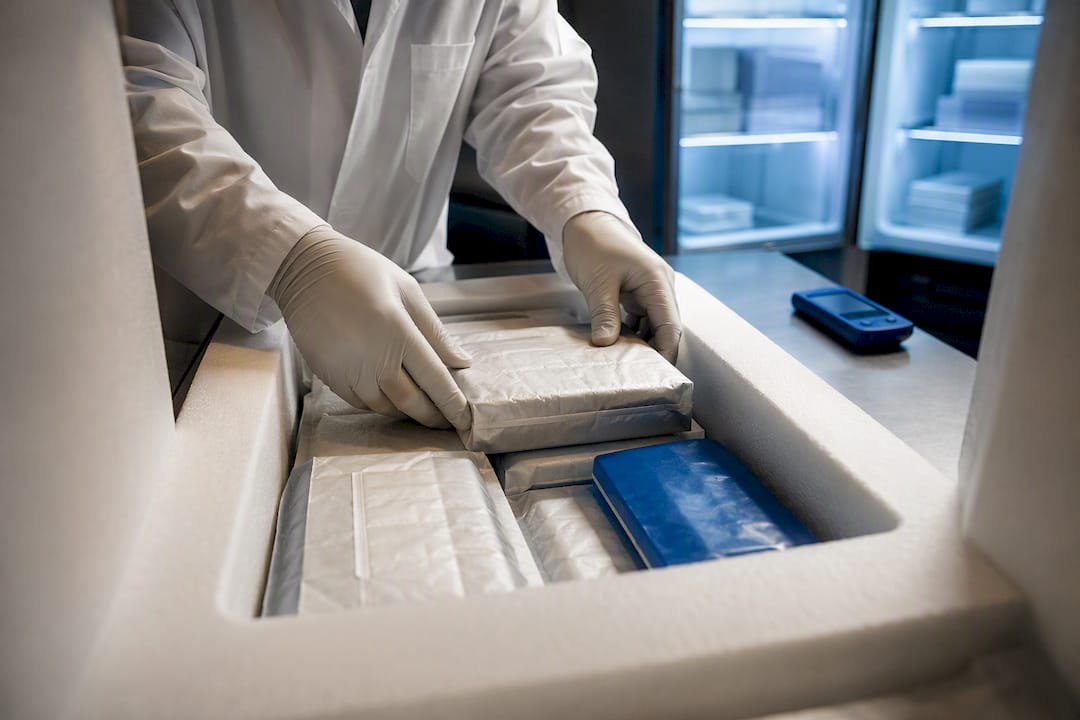
Cold chain shipping is the practice of keeping temperature-sensitive materials inside a defined range from the moment they’re packed until they reach the receiving lab, using validated packaging, refrigerants, and monitoring to hold that range. The standard bands run from controlled room temperature (CRT) to refrigerated (2–8°C), frozen, and cryogenic. The single rule that governs everything else: let the compound’s stability data set the temperature band, then build the packout around the worst-case lane, not the average one.
TL;DR:
- Use validated packaging and monitoring tools suited for the specific temperature band and transit duration to reduce the risk of excursions.
- Gel packs, dry ice, and phase-change materials each serve different shipping needs and should be chosen based on the compound’s stability and transit length.
- Proper packing layout, refrigerant conditioning ahead of time, and maintaining a controlled environment during staging are critical for maintaining the cold chain.
- Regular inspection, documentation, and deviation reporting during arrival help identify process gaps and prevent repeat failures.
- Carrier selection should consider shipment size, number of handoffs, and support for monitoring hardware to ensure consistent transit conditions.
Table of Contents
What Are the Standard Temperature Bands in Cold Chain Shipping?
Every cold chain decision starts with the compound itself, not the box. CRT typically spans 59 to 77°F and works for stable, non-reactive materials. Refrigerated shipping holds 2–8°C and covers most reconstituted peptides and biologics. Frozen shipments run at or below -20°C for materials with limited stability at higher temperatures. Cryogenic shipping, using liquid nitrogen vapor phase, drops below -150°C for cell lines and select biological samples.
Formulation state changes the math entirely. Lyophilized (freeze-dried) peptides often tolerate short ambient excursions because there’s no liquid matrix to degrade, while reconstituted peptides need continuous refrigerated control because degradation kinetics accelerate the moment water enters the picture, according to 3PLGuys’ peptide cold chain guide. Long-term frozen storage for many research peptides falls between -20°C and -80°C, with 2–8°C reserved for short-term handling.
- CRT: stable compounds, minimal excursion risk
- Refrigerated (2–8°C): reconstituted peptides, most biologics
- Frozen (below -20°C): long-term peptide storage, temperature-labile actives
- Cryogenic (below -150°C): cell lines, specialized biological samples
The band isn’t a guess. It comes from the stability data sheet or certificate of analysis for that specific batch, cross-checked against how long the shipment will actually sit in transit. Guidance on lyophilized peptide storage is a useful starting point when a lab is deciding whether a compound ships better freeze-dried or reconstituted.
How Do You Choose Packaging and Refrigerants for Cold Chain Shipping?
Packaging has to match both the temperature band and the realistic transit window, not the shortest possible one. Insulation comes in three main flavors: expanded polystyrene (EPS), which is cheap but bulky; polyurethane panels, which hold temperature longer per inch of thickness; and vacuum-insulated panels (VIPs), which cost more but shrink box size for the same thermal performance.
Refrigerant choice follows the band:
- Gel packs for 2–8°C shipments, best for short-duration transit
- Dry ice for frozen shipments at -20°C or below, but it’s classified as a hazmat material (UL 1845/UN 1845) and triggers labeling and carrier documentation requirements
- Phase-change materials (PCMs) for shipments that need a tighter, more stable temperature band than gel packs deliver over multiple days
There’s no universal shipping method that works for every compound. Gel packs, dry ice, and pre-validated shippers each solve a different problem, and picking the wrong one is where most excursions start, according to C.H. Robinson’s temperature-controlled shipping guide.
ISTA-qualified packaging (the ISTA 7E test protocol specifically) removes a lot of the guesswork. Pre-validated shippers from suppliers like TemperPack can hold 36 to 48+ hours of protection across frozen and 2–8°C profiles, with thermal qualification reports already on file. That paperwork matters when a QA team needs to defend a shipping method during an audit.
Pro Tip: Condition your refrigerants before packout, not during it. Gel packs and PCMs need to reach their target temperature in a freezer or fridge hours ahead of packing, not five minutes before the courier arrives, or the shipper starts its life already behind schedule.

Packout layout matters as much as the materials: refrigerant on the bottom and sides, product suspended in the center away from direct contact, void space minimized so there’s no room for internal air pockets to swing temperature.
What Monitoring and Documentation Does Cold Chain Shipping Require?
Monitoring choice depends on shipment value and regulatory exposure, not habit. Single-use time/temperature indicators are fine for low-risk, short-hop shipments. Continuous data loggers earn their cost on anything crossing multiple carrier handoffs. Real-time cellular or GPS-enabled sensors are worth it for high-value or strict-adherence shipments where someone needs to intervene before a package arrives compromised, not after.
Real-time monitoring and GPS-enabled telematics give the visibility needed for proactive intervention rather than after-the-fact investigation, a point Becker Logistics makes in its breakdown of cold chain technology.
| Monitoring type |
Best for |
Data captured |
| Single-use indicator |
Low-value, short transit |
Pass/fail excursion flag |
| Continuous data logger |
Multi-leg shipments |
Full temperature curve |
| Real-time sensor/GPS |
High-value, regulated shipments |
Live temperature + location |
Documentation isn’t optional paperwork, it’s the evidence trail. That means temperature logs matched to shipment ID, calibration records for every logger in rotation, a certificate of analysis tied to the batch, and a deviation report any time the record shows an excursion outside the validated range.
- Temperature logs archived per shipment, not per batch
- Calibration records for each logger, updated annually at minimum
- COA on file before the shipment leaves the building
- Deviation reports triggered automatically by any out-of-range reading
How Do You Choose a Carrier for Temperature-Controlled Shipping?
Carrier choice depends on shipment size and how many hands touch the box along the way.
- Parcel carriers (FedEx and similar networks) work for small-format, high-frequency shipments, but standard service levels weren’t built around cold chain and rely on your packout doing all the work.
- Dedicated cold chain freight carriers offer temperature-held trailers and holding facilities, which matters for larger or bulk research shipments where a passive shipper can’t hold the full transit window.
- Air freight cuts transit time dramatically but adds tarmac exposure and ramp handoffs as real risk points, especially on connecting itineraries.
Every handoff, a sort hub, a staging dock, a last-mile transfer, is a place where a package sits in ambient conditions longer than planned. Map those handoffs before choosing a service level. A solid carrier checklist covers dedicated cold-chain service options, historical transit-time consistency (not just the quoted number), holding facility availability at hubs, and whether the carrier supports your monitoring hardware in transit.
What SOPs Keep Cold Chain Shipping Repeatable?
Repeatability is the actual goal, not any single shipment going well. A cold chain program that works once but can’t be reproduced by a different operator on a different day isn’t a program.
Standard operating procedures need to lock down conditioning times for refrigerants (how many hours in the freezer before packout begins), a fixed kit list per shipment type so nobody improvises with whatever insulation is on hand, and documented operator training so packout doesn’t quietly drift as staff turn over. Packout repeatability, standardized components, timed conditioning, and trained operators, is what actually reduces excursion risk in practice, according to 3PLGuys’ analysis of peptide cold chain requirements.
Arrival inspection deserves its own checklist:
- Check the external indicator or logger reading before opening the shipper
- Quarantine anything showing a deviation, don’t use it while you investigate
- Run a decision tree: minor excursion within stability tolerance versus a hold for retesting
- Log root cause (packout error, carrier delay, refrigerant under-conditioning) so the next SOP revision actually fixes something
Pro Tip: Freeze-thaw cycling can do more damage to some peptides than a moderate sustained temperature rise. Train receiving staff to avoid refreezing anything that’s already thawed “just in case,” since that instinct often causes more harm than the original excursion.
What Drives Cold Chain Shipping Costs and Timelines?
Cost stacks up from five places: refrigerant type, insulation grade, carrier service level, monitoring hardware, and any special handling fees for hazmat materials like dry ice. Temperature-controlled shipping costs vary widely based on volume, packaging validation, and service level, with packaging and monitoring adding predictable line items to every shipment, according to Pelton Shepherd’s cold chain guide.
- Size packout duration to the worst-case lane, weather delays, holiday volume, rural last-mile, not the best-case transit estimate
- Consolidate shipments where possible to spread fixed packaging costs
- Right-size the shipper to the payload; oversized boxes waste refrigerant and money
- Reuse validated shipper designs instead of re-qualifying packaging for every new lane
Winter and summer extremes both add risk in opposite directions, which is exactly why lane-specific planning beats a single default packout for every shipment.
A validated SOP is only as good as the equipment behind it. Certain suppliers stock a few practical pieces that fit directly into a packout workflow rather than sitting on a shelf as an afterthought.
- A dedicated mini fridge for staging reconstituted peptides at 2–8°C before packout, instead of sharing space in a general-purpose lab fridge
- Travel bags built for short, controlled transfers between a storage point and a shipping station or between local sites
- Storage guidance in the lyophilized peptide storage resource, which lays out how formulation state should drive holding conditions before a compound ever reaches a shipper
None of these replace a validated thermal shipper for long-haul transit. They fill the gap on the near side of packout, the staging and short-transfer steps where a lot of avoidable excursions actually happen.
What Do Cold Chain Failures Actually Look Like in Practice?
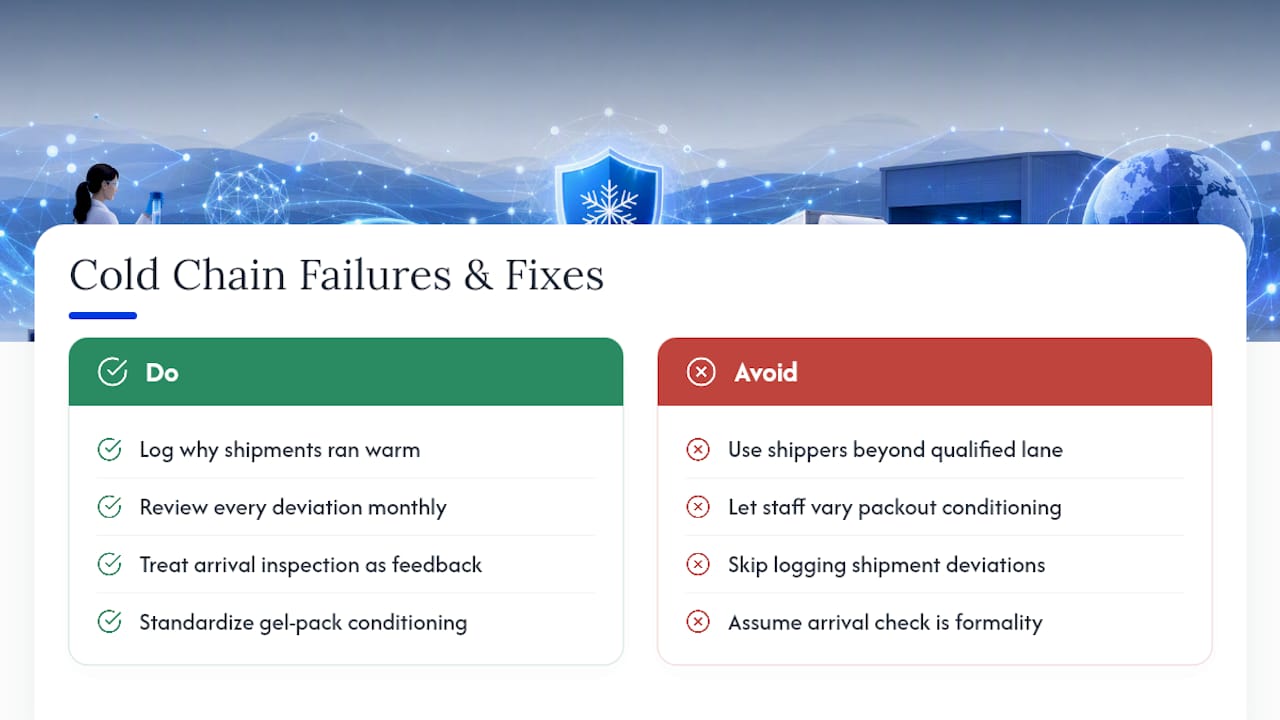
Lane mismatch causes more failures than bad refrigerant choices. Teams qualify a shipper for a two-day domestic lane, then use the same kit for a five-day route with two extra handoffs, and act surprised when it fails. Packout variability is the other repeat offender: different staff members conditioning gel packs for different lengths of time on different days.
Arrival inspection gets treated as a formality when it should be the feedback loop that fixes the SOP. If nobody logs why a shipment ran warm, the same mistake ships again next week. The habit worth adopting when scaling: review every deviation report monthly, not just when something visibly goes wrong.
— Mitch
How Synthrolab Supports Reliable Cold Chain Practices
Building a validated cold chain program means having the right equipment on hand at every stage, not just a good shipper at the end. Synthrolab carries the practical pieces that sit between storage and shipment: a mini fridge for staging compounds at the correct band before packout, and travel bags for short, controlled transfers that don’t require full shipping validation.
Before adding either to a workflow, check it against your own packout SOP: does it hold the target band for the duration you actually need, or is it a bridge between two validated steps? For labs still working out formulation and storage basics before shipping ever comes into play, the peptides for beginners guide is a solid starting point. Browse the mini fridge and travel bag listings from suppliers to see which fits your current packout gap, and order what your process is actually missing.
Sources
For packaging validation, see TemperPack’s ISTA-qualified shippers. For carrier and packaging selection, see C.H. Robinson’s guide. For regulatory recordkeeping models, see the CDC storage toolkit. For peptide-specific bands, see 3PLGuys.
Recommended
 21+ verification