GHRP-6 and GHRP-2 are both synthetic hexapeptide growth hormone secretagogues that act on the ghrelin receptor to stimulate pulsatile growth hormone release. The ghrp-6 vs ghrp-2 explained comparison comes down to two core differences: appetite stimulation and GH pulse potency. GHRP-2, also known as pralmorelin, produces 30–50% higher peak GH amplitude than some comparable GHRPs while causing only mild hunger. GHRP-6 delivers strong GH release paired with intense appetite stimulation within 15–20 minutes of injection. Both peptides elevate cortisol and prolactin at higher doses, and both appear on WADA’s prohibited list. Standard dosing for each runs approximately 100–300 mcg per injection, subcutaneously.
How do GHRP-6 and GHRP-2 differ in growth hormone release and appetite effects?
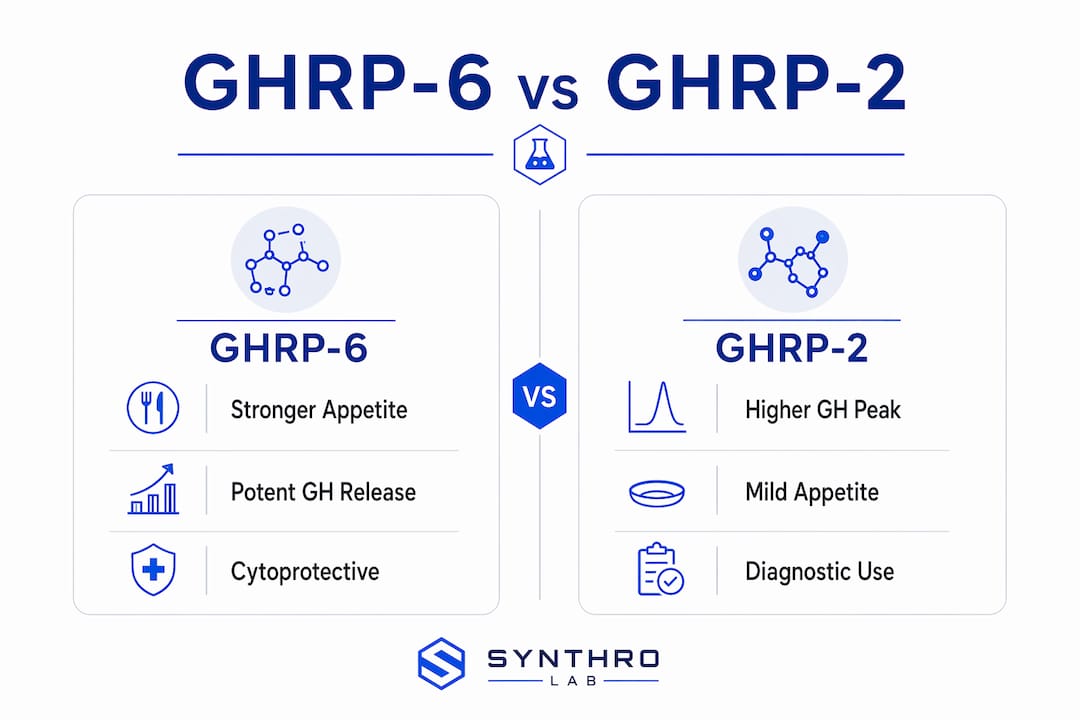
The most clinically meaningful difference between these two peptides is how they affect appetite alongside GH output. GHRP-2 generates a stronger GH pulse with minimal hunger, while GHRP-6 pairs its GH release with a pronounced hunger response that kicks in fast.
GH pulse amplitude and potency
GHRP-2 consistently produces a higher peak GH amplitude. Research in rodent models shows GHRP-2 outperforms comparable GHRPs by 30–50% in peak GH output. That gap matters when the research goal is maximizing GH pulse without secondary metabolic effects. GHRP-6 still produces a meaningful GH pulse, but researchers who need the highest amplitude per injection lean toward GHRP-2.
Appetite stimulation and receptor activity
GHRP-6’s intense hunger onset results from its engagement with peripheral ghrelin receptors that influence metabolic pathways beyond the pituitary. This is not just a minor side effect. The hunger signal is strong enough to affect caloric intake within 15–20 minutes of injection. GHRP-2 activates the same receptor class but with less peripheral engagement, producing a milder appetite response. Researchers studying appetite regulation or caloric intake as a variable need to account for this difference when designing protocols.
| Feature |
GHRP-6 |
GHRP-2 |
| GH pulse amplitude |
Strong |
Stronger (30–50% higher in some models) |
| Appetite stimulation |
Intense, onset 15–20 min |
Mild |
| Half-life |
~15–20 minutes |
~15–20 minutes |
| Cortisol/prolactin elevation |
Yes, dose-dependent |
Yes, dose-dependent |
| Regulatory approval |
None |
Japan (diagnostic use) |
- GHRP-2 is the better choice when maximum GH pulse with minimal appetite interference is the goal.
- GHRP-6 is more appropriate when appetite stimulation is a desired or acceptable outcome.
- Both peptides share a similar half-life, making injection frequency roughly equivalent.
Pro Tip: Pair either peptide with a GHRH analog like CJC-1295 to amplify the GH pulse synergistically. The combination targets both the GHRH receptor and the ghrelin receptor simultaneously, producing a larger GH release than either compound alone.
What are the side effects and hormonal impacts of GHRP-6 and GHRP-2?
Both peptides elevate stress-axis hormones in a dose-dependent pattern. At doses above 1 mcg/kg, cortisol rises approximately 1.8-fold and prolactin rises approximately 1.5-fold. These are not trivial changes. Sustained cortisol elevation can counteract anabolic signaling, and elevated prolactin carries its own downstream effects on reproductive hormones.
Compared to more selective peptides like Ipamorelin, both GHRP-6 and GHRP-2 are less selective for GH release and more likely to activate the stress axis. Ipamorelin does not meaningfully raise cortisol or prolactin at standard doses, which makes it a cleaner option for researchers who need GH stimulation without hormonal noise. The trade-off is that Ipamorelin produces a lower GH pulse amplitude than GHRP-2.
Key side effect considerations for both peptides:
- Cortisol elevation: Rises approximately 1.8-fold above baseline at doses exceeding 1 mcg/kg.
- Prolactin elevation: Rises approximately 1.5-fold, with potential downstream effects on sex hormones.
- Hunger: Significant with GHRP-6, mild with GHRP-2. Researchers tracking caloric intake must control for this.
- Water retention: Reported anecdotally at higher doses, likely linked to GH-mediated effects.
- Diminishing returns: Doses above the saturation threshold add side effects without adding GH output.
Pro Tip: Combining either GHRP with a GHRH analog reduces the relative cortisol and prolactin burden per unit of GH released. The synergistic GH output means you can use a lower GHRP dose to achieve the same GH pulse, which keeps stress-axis activation lower. Researchers interested in a selective GH secretagogue with minimal cortisol impact may find Ipamorelin a useful reference point.
What unique benefits and applications distinguish GHRP-6 and GHRP-2?
The choice between these peptides depends more on metabolic goals than on potency alone. Research experts confirm that appetite suppression is preferred in fat loss contexts, while hunger stimulation is useful in recovery scenarios. Each peptide has a distinct application profile that goes beyond simple GH output.
GHRP-6 applications
GHRP-6 carries a notable preclinical research profile beyond GH release. Preclinical studies show cardioprotective and gastroprotective effects, suggesting cytoprotective mechanisms that operate independently of GH signaling. This makes GHRP-6 relevant for researchers studying tissue protection, not just anabolic pathways. Its strong appetite stimulation also makes it the more practical choice in protocols where caloric intake needs to increase, such as recovery from illness or muscle-wasting research models.
- Cytoprotection: Cardioprotective and gastroprotective effects observed in preclinical models.
- Appetite support: Useful in recovery, weight gain, or muscle-wasting research contexts.
- GH stimulation: Strong pulse, though lower amplitude than GHRP-2 in direct comparisons.
- Metabolic research: Peripheral ghrelin receptor engagement makes it relevant for appetite pathway studies.
GHRP-2 applications
GHRP-2 is the preferred peptide when the primary goal is maximizing GH pulse amplitude with minimal appetite interference. Researchers focused on fat loss mechanisms, GH axis diagnostics, or protocols where food intake is a controlled variable favor GHRP-2. Its approval in Japan for diagnostic use provides a human safety data baseline that GHRP-6 lacks entirely. That regulatory distinction matters when evaluating the relative risk profiles of each compound.
- Maximum GH pulse: Higher amplitude per injection than GHRP-6 in most research models.
- Fat loss research: Mild appetite effect avoids confounding caloric intake data.
- Diagnostic use: Approved in Japan for GH axis evaluation, providing clinical safety reference data.
- GH axis research: Preferred when clean GH stimulation without metabolic noise is required.
How should GHRP-6 and GHRP-2 be dosed and administered for optimal results?
Standard dosing for both peptides runs approximately 100–300 mcg per injection, subcutaneously, with 1 mcg/kg body weight serving as the practical reference point. Dosing above this threshold does not proportionally increase GH output. It does, however, increase cortisol and prolactin disproportionately.
Timing is as critical as dose. Injecting in a fasted state and waiting 30–60 minutes post-injection before eating maximizes GH pulse amplitude. Elevated insulin from a recent meal can blunt the GH response by 50–75%. That is a significant reduction that makes meal timing one of the most controllable variables in any GHRP protocol.
Recommended administration steps:
- Fast for at least 2–3 hours before injection to minimize circulating insulin.
- Inject subcutaneously at approximately 1 mcg/kg body weight, typically 100–300 mcg per dose.
- Wait 30–60 minutes post-injection before consuming food, especially carbohydrates or fats.
- Limit doses to 2–3 injections per day to allow GH axis recovery between pulses.
- Do not exceed the saturation threshold. Higher doses above 1 mcg/kg raise cortisol and prolactin without adding meaningful GH output.
Pro Tip: Pairing either GHRP with a GHRH analog such as CJC-1295 with Ipamorelin produces a synergistic GH pulse that exceeds what either compound achieves alone. This combination also allows lower individual doses of each peptide, reducing the cortisol and prolactin burden.
Half-life for both peptides is approximately 15–20 minutes, which means the GH pulse is acute and time-limited. Injection frequency of two to three times daily is common in research protocols, timed around fasting windows and sleep to align with the body’s natural GH secretion rhythm.
What are the regulatory and safety considerations for GHRP-6 and GHRP-2?
Regulatory status separates these two peptides in one important way. GHRP-2, sold under the name pralmorelin, holds approval in Japan specifically for diagnostic evaluation of GH deficiency. That approval provides a documented human safety profile. GHRP-6 has no equivalent regulatory approval in any major jurisdiction.
Both peptides remain on WADA’s prohibited list and are classified as grey-market compounds in most countries. Neither carries approval for human therapeutic use outside Japan’s narrow diagnostic context. Researchers and practitioners need to understand this distinction clearly.
Key regulatory and safety points:
- GHRP-2 (pralmorelin): Approved in Japan for GH axis diagnostics. Provides limited but real human safety data.
- GHRP-6: No regulatory approval in any jurisdiction. Preclinical data only.
- WADA status: Both peptides are prohibited in competitive sport.
- Grey-market classification: Neither compound is approved as a dietary supplement or over-the-counter product.
- Sourcing quality: Purity and accurate concentration are critical. Unverified sources introduce contamination and dosing risks that invalidate research outcomes.
The absence of home-use safety clearance for either peptide does not mean the compounds are without research value. It means that responsible use requires verified, research-grade sourcing and a clear understanding of the regulatory context.
Key Takeaways
GHRP-2 delivers a higher GH pulse amplitude with minimal appetite stimulation, while GHRP-6 combines strong GH release with intense hunger and unique cytoprotective properties, making the right choice entirely dependent on the research goal.
| Point |
Details |
| GH potency difference |
GHRP-2 produces 30–50% higher peak GH amplitude than comparable GHRPs in some models. |
| Appetite as a variable |
GHRP-6 causes intense hunger within 15–20 minutes; GHRP-2 causes only mild appetite stimulation. |
| Saturation threshold |
Doses above 1 mcg/kg raise cortisol and prolactin without adding proportional GH output. |
| Regulatory distinction |
GHRP-2 holds diagnostic approval in Japan; GHRP-6 has no regulatory approval anywhere. |
| Timing matters |
Injecting fasted and waiting 30–60 minutes before eating prevents insulin from blunting the GH pulse by up to 75%. |
Choosing between GHRP-6 and GHRP-2: what I’ve learned from the research
After spending years working through peptide research, the single biggest mistake I see is choosing between GHRP-6 and GHRP-2 based on potency rankings alone. Potency is one variable. The appetite effect is the one that actually disrupts protocols.
Researchers who choose GHRP-6 for its cytoprotective properties or recovery applications often underestimate how much the hunger signal interferes with controlled feeding windows. If you are running a fat loss protocol or tracking caloric intake as a variable, GHRP-6’s appetite stimulation is not a minor inconvenience. It is a confounding factor. GHRP-2 is the cleaner tool for those contexts.
On the other hand, GHRP-6’s peripheral ghrelin receptor engagement makes it genuinely interesting for research beyond GH stimulation. The cardioprotective and gastroprotective signals observed in preclinical work are not artifacts. They point to mechanisms worth investigating separately from the GH axis entirely.
The dosing discipline matters more than which peptide you choose. Staying at or below 1 mcg/kg, timing injections around fasting windows, and pairing with a GHRH analog will produce better results than pushing doses higher with either compound. Purity is non-negotiable. Impure compounds introduce variables that make any research finding unreliable. Synthrolab’s verification standards exist precisely because compound quality is the foundation every protocol rests on.
— Mitch
Research-grade GHRP peptides from Synthrolab
Synthrolab supplies research-grade peptides verified for purity and concentration, including compounds relevant to GH secretagogue research. Every batch undergoes quality verification to support reliable, reproducible research outcomes.
Researchers working with growth hormone releasing peptides need compounds they can trust at the molecular level. Synthrolab’s anabolic signaling category includes secretagogues and related compounds sourced to research-grade standards. Purity documentation is available for every product, giving researchers the baseline confidence their protocols require. If you are building a protocol around GHRP-6, GHRP-2, or a combination stack, verified sourcing is the variable you control from day one.
FAQ
What is the main difference between GHRP-6 and GHRP-2?
GHRP-2 produces a higher GH pulse amplitude with mild appetite stimulation, while GHRP-6 combines strong GH release with intense hunger that begins within 15–20 minutes of injection.
Which peptide is better for fat loss research?
GHRP-2 is the better fit for fat loss protocols because its mild appetite effect avoids confounding caloric intake data, whereas GHRP-6’s strong hunger signal can interfere with controlled feeding windows.
What is the recommended dose for GHRP-6 and GHRP-2?
The standard research dose for both peptides is approximately 100–300 mcg subcutaneously, with 1 mcg/kg body weight as the practical ceiling. Doses above this threshold raise cortisol and prolactin without adding proportional GH output.
Does GHRP-2 have any regulatory approval?
GHRP-2, sold as pralmorelin, holds approval in Japan for diagnostic evaluation of growth hormone deficiency. Both GHRP-6 and GHRP-2 remain on WADA’s prohibited list and are grey-market compounds in most other countries.
How does timing affect GHRP injection results?
Injecting in a fasted state and waiting 30–60 minutes before eating maximizes GH pulse amplitude. Elevated insulin from a recent meal can reduce the GH response by 50–75%, making meal timing one of the most controllable variables in any GHRP protocol.
Recommended
 21+ verification