Ipamorelin is a selective ghrelin receptor agonist that triggers clean growth hormone (GH) pulses, while sermorelin is a synthetic analog of Growth Hormone-Releasing Hormone (GHRH) that works through the body’s natural GH production pathway. Understanding ipamorelin vs sermorelin explained in clinical terms matters because these two peptides share a goal but take fundamentally different biochemical routes to get there. Neither peptide is FDA-approved for anti-aging or bodybuilding in adults as of 2026. Synthrolab supplies both as research-grade compounds for investigators studying GH axis modulation, cellular signaling, and longevity-related mechanisms.
How do ipamorelin and sermorelin differ in mechanism and effects?
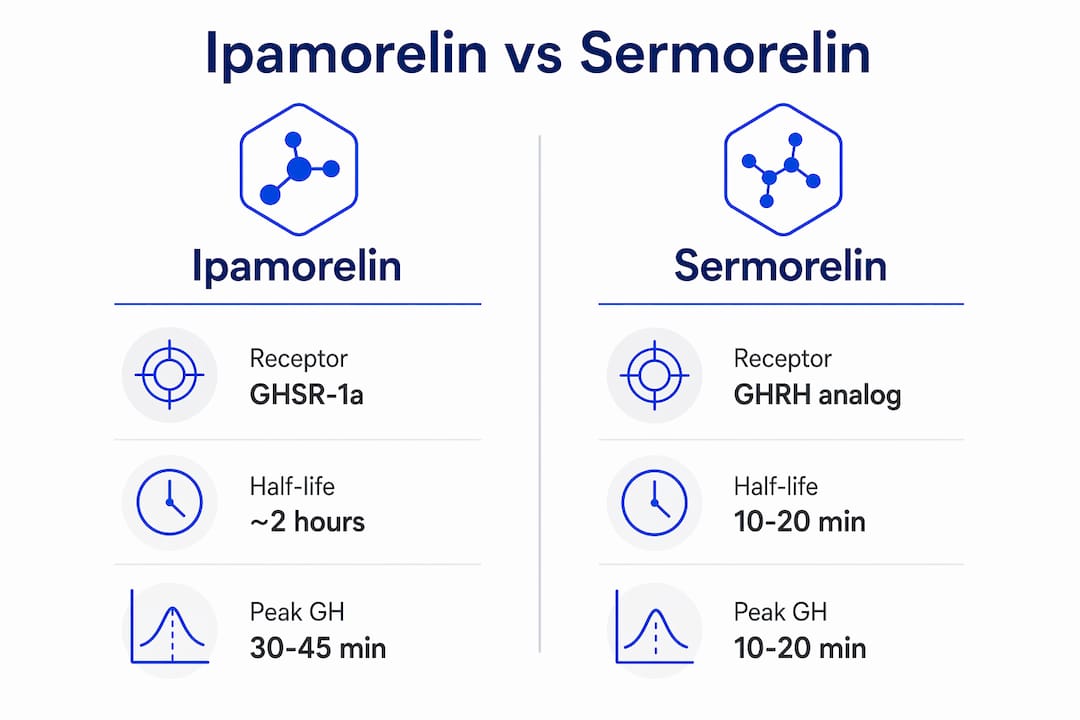
Ipamorelin and sermorelin use distinct mechanisms: ipamorelin binds the ghrelin receptor (GHSR-1a), while sermorelin mimics endogenous GHRH signaling at the pituitary. That single difference in receptor target produces meaningfully different hormonal profiles downstream.
Ipamorelin’s selective receptor action
Ipamorelin causes fewer cortisol, prolactin, and appetite spikes than older growth hormone-releasing peptides (GHRPs), offering a cleaner hormone profile for GH stimulation. This selective effect reduces what researchers call “hormonal noise,” which makes blood work easier to interpret during monitoring. The result is a rapid, well-defined GH pulse without the unwanted hormonal side effects that complicate older secretagogue protocols.
Sermorelin’s physiologic signaling
Sermorelin mimics natural GHRH signaling, producing gradual, physiologic GH pulses that follow the body’s own rhythm more closely. Because it works through the same receptor pathway as endogenous GHRH, the pituitary retains its normal feedback controls. This makes sermorelin a preferred compound in research focused on natural GH axis modulation rather than acute GH elevation.
Key differences at a glance:
- Receptor target: Ipamorelin acts on GHSR-1a (ghrelin receptor); sermorelin acts on GHRH receptors at the pituitary
- GH pulse character: Ipamorelin produces rapid, sharp pulses; sermorelin produces slower, more gradual release
- Cortisol and prolactin impact: Ipamorelin causes minimal elevation; sermorelin has a neutral profile as well, but through a different pathway
- Appetite stimulation: Ipamorelin has minimal appetite effect; sermorelin has essentially none
- Research utility: Ipamorelin is favored when ghrelin receptor activation is the study target; sermorelin is the standard for GHRH-mediated GH research
Pro Tip: If your research protocol requires clean GH stimulation without confounding hormonal variables, ipamorelin’s selectivity makes blood work interpretation significantly more straightforward.
What are the pharmacokinetics and dosing protocols for each peptide?
Half-life determines how often a peptide must be dosed and when the peak GH response occurs. Sermorelin has a shorter serum half-life of 10–20 minutes, peaking within 15 minutes post-injection. Ipamorelin has a half-life of approximately 2 hours, with peak GH response at 30–45 minutes.
Standard dosing schedules
Typical adult sermorelin dosing starts at 100–250 mcg nightly, titrated upward based on IGF-1 monitoring. Doses above 500 mcg increase side effect risk without proportional benefit. Ipamorelin’s longer half-life allows for multiple daily doses, though bedtime administration is most common for both peptides.
The rationale for bedtime dosing is precise. Timing injections before sleep aligns exogenous GH stimulation with natural slow-wave sleep GH pulses occurring 60–90 minutes after sleep onset. This approach maintains endocrine rhythms rather than overriding them.
Titration and monitoring
- Establish baseline labs. Measure IGF-1, cortisol, and prolactin before starting any protocol.
- Start at the low end. Begin sermorelin at 100 mcg nightly or ipamorelin at a conservative dose per clinical guidance.
- Recheck IGF-1 at 4–6 weeks. Clinicians repeat IGF-1 levels at this interval to assess response and adjust dose.
- Adjust incrementally. Increase dose only if IGF-1 remains below the target range and side effects are absent.
- Apply pulsed scheduling. Use a 5-days-on, 2-days-off cycle to prevent pituitary receptor desensitization.
| Parameter |
Ipamorelin |
Sermorelin |
| Half-life |
~2 hours |
10–20 minutes |
| Peak GH response |
30–45 minutes |
~15 minutes |
| Typical dosing frequency |
1–3 times daily |
Once nightly |
| Starting dose range |
Per clinical protocol |
100–250 mcg nightly |
| Monitoring marker |
IGF-1, cortisol, prolactin |
IGF-1 |
Pro Tip: Pulsed dosing schedules, such as 5 days on, 2 days off, help prevent pituitary downregulation. Continuous daily dosing without breaks can blunt peptide efficacy over weeks.
What are the clinical applications and benefits of each peptide?
Both peptides address a real physiological problem: the age-related decline in GH secretion known as somatopause. GH output declines roughly 15% per decade after age 30. That cumulative drop affects body composition, recovery speed, sleep quality, and metabolic rate.
Ipamorelin benefits in research and clinical contexts
Ipamorelin is favored in protocols where rapid, clean GH pulses are the priority. Its selective receptor activity makes it well-suited for research into:
- Recovery support. Rapid GH elevation after training or tissue stress accelerates cellular repair pathways.
- Fat metabolism. GH promotes lipolysis; ipamorelin’s clean pulse profile avoids cortisol-driven fat storage that can counteract this effect.
- Hormonal monitoring accuracy. Minimal cortisol and prolactin interference means lab results reflect true GH axis activity.
- Flexible dosing. The 2-hour half-life allows researchers to time doses around specific study windows.
Sermorelin benefits for long-term GH axis support
Sermorelin is preferred when the goal is gradual, physiologic GH restoration over time. Its GHRH-mimicking action keeps the pituitary’s own feedback loop intact, which matters for long-term protocols. Research contexts where sermorelin is the standard compound include natural GH axis modulation studies, longevity-related metabolic research, and investigations into sleep-related GH secretion patterns.
Sermorelin’s gradual release profile also makes it a closer analog to endogenous GHRH than direct GH administration. This is the core distinction in the sermorelin vs hgh debate: sermorelin stimulates the pituitary to produce GH naturally, while exogenous GH bypasses that axis entirely. Researchers studying the GH axis modulation pathway consistently prefer sermorelin for this reason.
Individual responses vary considerably. Age, baseline GH status, and overall health all influence how strongly either peptide stimulates GH release. Personalized dosing based on these factors is not optional. It is the only approach that produces reliable, interpretable results.
What safety considerations apply to ipamorelin and sermorelin use?
Neither ipamorelin nor sermorelin has robust human clinical trial data demonstrating anti-aging or fat loss efficacy. Most efficacy and safety data derive from small studies or animal models. That limitation shapes every clinical decision around these compounds.
Known side effects and risks:
- Injection site reactions. Redness, mild swelling, or irritation at the injection site are the most common reports.
- Headache. Typically transient and dose-dependent, most common at higher doses.
- Mild water retention. GH elevation can cause transient fluid retention, especially early in a protocol.
- Cortisol and prolactin changes. More relevant with older GHRPs than with ipamorelin, but still worth monitoring.
- Potential drug interactions. Corticosteroids can blunt GH response; thyroid medications may alter GH sensitivity. Both require consideration in protocol design.
The FDA classifies ipamorelin as a Category 2 bulk drug substance, which restricts its use in compounded preparations. Sermorelin’s regulatory status differs, but neither compound carries FDA approval for anti-aging or performance applications. Long-term safety data for combination protocols, such as pairing either peptide with other secretagogues, remains limited.
Pro Tip: Always monitor IGF-1, cortisol, and prolactin at baseline and at 4–6 week intervals. These three markers together give a complete picture of GH axis response and help catch adverse hormonal shifts before they become clinical problems.
How to choose between ipamorelin and sermorelin
The right peptide depends on the specific research or clinical goal, not on which compound is generally “better.” These two peptides solve different problems.
| Goal |
Preferred peptide |
Reason |
| Rapid, clean GH pulses for recovery research |
Ipamorelin |
Selective GHSR-1a agonism, minimal hormonal noise |
| Long-term GH axis modulation |
Sermorelin |
Physiologic GHRH mimicry, intact pituitary feedback |
| Minimal cortisol interference |
Ipamorelin |
Selective receptor profile avoids cortisol elevation |
| Sleep-aligned GH stimulation |
Either, bedtime dosing |
Both benefit from slow-wave sleep GH peak alignment |
| Flexible multi-dose scheduling |
Ipamorelin |
Longer half-life supports multiple daily doses |
Age and baseline GH status matter significantly in this decision. Younger individuals with relatively intact GH secretion may respond more strongly to either peptide. Those further into somatopause may need higher doses or longer protocols to achieve measurable IGF-1 changes.
Combined use of ipamorelin and sermorelin is practiced in some clinical settings, pairing the rapid GHSR-1a activation of ipamorelin with the sustained GHRH signaling of sermorelin. Researchers interested in this approach can find Synthrolab’s combination peptide formulation relevant to their protocol design. Combined protocols carry additional complexity and require tighter monitoring. No protocol involving these compounds should proceed without provider supervision and regular lab testing.
Key Takeaways
Ipamorelin and sermorelin stimulate GH through different receptor pathways, making peptide selection a function of research goal, dosing preference, and individual GH status rather than a simple ranking of one over the other.
| Point |
Details |
| Distinct mechanisms |
Ipamorelin targets GHSR-1a; sermorelin mimics GHRH at the pituitary. |
| Dosing frequency differs |
Sermorelin peaks in 15 minutes and is dosed nightly; ipamorelin peaks at 30–45 minutes and allows multiple daily doses. |
| Ipamorelin is cleaner hormonally |
Minimal cortisol and prolactin elevation makes monitoring more reliable in research settings. |
| Sermorelin preserves pituitary feedback |
Its GHRH-mimicking action keeps the body’s own GH axis intact, favoring long-term protocols. |
| Neither is FDA-approved for anti-aging |
Both lack robust human trial data; clinical supervision and IGF-1 monitoring are non-negotiable. |
What I’ve learned from watching researchers choose between these two peptides
Most people come into this comparison looking for a winner. They want someone to say ipamorelin is better, or sermorelin is better, and then they want to move on. That framing misses the point entirely.
What I’ve observed is that the researchers and clinicians who get the most useful data from these compounds are the ones who match the peptide to the specific question they’re trying to answer. If you need a clean GH pulse with minimal hormonal interference, ipamorelin is the obvious choice. If you’re studying how the GH axis responds to physiologic GHRH stimulation over weeks or months, sermorelin is the right tool.
The dosing nuance matters more than most guides acknowledge. The 5-days-on, 2-days-off schedule is not just a precaution. It reflects a real physiological reality: continuous receptor stimulation leads to downregulation, and downregulation makes your data meaningless. I’ve seen protocols fail not because the peptide was wrong, but because the schedule was too aggressive.
My honest caution is this: the gap between what these peptides can do in a well-designed protocol and what unsupervised use actually produces is enormous. The somatopause data is real. The receptor selectivity of ipamorelin is real. But neither fact translates into predictable outcomes without baseline labs, proper titration, and a provider who understands GH axis physiology. Evidence-based, monitored use is not a formality. It is the only version of this that works.
— Mitch
Synthrolab’s research-grade peptides for GH axis investigation
Researchers investigating GH secretagogue pathways need compounds they can trust at the molecular level. Synthrolab supplies research-grade ipamorelin and related GH axis peptides with full certificate of analysis documentation, supporting reproducible results across protocols.
Synthrolab’s catalog covers the full range of GH-related research compounds, from individual secretagogues to combination formulations. The Synthrolab peptide catalog includes products relevant to metabolic modulation, cellular regeneration, and longevity research. Every compound ships with purity verification to support rigorous scientific investigation.
FAQ
What is the main difference between ipamorelin and sermorelin?
Ipamorelin activates the ghrelin receptor (GHSR-1a) to produce rapid, selective GH pulses, while sermorelin mimics GHRH to stimulate the pituitary through its natural signaling pathway. The receptor target difference produces distinct hormonal profiles and dosing requirements.
How does ipamorelin work compared to sermorelin?
Ipamorelin binds GHSR-1a independently of the GHRH pathway, causing GH release without significant cortisol or prolactin elevation. Sermorelin works by activating GHRH receptors at the pituitary, producing a more gradual and physiologically patterned GH response.
What are the typical sermorelin dosage guidelines?
Sermorelin typically starts at 100–250 mcg nightly, with IGF-1 levels rechecked at 4–6 weeks to guide titration. Doses above 500 mcg increase side effect risk without proportional GH benefit.
Are there side effects from ipamorelin or sermorelin?
Both peptides can cause injection site irritation, transient headache, and mild water retention, particularly at higher doses. Neither carries FDA approval for anti-aging use, and long-term safety data from human trials remains limited.
Can ipamorelin and sermorelin be used together?
Some clinical protocols combine both peptides to pair ipamorelin’s rapid GHSR-1a activation with sermorelin’s sustained GHRH signaling. Combined use requires tighter monitoring and provider supervision due to increased protocol complexity.
Recommended
 21+ verification