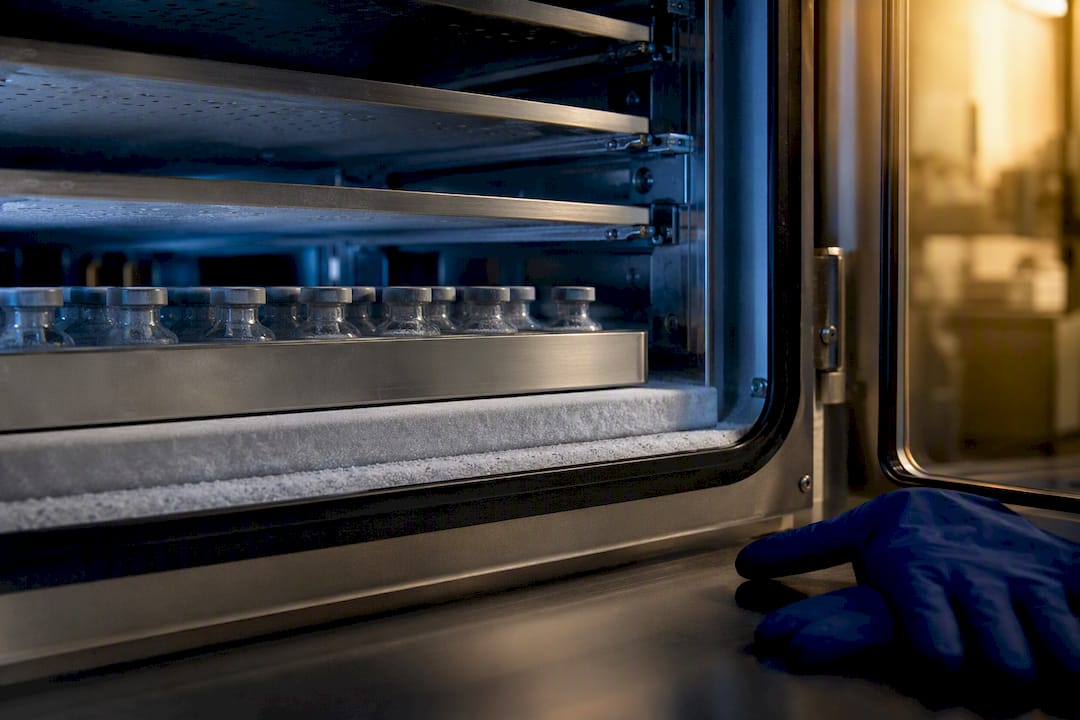
Lyophilization is a three-stage dehydration method that removes water from a frozen product by sublimation rather than heat, moving through freezing, primary drying, and secondary drying to leave behind a stable, low-moisture cake. Pharmaceutical teams rely on it to stabilize biologics and peptides that would otherwise degrade in liquid form. Getting the cycle right depends on hitting specific critical temperatures at each stage, verified with tools like FDA guidance and Karl Fischer moisture testing, both of which Synthrolab treats as baseline references for research-grade peptide handling.
TL;DR:
- Controlled ice nucleation during freezing reduces vial variability, shortens primary drying, and improves cake structure.
- The primary drying phase requires precise control of shelf temperature and chamber pressure to prevent cake collapse, typically using temperatures 2 to 3°C below the collapse temperature.
- Formulation choices, such as trehalose instead of sucrose, and effective pH and surfactant use, directly impact cycle speed and stability by altering critical temperature thresholds.
- Real-time endpoint tools like capacitance manometers and TDLAS improve cycle efficiency by accurately detecting when primary drying is complete.
- Scale-up success depends on measured equipment parameters, modeling, and maintaining consistent nucleation, with deviations risking product collapse or variability.
Synthrolab
Support Your Peptide Research
Synthrolab provides research-grade peptides and laboratory compounds for investigating cellular signalling, metabolism, recovery, and longevity mechanisms.
Explore Synthrolab
Table of Contents
What Happens During the Lyophilization Process
Every lyophilization cycle runs through the same three phases, but the parameters inside each one determine whether a batch turns out as a clean, quick-reconstituting cake or a collapsed, structurally ruined mess. The three-step sequence, freezing, primary drying, and secondary drying, each targets a different physical state of water in the product, and each has its own failure modes.
-
Freezing. The product is cooled until it solidifies completely, which sounds simple but is the most variable step in the entire cycle. Ice nucleation happens randomly across vials unless it’s controlled, and a vial that nucleates at negative 5°C forms different ice crystal structures than one that nucleates at negative 15°C. That variability shows up later as inconsistent drying rates across the same batch. Controlled ice nucleation (CIN), whether induced by ice fog or vacuum pulses, forces nucleation to happen at a set temperature across all vials simultaneously. That reduces inter-vial variability, tends to produce larger ice crystals, and often shortens primary drying because larger crystals leave wider channels for vapor to escape. Annealing, holding the frozen product at a slightly warmer sub-zero temperature for a period before primary drying, helps some formulations crystallize bulking agents more completely and can improve cake structure.
-
Primary drying. This is where sublimation happens: ice converts directly to vapor under vacuum, skipping the liquid phase entirely. It’s also the longest and most energy-intensive part of the cycle, and where most formulation failures show up. The shelf temperature, chamber pressure, and resulting product temperature all interact, and the product temperature has to stay below the collapse temperature (Tc) or glass transition temperature (Tg’) or the cake structure collapses on itself. Typical operating windows for many biologics run shelf temperatures between negative 25°C and negative 10°C with chamber pressures around 50 to 200 mTorr, keeping product temperature 2 to 3°C below the collapse point.
-
Secondary drying. Once the ice is gone, bound water still clings to the solid matrix through weaker molecular forces. Secondary drying raises the shelf temperature, sometimes well above zero, under continued vacuum to desorb that residual moisture. Ramp rate matters enormously here: pushing the shelf temperature up too fast risks cracking the cake structure. Final residual moisture targets typically fall in the 0.5 to 3% range, confirmed by Karl Fischer titration on sacrificial vials pulled during development.
Cycle length depends heavily on fill volume and vial geometry. A thin fill in a wide vial dries faster than a deep fill in a narrow one, because the vapor has a shorter path to travel out of the cake.
The formulation, not just the freeze-dryer settings, decides how aggressive a cycle can be. Every excipient choice shifts the collapse temperature up or down, which directly changes how high you can push shelf temperature during primary drying and how long the whole cycle takes.
- Sucrose vs. trehalose: both are non-reducing sugars commonly used as protein stabilizers, but they carry different glass transition temperatures. Trehalose generally has a higher Tg’ than sucrose, which gives formulators more room to run a warmer, faster primary drying cycle without risking collapse.
- Mannitol as a bulking agent: mannitol crystallizes readily, which gives the cake mechanical strength and an elegant appearance, but a poorly controlled crystallization can trap amorphous mannitol pockets that behave unpredictably during drying.
- Protein or peptide concentration and sugar ratio: a sugar-to-protein mass ratio that’s too low leaves the biologic under-protected during dehydration stress; most formulators start in a range that provides enough stabilizer without diluting the active ingredient below a useful concentration.
- pH and surfactants: pH shifts during freezing (a phenomenon tied to buffer component crystallization) can denature sensitive peptides, and surfactants like polysorbate help prevent aggregation at the ice-water interface.
- Net effect on cycle design: a formulation with a higher Tg’ or Tc tolerates a warmer, shorter primary drying step, while a fragile, low-Tg’ formulation demands a conservative, slower cycle to avoid collapse.
Peptide researchers working with lyophilized material should treat the formulation sheet as the first place to look when a cycle underperforms, not the freeze-dryer’s programming.
Equipment And Heat Transfer: Why Kv And Rp Matter
Heat has to move from the shelf into the product, and that transfer rate, called Kv (vial heat transfer coefficient), depends on shelf contact, chamber pressure, and vial geometry. It’s not uniform across a shelf, and it’s definitely not uniform across a batch.
- Kv and Rp together set your ceiling. Kv describes how efficiently heat reaches the product; Rp (product resistance to vapor flow) describes how hard it is for water vapor to escape through the drying cake. High Rp forces you to run a lower shelf temperature or the product temperature will exceed Tc even at a modest heat input.
- Vacuum bands: most pharmaceutical primary drying cycles run in the 50 to 200 mTorr range, with condenser temperature kept well below the product’s sublimation front temperature to keep capturing vapor efficiently.
- Thermocouples vs. wireless sensors: inserted thermocouples are the traditional standard but they can act as artificial nucleation sites and don’t always represent the coldest or slowest-drying vial in the chamber. Wireless temperature sensors placed in non-instrumented vials give a more representative read of true batch behavior.
- Edge effects: vials at the edge of the shelf receive additional radiant heat from the chamber walls and often dry faster than center vials, which is why cycle development studies map edge vials separately.
Pro Tip: Run edge-vial and center-vial thermocouples simultaneously during development runs. The gap between them tells you how much safety margin you actually need before scaling to full batch size.
Knowing exactly when primary drying finishes matters more than most non-specialists assume. End too early and ice remains, ruining the cake structure once secondary drying starts. End too late and you’ve wasted expensive chamber time.
- Pirani vs. capacitance manometer convergence: a Pirani gauge reads pressure based on gas composition and reports artificially high values when water vapor dominates the chamber atmosphere. A capacitance manometer reads true pressure regardless of gas type. When the two gauges converge, most of the water vapor is gone and primary drying is essentially complete.
- Pressure-rise tests: briefly isolating the chamber and watching how fast pressure climbs gives a rough estimate of remaining sublimation activity.
- TDLAS (tunable diode laser absorption spectroscopy): measures water vapor concentration and mass flow directly in the duct between chamber and condenser, giving a real-time, non-invasive endpoint signal without needing product-contact probes.
- Sacrificial vials and Karl Fischer titration: pulling vials at intervals during development and measuring residual moisture directly is still the gold standard for setting the final secondary-drying hold time.
These tools increasingly feed closed-loop control systems that adjust shelf temperature automatically based on real-time endpoint signals, cutting both cycle time and batch-to-batch variability.
Building A Design Space For Scale-Up And Validation
Moving a cycle from a lab-scale freeze-dryer to a commercial unit is where a lot of otherwise solid formulations run into trouble, because chamber geometry, shelf uniformity, and condenser capacity all change.
- Gather your inputs. A defensible design space needs measured Kv, Rp, Tc or Tg’, and the equipment’s actual capability curve, not its theoretical maximum. Skipping direct measurement and relying on literature values is one of the most common causes of scale-up failure.
- Model before you run full batches. Steady-state heat and mass transfer models let you predict product temperature across a range of shelf temperature and chamber pressure combinations before committing chamber time. Most teams build in a safety margin of roughly 2 to 5°C below Tc to absorb equipment-to-equipment variability.
- Move through the validation sequence properly. Process design defines the operating ranges; performance qualification confirms the cycle works reliably at commercial scale across multiple runs; continued process verification monitors ongoing batches to catch drift before it becomes an out-of-specification result.
- Lean on controlled nucleation for consistency. CIN and closed-loop shelf control both reduce the vial-to-vial and batch-to-batch variability that tends to widen as batch size grows, keeping the commercial-scale product temperature distribution closer to what was validated at lab scale.
Fixing The Most Common Lyophilization Failures
Most cycle failures trace back to one of four recurring problems, and catching them early saves an entire batch.
- Cake collapse: shows up as a shrunken, glassy, or puddled cake instead of a rigid porous structure. If temperature data shows the product exceeded Tc during primary drying, drop shelf temperature or chamber pressure immediately on the next run.
- Premature stoppering: ice buildup on precooled shelves or a miscalibrated stoppering mechanism can partially seat stoppers before the cycle finishes, a known failure mode flagged in FDA inspection guidance. Check shelf condition and stoppering calibration before every load.
- Cracking during secondary drying: usually caused by ramping shelf temperature too aggressively. Rates around 0.1 to 0.3°C per minute are a safer starting point for biologics than faster ramps.
- Inter-vial variability: uncontrolled nucleation is usually the root cause. Introducing CIN at the freezing stage tightens the spread significantly.
Pro Tip: If cracking appears only in vials near the chamber door, check for a localized temperature gradient before blaming the formulation.
Practitioner Rules For Storing And Reconstituting Lyophilized Peptides
Getting the cycle right is only half the job. What happens after the vial leaves the freeze-dryer determines whether the peptide inside still performs as expected weeks or months later.
- Storage decisions should follow stability data, not habit. Synthrolab’s peptide storage guidelines outline temperature thresholds by compound class rather than a blanket refrigeration rule.
- Fill volume affects both cycle time and dose accuracy. Under-filling a vial to speed up drying can make small-volume dosing less precise once reconstituted.
- Reconstitution technique matters as much as the diluent. Synthrolab’s reconstitution guide walks through gentle mixing methods that avoid denaturing the peptide at the air-liquid interface.
- Shelf-life estimates depend on residual moisture at packaging. Check how peptide degradation timelines shift with storage temperature before assuming a lyophilized vial is stable indefinitely at room temperature.
Environmental And Safety Considerations In Lyophilization
Running a freeze-dryer at scale isn’t just a formulation and equipment problem, it carries real environmental and occupational safety implications that cycle designers need to plan around from the start.
Vacuum pumps used in lyophilization, particularly oil-sealed rotary vane pumps, generate pump oil waste that requires proper disposal under hazardous waste regulations if it’s contaminated with process chemicals. Many facilities have shifted to dry or oil-free pump technology specifically to avoid this waste stream and reduce the risk of oil vapor backstreaming into the vacuum chamber, which can contaminate the product itself.
Energy consumption is a genuine concern at commercial scale. Primary drying alone can run for 20 to 40 hours per batch, and the combination of mechanical refrigeration for the shelves and condenser plus continuous vacuum pumping makes lyophilization one of the more energy-intensive unit operations in pharmaceutical manufacturing. Facilities running multiple freeze-dryers around the clock factor this into both operating cost models and sustainability reporting.
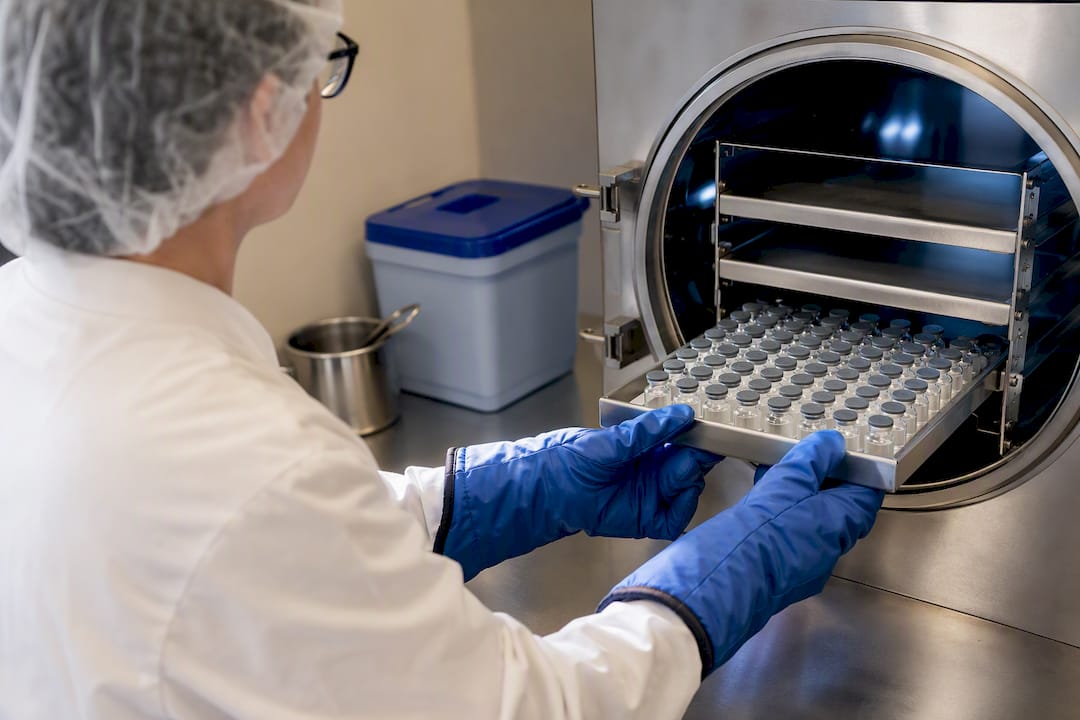
Personnel safety during loading and unloading deserves attention too. Cryogenic surfaces on shelves and condensers pose frostbite risk, and broken glass vials under vacuum create a sharps hazard that standard glove protocols need to account for. Aseptic processing areas add another layer: operators need gowning procedures that don’t compromise sterility while still protecting against cold-contact injuries. Facilities handling biologics with any infectious potential also need containment protocols that satisfy both biosafety and cleanroom requirements simultaneously, which is a harder balance than it sounds.
Regulatory Requirements Shaping Lyophilization In Pharmaceuticals
Regulatory bodies treat lyophilization as a critical process step precisely because so much can go wrong invisibly, a batch can look fine on inspection and still carry unacceptable residual moisture or hidden structural collapse inside the cake.
FDA inspection guidance for lyophilized parenterals specifically calls out aseptic transfer procedures, correct vial loading sequences, and continuous monitoring of shelf temperature, product temperature, condenser temperature, and chamber pressure throughout the run. Inspectors look for documented evidence that these parameters stayed inside validated ranges for every single batch, not just the batches used during initial qualification.
Compliance extends beyond the freeze-dryer itself. Manufacturers need documented evidence connecting formulation development, thermal characterization (Tg’ and Tc measurement), cycle design, and the final validated commercial process into a single coherent package. Regulators expect to see the reasoning behind chosen shelf temperatures and pressures, not just the final recipe. Deviation investigations, when a batch’s product temperature drifts outside the validated window, need root-cause analysis and a documented corrective action before the batch can be released or the cycle can run again unmodified.
For peptide and biologic researchers working outside commercial manufacturing, the same underlying discipline applies at a smaller scale: batch-specific certificates of analysis, documented storage conditions, and traceable handling records build the same kind of evidentiary trail that regulators expect from full-scale operations.
Validation And Quality Control Specific To Lyophilization
Validating a lyophilization cycle is fundamentally different from validating most other pharmaceutical unit operations, because the process itself changes the physical state of the product three separate times, and each transition is a potential failure point.
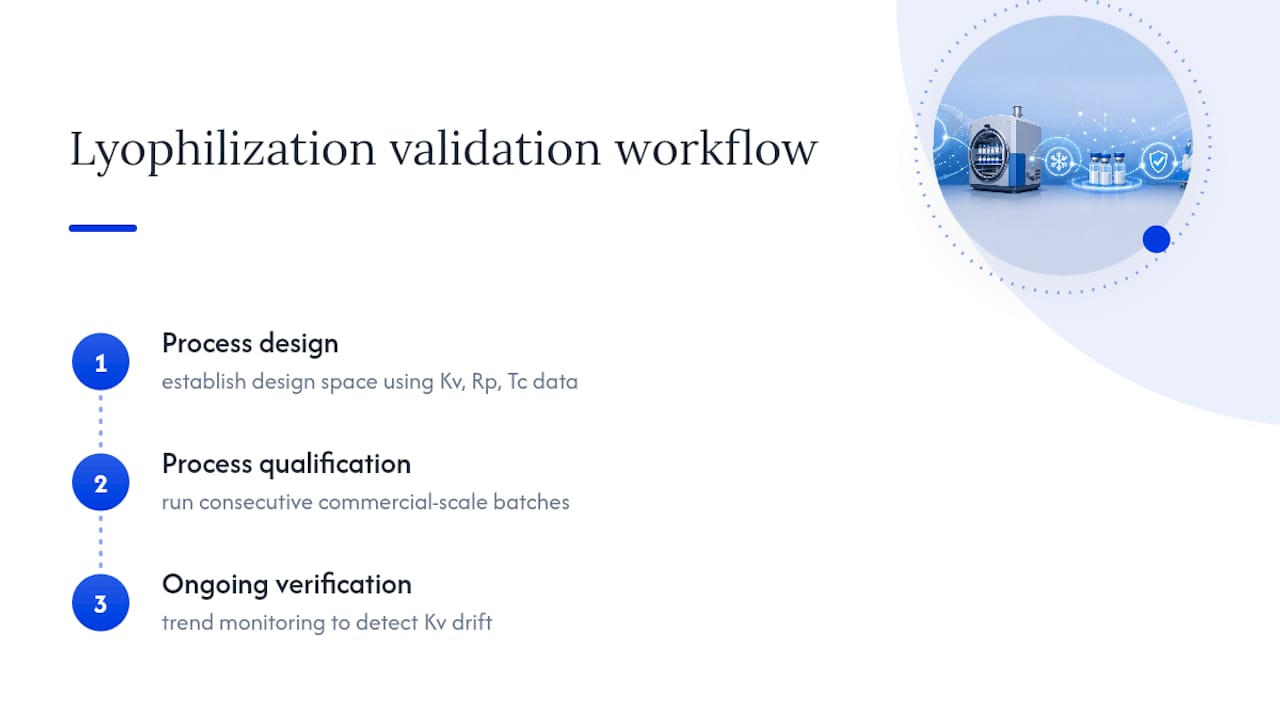
Process design comes first: establishing the design space using measured Kv, Rp, and critical temperature data, as cycle development best practices recommend. Process qualification follows, running multiple consecutive batches at commercial scale to confirm the cycle reliably produces product within specification across normal equipment variability. Continued process verification is the ongoing phase, ideally using trend data from routine batches to catch slow drift in Kv (from shelf aging or condenser fouling) before it produces an out-of-spec result.
Quality control for the finished product centers on a handful of tests that map directly back to the cycle’s critical parameters. Residual moisture, measured by Karl Fischer titration, confirms secondary drying reached its target. Cake appearance and reconstitution time serve as a proxy for whether the product structure held up through primary drying without collapse. Potency and purity assays, run against a stability-indicating method, confirm the active ingredient survived the thermal and mechanical stress of the entire cycle intact.
Documentation ties it all together. A validated lyophilization process needs a batch record that captures shelf temperature, chamber pressure, and product temperature data continuously throughout the run, not just at set checkpoints, because a brief excursion above Tc for even a few minutes can be enough to compromise cake structure without leaving any other visible sign.
When Lyophilization Is The Right Call
Lyophilization earns its cost and complexity for thermolabile biologics, vaccines, and peptides that need long shelf life outside a cold chain. For a stable small molecule that tolerates refrigerated liquid formulation, the added cycle time and sterile handling burden usually aren’t worth it.
— Mitch
Synthrolab’s Resources For Researchers Working With Lyophilized Peptides
Getting a peptide safely from freeze-dryer to bench takes more than a good cycle, it takes accurate storage data and a reconstitution method that doesn’t undo all that careful thermal engineering. Batch-specific certificates of analysis alongside stability data help researchers make cold-chain decisions based on actual measured degradation curves rather than generic assumptions.
If you’re deciding how long a lyophilized peptide can sit at room temperature before it degrades, or which diluent and mixing method to use during reconstitution, Synthrolab’s peptide storage rules and reconstitution guide walk through both in practical, lab-ready terms. For researchers sourcing lyophilized research peptides directly, Synthrolab’s product catalog includes COA documentation with every batch, and labs ordering at volume can request wholesale pricing directly.
Sources
Consult FDA’s lyophilization inspection guidance and peer-reviewed design-space recommendations before finalizing any commercial cycle or regulatory filing.
FAQ
What Is The Difference Between Drying And Lyophilization?
Conventional drying uses heat to evaporate liquid water, which can denature proteins and collapse delicate structures. Lyophilization freezes the product first, then removes water by sublimation under vacuum, avoiding the liquid state entirely and preserving structure far better for biologics and peptides.
What Are The Four Stages Of Freeze-Drying?
Most technical breakdowns describe three core stages, freezing, primary drying, and secondary drying, though some sources split pretreatment (formulation and vial loading) out as a separate first stage, making four. The physical dehydration itself still happens across freezing, sublimation, and desorption.
Which Oil Is Used In A Lyophilizer?
Oil-sealed rotary vane vacuum pumps typically use specialized hydrocarbon or synthetic vacuum pump oils rated for the pressure ranges involved. Many pharmaceutical facilities now use oil-free or dry vacuum pumps specifically to eliminate oil vapor backstreaming risk into the product chamber.
What Temperature Is Product Lyophilized At?
It varies by formulation, but many biologic primary drying cycles run shelf temperatures between negative 25°C and negative 10°C, while secondary drying often ramps shelf temperature above zero, sometimes to 20 to 40°C, to desorb bound water without exceeding the product’s thermal tolerance.
How Is Residual Moisture Measured After Lyophilization?
Karl Fischer titration on sacrificial vials is the standard method, typically confirming a final residual moisture target in the 0.5 to 3% range for most lyophilized biologics and peptides.
Recommended
 21+ verification