For reproducible subcutaneous peptide dosing, rotate injection sites by ≥1 cm from the previous puncture in a systematic clockwise quadrant pattern and log every injection with lot number and anatomical zone.
Three facts anchor this protocol: lipohypertrophy affects many regular injectors who rotate poorly; the spacing rule to move at least about 1 cm comes from peer-reviewed clinical guidance; and Synthrolab provides SOP templates researchers can drop directly into institutional protocols.
TL;DR — paste into your SOP header:
- Rotate ≥1 cm from the prior site; use a clockwise quadrant pattern
- Prefer one anatomical region per study for PK-sensitive endpoints
- Hold needle 5–10 seconds post-injection; allow alcohol to dry 30 seconds before inserting
- Never reuse needles; log every injection with date, zone, lot, and COA reference
- Inspect and palpate sites weekly; retire any site showing a firm nodule
Table of Contents
What the evidence says about injection site rotation for peptide research
Injection site-dependent PK affects at least 50% of peptides and small proteins with data from multiple SC sites. That figure alone justifies treating rotation as a scientific variable, not a housekeeping task.
Key finding: Lipohypertrophy (LH) is present in over 50% of regular injectors who rotate poorly or reuse needles. Injecting into an LH nodule produces erratic, unpredictable absorption — the kind of variability that contaminates PK datasets and makes study results unreliable.
The ≥1 cm rotation rule and clockwise quadrant progression appear consistently across peer-reviewed clinical guidance. Moving less than a centimeter between doses is functionally the same as returning to the same spot: the tissue never fully recovers between punctures.
Absorption speed follows a clear anatomical hierarchy:
- Abdomen: fastest onset, most consistent capillary density
- Upper arm: moderately fast, slightly more variable
- Thigh: slower, more variable; acceptable for weekly-dosed compounds
- Buttocks: slowest absorption, highest inter-individual variability
For peptides and small proteins (MW <16 kDa), site-dependent absorption is especially pronounced when Tmax ≤2 hours or CL/F ≥39 L/h. If your compound falls in that range, site selection is a PK decision, not just a comfort preference.
A step-by-step rotation protocol you can insert into a study SOP
Zone selection
Choose one anatomical region for PK-sensitive studies. The abdomen is the default for most peptide classes. If dosing frequency requires more tissue, define a documented multi-zone schedule before the study begins.

Quadrant and grid approach
Divide your chosen region into four quadrants. Label them (e.g., UL, UR, LL, LR for upper-left, upper-right, lower-left, lower-right). Rotate clockwise through quadrants, and within each quadrant, keep successive punctures ≥1 cm apart. Do not return to any exact spot for at least one to two weeks.
Per-injection checklist
- Confirm the next zone from the rotation log before touching the subject
- Visually inspect the site for redness, swelling, or raised tissue
- Palpate the zone for firm or rubbery nodules; if found, skip to the next zone
- Swab with 70% isopropyl alcohol; allow 30 seconds to air-dry
- Pinch a skin fold; insert at 90° (adequate SC tissue) or 45° (lean site)
- Inject slowly and steadily
- Hold needle 5–10 seconds after injection to reduce backflow
- Withdraw; apply gentle pressure without rubbing
- Document: date/time, zone/quadrant, distance from prior site, needle gauge/length, lot number, COA reference, and brief site assessment
Pro Tip: Assign each quadrant an alphanumeric code (e.g., AB-UL for abdominal upper-left) and pre-print a body-map grid on the log sheet. Researchers fill in the code rather than describing the site in free text, which cuts transcription errors and makes audit review faster.
| Schedule type |
Rotation approach |
Minimum rest per spot |
| Daily dosing |
Rotate across 3–4 zones per cycle |
3–4 days |
| Every-other-day |
Two-zone alternation within one region |
2 days |
| Weekly dosing |
Single zone per week, clockwise |
7 days |
| Twice-weekly |
Two fixed zones, alternating |
3–4 days |
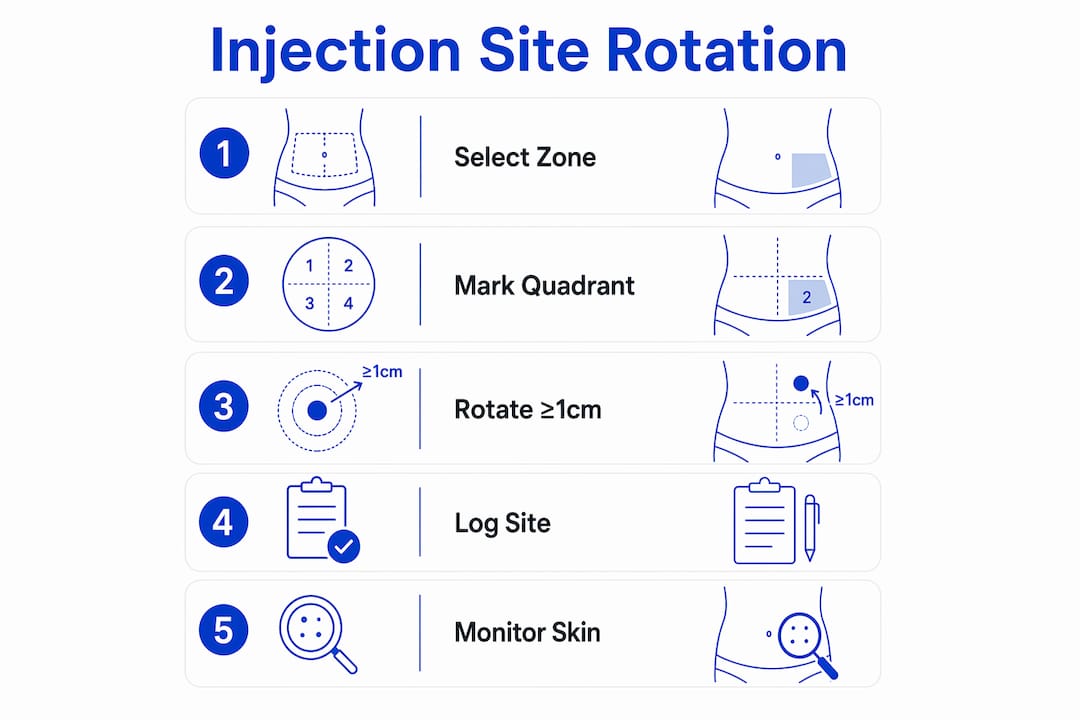
How anatomical region choice affects PK consistency
Single-region rotation and multi-region rotation serve different research goals. The choice should be documented in the study design, not left to the administrator’s preference on dosing day.
Rotating within one region keeps absorption characteristics stable across study visits. Switching between body regions across consecutive doses introduces variability that is difficult to separate from true compound effects during PK analysis.
Single-region rotation (recommended for PK-sensitive studies):
- Absorption rate stays consistent across visits
- Easier to detect site-related anomalies in PK data
- Limits available tissue for high-frequency dosing
- Requires careful within-region spacing to prevent LH
Multi-region rotation (appropriate for tissue-rest priority):
- Larger total tissue pool; practical for daily or twice-daily dosing
- Introduces inter-region absorption variability
- Requires documented rationale and, ideally, a wash-in period when switching regions
- Better suited to studies where PK precision is secondary to safety or tolerability endpoints
For weekly-dosed peptides, a postcard-sized abdominal zone typically provides enough rotation space. Daily dosing across a study of several weeks usually requires a credit-card-sized grid or a formally defined multi-zone schedule.
How to prevent, detect, and manage injection-site complications
LH is the primary complication in long-term SC injection protocols. Visual inspection alone misses many cases; palpation is the reliable detection method.
Detection standard: Run fingertips slowly across each injection zone, feeling for firm, rubbery, or thickened tissue. Many LH nodules are invisible and only found by touch. Add palpation to every weekly site review.
Prevention rules (non-negotiable for protocol integrity):
- Never reuse needles; microscopic barbing damages tissue even when invisible to the eye
- Enforce ≥1 cm spacing between successive punctures
- Use the shortest needle length that reliably reaches SC tissue (4–6 mm is commonly recommended for most subject populations)
- Allow alcohol to fully dry before injection
- Hold needle 5–10 seconds post-injection
Management steps when LH is detected:
- Stop using the affected zone immediately; document the finding with date and zone code
- Move to the next pre-defined alternate zone per the rotation schedule
- Record the estimated nodule size and location in the CRF
- Flag all PK data collected from that zone for sensitivity analysis
- Do not return to the affected spot until palpation confirms full resolution (typically several weeks)
Red flags requiring institutional safety review:
- Persistent lump beyond 48 hours with no reduction
- Erythema, warmth, or fluctuance suggesting infection
- Unexplained drift in PK parameters correlating with site history
What to record in study logs to keep site data audit-ready
Every injection log row should carry enough information to reconstruct the full site history and link it to PK outcomes. Missing fields are the most common reason site-related variability goes undetected until analysis.
Minimum required fields per injection:
- Date and time
- Compound name, lot number, and COA reference
- Anatomical zone and quadrant code
- Estimated distance from prior site (cm)
- Needle gauge and length
- Administrator ID
- Site assessment: visual (clear / redness / swelling) and palpation (clear / nodule detected)
| Log field |
Acceptable values |
Flag condition |
| Zone/quadrant code |
AB-UL, AB-UR, AB-LL, AB-LR, TH-L, TH-R |
Blank or free-text description |
| Distance from prior site |
≥1 cm (estimated) |
<1 cm or “same spot” |
| Site assessment — palpation |
Clear / Nodule detected |
Nodule detected |
| Lot/COA reference |
Alphanumeric lot ID |
Missing |
| Needle reuse |
No |
Yes |
Pro Tip: Link the lot number and COA reference in the same log row as the site code. If a PK anomaly appears, you can immediately check whether it correlates with a specific batch, a specific zone, or both — without reconstructing the timeline from separate documents.
One-page SOP checklist for institutional use
Per-injection procedure:
- Confirm next zone from rotation log
- Inspect site visually (redness, swelling, raised tissue)
- Palpate for nodules; skip zone if any found
- Swab with 70% IPA; wait 30 seconds
- Pinch skin fold; insert needle at correct angle
- Inject slowly; hold 5–10 seconds; withdraw
- Apply gentle pressure; do not rub
- Complete log entry (zone, lot, COA, assessment)
Weekly site review:
- Palpate all active zones; document findings
- Confirm no zone has been used more than the protocol allows
- Review log for spacing compliance; flag any <1 cm entries
- Update rotation schedule if a zone is retired
Standing rules:
- ≥1 cm spacing between successive punctures
- Clockwise quadrant progression; do not skip zones
- Single-use needles only
- 30-second alcohol dry time before every injection
- Log every injection; no exceptions
SOP version control block:
| Field |
Entry |
| SOP title |
Injection Site Rotation Protocol |
| Version |
≥1 cm |
| Effective date |
____________ |
| Reviewed by |
____________ |
| Authorized by |
____________ |
Key Takeaways
Systematic research peptide injection site rotation, anchored by ≥1 cm spacing and quadrant-based logging, is the single most effective control for preventing lipohypertrophy and keeping SC absorption data reproducible across study visits.
| Point |
Details |
| Rotate ≥1 cm, clockwise |
Move at least one finger-width from the prior site and progress through quadrants in order. |
| Single-region for PK studies |
Rotating within one anatomical region keeps absorption characteristics stable across visits. |
| Lipohypertrophy prevalence |
Over 50% of regular injectors who rotate poorly or reuse needles develop LH, which corrupts absorption data. |
| Log every injection |
Record zone code, lot number, COA reference, and site assessment for every dose administered. |
| Synthrolab SOP templates |
Synthrolab supplies research-grade peptides with batch COAs and protocol templates to support audit-ready rotation logs. |
Why rotation discipline is the most underrated variable in peptide research
Most researchers who design careful peptide studies spend real time on compound selection, reconstitution, and dosing intervals. Site rotation gets a line in the protocol and then gets forgotten in practice. That gap is where data quality quietly erodes.
The over 50% LH prevalence figure is not a worst-case scenario. It reflects what happens in real injection practice when rotation is treated as a suggestion rather than a tracked variable. A nodule changes local blood flow and fibrous tissue density. The compound still goes in, but what comes out the other side — the absorption curve — is no longer the same experiment.
The fix is not complicated. A body-map grid, an alphanumeric zone code, and a log field for palpation assessment add maybe 90 seconds per injection visit. What they prevent is the kind of site-related PK drift that only shows up during analysis, when it is too late to do anything about it. Structured rotation training and documented logging have been shown to reduce LH incidence at follow-up compared with verbal instruction alone.
The other underappreciated point: single-region rotation is almost always the right call for PK-sensitive endpoints, and most researchers default to multi-region rotation because it feels more thorough. It is not. Switching between the abdomen and the thigh mid-study introduces a confound you cannot fully correct for in analysis.
Synthrolab supports reproducible peptide research from batch to protocol
Reproducible site-rotation data starts with a compound you can actually trust. Synthrolab supplies research-grade peptides with independent batch testing and certificates of analysis for every lot — so the lot number you log in your rotation record links directly to a verifiable purity document.
Beyond the compound itself, Synthrolab provides protocol templates and research support designed to integrate with institutional SOPs. The COA landing page gives researchers direct access to batch documentation for traceability audits. For researchers building out a full rotation protocol, the Tissue Repair Peptide Research Protocol offers stepwise templates adaptable to site-rotation CRFs.
Download the SOP template or request COA files directly through Synthrolab’s research support team. Products are supplied for research use only.
Useful sources
- PMC: The injection technique factor — lipohypertrophy prevalence, rotation rules, and needle reuse evidence
- ScienceDirect: Impact of injection sites on clinical pharmacokinetics of SC peptides and proteins
- PubMed: Absorption differences and site preparation guidance
- University of Rochester Medical Center: Injection site rotation guidance
- Synthrolab COA page — batch certificates for traceability
- Synthrolab Tissue Repair Protocol — SOP templates and rotation mapping tools
| Resource |
Type |
Primary use |
| PMC injection technique review |
Peer-reviewed |
LH prevalence, rotation rules, needle reuse evidence |
| ScienceDirect PK survey |
Peer-reviewed |
Site-dependent absorption data for peptides/proteins |
| URMC site rotation guide |
Clinical reference |
Anatomical site selection and absorption hierarchy |
| Synthrolab COA page |
Supplier document |
Batch traceability for log entries |
| Synthrolab SOP template |
Protocol download |
Rotation checklist for institutional SOP insertion |
Recommended