Collagen peptides are enzymatically hydrolyzed fragments of native collagen protein, broken into small chains of 2–5 kDa that your body absorbs with roughly 90% bioavailability. The industry standard term is hydrolyzed collagen, though “collagen peptides” is now the dominant consumer label for the same compound. These fragments support skin hydration, joint cartilage integrity, and connective tissue repair by acting as both structural building blocks and cellular signaling molecules. Clinical research from Springer Nature and Time confirms measurable benefits at doses as low as 2.5g per day, making them one of the most evidence-backed protein supplements available in 2026.
What are collagen peptides and how are they made?
Collagen peptides are produced through enzymatic hydrolysis, a process that breaks native collagen into short amino acid chains averaging 2,000–5,000 Daltons in molecular weight. Native collagen, the structural protein making up skin, tendons, cartilage, and bone, is too large and insoluble for meaningful oral absorption. Hydrolysis solves that problem by cleaving peptide bonds at specific sites, yielding water-soluble fragments that dissolve easily in liquids and survive digestion intact.

Collagen sources: bovine, marine, and chicken
Three primary sources dominate the collagen peptide market:
- Bovine collagen (from cattle hides and bones) is rich in Type I and Type III collagen, making it well-suited for skin, hair, and tendon support.
- Marine collagen (from fish skin and scales) delivers predominantly Type I collagen with a smaller average molecular weight, which some researchers associate with faster absorption.
- Chicken collagen (from cartilage) provides Type II collagen, relevant for joint-specific applications.
The source matters because collagen type determines which tissues receive the most structural support. Marine collagen is often favored for skin-focused protocols; bovine collagen covers a broader range of connective tissue targets.
How collagen peptides differ from gelatin
Gelatin is partially hydrolyzed collagen. It gels in cold water and has a much larger molecular size than fully hydrolyzed peptides. Clinical evidence consistently favors fully hydrolyzed peptides over gelatin for absorption and measurable benefit. Gelatin has its place in cooking and gut health protocols, but it is not interchangeable with collagen peptides for tissue-targeted supplementation.
Pro Tip: When evaluating a collagen supplement, look for “hydrolyzed collagen” or “collagen peptides” on the label with a listed molecular weight below 5 kDa. Products that list only “collagen protein” without specifying hydrolysis may contain intact or partially hydrolyzed collagen with significantly lower bioavailability.
How do collagen peptides work in the body?
Collagen peptides are absorbed as di- and tripeptides such as Pro-Hyp (proline-hydroxyproline) and Hyp-Gly (hydroxyproline-glycine). These short chains resist complete breakdown during digestion, which is what makes them biologically active rather than just a source of raw amino acids.
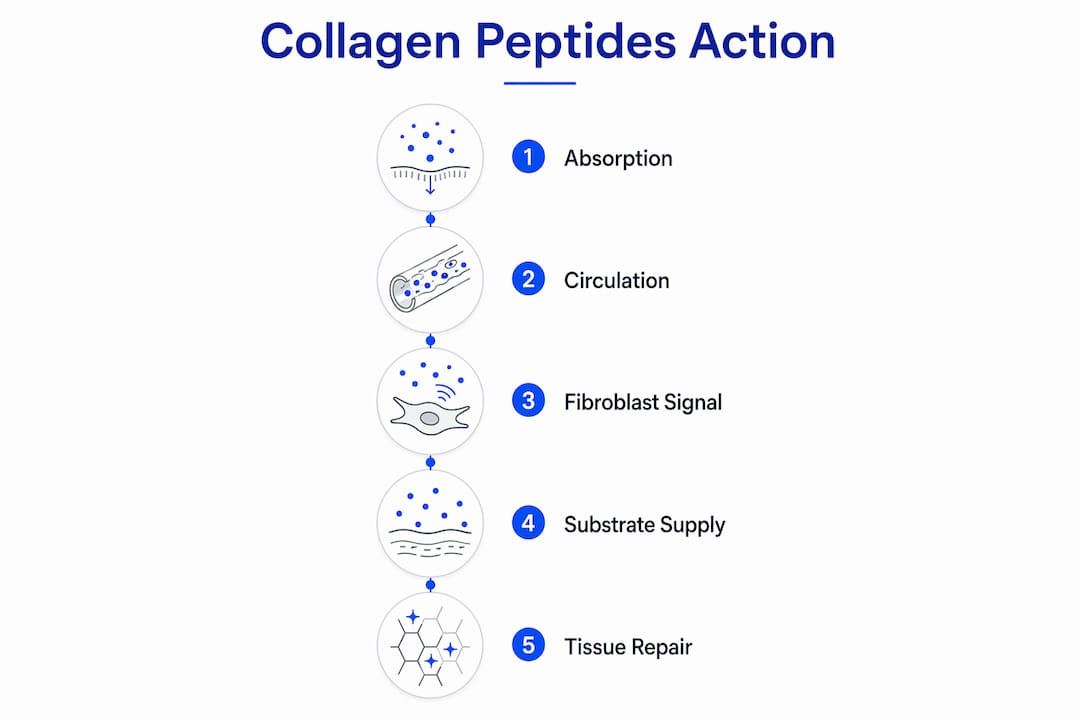
The dual mechanism: substrate and signal
Collagen peptides work through two distinct pathways:
- Substrate provision: The amino acids glycine, proline, and hydroxyproline are delivered directly to fibroblasts in skin and chondrocytes in cartilage, giving these cells the raw material needed for new collagen synthesis.
- Cellular signaling: Bioactive peptides like Pro-Hyp bind to fibroblasts and chondrocytes, triggering upregulation of endogenous collagen and extracellular matrix production. This is the mechanism that separates collagen peptides from a generic protein supplement.
This dual action is why collagen peptides outperform standard whey or casein for connective tissue support, even though those proteins contain more total amino acids. The signaling function is specific to collagen-derived peptides and does not occur with complete proteins. Researchers studying anabolic signaling pathways have documented this distinction clearly.
Why vitamin c is non-negotiable
Vitamin C is a mandatory cofactor for collagen synthesis. It hydroxylates proline and lysine residues, a step that cannot be skipped in the formation of stable collagen triple helices. If your vitamin C intake is low, collagen peptide supplementation will produce a fraction of its potential benefit. This is not a minor caveat. Deficiency actively blocks the synthesis pathway regardless of how much collagen you consume.
Pro Tip: Take collagen peptides alongside 250–500mg of vitamin C. A simple combination of a collagen powder mixed into citrus juice covers both requirements without adding a separate supplement.
What are the proven benefits of collagen peptide supplementation?
The clinical record for collagen peptides is stronger than for most wellness supplements. Skin, joint, and bone outcomes have all been studied in randomized controlled trials with consistent results across multiple research groups.
Skin health: hydration, elasticity, and wrinkle reduction
Daily supplementation of 2.5–10g of hydrolyzed collagen peptides over 8–24 weeks produces measurable improvements in skin hydration, elasticity, and wrinkle depth. At 10g per day over 12 weeks, studies record reductions in both wrinkle count and wrinkle length. These are not subjective self-reports. The Springer Nature Dermatology and Therapy study used validated imaging and biophysical measurement tools to confirm the changes.
Joint and bone support
Daily doses of 10–15g relieve osteoarthritis symptoms within 12–24 weeks. Active adults using 10–20g daily over 6–9 months report improvements in joint pain, functionality, and mood. Bone density benefits appear at 5–10g per day over 12 or more months, though this application requires longer commitment than skin or joint protocols.
Clinical dosage reference table
| Health Goal |
Daily Dose |
Duration |
Observed Benefit |
| Skin hydration and elasticity |
2.5–10g |
8–24 weeks |
Improved moisture retention and skin firmness |
| Wrinkle reduction |
10g |
12 weeks |
Reduced wrinkle count and depth |
| Joint pain relief |
10–15g |
12–24 weeks |
Decreased osteoarthritis symptoms |
| Joint function (active adults) |
10–20g |
6–9 months |
Better mobility and reduced discomfort |
| Bone density |
5–10g |
12+ months |
Measurable increases in bone mineral density |
The table reflects documented clinical outcomes from peer-reviewed trials. Results vary by individual health status, diet quality, and consistency of supplementation.
How do collagen peptides compare to other protein sources?
Consumers often confuse hydrolyzed collagen peptides with gelatin, undenatured type II collagen (UC-II), and complete proteins like whey. These forms have distinct mechanisms and are not interchangeable.
Collagen peptides vs. uc-ii vs. complete proteins
Undenatured type II collagen works through oral immune tolerance. At roughly 40mg per day, UC-II presents intact collagen fragments to gut-associated lymphoid tissue, which reduces joint inflammation through an immune pathway. This is pharmacologically different from the synthesis-stimulating mechanism of hydrolyzed peptides. UC-II is specifically suited for inflammatory joint conditions; hydrolyzed peptides are better for tissue building and skin support.
Collagen peptides are low in leucine and lack tryptophan, which means they cannot replace a complete protein for muscle protein synthesis. This is a critical distinction for anyone using collagen as their primary protein source. Collagen peptides complement a complete diet focused on tissue integrity. They do not substitute for whey, eggs, or other complete proteins in a muscle-building protocol.
| Form |
Molecular Size |
Mechanism |
Best Use Case |
| Hydrolyzed collagen peptides |
2–5 kDa |
Substrate + cellular signaling |
Skin, joints, tendons, bone |
| Gelatin |
10–300 kDa |
Partial substrate only |
Gut support, cooking |
| Undenatured type II collagen (UC-II) |
Native (intact) |
Oral immune tolerance |
Inflammatory joint conditions |
| Whey protein |
Mixed peptides + intact |
Complete amino acid delivery |
Muscle protein synthesis |
How to choose and use collagen peptide supplements
Choosing a quality collagen peptide supplement comes down to source transparency, molecular weight confirmation, and third-party testing. The supplement market is crowded, and label quality varies widely.
What to look for on the label
- Confirmed hydrolysis: The label should state “hydrolyzed collagen” or “collagen peptides,” not just “collagen protein.”
- Molecular weight: Products listing a molecular weight below 5 kDa signal proper hydrolysis.
- Source disclosure: Bovine, marine, or chicken should be clearly stated. Avoid products that list only “collagen” without specifying the animal source.
- Third-party certification: Look for NSF Certified for Sport, Informed Sport, or a certificate of analysis (COA) from an independent lab.
- No unnecessary fillers: Avoid products with artificial sweeteners, maltodextrin, or proprietary blends that obscure actual collagen content.
Collagen peptides are available as unflavored powders, flavored drink mixes, capsules, and ready-to-drink beverages. Powders offer the most flexibility for hitting therapeutic doses of 10–15g per day. Capsules are convenient but often require 6–10 per serving to match powder doses. Timing is flexible. Morning use with a vitamin C source is a practical default, though collagen peptides work best as part of a consistent daily routine that includes resistance training and adequate overall protein intake.
Pro Tip: If you train regularly, take collagen peptides 30–60 minutes before a workout. Research from the Journal of the International Society of Sports Nutrition suggests pre-exercise collagen intake may increase collagen synthesis in tendons and ligaments during the post-exercise repair window.
The quality gap nobody talks about
Most collagen peptide articles focus on whether the supplement works. The more useful question is whether the specific product you are buying actually contains what it claims.
I have reviewed dozens of collagen supplements over the years, and the quality gap between the best and worst products is significant. Molecular weight is rarely listed. Source transparency is inconsistent. Third-party COAs are the exception, not the rule. A product labeled “marine collagen peptides” with no COA and no listed molecular weight could be partially hydrolyzed gelatin with a better marketing budget.
The clinical studies showing skin and joint benefits used verified, fully hydrolyzed peptides at confirmed doses. Replicating those results requires using a product with the same level of quality control. Generic store-brand collagen powders often do not meet that standard.
My other observation is about expectations. Collagen peptides are not a shortcut. The 8–24 week timelines in clinical trials are real. People who take collagen for two weeks and report no change are not giving the mechanism time to work. Fibroblast upregulation and cartilage matrix remodeling are slow biological processes. Consistency over months, not days, is what produces the outcomes the research documents.
Collagen peptides also work better when the rest of your health foundation is solid. Vitamin C intake, resistance training, adequate sleep, and overall protein sufficiency all influence how much benefit you get. Treating collagen as a standalone fix misses the point. It is one well-supported tool in a broader tissue health strategy.
— Mitch
Explore research-grade peptides at Synthrolab
Synthrolab provides research-grade peptides and laboratory compounds for investigators studying cellular signaling, recovery pathways, and longevity mechanisms. If collagen peptide research has you thinking about the broader science of tissue regeneration and cellular repair, Synthrolab’s catalog goes deeper.
The cellular regeneration catalog includes compounds studied for their roles in skin, cartilage, and connective tissue repair pathways. For researchers exploring tissue repair alongside collagen mechanisms, BPC-157 10mg is a widely studied peptide in recovery and healing research. Every product ships with a certificate of analysis and meets the purity standards required for serious scientific investigation. Visit Synthrolab to review the full compound library.
FAQ
What is a collagen peptide, exactly?
A collagen peptide is a short amino acid chain produced by enzymatically hydrolyzing native collagen protein into fragments of 2–5 kDa. These fragments are water-soluble and approximately 90% bioavailable upon oral ingestion.
How long does it take for collagen peptides to work?
Clinical trials show measurable skin improvements after 8–12 weeks at 2.5–10g per day. Joint benefits typically require 12–24 weeks of consistent supplementation at higher doses of 10–15g daily.
Are collagen peptides a complete protein?
No. Collagen peptides are low in leucine and contain no tryptophan, so they do not qualify as a complete protein. They support tissue integrity but should not replace complete protein sources for muscle synthesis.
What is the difference between collagen peptides and uc-ii?
Hydrolyzed collagen peptides stimulate collagen synthesis by signaling fibroblasts and chondrocytes. Undenatured type II collagen (UC-II) works through oral immune tolerance at roughly 40mg per day, reducing joint inflammation through a separate immune pathway.
Do collagen peptides require vitamin c to work?
Yes. Vitamin C is a required cofactor for collagen synthesis. It hydroxylates proline and lysine residues during collagen triple helix formation. Low vitamin C intake directly limits the effectiveness of collagen peptide supplementation.
Key takeaways
Collagen peptides deliver measurable tissue health benefits through a dual mechanism of substrate provision and cellular signaling, but only when sourced from verified hydrolyzed products and taken consistently at clinically supported doses.
| Point |
Details |
| Bioavailability is the key advantage |
Hydrolyzed collagen peptides at 2–5 kDa are roughly 90% bioavailable, far exceeding intact collagen or gelatin. |
| Dual mechanism drives results |
Peptides like Pro-Hyp act as both raw material and signaling molecules for fibroblasts and chondrocytes. |
| Dosage must match your goal |
Skin benefits start at 2.5g daily; joint and bone support requires 10–20g daily over months. |
| Vitamin C is required |
Without adequate vitamin C, collagen synthesis is blocked regardless of supplementation dose. |
| Collagen peptides are not complete protein |
They lack tryptophan and are low in leucine; use them for tissue support, not muscle protein synthesis. |
Recommended
Article generated by BabyLoveGrowth
 21+ verification