Secretagogues are defined as compounds that stimulate the body’s own growth hormone (GH) release rather than supplying GH directly. This distinction matters enormously. By engaging the hypothalamic-pituitary axis through the ghrelin receptor (GHSR-1a) and the growth hormone-releasing hormone receptor (GHRHR), secretagogues amplify natural, pulsatile GH secretion while keeping the body’s feedback systems intact. Understanding why secretagogues stimulate GH this way explains their appeal over exogenous GH therapy: they work with physiology, not around it. The somatostatin feedback loop remains active, IGF-1 still signals the pituitary to moderate output, and receptor sensitivity is preserved.
Why secretagogues stimulate GH through distinct receptor pathways
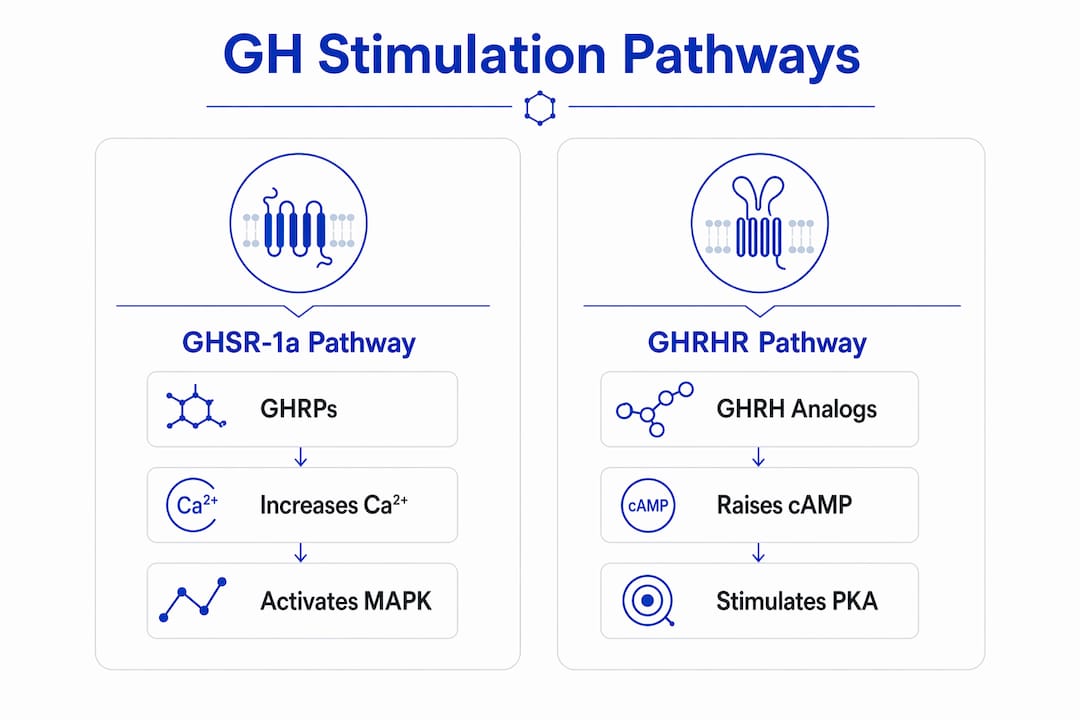
Two separate intracellular signaling cascades drive GH release when secretagogues are present. The first runs through GHSR-1a. When a growth hormone-releasing peptide (GHRP) or ghrelin itself binds this receptor on pituitary somatotrophs, it activates the Gq/11 protein, which triggers phospholipase C. That enzyme cleaves PIP2 into IP3 and DAG, raising intracellular calcium and activating protein kinase C (PKC). The calcium surge directly triggers GH granule exocytosis. GHRPs bind GHSR-1a, producing a signaling cascade entirely distinct from how GHRH works.
The second pathway runs through the GHRHR. GHRH binds its own receptor, activates Gs protein, raises cyclic AMP (cAMP), and activates protein kinase A (PKA). PKA then promotes GH gene transcription and stimulates vesicle release. These two pathways do not compete. They run in parallel, which is why combining GHRH analogs and GHRPs produces synergistic GH release several times greater than either compound alone.
| Feature |
GHSR-1a pathway (GHRPs) |
GHRHR pathway (GHRH analogs) |
Exogenous GH |
| Receptor target |
GHSR-1a on somatotrophs |
GHRHR on somatotrophs |
No pituitary receptor |
| Second messenger |
IP3, Ca2+, PKC |
cAMP, PKA |
N/A |
| Feedback preserved |
Yes |
Yes |
No |
| Pulsatile release |
Yes |
Yes |
No |
| Receptor desensitization risk |
Low with correct dosing |
Low with correct dosing |
High |
Exogenous GH bypasses the pituitary entirely and delivers a flat, continuous hormone load. That approach suppresses endogenous production and accelerates receptor downregulation. Secretagogues avoid both problems by working upstream.
Pro Tip: Stack a GHRH analog like CJC-1295 with a selective GHRP like Ipamorelin. The two pathways amplify each other, producing a GH pulse that neither compound generates alone. Synthrolab’s CJC-1295 + Ipamorelin combination is formulated specifically for this synergistic protocol.
How physiological feedback keeps GH stimulation self-limiting
Somatostatin is the pituitary’s brake pedal. The hypothalamus releases it to suppress GH secretion between natural pulses. Secretagogues partially overcome this inhibition during the pulse window, but they do not eliminate somatostatin signaling entirely. That partial override is intentional. It means GH levels rise sharply during a pulse and then fall back, exactly as they do naturally.

Secretagogues maintain somatostatin-mediated feedback, which creates a natural ceiling on GH levels. Recombinant human GH (rhGH) has no such ceiling. Administered exogenously, it bypasses the hypothalamic-pituitary axis, suppresses endogenous GH production, and can desensitize hepatic GH receptors over time. The physiological feedback loop that secretagogues preserve is not a limitation. It is a safety feature.
IGF-1 adds a second layer of regulation. As GH rises and stimulates IGF-1 production in the liver, IGF-1 feeds back to the hypothalamus and pituitary to reduce further GH output. Secretagogues preserve this hypothalamic-pituitary-IGF-1 axis, unlike rhGH, which can suppress endogenous production and cause receptor desensitization over time. That preserved axis is what keeps long-term secretagogue use safer than continuous exogenous GH.
Pulsatile GH secretion is critical because continuous GH exposure leads to receptor downregulation and reduced hepatic responsiveness. Secretagogues amplify pulse amplitude rather than altering pulse frequency, which is exactly the right lever to pull.
Benefits of preserving physiological feedback versus exogenous GH use:
- Somatostatin remains active, preventing runaway GH elevation
- IGF-1 negative feedback keeps the axis self-regulating
- Pituitary somatotrophs retain sensitivity to future stimulation
- Endogenous GH production continues rather than being suppressed
- Receptor downregulation risk stays low when dosing is pulsatile
Pro Tip: Researchers tracking IGF-1 levels in secretagogue protocols often find that IGF-1 rises modestly and plateaus rather than climbing indefinitely. That plateau is the feedback axis working correctly, not a sign of inadequate dosing.
What systemic effects do secretagogues produce beyond GH release?
GHSR-1a is not exclusive to the pituitary. The receptor is expressed broadly across the hypothalamus, hippocampus, vagus nerve, and peripheral tissues including the heart and gut. This distribution explains why secretagogues produce effects well beyond GH stimulation.
GHSR-1a on hypothalamic neurons regulates hunger through the agouti-related protein (AGRP) and neuropeptide Y (NPY) pathway. Activating these neurons increases appetite, which is why older GHRPs like GHRP-6 cause noticeable hunger. More selective compounds minimize this effect while retaining GH release efficacy. The discovery of GHSR-1a unified the understanding of how synthetic peptides stimulate GH, appetite, and other systemic effects, confirming multi-functional roles beyond GH release.
Systemic effects documented in research include:
- Appetite regulation. GHSR-1a activation in the hypothalamus increases AGRP/NPY signaling, driving caloric intake. Compound selection determines how pronounced this effect is.
- Cardiac function. Ghrelin receptors on cardiomyocytes mediate protective effects on cardiac output and vascular tone, independent of GH.
- Sleep architecture. GH secretion is tightly coupled to slow-wave sleep. Secretagogues that amplify the nocturnal GH pulse also deepen slow-wave sleep quality.
- Neuroprotection. GHSR-1a activation in the hippocampus supports neuronal survival pathways, suggesting roles in cognitive resilience.
- Metabolic homeostasis. Ghrelin receptor signaling in peripheral tissues influences glucose metabolism and fat oxidation, contributing to body composition changes that extend beyond GH-driven IGF-1 production.
These pleiotropic effects mean secretagogues function as multi-pathway compounds. Researchers studying metabolic modulation increasingly treat them as tools for systemic signaling research, not just GH axis work.
Timing, compound selectivity, and minimizing side effects
Timing is the variable most researchers underestimate. GH secretion follows a circadian pattern, with the largest pulse occurring shortly after sleep onset. Secretagogues work best when administered in alignment with this natural rhythm, because receptor responsiveness peaks during the endogenous pulse window. Dosing at random times across the day blunts efficacy and risks receptor desensitization.
Compound selectivity is equally consequential. Older GHRPs like GHRP-6 exhibit stronger off-target effects including elevated cortisol and prolactin, whereas selective compounds like Ipamorelin minimize these effects while maintaining GH release efficacy. The difference comes from biased agonism at GHSR-1a. Different peptides activate the receptor in subtly different conformations, engaging downstream pathways to varying degrees. Selecting the right peptide can minimize side effects such as cortisol elevation or appetite stimulation without sacrificing GH output.
Practical considerations for secretagogue protocols:
- Administer close to sleep onset to align with the natural nocturnal GH pulse
- Use pulsatile dosing rather than continuous infusion to prevent receptor downregulation
- Choose Ipamorelin over GHRP-6 when cortisol elevation or appetite stimulation is a concern
- Avoid back-to-back dosing within the same pulse window, as receptor saturation limits additional GH release
- Monitor IGF-1 as a proxy for cumulative GH exposure rather than relying on single-point GH measurements
Non-pulsatile or misaligned dosing risks receptor downregulation and reduced biological effectiveness. This is the most common protocol error in secretagogue research, and it is entirely avoidable with correct timing.
Pro Tip: Synthrolab’s Ipamorelin 10mg is a selective GHSR-1a agonist with a clean side-effect profile, making it the preferred starting compound for researchers who want GH stimulation without the cortisol and appetite noise of older GHRPs.
Key Takeaways
Secretagogues stimulate GH by activating GHSR-1a and GHRHR through parallel signaling cascades that preserve the body’s natural feedback axis, producing pulsatile GH release without suppressing endogenous production.
| Point |
Details |
| Dual receptor pathways |
GHSR-1a and GHRHR activate separate cascades that combine for synergistic GH pulses. |
| Feedback preservation |
Somatostatin and IGF-1 loops remain active, creating a natural ceiling on GH levels. |
| Pulsatile dosing matters |
Continuous or mistimed dosing causes receptor downregulation and reduces long-term efficacy. |
| Compound selectivity |
Ipamorelin produces fewer off-target hormonal effects than older GHRPs like GHRP-6. |
| Systemic effects |
GHSR-1a distribution across the brain and periphery drives appetite, cardiac, and metabolic outcomes beyond GH. |
The case for physiological fidelity in secretagogue research
The biggest mistake I see in secretagogue research is treating these compounds as simple GH boosters. Researchers dose continuously, ignore circadian timing, and then wonder why efficacy drops after a few weeks. The answer is always the same: they broke the feedback loop.
What I have come to appreciate is that the hypothalamic-pituitary axis is not an obstacle to work around. It is the mechanism. Secretagogues are effective precisely because they work within that system. The moment you dose in a way that flattens the pulse or saturates the receptor, you lose the physiological advantage that makes secretagogues worth studying in the first place.
The contrast with exogenous GH is instructive. Recombinant GH produces supraphysiological levels, suppresses endogenous production, and creates dependency on continued administration. Secretagogues, used correctly, do the opposite. They train the axis to produce more, not less.
Compound selection is where I see the most room for improvement. Researchers who move from GHRP-6 to Ipamorelin consistently report cleaner data because they eliminate cortisol and prolactin as confounding variables. That is not a minor detail. It is the difference between studying GH signaling and studying a hormonal cocktail.
Synthrolab’s approach to formulating research-grade secretagogues reflects this principle. Purity, selectivity, and physiological alignment are not marketing language. They are the conditions under which meaningful data gets produced.
— Mitch
Synthrolab’s research-grade secretagogue compounds
Researchers who understand the mechanisms covered here need compounds that match the science. Synthrolab provides research-grade peptides formulated for physiological fidelity, including selective GHSR-1a agonists, GHRH analogs, and combination compounds designed to replicate natural GH pulse dynamics.
Every compound in the Synthrolab catalog is backed by a certificate of analysis and produced to research-grade standards. The anabolic signaling and metabolic modulation ranges include the specific secretagogues discussed throughout this article. Researchers looking to build a protocol grounded in the dual-pathway synergy model can find the full product range at Synthrolab. Quality documentation, including COA verification, is available for every compound.
FAQ
What is a secretagogue and how does it differ from GH?
A secretagogue is a compound that stimulates the pituitary to release its own GH, whereas exogenous GH replaces the hormone directly. Secretagogues preserve natural feedback regulation; exogenous GH bypasses it.
Why do secretagogues produce pulsatile GH release?
Secretagogues activate GHSR-1a and GHRHR during the natural pulse window while somatostatin remains active between pulses. This on-off pattern mirrors endogenous GH secretion and prevents receptor downregulation.
What makes Ipamorelin preferable to GHRP-6?
Ipamorelin is a selective GHSR-1a agonist that produces minimal cortisol and prolactin elevation, whereas GHRP-6 activates off-target pathways that raise both hormones alongside GH.
Can secretagogues be stacked for greater GH release?
Combining a GHRH analog with a GHRP activates two non-competing pathways simultaneously, producing synergistic GH release several times greater than either compound administered alone.
When is the best time to administer secretagogues?
Administration aligned with the natural nocturnal GH pulse, shortly before sleep onset, produces the strongest response. Mistimed or continuous dosing reduces receptor responsiveness and long-term efficacy.
Recommended
 21+ verification