Human trials confirm urolithin A induces mitophagy markers and shifts mitochondrial biomarkers, most notably plasma acylcarnitines and muscle gene expression, within four weeks of dosing. Randomized data also show measurable gains in muscle strength and exercise performance in middle-aged and older adults. What remains unsettled: whether these biomarker shifts translate into long-term clinical outcomes, and how the compound performs in populations no trial has yet studied.
TL;DR:
- Most human studies dose 500 to 1000 mg of urolithin A daily for 28 days to four months, reliably shifting mitochondrial biomarkers like acylcarnitines.
- Functional benefits such as muscle strength improvements are supported by some trials, but effects vary depending on baseline fitness and duration.
- No long-term clinical outcome data, like effects on disability or mortality, has been collected, and trials are underpowered for subgroup analysis.
- Safety profiles are reassuring up to four months, but evidence is lacking for children, pregnant women, or those with liver or kidney impairments.
- Variability in gut microbiota affects individual UA production from diet; direct supplementation circumvents this issue for consistent dosing.
Table of Contents
What Human Trials Show About Urolithin A and Mitochondrial Health
The clinical record on urolithin A is still small by pharmaceutical standards, but it’s unusually consistent for a supplement compound. Roughly a handful of controlled human trials exist, spanning a first-in-human Phase 1 safety and pharmacokinetic study through randomized, placebo-controlled efficacy trials in middle-aged and older adults. That’s a modest evidence base, but the repeated signal across independent cohorts is what makes it worth taking seriously.
The foundational study, published in Nature Metabolism, established that UA is safe and bioavailable in humans and that it produces a specific molecular signature: modulation of mitochondrial and cellular health markers, including skeletal muscle mitochondrial gene expression and plasma acylcarnitines, after four weeks at 500 mg and 1000 mg daily. That single study anchors nearly everything that came after it, because it’s the first place researchers saw the biomarker shift that later trials would try to replicate and extend into functional outcomes.
The functional follow-through arrived with a randomized trial in middle-aged adults, which reported that UA supplementation improved muscle strength, exercise performance, and biomarkers of mitochondrial health relative to placebo. That’s the trial researchers cite most often, because it’s the first to connect a mitochondrial biomarker shift to something a participant could actually feel in a grip-strength test or a six-minute walk.
A 2024 systematic review pulled these threads together across a broader set of trials. It found that studies dosing UA anywhere from 10 mg/day up to 1000 mg/day, for periods running from 28 days to four months, consistently showed dose-dependent anti-inflammatory effects and upregulation of autophagy and fatty-acid-oxidation markers in healthy adults. The review covered roughly 250 healthy individuals pooled across the included trials, which is still a small population by clinical-trial standards but large enough to establish a reproducible dose-response pattern rather than a one-off finding.
A separate 2023 review focused specifically on muscle outcomes, synthesizing both the preclinical and early human evidence on UA’s role in muscle health and performance. Its conclusion is measured: the mechanistic case is strong, the early human signal is real, but the trials run so far are too short and too small to call this settled science.
What hasn’t moved consistently across trials is worth naming as clearly as what has:
- Body composition changes (fat mass, lean mass) show weaker, less consistent effects than mitochondrial biomarkers.
- Not every trial reports the same magnitude of strength improvement, and effect sizes vary by baseline fitness and age of the cohort.
- Longer-duration outcomes, beyond four months, simply don’t exist yet in the published record.
- Clinically hard endpoints, hospitalization, mortality, disability onset, have not been studied.
The pattern that emerges is a compound with a highly reproducible biological fingerprint and a still-developing functional story. Researchers evaluating this literature should treat the biomarker data as solid ground and the functional data as promising but early.
Inside the Key Trials: Design, Endpoints, and What to Watch For
Trial quality matters more than trial existence, and UA’s evidence base rewards a close read of methodology rather than a glance at headline conclusions.
-
The 2019 Phase 1 study (Nature Metabolism) used a randomized, dose-escalation design in humans, testing single and multiple doses up to 1000 mg daily. Its primary aim was safety and pharmacokinetics, not efficacy, but it also captured skeletal muscle biopsies showing shifts in mitochondrial gene expression and plasma acylcarnitine profiles after four weeks. Because this was a safety-first design, sample sizes were small, and efficacy conclusions should be read as hypothesis-generating rather than confirmatory.
-
The Singh et al. randomized trial enrolled middle-aged and older adults and used muscle strength and exercise performance as primary functional endpoints, with mitochondrial biomarkers as secondary measures. The reported improvements held across both the functional and biomarker arms, which is the strongest piece of triangulating evidence in the current literature: two different endpoint types moving in the same direction in the same cohort.
-
Registered trials on ClinicalTrials.gov, including NCT03464500, document additional study arms and outcome measures that extend beyond what’s yet been published in full. Checking the registry entry against the eventual publication is standard due diligence, since registered primary outcomes sometimes differ from what gets emphasized in the final paper.
-
A 2019 bioavailability and gene-modulation study replicated the core finding that 500 mg and 1000 mg daily doses alter muscle mitochondrial gene expression within four weeks, reinforcing that this isn’t a single-lab artifact.
Trial snapshot: Across the published human studies, dose ranges cluster around mid to high daily doses, intervention windows run 28 days to 4 months, and the systematic review pooling this data covers roughly 250 healthy adults total, a small but reproducible dataset.
The methodological caveats matter as much as the results. Most trials to date use surrogate endpoints, gene expression, circulating metabolites, grip strength, rather than hard clinical outcomes like disability-free survival or fracture risk. Statistical power in several trials is adequate for detecting biomarker shifts but underpowered for subgroup analysis by age, sex, or baseline metabolic status. Sponsor involvement in trial design and funding is worth checking on a study-by-study basis, since industry-sponsored dose-selection can bias which arms get emphasized in publication. None of this invalidates the findings, but it does mean researchers should treat effect sizes as provisional until replicated in independently funded, larger cohorts.
How Urolithin A Triggers Mitophagy: The Mechanistic Case
Urolithin A’s headline mechanism is mitophagy activation, the selective clearance of damaged mitochondria so cells can replace them with functional ones. This isn’t a UA-specific invention; it’s a conserved cellular quality-control process. What UA appears to do is nudge that process into higher gear, particularly in tissues like skeletal muscle where mitochondrial turnover slows with age.
The preclinical case behind this mechanism is broad and multi-species. A comprehensive review of urolithin metabolism and bioactivity documents mitophagy induction and improved mitochondrial function across C. elegans, rodent models, and cultured cells, with lifespan extension observed in invertebrate models and improved muscle function in aged mice. A separate systematic review of in vivo studies catalogs a wider range of protective effects tied to the same pathway, including neuroprotective and cardioprotective signals in animal models, alongside reduced markers of inflammation.
The biomarkers used in human trials aren’t arbitrary; they’re chosen because they track the mechanism. Key connections worth understanding:
- Mitochondrial gene expression panels in muscle biopsies capture upregulation of genes tied to mitochondrial biogenesis and quality control, the downstream signature of mitophagy activation.
- Plasma acylcarnitines reflect how efficiently mitochondria are processing fatty acids for energy; shifts here suggest improved oxidative capacity.
- Preclinical lifespan and muscle-function endpoints in animal models map conceptually, though not directly, onto the human strength and endurance endpoints used in trials like Singh et al.
Reproducibility is the sticking point that deserves more attention than it usually gets. A meaningful share of the foundational in vitro mitophagy work used UA concentrations and chemical forms that don’t reflect what actually circulates in human plasma after oral dosing, mostly glucuronide and sulfate conjugates rather than free UA. That mismatch doesn’t invalidate the mechanism, but it does mean some cell-culture findings may overstate potency relative to physiological exposure.
Pro Tip: If you’re designing a mechanistic substudy, use conjugated UA metabolites at concentrations matched to observed human plasma levels, not free-form UA at arbitrary micromolar doses. It’s the single most common source of preclinical-to-clinical disconnect in this literature.
Dosing Ranges, Bioavailability, and What to Sample For
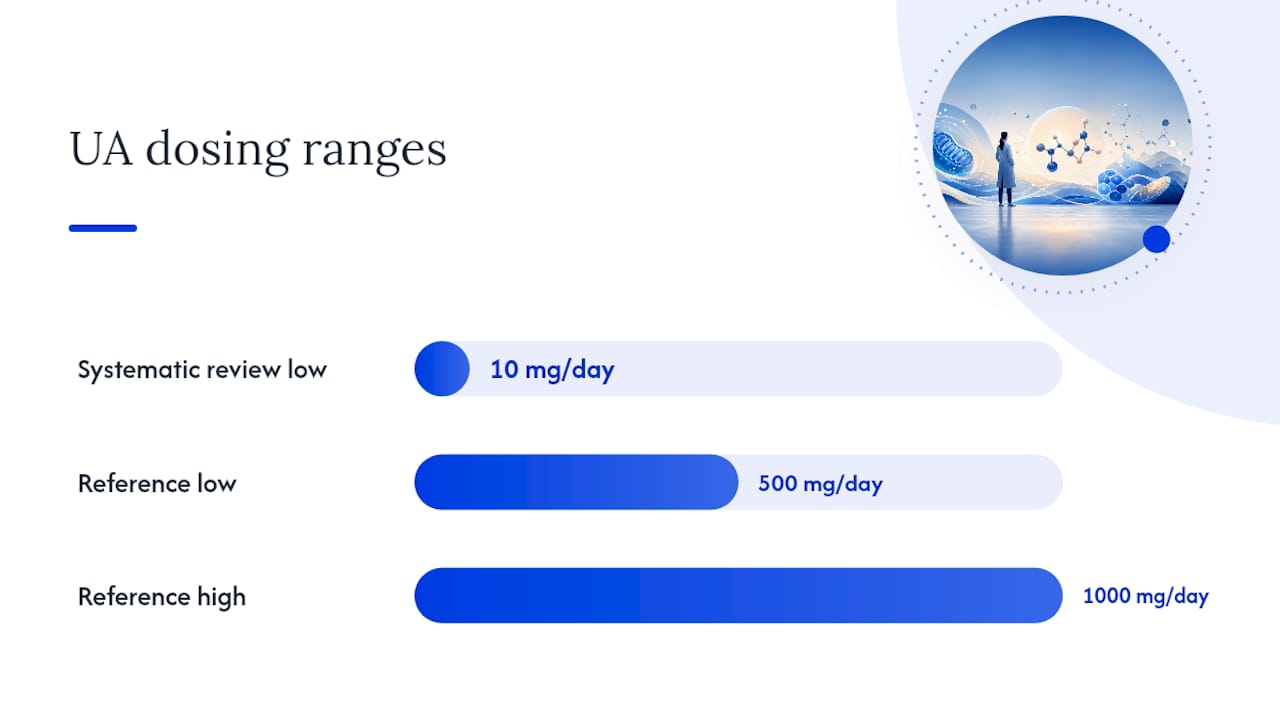
Published human trials span an unusually wide dose range, from 10 mg/day at the low end of the systematic review’s pooled data up to 1000 mg/day in the Phase 1 and Singh et al. studies. Most of the biomarker and functional signal comes from the 500 to 1000 mg/day range over 28 days to 4 months, which is the regimen researchers should treat as the current reference standard when designing new dose arms.
Bioavailability is the first thing to plan around. Orally administered UA undergoes extensive first-pass metabolism, meaning the free compound barely appears in circulation. What you actually measure in plasma is dominated by glucuronide and sulfate conjugates, not parent UA. That has direct implications for sampling design:
- Plasma timing matters more than plasma volume; conjugate levels peak and decline faster than a single trough draw will capture.
- Twenty-four-hour urine collection can complement plasma sampling by capturing total conjugate excretion, useful when plasma kinetics are noisy.
- Enterohepatic recirculation appears to extend UA’s effective exposure window beyond what a simple half-life estimate would suggest, so single-timepoint PK sampling risks underestimating total exposure.
Key figure: The Phase 1 trial established that 500 mg and 1000 mg daily doses over four weeks reliably produced detectable shifts in muscle gene expression and plasma acylcarnitines, the two most replicated biomarkers in the literature to date.
For investigators formulating new dose arms, the practical recommendation is to bracket the established 500 to 1000 mg/day range rather than exploring far outside it without strong preclinical justification, and to build in multiple PK sampling points across the dosing interval rather than a single trough draw. Researchers sourcing compound for these protocols should confirm purity and identity through a certificate of analysis, since conjugate ratios in circulation can shift depending on formulation and excipients.
What the Safety Data Show, and Who’s Still Missing From It
The safety picture from published human trials is reassuring within the populations studied. The Phase 1 dose-escalation trial and the subsequent randomized efficacy trials both report good tolerability with no serious adverse events attributed to UA at doses up to a high daily amount over periods up to several months. The 2024 systematic review’s pooled safety data across roughly 250 participants reinforces that picture: mild, non-specific adverse events at rates comparable to placebo, no consistent dose-related toxicity signal.
That said, “safe in the populations studied” is a narrower claim than it sounds:
- No published trial has enrolled pregnant or lactating participants, children, or adolescents.
- Individuals with significant hepatic or renal impairment have not been studied, which matters given UA’s conjugation and excretion pathways run through the liver and kidneys.
- Reproductive safety data simply doesn’t exist yet in humans.
- Long-term exposure beyond four months hasn’t been evaluated in any published trial.
Investigators designing new protocols should build in explicit monitoring for hepatic and renal markers even in healthy cohorts, and consent language should state plainly that safety data outside the studied age range and health status is not established. That’s not a regulatory formality; it’s an accurate representation of where the evidence actually stands.
Why Gut Bacteria Change How Much Urolithin A You Actually Absorb
Not everyone produces the same amount of UA from the same diet, and that variability is a real confound in any study relying on dietary ellagitannins rather than direct UA dosing. Researchers classify people into three urolithin metabotypes based on gut microbial composition: UM-A, UM-B, and UM-0.
UM-A individuals convert dietary ellagitannins efficiently into urolithin A itself. UM-B individuals produce urolithin A along with isourolithin A and other related metabolites, a mixed profile. UM-0 individuals produce essentially no measurable urolithins from dietary precursors, regardless of intake. A comprehensive review of urolithin metabolism documents this heterogeneity in detail and notes it as a major source of variability in studies that feed pomegranate extract or walnuts rather than administering UA directly.
This has a direct design consequence. Feeding ellagitannin-rich foods to an unclassified cohort will produce wildly inconsistent plasma UA exposure, some participants convert well, some barely at all, which muddies any dose-response analysis. Direct UA supplementation sidesteps this problem entirely, which is why most of the recent clinical trials dose UA itself rather than its dietary precursors.
Practical recommendations for investigators:
- Classify baseline metabotype using a standardized ellagitannin challenge or validated urinary/plasma metabolite panel before enrollment when precursor feeding is part of the design.
- Prefer direct UA administration over precursor feeding whenever consistent, predictable exposure is the study priority.
- Run responder-analysis separately by metabotype when precursor-based designs are unavoidable, since pooling UM-A and UM-0 participants together will dilute any real effect.
Where the Evidence Gaps Are and What Should Get Funded Next
The current literature is strong on mechanism and biomarkers, thin on long-duration clinical outcomes. Closing that gap should be the field’s priority, and a few specific moves would accelerate it.
- Fund longer trials with clinically meaningful endpoints. Trials currently last several months; longer trials with clinically meaningful outcomes would answer questions biomarkers alone can’t.
- Standardize the biomarker panel. Acylcarnitines and mitochondrial gene expression are the most replicated markers; adopting them as a minimum reporting standard across trials would make cross-study comparison far easier than it currently is.
- Enroll populations the field has skipped. No trial has included pregnant participants, individuals with hepatic or renal impairment, or adolescents; even small, carefully monitored pilot cohorts would close a real evidence gap.
- Preregister analysis plans on ClinicalTrials.gov before enrollment, including primary and secondary endpoints, to prevent outcome-switching in publication.
- Explore combination substudies. Pairing UA with other autophagy-relevant interventions, spermidine being the most discussed candidate, could reveal whether mitophagy and broader autophagy induction produce additive functional benefits.
Pro Tip: When designing a nested translational substudy, budget for muscle biopsy collection at baseline and endpoint even if it’s not your primary outcome. Gene expression data from biopsies has been the single most consistent signal in this literature, and skipping it to save cost is the most common regret investigators report after the fact.
Researchers building these protocols can use a study design tool to map dose arms, sampling windows, and biomarker panels before finalizing a submission.
Where the Real Uncertainty Lies in Urolithin A Research
The mechanistic case for UA as a mitophagy inducer is about as solid as compound science gets outside of approved pharmaceuticals. Multiple independent human trials replicate the same biomarker shifts using the same methods, which is rarer in supplement research than most people realize. Where I think the field gets ahead of itself is in treating biomarker consistency as equivalent to proven clinical benefit. It isn’t, yet.
The honest position is that UA has earned its place as one of the more rigorously studied mitophagy-related compounds available for research, not that it’s a settled aging intervention. Preclinical work on related metabolic and longevity pathways suggests real translational promise, but promise isn’t proof, and the trials needed to close that gap, longer duration, harder endpoints, broader populations, simply haven’t been run yet.
What would change my mind fastest is a well-powered twelve-month trial with a hard functional endpoint, not another four-week biomarker study. Synthrolab’s role here is supplying investigators with purity-verified, batch-tested compound and the documentation to make that next generation of trials reproducible from the start. If you’re planning that kind of study, preregistration and transparent reporting aren’t optional extras. They’re what separates the next good UA trial from another biomarker paper that confirms what we already know.
— Mitch
Designing a UA study means sourcing compound whose purity and identity you can actually verify, not taking a label’s word for it. Synthrolab supplies research-grade peptides and laboratory compounds with batch-specific certificates of analysis, so investigators can document exactly what went into every dose arm.
For protocol development, the Test Builder tool helps map dose arms, sampling schedules, and biomarker panels before you finalize a submission, useful whether you’re planning a mitophagy-focused trial or a broader metabolic health study. Every compound ships with a certificate of analysis confirming purity and identity, and all products are sold strictly for laboratory research use, not for human consumption or clinical application. If your work extends into related mitochondrial and metabolic pathways, Synthrolab’s metabolic health compound guide is the place to start sourcing materials for your next protocol.
This article is general information, not a substitute for advice from a qualified doctor. Consult a qualified healthcare professional about your own circumstances before acting on anything here.
Sources
Recommended
 21+ verification