CJC-1295 DAC is a modified growth hormone releasing hormone (GHRH) analog engineered to bind serum albumin, extending its active window to roughly six to eight days instead of minutes. Human trial data from Teichman et al. shows dose-dependent GH and IGF-1 elevation sustained across multiple days per injection. It carries Research Use Only (RUO) status in the United States, is not FDA-approved for any clinical indication, and any laboratory acquiring it should confirm identity through a certificate of analysis with mass spectrometry data before use.
TL;DR:
- CJC-1295 DAC extends its active window to six or more days by binding serum albumin, resulting in prolonged GH and IGF-1 increases observed in human trials.
- Its half-life of roughly 6 to 8 days allows infrequent dosing, supporting long-acting protocols, but requires careful identification verification via mass spectrometry.
- DAC supports sustained IGF-1 elevation, contrasting with no-DAC versions that mimic natural GH pulsatility but require multiple daily injections.
- The research is limited to hormone kinetics with no long-term safety data, and it is not FDA-approved, only sold as a Research Use Only compound.
- Proper handling demands batch-specific analysis, especially mass spectrometry, to confirm the presence of DAC linkage and avoid mislabeling.
Synthrolab
Support Rigorous Peptide Research
Synthro Lab provides research-grade peptides and laboratory compounds for investigating cellular signalling, metabolism, recovery, and longevity mechanisms.
Explore Synthro Lab
Table of Contents
What Is CJC-1295 DAC and How Does the Albumin Conjugation Work?
CJC-1295 DAC starts as a 29-amino acid GHRH fragment, engineered with substitutions that resist DPP-IV enzymatic breakdown, the same enzyme system that degrades native GHRH within minutes of release. On its own, that modified backbone, often sold as CJC-1295 no-DAC or MOD GRF 1-29, still clears the body fast.
The DAC part changes everything. DAC stands for Drug Affinity Complex, a maleimido lysine group attached to the peptide’s C-terminus that forms a covalent bond with cysteine-34 on circulating serum albumin. Once bound, the peptide rides along with one of the most abundant, slow-turnover proteins in blood plasma. That binding does two things: it shields the peptide from proteolytic enzymes and reduces renal filtration, since albumin-bound molecules aren’t small enough to pass through the kidney’s filtration barrier efficiently.
What DAC does not do is change how the peptide interacts with its target. Once released from albumin, CJC-1295 DAC binds the same GHRH receptor (GHRHR) on pituitary somatotrophs and triggers the same downstream signaling cascade as unmodified GHRH.
- The base peptide provides receptor specificity and DPP-IV resistance.
- The DAC modification provides duration through albumin binding.
- Receptor pharmacology stays identical between DAC and no-DAC versions; only exposure time changes.
What Does Human Trial Data Show About CJC-1295 DAC’s Half-Life and Effects?
The single most cited human dataset on this compound comes from a randomized, placebo-controlled trial published in the Journal of Clinical Endocrinology & Metabolism, which tested ascending single and multiple doses in healthy adults. The findings give researchers actual numbers instead of extrapolated theory.
By the numbers: Single doses of CJC-1295 DAC produced GH increases of 2 to 10 times baseline, sustained for six or more days per injection. IGF-1 rose 1.5 to 3 times baseline and stayed elevated for 9 to 11 days. Estimated half-life ranged from 5.8 to 8.1 days.
That’s an unusually long pharmacokinetic tail for a peptide. Most GHRH-family compounds without an albumin-binding modification clear in well under an hour.
A separate report from Ionescu and Frohman adds a nuance worth sitting with: despite the elevated baseline GH from DAC, pulsatile secretion patterns were preserved. The pituitary still released GH in discrete bursts layered on top of the raised floor, rather than collapsing into a flat, tonic output. That distinction matters for anyone modeling whether sustained GHRH stimulation mimics natural secretory rhythm or overrides it.
A few caveats temper how far this evidence should be extrapolated:
- Trial cohorts were small, typical of early-phase pharmacokinetic studies, not large outcome trials.
- Endpoints were pharmacokinetic and pharmacodynamic (hormone levels), not long-term clinical outcomes like body composition or performance.
- No published long-term safety data exists beyond the trial window described above.
Researchers designing protocols around this compound are working from strong signal on hormone kinetics and comparatively little on downstream physiological consequences over months or years.
How Is CJC-1295 DAC Different From No-DAC or MOD GRF 1-29?
The defining difference is duration, and it cascades into how each version gets used in research design.
- Half-life gap. DAC’s albumin binding extends half-life to roughly 6 to 8 days. No-DAC (MOD GRF 1-29) clears in about 30 minutes, requiring multiple daily injections to maintain any GH pulse stimulation.
- Dosing frequency. DAC’s long tail supports infrequent dosing, sometimes once or twice weekly. No-DAC demands a much tighter schedule tied to sleep and exercise-linked GH pulses.
- Research objective fit. DAC suits protocols aimed at sustained, elevated IGF-1 baselines. No-DAC fits designs that want to preserve natural pulsatile GH architecture, often stacked with a growth hormone releasing peptide (GHRP) like ipamorelin timed around known pulse windows.
- Trade-off. DAC trades physiological pulse fidelity for convenience and steadier exposure; no-DAC trades convenience for a pattern closer to how the body naturally secretes GH, but at the cost of far more frequent handling and injection burden.
Neither is a universally better model. The right choice depends entirely on what the research question is actually measuring.
What Are Typical Research Dosing Patterns and Monitoring Approaches?
Community and supplier guidance converge on dosing conventions in the range of 1 to 2 milligrams per week for DAC formulations, typically split across one or two weekly injections given the extended half-life. That’s a rough translation from the microgram-per-kilogram dosing used in controlled trials into the milligram-per-week language common in lab research settings, and it should be treated as a starting framework rather than a validated clinical protocol.
Stacking rationale usually follows one of two logics. Pairing DAC with a GHRP creates a sustained GHRH floor with intermittent GH pulses layered on top. Pairing no-DAC with a GHRP instead aims for synergistic, sharper pulses timed to specific windows, often fasting-state or pre-sleep, when endogenous GH secretion is already primed.
- Baseline IGF-1 measurement before starting any protocol.
- Follow-up IGF-1 at intervals matched to the compound’s half-life, not arbitrary calendar weeks.
- Fasting glucose and insulin tracking, since GH signaling intersects with insulin sensitivity.
- Standard safety labs (liver, kidney panels) given the metabolic load of sustained GH elevation.
Pro Tip: Draw IGF-1 samples at a consistent time of day and consistent fasting state across the entire study. IGF-1 has enough day-to-day variance that inconsistent draw conditions can mask or exaggerate a real treatment effect.
What Safety Risks and Regulatory Status Should Researchers Know?
The Teichman trial reported adverse events including flushing, nausea, and injection-site reactions. With DAC specifically, these effects can persist longer than with short-acting analogs, simply because the albumin-bound peptide keeps circulating and signaling for days rather than clearing within the hour.
There’s a structural wrinkle here worth naming directly: because the DAC bond is covalent, you cannot rapidly reverse exposure by stopping dosing. Once bound to albumin, the peptide keeps working through its full half-life. That raises the bar for monitoring compared to short-acting compounds where an adverse reaction can be managed by simply halting the next dose.
Theoretical risks that remain under-studied include:
- Insulin resistance from sustained GH/IGF-1 elevation, since GH physiologically antagonizes insulin signaling.
- Pituitary receptor desensitization from continuous rather than pulsatile GHRHR stimulation.
- Unknown effects in populations with active malignancy, given IGF-1’s role in cell proliferation, or in pregnancy, where GH-axis compounds have not been studied.
On regulatory status, the picture is unambiguous. CJC-1295 DAC is not FDA-approved for any therapeutic use and is sold strictly as a Research Use Only compound. It also appears on the World Anti-Doping Agency’s list of prohibited substances for competitive athletics, a relevant fact for any research context that intersects with sport science.
How Do You Verify CJC-1295 DAC Identity and Handle It Safely in the Lab?
Naming confusion between DAC and no-DAC versions is common in this space, and the two have a measurable difference: PubChem lists a molecular weight around 3,647 Da for the DAC-modified compound, distinct from the shorter no-DAC fragment. A label alone cannot confirm which one is in the vial.
- Demand mass spectrometry, not just HPLC. HPLC confirms purity but can’t reliably distinguish DAC from no-DAC; intact-mass MS showing the maleimide mass shift is what actually confirms the DAC linkage is present.
- Check that the COA ties to a specific lot number. A generic certificate not linked to the batch in hand tells you nothing about what’s actually in your vial.
- Store lyophilized peptide frozen, and reconstituted solution refrigerated, using it within the supplier’s stated timeline. Avoid reducing agents during reconstitution, which can damage the peptide’s structure.
- Ask suppliers for lot-specific spectra, not a generic template document reused across batches.
How Synthrolab Supports Reproducible Peptide Research
Reproducibility starts with knowing exactly what’s in the vial, batch after batch. Research-grade peptides and laboratory compounds are designed for investigation into cellular signaling, metabolism, and longevity-related mechanisms, with identity verification standards as described above incorporated into sourcing.
- CJC-1295 no-DAC paired with ipamorelin supports anabolic signaling research designs that favor pulsatile GH stimulation over sustained elevation.
- NAD+ at 100mg supports mitochondrial and metabolic research often run alongside GH-axis studies.
- Batch-level certificates of analysis map directly to the verification checklist above: HPLC purity data and identity confirmation tied to lot numbers, not generic templates.
For labs building multi-peptide protocols, that combination of no-DAC GHRH stimulation and metabolic-pathway compounds covers two of the most common experimental angles in this research category at once.
What Should Researchers Weigh Before Choosing DAC Over No-DAC?
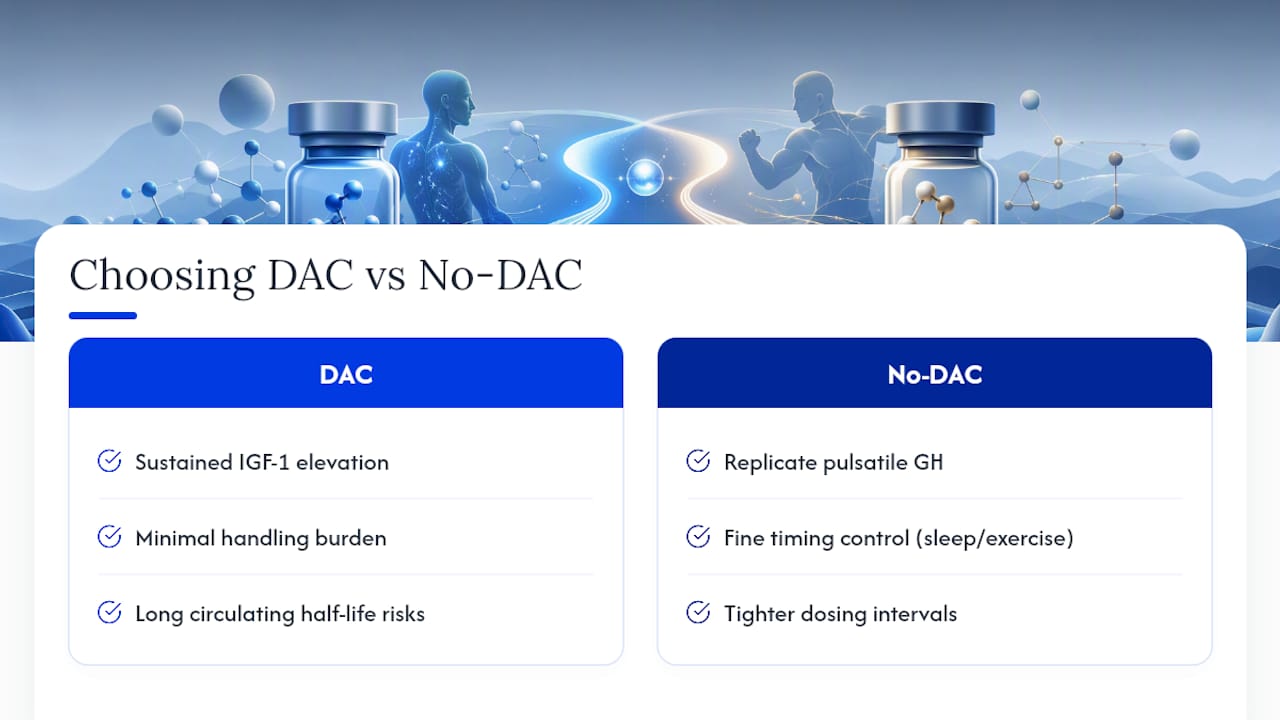
Choosing DAC over no-DAC comes down to what your endpoint actually needs. If the research question is sustained IGF-1 elevation over days or weeks with minimal handling burden on subjects, DAC’s pharmacokinetic profile fits. If the question depends on replicating natural pulsatile GH architecture, or on fine control over timing relative to sleep or exercise, no-DAC paired with tight dosing intervals is the more defensible design choice.
Any protocol involving human or animal subjects needs institutional review board oversight, and informed consent language should explicitly state that this is an investigational research compound, not an approved therapeutic, with adverse events that may persist for the compound’s full circulating half-life rather than resolving on discontinuation.
— Mitch
Get Research-Grade CJC-1295 and Support Compounds From Synthrolab
Running a protocol around GHRH analogs means your data is only as good as your source material. Synthrolab supplies research-grade peptides with batch-specific certificates of analysis, so what’s on the label matches what mass spectrometry confirms is actually in the vial.
Beyond the no-DAC and ipamorelin combination referenced above, The catalog includes bundled recovery-pathway peptides and metabolic compounds for labs running multi-arm studies. If you’re new to sourcing and want the fundamentals on peptide categories, purity standards, and what a proper COA should include, the peptide quality and sourcing guide is a solid starting point before placing an order.
Sources
This article is general information, not a substitute for advice from a qualified doctor. Consult a qualified healthcare professional about your own circumstances before acting on anything here.
Recommended
 21+ verification