Simple peptides are short chains of amino acids that act as biological regulators, influencing everything from immune function to cellular repair. Unlike proteins, which can contain hundreds of amino acids, simple peptides typically consist of just two to a few dozen linked amino acids. That structural simplicity is exactly what makes them so biologically potent. Synthrolab researches these compounds precisely because their small size allows them to cross cell membranes and interact directly with gene expression pathways. For health enthusiasts exploring longevity and wellness, understanding what these molecules do and where to source them responsibly is the starting point for informed decisions.
What are simple peptides and how do they work in the body?
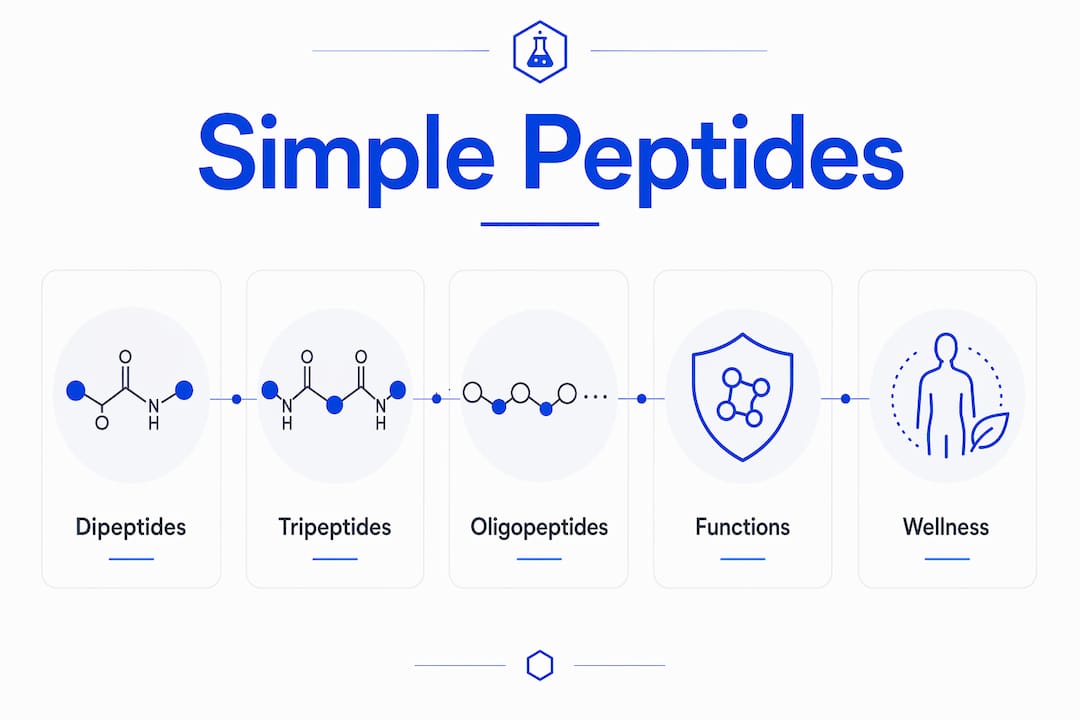
Simple peptides are short chains of amino acids that serve as both structural building blocks and signaling molecules within living tissue. The shortest form, a dipeptide, contains just two amino acids. Tripeptides contain three. Each additional amino acid expands the molecule’s potential to interact with receptors, enzymes, and gene regulatory systems.
The biological roles of these short chains go well beyond simple structure. Peptides regulate immune responses, coordinate metabolic activity, and trigger tissue repair signals. A dipeptide can bind to a cell surface receptor and set off a cascade of downstream effects, all from a molecule smaller than most drugs. That signaling efficiency is what drives scientific interest in peptide research.
Chain length directly determines function. Short peptides tend to act as precise messengers, while longer polypeptides often serve structural roles, like collagen fibers in connective tissue. The distinction matters for health enthusiasts because the benefits you read about, whether immune modulation or recovery support, are almost always tied to specific short chains rather than peptides in general.
- Dipeptides (2 amino acids): The smallest functional peptides; examples include carnosine (beta-alanyl-L-histidine), which acts as an antioxidant in muscle tissue.
- Tripeptides (3 amino acids): Slightly longer chains with expanded receptor interactions; glutathione (Gly-Cys-Glu) is the most studied example in cellular defense.
- Oligopeptides (4–20 amino acids): The range where most bioregulator research sits, including the Khavinson peptides studied for longevity effects.
- Polypeptides (20+ amino acids): Larger chains that begin to resemble proteins in complexity and structural function.
Pro Tip: When reading peptide research, always check which specific chain length was tested. A study on a tripeptide tells you nothing reliable about a polypeptide with the same amino acids in a different order.
What categories and examples of simple peptides matter for wellness?
The most studied category in longevity research is the bioregulator peptides, a class of short peptides originally developed in Russia during the 1980s and 1990s. Vilon is a synthetic dipeptide composed of lysine and glutamic acid (Lys-Glu). Researchers developed it to study immune modulation, and its two-amino-acid structure makes it one of the simplest examples of a functional bioregulator.

The “short-peptide thesis” behind Vilon and similar compounds proposes that even very short peptide chains carry enough biological information to influence tissue function and gene expression. The hypothesis is scientifically credible, but large-scale human randomized controlled trials are still absent. That gap between promising early data and confirmed clinical outcomes is the defining challenge of this entire research category.
Short peptides and polypeptides serve different purposes, and conflating them leads to poor sourcing decisions.
| Category |
Chain length |
Primary research focus |
Human trial status |
| Dipeptides |
2 amino acids |
Immune modulation, antioxidant activity |
Limited; mostly animal and cell studies |
| Tripeptides |
3 amino acids |
Cellular defense, skin repair |
Some human data, mostly topical |
| Oligopeptides |
4–20 amino acids |
Bioregulation, longevity signaling |
Early-phase human studies ongoing |
| Polypeptides |
20+ amino acids |
Structural support, hormone mimicry |
Varies widely by compound |
Pro Tip: If a vendor markets a “peptide blend” without specifying chain length and amino acid sequence, treat it with skepticism. Exact sequence determines function. Vague labeling is a red flag, not a feature.
What should you know about peptide supplier quality and transparency?
Sourcing quality is the most underappreciated factor in peptide research. A peptide that passes a purity test can still deliver wildly inconsistent doses between batches. Passing purity tests does not guarantee dose accuracy, and discrepancies between batches can significantly undermine experimental reliability. For anyone running a structured wellness protocol, that variability is not a minor inconvenience. It means your results cannot be replicated or trusted.
Independent testing aggregators have documented dose accuracy variation of nearly 95% between batches from the same vendor. That figure is not an outlier. It reflects a systemic problem in the peptide supply market, where purity testing is common but quantity verification is rare.
Vendor transparency goes beyond a clean website. The factors that actually predict accountability include:
- Named founders and physical addresses: Company ownership transparency strongly correlates with vendor legitimacy. Anonymous vendors have no accountability when problems arise.
- Batch-specific Certificates of Analysis (COAs): A COA should reference a specific batch number, not just a compound name. Generic COAs are nearly worthless for verification.
- Named testing laboratories: A COA from an unnamed lab cannot be independently verified. Knowing which third-party lab ran the test lets you cross-check the lab’s accreditation.
- Purity vs. quantity testing: Purity confirms the compound is what it claims to be. Quantity testing confirms the amount matches the label. Both are required for research-grade confidence.
Vendor trust scores calculated on 295 Certificates of Analysis provide a more objective quality metric than customer reviews alone. Reviews reflect satisfaction. COA data reflects chemistry. Those are very different things.
Researchers emphasize that health enthusiasts should assess infrastructure transparency rather than rely on marketing claims. A vendor with a compelling brand story but no named testing lab is a liability, not a resource.
What are the practical applications and benefits of simple peptides?
The practical applications of short peptides in wellness fall into three broad areas: immune support, tissue repair, and longevity modulation. Each area has a different evidence base, and treating them as equally proven would be inaccurate.
-
Immune support: Dipeptides like Vilon have been studied for their ability to modulate gene expression in immune cells. The mechanism is plausible and the early data is promising, but the absence of large-scale human trials means these effects remain investigational rather than confirmed.
-
Tissue repair: Tripeptides and oligopeptides appear in wound healing and skin regeneration research. Collagen-derived peptides, for example, have more human clinical data behind them than most other peptide categories. The gut health peptide examples from current research illustrate how specific short chains target distinct tissue repair pathways.
-
Longevity modulation: Protocols combining Vilon with Epithalon represent the most cited example of peptide combinations aimed at longevity effects. Studies in elderly cohorts have associated cyclic use with reduced mortality markers. The data is intriguing, but these are not peer-reviewed randomized controlled trials by Western standards.
-
Metabolic regulation: Short peptides interact with receptors involved in glucose metabolism, appetite signaling, and mitochondrial function. This is an active area of research with growing preclinical evidence.
-
Safety considerations: Short peptides generally show favorable safety profiles in research settings, largely because the body already produces and degrades amino acid chains continuously. That said, purity and dose accuracy matter enormously. An impure compound or a misdosed protocol introduces variables that make outcomes unpredictable.
The most responsible approach for health enthusiasts is to treat peptide use as research participation, not supplementation. That means sourcing from vendors with verified COAs, starting with well-documented compounds, and tracking outcomes systematically. Synthrolab’s peptide research protocol builder is one resource designed to support that kind of structured approach.
Key Takeaways
Simple peptides are short amino acid chains whose biological function depends entirely on sequence and length, making sourcing quality and dose accuracy as important as the compound itself.
| Point |
Details |
| Chain length determines function |
Dipeptides, tripeptides, and oligopeptides each interact with different biological targets and cannot be used interchangeably. |
| Purity does not equal dose accuracy |
Batch-to-batch dosage variation can reach nearly 95%, undermining research reproducibility even when purity tests pass. |
| Transparency signals accountability |
Named founders, physical addresses, and named testing labs are the minimum standard for a trustworthy peptide vendor. |
| Bioregulators show promise but need more trials |
Compounds like Vilon have credible mechanisms but lack large-scale human RCTs, making them investigational rather than confirmed. |
| Structured protocols improve outcomes |
Tracking dosage, batch numbers, and physiological responses turns personal peptide use into reproducible data. |
The part of the peptide conversation most people skip
What strikes me most about the peptide space is how much energy goes into debating which compound to use and how little goes into verifying what you actually received. I’ve watched health enthusiasts spend hours researching Vilon or Epithalon protocols, then order from a vendor with no named testing lab and no batch-specific COA. The compound in the vial might be exactly right. Or it might be 40% off in quantity. You genuinely cannot know without the data.
The “short-peptide thesis” is scientifically interesting. The longevity research coming out of Russian clinical programs deserves serious attention, not dismissal. But interesting science and reliable sourcing are two separate problems, and conflating them is where most people go wrong. You can believe in the mechanism and still demand verification of what you’re actually using.
My honest forecast: the next five years will produce better human trial data on bioregulator peptides, particularly for immune modulation and longevity markers. The compounds that survive that scrutiny will be the ones worth building protocols around. Until then, the most valuable thing a health enthusiast can do is learn to read a COA, understand what batch traceability actually means, and source from vendors who treat transparency as a baseline rather than a selling point. That discipline separates serious researchers from people who are just hoping for the best.
— Mitch
Synthrolab’s approach to research-grade peptide sourcing
Research-grade peptides require more than a clean label. Synthrolab provides compounds with batch-specific Certificates of Analysis and full traceability, so every research protocol starts from a verified baseline.
For health enthusiasts new to this space, the peptides for beginners guide covers safety fundamentals, how to read COA data, and which compounds have the strongest evidence base. For those ready to go deeper, Synthrolab’s cellular regeneration catalog includes compounds studied for tissue repair and longevity pathways, each supported by documented quality controls. Sourcing from a vendor that publishes its COA verification process is not optional for serious research. It is the starting point.
FAQ
What are simple peptides?
Simple peptides are short chains of two or more amino acids linked by peptide bonds. They function as biological signaling molecules, influencing immune activity, tissue repair, and metabolic regulation.
How are simple peptides different from proteins?
Proteins are long, folded polypeptide chains typically containing hundreds of amino acids. Simple peptides are much shorter, which allows them to act as precise cellular messengers rather than structural components.
What is Vilon and why is it studied for longevity?
Vilon is a synthetic dipeptide (Lys-Glu) developed to study immune modulation and gene expression in aging tissue. It is one of the most cited examples of a bioregulator peptide, though large-scale human trials are still limited.
Why does dose accuracy matter more than purity in peptide sourcing?
A peptide can be chemically pure but still contain the wrong quantity per dose. Batch-to-batch dosage variation can reach nearly 95%, which makes purity alone an insufficient quality standard for any structured research protocol.
What should I look for in a peptide vendor’s Certificate of Analysis?
A reliable COA references a specific batch number, names the third-party testing laboratory, and reports both purity and quantity against label claims. Generic COAs without a named lab or batch number cannot be independently verified.
Recommended
 21+ verification