Thymalin is a calf-thymus-derived polypeptide complex with suggestive, but not definitive, clinical signals for immune restoration in older adults and in severe COVID-19. Human data include an observed reduction in respiratory infections in elderly cohorts and a reported drop in hospital mortality during acute illness. None of this evidence has cleared FDA review, and in the United States, thymalin exists strictly as a research-use-only compound for laboratory investigation, not a therapeutic product.
TL;DR:
- Thymalin’s bioactivity mainly comes from a mix of peptides that vary batch to batch, making reproducibility challenging without detailed analytical documentation.
- Current human evidence suggests possible benefits for immune support and reduced COVID-19 mortality in small, concentrated studies, but independent validation is lacking.
- Thymalin remains unapproved by the FDA in the United States and should only be obtained and used for research with proper certifications and testing.
- Sourcing quality research-grade thymalin requires verifying batch-specific analysis, endotoxin testing, and traceable tissue origins for reliable experimental results.
- Future research needs well-powered, multi-center trials using characterized material and isolating individual peptides to clarify mechanisms and confirm efficacy.
Synthrolab
Explore Thymalin Research Materials
Synthro Lab provides research-grade peptides and laboratory compounds for investigating cellular signalling, metabolism, recovery pathways, and longevity mechanisms.
Visit Synthro Lab
Table of Contents
What Is Thymalin? Composition and Proposed Mechanism
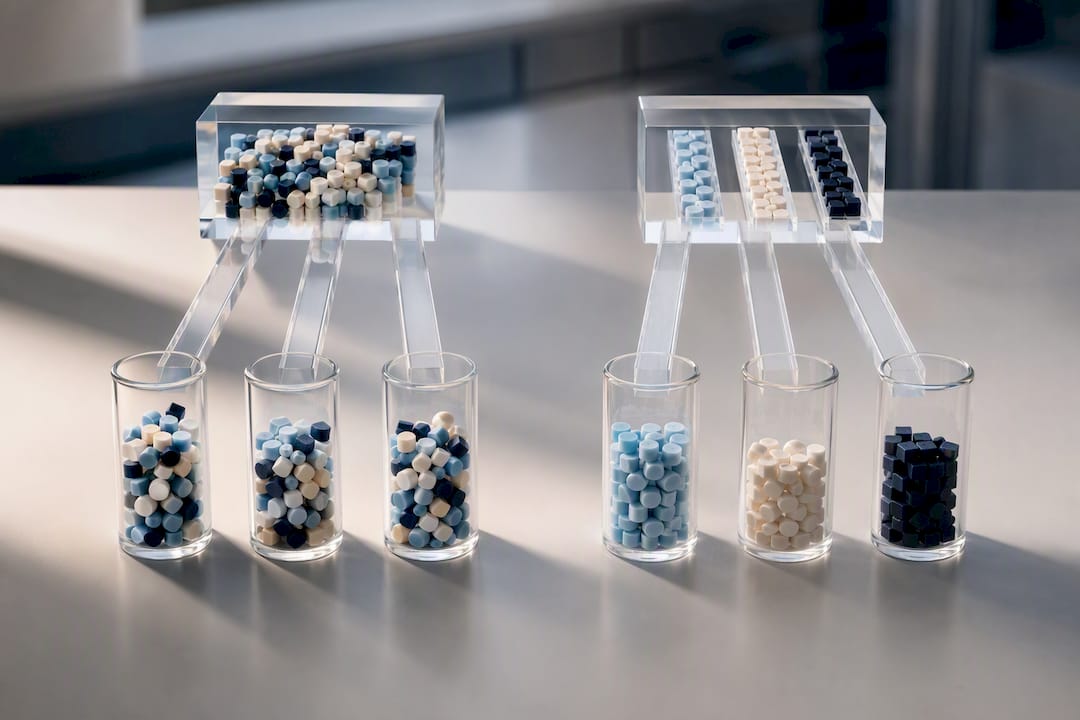
Thymalin is not one molecule. It’s a heterogeneous extract pulled from calf thymus tissue, containing a mix of short peptides rather than a single, defined amino acid sequence. That distinction matters more than it sounds. A synthetic peptide like thymosin alpha-1 has a fixed 28-amino-acid structure you can specify on a certificate of analysis down to the last residue. Thymalin, by contrast, is a polypeptide complex whose exact peptide ratios can vary from batch to batch depending on extraction method and source tissue, according to reviews describing thymalin’s biological activity.
Three short peptides get the most attention in the literature:
- EW (Glu-Trp), also studied independently as Thymogen, a dipeptide associated with immune signaling effects.
- KE (Lys-Glu), known separately as Vilon, linked to gene expression modulation in aging research.
- EDP (Glu-Asp-Pro), sometimes called Crystagen, implicated in cell differentiation pathways.
Researchers have detected these fragments using HPLC and mass spectrometry, and peptide research profiles attribute much of thymalin’s reported bioactivity to this trio, though isolating cause and effect within a multi-component mixture is inherently harder than testing a single compound.
The leading mechanistic hypothesis holds that these peptides interact directly with DNA and histone proteins, nudging gene expression patterns that govern T-cell proliferation and differentiation. The molecular activity review from PMC frames this as an epigenetic-adjacent mode of action rather than the receptor-binding mechanism typical of hormone-like peptides. An alternative framing from the original Russian research program treats thymalin as an organ-specific “bioregulator,” meaning it preferentially restores function in the organ it was extracted from. That idea remains theoretical and has not been independently validated through mechanistic studies outside the originating lineage.
The practical takeaway for anyone designing an experiment: treat thymalin as an operationally defined extract, not a fixed chemical entity. Two vials labeled “thymalin” from different suppliers may not contain identical peptide ratios unless both carry detailed analytical characterization. If mechanistic clarity is the goal, testing the isolated peptides EW, KE, or EDP individually often produces more reproducible data than testing the full complex.
What Does the Clinical Evidence on Thymalin Actually Show?
The most cited human data on thymalin cluster around two populations: aging cohorts studied for infection resistance, and hospitalized COVID-19 patients studied for immune recovery. Both data sets point in a promising direction. Neither is large enough or independently replicated enough to call the case closed.
Statistic snapshot: In a clinical report on severe COVID-19 in older patients, those receiving thymalin alongside standard therapy showed faster clinical improvement, quicker recovery from lymphopenia, faster normalization of C-reactive protein and D-dimer, and a hospital mortality rate roughly half that of the control group on standard therapy alone, according to the peer-reviewed report on thymalin in severe COVID-19.
That’s a striking effect size for a 36-patient treatment arm. It’s also exactly the kind of result that demands scrutiny before anyone extrapolates it to broader use. A single-site study with fewer than 40 treated patients can produce dramatic-looking numbers that don’t hold up once a larger, multi-center trial repeats the design.
Separately, in observational research on older adults, thymalin administration was associated with a notable reduction in acute respiratory infections compared to untreated seniors. This figure comes from the Khavinson research group’s long-running work on thymic bioregulators in elderly populations, and it’s consistent with the broader claim that thymalin supports immune competence as thymic function naturally declines with age. Consistency across studies from the same lab, however, isn’t the same as independent replication.
Here’s where the evidence base gets thin, not fabricated, just thin:
- The literature is concentrated almost entirely in Russian-language publications tied to a single research lineage centered at the St. Petersburg Institute of Bioregulation and Gerontology.
- Sample sizes in the human trials are modest by modern RCT standards, and blinding protocols aren’t always described in detail.
- Independent Western replication is essentially absent, which evidence syntheses on thymalin flag as the single biggest gap separating “interesting signal” from “established therapy.”
- Language and access barriers mean many of the original datasets haven’t been scrutinized by outside statisticians or subjected to meta-analysis.
None of this means the data are worthless. A halved mortality signal and a doubling of infection resistance are the kind of numbers that justify follow-up funding, not the kind that justify treatment claims. Read them as a strong hypothesis generator, not a settled verdict.
Is Thymalin Safe, and What Is Its Regulatory Status in the U.S.?
The Russian clinical literature characterizes thymalin as having low toxicity across its historical use, and the COVID-19 report cited above did not describe adverse events attributable to the treatment arm. That’s a reassuring signal, though it comes with the same caveat as the efficacy data: it’s drawn from a limited, geographically concentrated body of research rather than large-scale, independently monitored pharmacovigilance data of the kind the FDA would require for approval.
Thymalin is not FDA-approved for any human therapeutic use in the United States. It has never gone through the clinical trial pathway American regulators require, and reference guides on thymalin’s regulatory position confirm it sits outside Western approval frameworks entirely, despite decades of clinical use in Russia. That gap between “used clinically abroad” and “approved domestically” is the single most important fact for any U.S.-based researcher to internalize before ordering material.
For labs and institutions working with thymalin in a legitimate research context, a few compliance steps keep the work defensible:
- Confirm the material is labeled and sold strictly for research use only, never marketed or implied for human therapeutic use.
- Secure Institutional Review Board or ethics committee approval before any protocol involving human subjects or human-derived samples.
- Execute a Material Transfer Agreement with the supplier that documents research-only intent and chain of custody.
- Request and review the certificate of analysis for identity, purity, and endotoxin/sterility results before use.
- If human research is contemplated, draft informed consent language that accurately reflects the compound’s non-approved status and the limited evidence base.
Pro Tip: Don’t assume a COA from a supplier automatically covers endotoxin testing. Many standard purity certificates only confirm peptide identity and concentration. Ask specifically for a separate endotoxin or LAL test result, especially if downstream work involves cell culture or animal models where lipopolysaccharide contamination can silently wreck your immune readouts.
How Do You Source and Handle Thymalin for Lab Research?
Good data starts with good material, and thymalin’s mixture-based nature makes vendor documentation more important than it would be for a single-sequence synthetic peptide. Before placing an order, request the following from any supplier:
- A current certificate of analysis showing peptide identity confirmation, typically via HPLC and mass spectrometry.
- Batch-specific testing results rather than a generic template document.
- Traceability information on the animal source tissue.
- Endotoxin testing results, since endotoxin contamination is a common and underappreciated confound in peptide research, particularly for extracts derived from biological tissue rather than synthesized in a controlled reactor.
On handling: lyophilized thymalin should be reconstituted with bacteriostatic water or an appropriate sterile diluent immediately before use, kept refrigerated once reconstituted, and used within the stability window your supplier’s documentation specifies. Avoid repeated freeze-thaw cycles, which degrade peptide integrity faster than most researchers expect.
For dosing context, historical Russian clinical practice referenced administration of 10 mg intramuscularly, once daily, for a course of 10 days, according to compound reference data on thymalin. That figure describes clinical use in a different regulatory environment, not a recommendation, and any research protocol should set its own dosing rationale based on study design and species model.
For endpoints, pair immune cell counts with functional and clinical markers rather than relying on any single readout:
- Immunophenotyping: CD4/CD8 ratios, naive versus memory T-cell counts.
- Functional assays: NK cell cytotoxicity, phagocytic activity.
- Cytokine panels: IL-6, IL-1β, TNF-α.
- Coagulation and inflammation markers: D-dimer, CRP.
- Clinical respiratory outcomes where applicable.
Pro Tip: If you’re working with a limited budget, prioritize the cytokine panel and CD4/CD8 ratio over a broader immunophenotyping suite. Those two data points map most directly onto the effect sizes reported in the existing clinical literature, making your results easier to compare against the published baseline.
Where Should Thymalin Research Go Next?
The field’s biggest need isn’t more observational data from the same research group. It’s independent replication with modern trial architecture. Priority items for anyone designing the next study:
- Well-powered, blinded randomized controlled trials conducted outside the originating research lineage.
- A single, analytically characterized batch used across all trial arms, with full COA and stability data published alongside results.
- Mechanistic human-cell studies isolating EW, KE, and EDP individually to separate their contributions from the whole-complex effect.
- Multi-center designs that avoid the single-institution concentration that currently limits confidence in the published effect sizes.
Avoid the two pitfalls that have shaped the field so far: using inconsistently characterized material across studies, and drawing conclusions from small, single-center trials without external replication.
An Editorial Take on Where Thymalin Fits in Peptide Research
Thymalin sits at an interesting crossroads: genuinely promising numbers from a research tradition most Western scientists have never read in the original language. The mortality and infection-reduction signals deserve follow-up, not dismissal, but they also don’t justify the confidence some marketing copy assigns them. If you’re considering mechanistic work, isolating EW, KE, or EDP will get you cleaner data than the full complex. Source material with real batch documentation, and treat “used in Russia for decades” as a research lead, not a safety guarantee.
— Mitch
Sourcing Research-Grade Thymalin Without the Guesswork
Every checklist item covered above, batch-specific COA, endotoxin testing, traceable sourcing, comes down to one problem: most suppliers hand you a generic template instead of documentation you can actually cite in a methods section. Some suppliers provide research-grade peptides with batch testing and certificates of analysis designed for this kind of scrutiny.
That means the QC checklist in this article isn’t aspirational; it’s the baseline for what should arrive with your order. Synthrolab’s peptide quality and COA guide walks through the same purity, identity, and testing standards researchers need before running a defensible protocol, and the team supports labs sourcing compounds for cellular signaling, immune, and longevity-focused research. If your institution needs volume pricing or ongoing supply for a multi-arm study, request wholesale information to get documentation and pricing tailored to your research scope.
This article is general information, not a substitute for advice from a qualified doctor. Consult a qualified healthcare professional about your own circumstances before acting on anything here.
Sources
FAQ
What Is Thymalin?
Thymalin is a polypeptide complex extracted from calf thymus tissue, containing short bioactive peptides including EW, KE, and EDP that researchers link to immune cell regulation.
Who Should Not Take Thymosin-Class Peptides?
Thymosin and thymalin-class compounds are not approved therapeutics, and neither should be used outside a supervised research or clinical trial setting; anyone with an autoimmune condition, active malignancy, or who is pregnant should avoid uncontrolled use given the absence of safety data in these groups.
What Are the Benefits Associated With Thymogen-Type Peptides?
Thymogen, the dipeptide EW found within thymalin, has been studied for effects on immune cell signaling and gene expression, though most of that evidence comes from the same concentrated research base as thymalin itself and warrants the same cautious interpretation.
Where Can Researchers Source Thymalin Peptide?
Researchers should source thymalin only from suppliers providing a batch-specific certificate of analysis and endotoxin testing; Synthrolab’s research-grade peptide catalog is built around that documentation standard.
What Is the Difference Between Thymulin and Thymalin?
Thymulin is a distinct, structurally defined nonapeptide produced naturally by the thymus, while thymalin is a multi-component extract; the two are related by tissue origin but are not the same compound, and evidence reviews on thymic peptides caution against conflating them in study design or literature searches.
Recommended
 21+ verification