Melanotan 2 (MT-2) is a synthetic cyclic peptide analog of alpha-melanocyte-stimulating hormone (α-MSH), developed in the late 1980s at the University of Arizona. It activates multiple melanocortin receptors simultaneously, producing effects on skin pigmentation, sexual arousal, and metabolic regulation. As of 2026, neither the FDA nor the TGA has approved MT-2 for therapeutic or cosmetic use. It is classified strictly as a research-grade compound.
Key facts about MT-2 at a glance:
- Chemical identity: Synthetic cyclic heptapeptide analog of α-MSH
- Receptor profile: Non-selective agonist at MC1R, MC3R, MC4R, and MC5R
- Primary observed effects: Skin tanning, spontaneous erections, appetite suppression
- Regulatory status: Unapproved by FDA and TGA; classified as a research chemical
- Common adverse effects: Nausea, facial flushing, yawning, stretching, somnolence
- Available form: Lyophilized powder for reconstitution, sold for research purposes only
What is the chemical structure of peptide MT2?
MT-2 has a cyclic lactam-bridged structure with the amino acid sequence Ac-Nle-cyclo[Asp-His-D-Phe-Arg-Trp-Lys]-NH2, giving it a molecular weight of approximately 1,024 Da. Two structural modifications set it apart from natural α-MSH: N-terminal acetylation and C-terminal amidation. Both changes increase the peptide’s metabolic stability and receptor binding potency compared to the endogenous hormone.
The lactam bridge connecting the aspartate and lysine residues locks the molecule into a constrained cyclic conformation. That rigidity is not incidental. It prevents rapid enzymatic degradation and forces the pharmacophore into an orientation that binds melanocortin receptors with high affinity.
Where natural α-MSH selectively targets MC1R, MT-2 engages MC1R, MC3R, MC4R, and MC5R without meaningful selectivity. That broad receptor profile is the root of both its research interest and its safety complexity. MC1R activation drives eumelanin synthesis in melanocytes. MC3R and MC4R engagement in the central nervous system produces appetite suppression and the spontaneous erections documented in clinical studies. MC5R activation influences exocrine gland secretion, though this pathway is less studied in the context of MT-2.
Key structural and physicochemical properties:
- Sequence: Ac-Nle-cyclo[Asp-His-D-Phe-Arg-Trp-Lys]-NH2
- Molecular weight: ~1,024 Da
- Modifications: N-terminal acetylation, C-terminal amidation
- Bridge type: Lactam bridge (Asp5–Lys10)
- Receptor targets: MC1R, MC3R, MC4R, MC5R (non-selective)
- Stability advantage: Cyclic conformation resists proteolytic cleavage
What do clinical studies show about Melanotan 2?
The most cited human data comes from a Phase I pilot study conducted in three healthy male volunteers. Subcutaneous injections were administered on alternating days (Monday through Friday) for two consecutive weeks, starting at 0.01 mg/kg and escalating in 0.005 mg/kg increments. Two subjects reached 0.03 mg/kg; one reached 0.025 mg/kg.
Results were notable on two fronts. First, some subjects showed measurable increases in skin pigmentation on the face, upper body, and buttocks, confirmed by quantitative reflectance measurement within one week after dosing ended. Second, a stretching and yawning complex appeared consistently and correlated with the onset of spontaneous penile erections lasting 1–5 hours post-dose, depending on the dose level.
The side effect picture was dose-dependent. Mild nausea appeared at most dose levels but did not require antiemetic treatment. At higher doses, some subjects experienced moderate somnolence and fatigue. No serious adverse events were recorded at the doses tested, but the trial was small and short.
- Subcutaneous MT-2 at 0.025 mg/kg produced visible tanning after just five low doses administered every other day.
- Spontaneous erections occurred 1–5 hours after dosing, preceded by yawning and stretching, reflecting central MC4R activation.
- Nausea was the most consistent adverse effect across dose levels.
- Grade II somnolence and fatigue appeared at 0.03 mg/kg in one subject.
- The recommended dose for future Phase I studies was set based on observed efficacy-to-tolerability balance.
The distinction between MT-2 and bremelanotide (PT-141) is worth understanding clearly. Bremelanotide selectively targets MC4R, isolating the sexual arousal pathway while avoiding the broad pigmentation and metabolic effects of MT-2. The FDA approved bremelanotide in 2019 for female sexual arousal disorder. MT-2 remains unlicensed. Medical research shifted toward bremelanotide precisely because selective receptor targeting allowed a cleaner safety and regulatory pathway.
“These results demonstrate that MT-II has tanning activity in humans given only 5 low doses every other day by subcutaneous injection.” — Phase I clinical study, Journal of Clinical Endocrinology & Metabolism, 1996
What are the uses and safety precautions for Melanotan 2?
MT-2 has been studied for three primary applications: skin tanning via eumelanin induction, erectile dysfunction and sexual arousal, and appetite suppression. All three effects trace back to its non-selective receptor agonism across the melanocortin system. In research contexts, these overlapping effects are part of what makes MT-2 pharmacologically interesting. In unsupervised consumer use, they are a liability.

The tanning effect works through MC1R activation in melanocytes, stimulating eumelanin production without UV exposure. That sounds appealing, but the pigmentation is not uniform. Uneven darkening, mole changes, and the appearance of new nevi are documented concerns. Health agencies including the FDA and TGA warn explicitly against MT-2 use, citing uneven pigmentation, mole darkening, and the absence of any purity oversight for products sold online.
Common adverse effects observed in research:
- Nausea: Most frequently reported, typically mild and transient
- Facial flushing: Occurs shortly after dosing
- Yawning and stretching: Neurological marker of MC4R CNS engagement
- Spontaneous erections: Occur 1–5 hours post-dose in male subjects
- Somnolence and fatigue: Dose-dependent; Grade II at 0.03 mg/kg in one Phase I subject
- Uneven pigmentation: Risk with repeated dosing; mole changes documented
Safety warnings extend beyond the pharmacological effects. Products sold online as MT-2 carry real contamination and adulteration risks. Without regulatory oversight, there is no guarantee of identity, purity, or sterility. Counterfeit or degraded peptide introduces unpredictable variables that no dosing protocol can account for.
Pro Tip: MT-2 lyophilized powder is sensitive to light, moisture, and temperature fluctuations. Proper storage, away from heat and humidity, is critical to maintaining structural integrity before reconstitution.
Contraindications and precautions worth noting for research contexts include pre-existing pigmented lesions, cardiovascular sensitivity (given the flushing and arousal responses), and any condition affected by appetite or metabolic changes. Drug interactions have not been systematically studied, but the CNS activity of MC4R agonism suggests caution alongside other agents affecting dopaminergic or serotonergic pathways.
Where can you buy Melanotan 2 in the US, and what should you know?
MT-2 has no FDA approval for therapeutic, cosmetic, or dietary use. It is not a licensed drug, not a regulated supplement, and not approved for human administration in any clinical context in the United States. It circulates as an unlicensed research chemical, which means its sale is technically legal for laboratory research purposes but sits in a gray area regarding importation and personal use.

The standard product form is a lyophilized powder in sealed vials, typically at 10 mg per vial, intended for reconstitution with bacteriostatic water before use in research settings. Typical pricing runs approximately $35–$40 per 10 mg vial, though prices vary by supplier and order volume.
| Factor |
What to look for |
| Certificate of Analysis (COA) |
Third-party HPLC purity verification |
| Manufacturer transparency |
Named laboratory, traceable production batch |
| Sterility testing |
Documented endotoxin and microbial testing |
| Packaging |
Sealed, labeled vials with lot number |
| Legal disclaimer |
Explicit “for research use only” labeling |
The counterfeit problem in the online MT-2 market is real and well-documented. Products sold through unverified channels frequently contain incorrect peptide sequences, undisclosed fillers, or microbial contamination. A certificate of analysis from an independent third-party laboratory, specifically showing HPLC purity data, is the minimum credibility threshold for any supplier worth considering.
Importation of MT-2 into the United States without FDA authorization can trigger regulatory scrutiny. Researchers sourcing MT-2 should work with domestic suppliers who operate under clear research-use frameworks and provide full documentation. Purchasing from overseas vendors with no COA, no traceable batch data, and no stated research-use policy is a risk that goes well beyond the pharmacological.
Synthrolab’s research-grade Melanotan 2 for scientific investigation
Synthrolab supplies research-grade Melanotan II at 10 mg per vial, formulated as lyophilized powder for laboratory reconstitution. The product is intended for scientific investigation into melanocortin receptor pharmacology, pigmentation biology, and related cellular signaling pathways.
What distinguishes a research-grade supplier from the broader online market comes down to documentation and process. Synthrolab’s approach centers on:
- Third-party COA: Independent purity verification via HPLC, confirming peptide identity and concentration
- Batch traceability: Lot-specific documentation for every vial
- Research-use framework: Products are supplied exclusively for laboratory and scientific research, not for human administration
- Scientific resources: Supporting educational content on peptide handling, receptor biology, and research protocols
- Storage guidance: Lyophilized product shipped and stored under conditions that preserve structural integrity
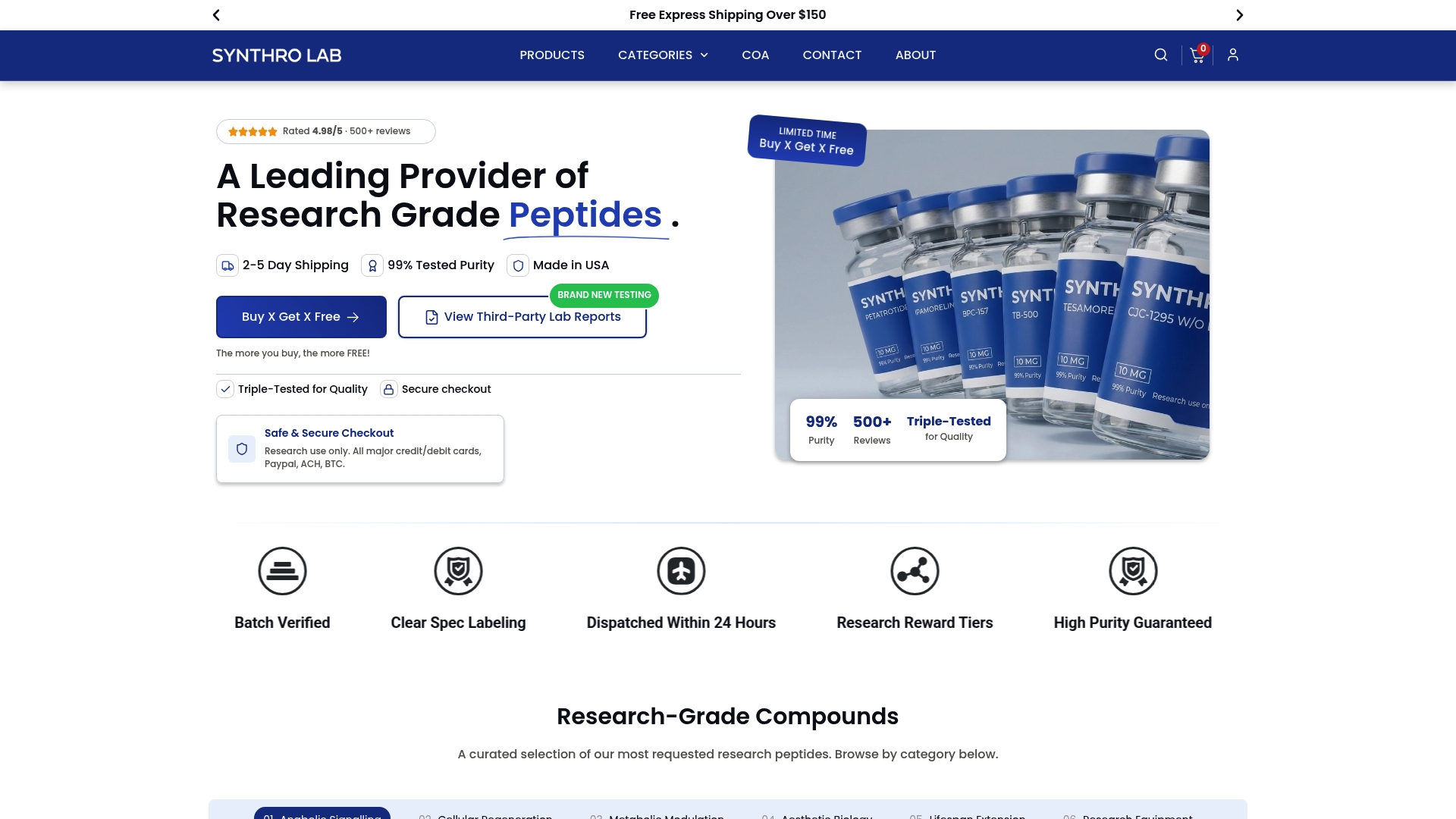
Researchers working with MT-2 as part of broader melanocortin studies will find Synthrolab’s catalog relevant beyond this single compound. The metabolic modulation category includes compounds that intersect with the appetite and energy-regulation pathways MT-2 also engages, which can be useful for comparative or mechanistic research designs.
For researchers new to peptide handling, Synthrolab’s peptide safe-start guide covers reconstitution, storage, and research-use compliance in practical terms.
Key Takeaways
MT-2 is a non-selective melanocortin receptor agonist with documented effects on pigmentation, sexual function, and appetite, but it remains unapproved by the FDA and TGA and is available only as a research-grade compound.
| Point |
Details |
| Chemical identity |
MT-2 is a cyclic heptapeptide analog of α-MSH with a molecular weight of ~1,024 Da and non-selective MC1R/MC3R/MC4R/MC5R agonism. |
| Clinical tanning evidence |
Phase I data showed visible pigmentation after five subcutaneous doses at 0.025 mg/kg, administered every other day. |
| Side effect profile |
Nausea, flushing, yawning, and spontaneous erections are the most consistently observed effects; Grade II somnolence appeared at 0.03 mg/kg. |
| Regulatory status |
MT-2 is unapproved by the FDA and TGA; bremelanotide (PT-141), a selective MC4R agonist, received FDA approval in 2019 for female sexual arousal disorder. |
| Sourcing standard |
A third-party COA with HPLC purity data is the minimum credibility threshold when sourcing MT-2 for research. |
The research promise of MT-2 is real, but the gap between lab and consumer use is wide
MT-2 occupies an unusual position in peptide pharmacology. The Phase I data is genuinely interesting. A compound that produces measurable tanning from five low doses, while simultaneously engaging central appetite and arousal pathways through a single receptor family, gives researchers a useful tool for probing the melanocortin system’s reach. That breadth is exactly what makes it scientifically valuable.
The problem is that the same breadth makes it poorly suited to unsupervised use. Non-selective receptor agonism is not a feature you want in a consumer product. The yawning-and-stretching complex that precedes spontaneous erections is not a minor inconvenience. It is a visible marker of central nervous system engagement that most people are not equipped to monitor or manage outside a clinical setting. Add the mole-change risk, the contamination problem in the online market, and the complete absence of long-term safety data, and the case against casual use becomes hard to argue with.
What the research community actually needs from MT-2 is more controlled, well-documented investigation, not wider consumer access. The transition from MT-2 to bremelanotide shows what happens when researchers take a promising but blunt pharmacological tool and refine it toward a specific therapeutic target. That process took decades and required the kind of rigorous clinical work that cannot happen when the compound circulating in the market is of unknown purity.
For anyone working with MT-2 in a legitimate research context, the sourcing decision matters as much as the protocol. A degraded or contaminated peptide does not just produce unreliable data. It introduces variables that can invalidate an entire study. The COA is not a formality.
Recommended
 21+ verification