What is peptide GHK-Cu and why does it matter for aging research?
GHK-Cu (glycyl-L-histidyl-L-lysine bound to Cu(II)) is a naturally occurring copper tripeptide first isolated from human plasma albumin by Loren Pickart in 1973. It circulates in blood, saliva, and urine, and gets released at injury sites through protein breakdown. What makes it genuinely interesting for longevity researchers is the breadth of its activity: it drives tissue repair, modulates collagen synthesis, supports antioxidant defense, and regulates gene expression across pathways directly tied to aging.
The plasma concentration data alone frames the research question sharply. GHK-Cu sits at roughly 200 ng/mL at age 20 and falls to approximately 80 ng/mL by age 60. That 60% drop tracks closely with the well-documented decline in regenerative capacity across the same decades.
- Molecular identity: Tripeptide Gly-His-Lys complexed with Cu(II); molecular formula includes copper and amino acids
- Natural sources: Human plasma, saliva, urine; released from albumin, collagen, and SPARC protein at injury sites
- Core biological roles: Collagen and elastin synthesis, metalloproteinase regulation, antioxidant enzyme support, gene expression modulation
- Aging relevance: Plasma decline correlates with reduced tissue regeneration and increased inflammatory signaling
The 2018 MDPI review published in International Journal of Molecular Sciences remains the most cited synthesis of GHK-Cu’s mechanism, connecting its copper-delivery function with genome-wide transcriptional effects that no single pathway model had previously explained.
How GHK-Cu is released endogenously and what it does at the cellular level
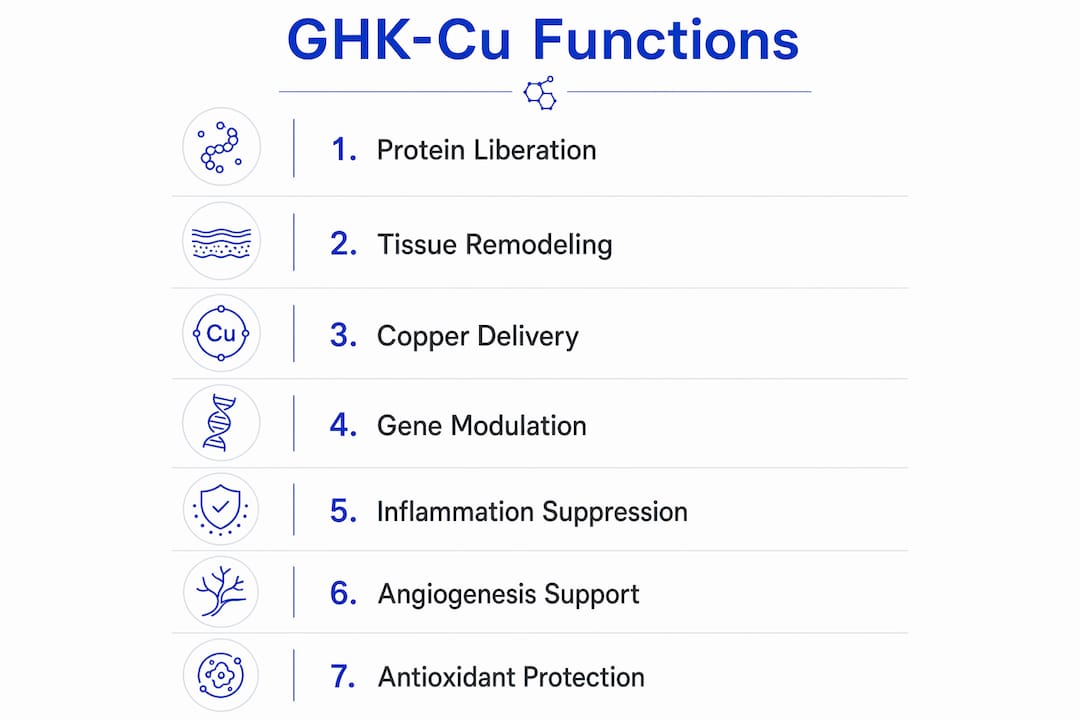
1. Proteolytic liberation from structural proteins
GHK is not synthesized de novo on demand. Instead, it is liberated through proteolytic cleavage of albumin, collagen, and SPARC protein fragments at sites of tissue injury. This release mechanism is a critical design consideration for any in vitro model attempting to replicate endogenous GHK-Cu signaling. A cell culture that simply adds exogenous peptide misses the spatial and temporal context of natural release.
2. Dual-action tissue remodeling
GHK-Cu operates as a dual-action remodeling molecule: it simultaneously activates metalloproteinases to clear damaged matrix proteins and stimulates fibroblasts to deposit new collagen, elastin, proteoglycans, and glycosaminoglycans. This balance is what separates productive wound healing from scar-forming repair. TGF-beta secretion from fibroblasts is reduced during this process, which directly limits excessive scar tissue formation.
3. Copper delivery to enzymatic systems
The Cu(II) ion chelated by GHK is delivered to cells in a non-toxic, bioavailable form because copper’s redox activity is silenced within the complex. Once inside, it fuels copper-dependent enzymes, including lysyl oxidase (collagen and elastin crosslinking), superoxide dismutase (antioxidant defense), and cytochrome c oxidase (mitochondrial electron transport). Without adequate copper supply, none of these processes run at full capacity.
4. Broad gene expression modulation
Microarray studies revealed that GHK-Cu modulates approximately 4,000 human genes, affecting pathways related to tissue repair, inflammation, oxidative stress, and regeneration. It upregulates genes tied to tissue repair, neural cell survival, and antioxidant defense while downregulating fibrinogen production, inflammatory mediators, and tissue-destructive pathways. The Connectivity Map tool from the Broad Institute of MIT and Harvard was central to uncovering this transcriptomic scope.
5. Inflammatory pathway suppression
GHK-Cu blocks NFκB p65 and p38 MAPK activation, reducing TNF-1 and IL-6 production. NFκB p65 activation correlates with multiple diseases of aging and cancer development. The p38 MAPK pathway governs cellular responses to external stressors, including apoptosis, cell mobility, and gene expression, so its modulation by GHK-Cu has implications well beyond simple anti-inflammatory effects.
6. Angiogenesis and nerve outgrowth support
GHK-Cu provides a copper depot for blood vessel formation during angiogenesis, a process that cannot proceed without adequate copper availability. It also promotes axon differentiation and proliferation within neurons. Both effects matter for tissue repair models studying vascularization and neural regeneration in parallel.
7. Antioxidant protection at the lipid level
GHK completely blocks Cu(II)-dependent oxidation of low-density lipoproteins and inactivates lipid peroxidation byproducts including 4-hydroxynonenal, acrolein, and malondialdehyde. For comparison, superoxide dismutase (SOD1) provided only 20% protection in the same LDL oxidation assay. That difference is worth noting when designing oxidative stress models.
How plasma GHK-Cu levels change with age and what that means for longevity research
The quantitative decline is well-documented. Plasma GHK-Cu concentrations decline substantially from young adulthood to older age, a reduction that coincides with the period when tissue regeneration slows most noticeably in healthy adults.
Statistic to anchor: A 60% reduction in circulating GHK-Cu between early adulthood and middle age maps directly onto the window where age-associated tissue degeneration accelerates.
- Regenerative capacity: Lower GHK-Cu means less fibroblast activation, reduced collagen turnover, and slower wound closure
- Inflammatory tone: Declining GHK-Cu correlates with rising NFκB activity and increased fibrinogen production, both markers of chronic low-grade inflammation
- Gene expression shifts: The same pathways GHK-Cu upregulates (TGF-beta, antioxidant genes, tissue remodeling) become progressively underactive as plasma levels fall
- Biomarker potential: Plasma GHK-Cu concentration is a candidate biomarker for biological age, distinct from chronological age, with implications for longevity protocol design
- Research implication: Restoring GHK-Cu to youthful concentrations in cell culture models allows researchers to study whether the gene expression profile of aged tissue can be partially reversed
The COPD gene expression data illustrates this concretely. In emphysema patients, 127 genes shifted expression in a characteristic pattern, with tissue remodeling genes suppressed and inflammatory genes elevated. GHK-Cu reversed that pattern using the TGF-beta pathway, suggesting its plasma decline may contribute to the gene expression drift researchers associate with biological aging.
What is the current regulatory status of GHK-Cu for research use?
GHK-Cu is not approved by the FDA or equivalent regulatory bodies for systemic, injectable, or veterinary use. Its approved classification covers two contexts only: topical cosmetic ingredient and laboratory research reagent.
- Cosmetic use: Regulated as a cosmetic ingredient (INCI name: Copper tripeptide-1) for topical skincare; clinical studies support improvements in skin thickness, elasticity, and collagen density after topical application
- Research use: Permitted as an in vitro research chemical under standard laboratory compliance frameworks
- Injectable status: Injectable GHK-Cu lacks regulatory approval and has not been evaluated for safety in controlled human trials; no established safe dose exists for systemic administration
- Safety profile (topical): Generally well tolerated at cosmetic concentrations; reported effects are limited to mild skin irritation or occasional contact sensitivity
- Systemic risk considerations: Copper is tightly regulated in the body; excess copper is harmful, and no controlled trial has assessed the safety of introducing copper-containing compounds systemically
- Lab compliance: Researchers working with GHK-Cu must classify it as an investigational compound and operate within institutional biosafety and chemical handling protocols
The practical takeaway for research labs is straightforward. Topical and in vitro work sits on solid regulatory ground. Any protocol involving systemic or injectable administration requires institutional review and carries no approved clinical safety data to reference.
How Synthrolab supports GHK-Cu research with laboratory-grade compounds
Synthrolab’s catalog addresses the full range of GHK-Cu research applications, from single-compound mechanistic studies to multi-peptide signaling investigations.
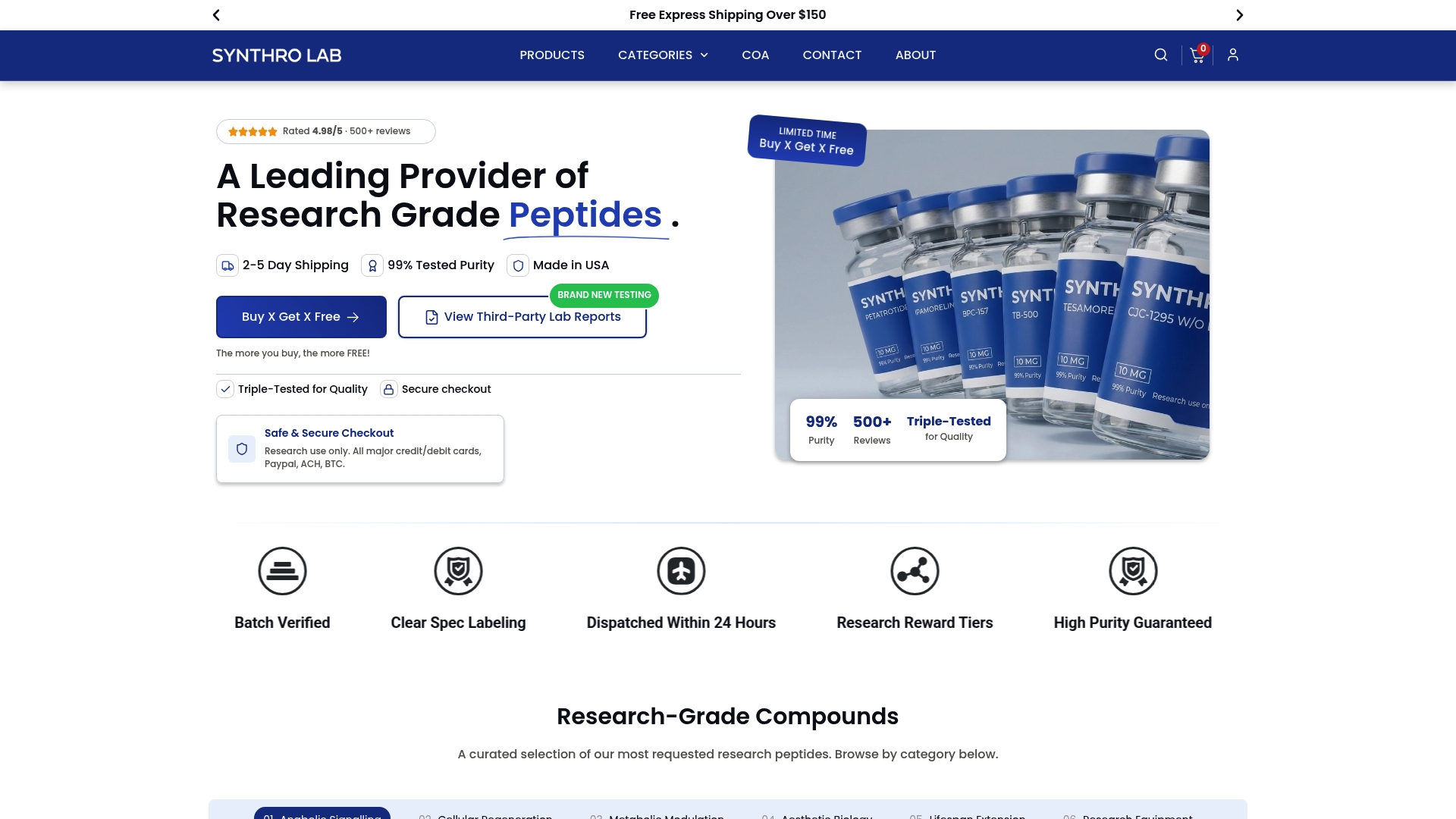
- GHK-CU 50mg: Research-grade copper tripeptide formulated for preclinical and laboratory use, supporting studies on collagen synthesis, gene expression modulation, and oxidative stress pathways
- GHK-C + BPC157 + TB-500 combination: A multi-peptide product pairing GHK-Cu with BPC157 and TB-500 for researchers studying overlapping cellular signaling and tissue regeneration mechanisms
- GLP-3 RETA 10mg: Available for extended research programs exploring metabolic signaling alongside regenerative peptide pathways
- Quality assurance: Synthrolab provides certificates of analysis supporting reproducible experimental outcomes across research batches
- Research scope: Products are designed for scientific investigation into cellular signaling, recovery pathways, mitochondrial function, and longevity-related mechanisms
Researchers building longevity or cellular signaling protocols can find Synthrolab’s full peptide research catalog alongside detailed compound specifications. For broader context on peptide mechanisms relevant to GHK-Cu studies, the collagen peptide research guide covers the extracellular matrix biology that underpins much of GHK-Cu’s tissue repair activity.
Key Takeaways
GHK-Cu’s plasma concentration declines notably with age, underscoring its potential role in aging and regenerative biology.
| Point |
Details |
| Plasma level decline with age |
Plasma GHK-Cu declines from about 200 ng/mL at age 20 to 80 ng/mL by age 60, a 60% drop that tracks with reduced regenerative capacity. |
| Endogenous release mechanism |
GHK is liberated by proteolytic cleavage of albumin, collagen, and SPARC protein at injury sites, not synthesized de novo. |
| Gene expression scope |
GHK-Cu modulates approximately 4,000 human genes, affecting tissue repair, inflammation, oxidative stress, and regeneration. |
| Regulatory classification |
GHK-Cu is approved only as a topical cosmetic ingredient and research reagent; injectable use has no regulatory approval or established safety data. |
| Research-grade sourcing |
Synthrolab offers GHK-CU 50mg and combination products with BPC157 and TB-500 for preclinical cellular signaling studies. |
Recommended
 21+ verification