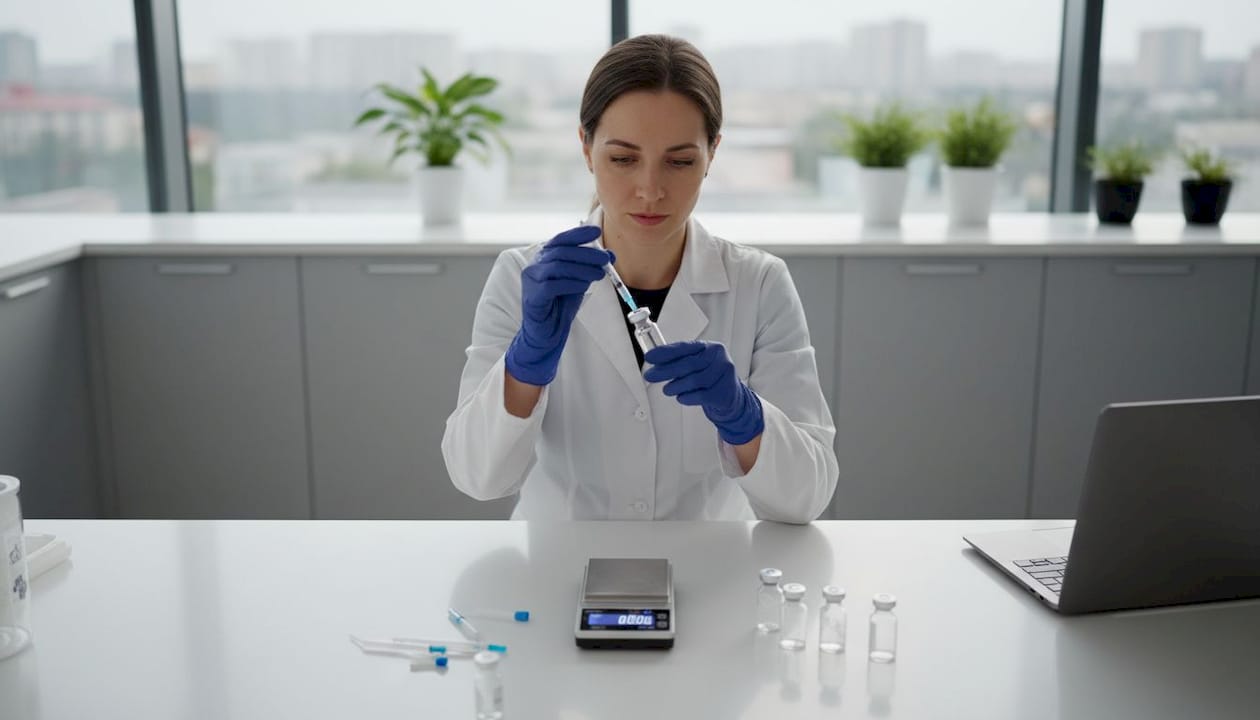
Bacteriostatic water is the standard diluent for peptide reconstitution in research settings. It is sterile water containing 0.9% benzyl alcohol as a preservative, which inhibits microbial growth after the vial is first punctured. That single property makes it practical for multi-dose workflows where the same vial is accessed repeatedly over days or weeks. The informal term “peptide water” refers to this class of sterile, laboratory-grade diluent used to dissolve lyophilized peptide powders into defined working concentrations. Key characteristics of research-grade bacteriostatic water include:
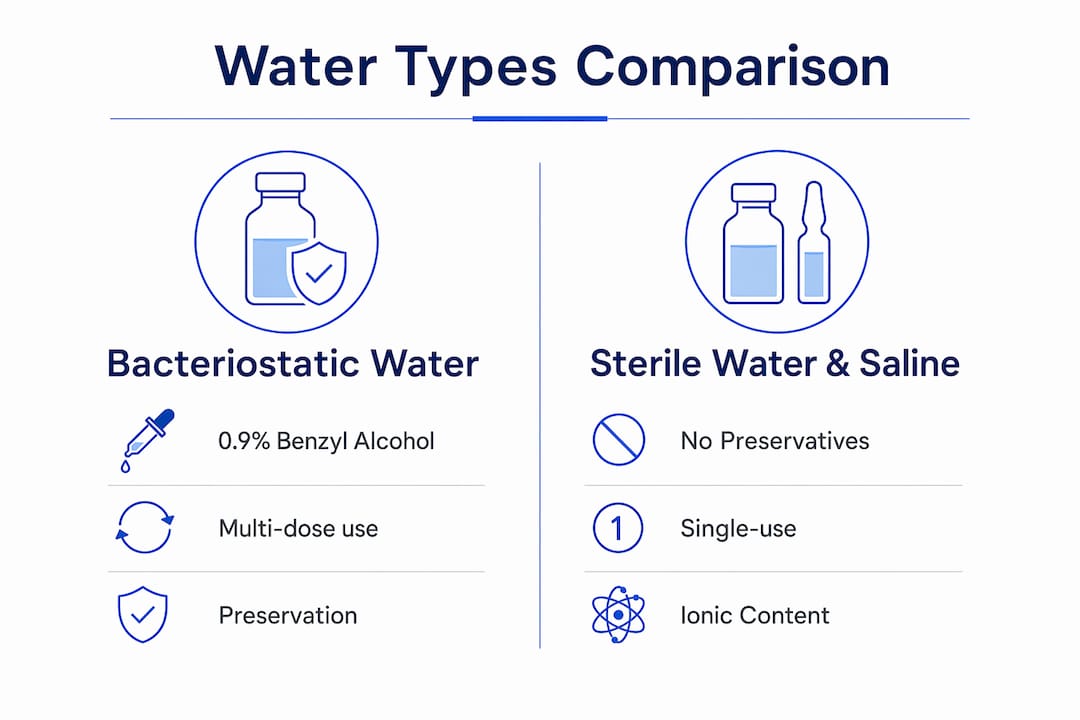
- Preservative content: 0.9% benzyl alcohol, inhibiting microbial proliferation during repeated vial access
- Sterility: produced under controlled conditions and tested per pharmacopeial standards
- Low endotoxin: USP-grade criteria require endotoxin levels below 0.25 EU/mL
- Traceability: lot-specific Certificates of Analysis documenting sterility, preservative content, and microbial limits
- Research-only designation: not formulated for clinical or human administration
- Example product: Synthro Lab BAC Water 10ml, a research-grade bacteriostatic water meeting USP-grade sterility standards for peptide workflows
Table of Contents
How much bacteriostatic water should you use for peptide reconstitution?
Typical reconstitution volumes range from 1 mL to 3 mL for most peptides, with the exact volume determined by the peptide amount and your target working concentration. A 5 mg peptide vial reconstituted with 2 mL of bacteriostatic water yields a 2.5 mg/mL stock solution. Adjust the volume up or down to hit the concentration your assay requires, and always calculate before you pipette.
Aseptic technique is non-negotiable throughout. Sanitize the rubber stopper with 70% isopropyl alcohol before every puncture, use a fresh sterile syringe and needle each time, and minimize the total number of vial entries by planning your withdrawals in advance.
Pro Tip: Use a “wetting and diluting” approach for difficult peptides: add a small initial volume of bacteriostatic water to wet the lyophilized cake, allow it to dissolve gently, then bring the solution to final volume. This prevents precipitation and improves recovery, especially for hydrophobic sequences.
Documentation is part of the protocol, not an afterthought. Record the reconstitution date, lot number of the bacteriostatic water, peptide lot number, final volume, and calculated concentration on the vial label and in your lab notebook. That data trail supports reproducibility and satisfies audit requirements.
- Confirm peptide mass and target concentration before adding any diluent
- Direct the diluent stream gently down the vial wall to avoid foaming, which can denature peptide structures
- Swirl or roll the vial slowly; never vortex or shake vigorously
- Label immediately with concentration, diluent type, date, and lot numbers
- Store per peptide-specific guidance, typically refrigerated and protected from light
Bacteriostatic water vs. sterile water vs. saline: which one fits your workflow?
Sterile water for injection carries no preservative, making it the right choice for single-use applications or assays where even trace benzyl alcohol could interfere with results. LC-MS workflows and certain enzymatic assays fall into this category. The trade-off is stricter handling discipline: once punctured, a preservative-free vial must be used immediately or discarded, and contamination risk rises sharply with repeated access.
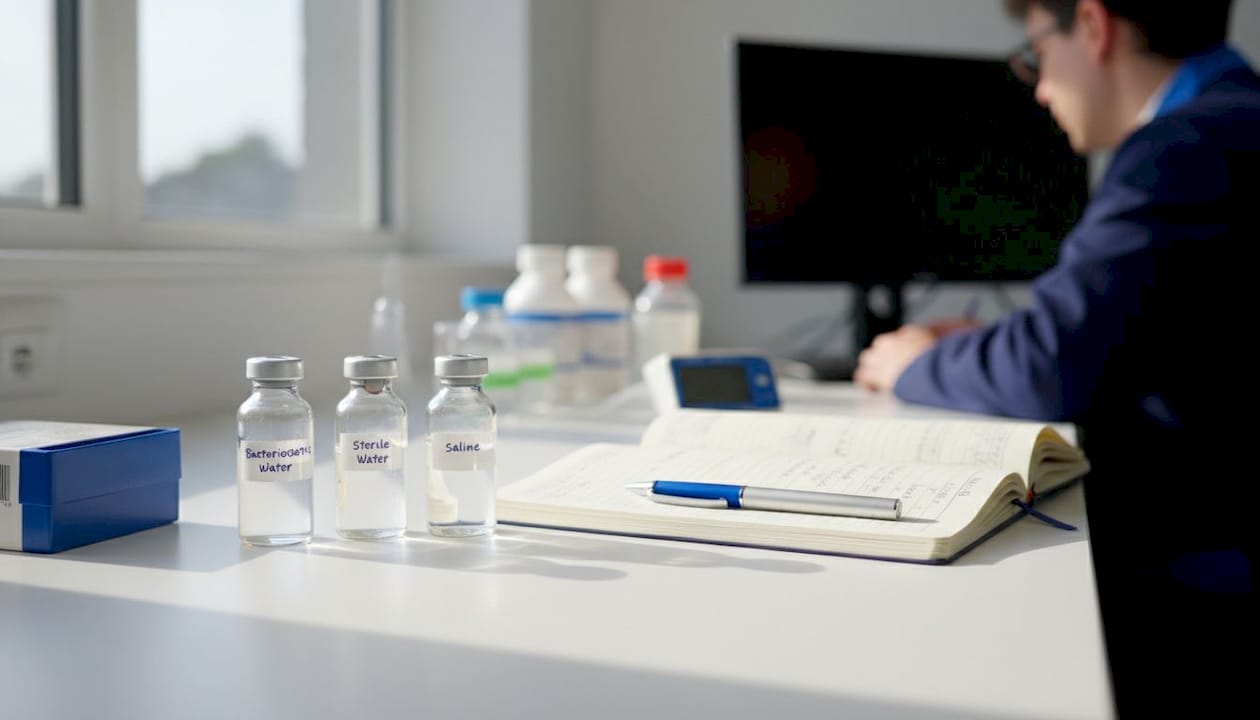
Normal saline (0.9% sodium chloride) is occasionally used as a diluent but introduces ionic content that can shift peptide charge state, alter chromatographic retention, or interfere with binding assays. For most analytical peptide work, saline is the least preferred option unless the downstream application specifically requires a physiological salt concentration.
| Property |
Bacteriostatic water |
Sterile water |
Normal saline (0.9% NaCl) |
| Preservative |
0.9% benzyl alcohol |
None |
None |
| Multi-dose use |
Yes |
No (single-use) |
No (single-use) |
| Ionic content |
Minimal |
None |
High (0.9% sodium chloride) |
| Best for |
Multi-day peptide workflows, repeated vial access |
Single-use, LC-MS, sensitive assays |
Physiological dilutions only |
| Main risk |
Preservative interference in sensitive assays |
Contamination with repeated access |
Ion interference in analytical methods |
| USP-grade available |
Yes |
Yes |
Yes |
Choosing between these three comes down to two questions: how many times will you access the vial, and how sensitive is your downstream assay to additives? If both answers point in opposite directions, run a small-scale compatibility pilot before committing to a full experiment.
How solvent choice shapes your peptide research outcomes
Peptide chemistry interacts with the diluent in ways that directly affect data quality. Charge state, hydrophobicity, and sequence-dependent folding all influence how a peptide behaves in solution, and the wrong diluent can cause aggregation, adsorption to container walls, or unexpected signal artifacts before the sample ever reaches the instrument.
Benzyl alcohol can interfere with certain downstream assays, particularly LC-MS and high-sensitivity binding assays. Validate compatibility with a pilot test before scaling up any workflow where the preservative’s presence is uncertain. This is not a theoretical concern: a confounding peak in a chromatogram traced back to the diluent is a reproducibility failure that wastes both time and sample.
Endotoxins, particulates, and microbial contamination in low-quality diluents cause erratic chromatography peaks and biological assay variability. High-purity, endotoxin-tested peptide water minimizes background noise and keeps baseline drift from masking real signal. For quantitative proteomics or immunoassay development, the diluent grade is as important as the peptide grade.
Key considerations for solvent selection and experimental integrity:
- Peptide hydrophobicity: highly hydrophobic sequences may require a small percentage of organic co-solvent (acetonitrile or DMSO) before dilution into bacteriostatic water; verify that any co-solvent does not compromise the preservative’s antimicrobial function
- USP-grade and lot-specific COAs: documentation of lot numbers, expiration dates, and COA data is required for traceability in research-grade workflows; request this from every supplier
- Storage and shelf life: bacteriostatic water vials, once opened, should be used within the period specified by the manufacturer under refrigerated conditions; discard any vial showing particulates or turbidity
- Aseptic technique as a variable: inadequate technique compromises experimental reproducibility even when a preservative is present; treat every vial entry as a potential contamination event
- Freeze-thaw sensitivity: some peptides degrade through repeated freeze-thaw cycles; prepare single-use aliquots from the reconstituted stock to preserve integrity across time points
- Supplier qualification: for US labs, prioritize domestically produced, research-grade diluents with cleanroom filling, tamper-evident seals, and full lot traceability; these attributes support internal SOPs and external audits alike
For researchers building out their peptide reconstitution protocols, the diluent choice is an experimental variable in the same category as pH, temperature, and concentration. Treat it accordingly.
Key Takeaways
Bacteriostatic water containing 0.9% benzyl alcohol is the standard research-grade diluent for multi-dose peptide reconstitution, requiring USP-grade sterility, endotoxin below 0.25 EU/mL, and lot-specific documentation for reproducible laboratory results.
| Point |
Details |
| Preservative content |
Bacteriostatic water contains 0.9% benzyl alcohol, enabling safe repeated vial access in multi-dose workflows. |
| Reconstitution volume |
Typical volumes range from 1 mL to 3 mL depending on peptide amount and target working concentration. |
| Diluent selection |
Sterile water suits single-use and LC-MS workflows; bacteriostatic water fits multi-day, repeated-access protocols. |
| Quality standards |
USP-grade diluents require endotoxin below 0.25 EU/mL and lot-specific Certificates of Analysis for traceability. |
| Assay compatibility |
Benzyl alcohol can interfere with sensitive assays; run a pilot compatibility test before scaling any new workflow. |
Synthrolab supplies research-grade bacteriostatic water and peptide compounds for laboratory investigation. Explore the Synthro Lab BAC Water 10ml and review the full evidence-based peptide catalog to match your reconstitution workflow to a verified, documented diluent source.
Recommended
 21+ verification