Cognitive enhancement peptides are short amino acid chains that interact directly with brain signaling pathways to boost memory, focus, and neuroprotection. Cognitive enhancement peptide research now covers a growing class of compounds, including Semax, Selank, Dihexa, Noopept, and Cerebrolysin, each targeting distinct neurobiological mechanisms. These peptides work through pathways involving brain-derived neurotrophic factor (BDNF) and nerve growth factor (NGF), two proteins central to synaptic plasticity and neuronal survival. None currently hold FDA approval in the United States, though Semax and Selank carry clinical approvals in Russia. This guide breaks down the science, stacking strategies, dosing protocols, and safety considerations researchers need to navigate this field with confidence.
What types of cognitive enhancement peptides are currently researched?
Cognitive function peptides fall into four main categories, each defined by its primary mechanism of action. Understanding these categories helps researchers select compounds that match their specific investigational goals.
Neurotrophic peptides like Semax and Cerebrolysin work by upregulating BDNF and NGF. Semax increases hippocampal BDNF protein by 1.4-fold in rodent studies and modulates dopamine and serotonin systems within hours of a single intranasal dose. That dual action on neurotrophic factors and neurotransmitters makes Semax one of the most studied nootropic peptide compounds in preclinical research.

Anxiolytic peptides like Selank target the GABAergic system. Selank modulates GABA-A receptor expression and stabilizes endogenous enkephalins without causing sedation or cognitive impairment. The result is improved stress resilience, which indirectly supports cognitive performance under pressure.
Synaptogenic peptides represent a newer category. Dihexa activates HGF/c-Met signaling to promote synaptogenesis, and its preclinical potency exceeds that of BDNF itself. No completed human trials exist as of 2026, which means its profile remains entirely preclinical.
Racetam-like peptides include Noopept (also known as Omberacetam). Though chemically derived from the racetam family, Noopept qualifies as a nootropic peptide compound because its active metabolite, cycloprolylglycine, activates AMPA and TrkB receptors to produce neurotrophic and anxiolytic effects. Noopept is effective at doses 1,000-fold lower than piracetam, with clinical trials in 53 patients showing MMSE scores improving from 26 to 29 over 56 days at 10–30 mg/day.
| Peptide |
Primary mechanism |
Clinical status |
| Semax |
BDNF/NGF upregulation, dopamine/serotonin modulation |
Approved in Russia |
| Selank |
GABA-A modulation, enkephalin stabilization |
Approved in Russia |
| Dihexa |
HGF/c-Met synaptogenesis |
Preclinical only |
| Noopept |
AMPA/TrkB activation, cycloprolylglycine metabolite |
Clinical trials in Russia |
| Cerebrolysin |
Multimodal neurotrophic and neuroprotective |
Approved in 40+ countries |
Cerebrolysin holds the strongest clinical evidence of any peptide in this class. Six randomized controlled trials covering 597 participants show statistically significant MMSE improvements in vascular dementia patients. That evidence base is substantially larger than what exists for any other cognitive peptide.
Pro Tip: When reviewing nootropic peptide studies, separate preclinical rodent data from human RCT data. Dihexa looks extraordinary in animal models but has zero human trial data. Cerebrolysin is the opposite: modest effects in animals but meaningful human evidence.
How can peptide stacks optimize cognitive enhancement effects?
Peptide stacks for cognitive enhancement work by targeting multiple neurobiological pathways simultaneously. A single peptide addresses one mechanism. A well-designed stack addresses memory consolidation, stress regulation, and synaptic growth at the same time.
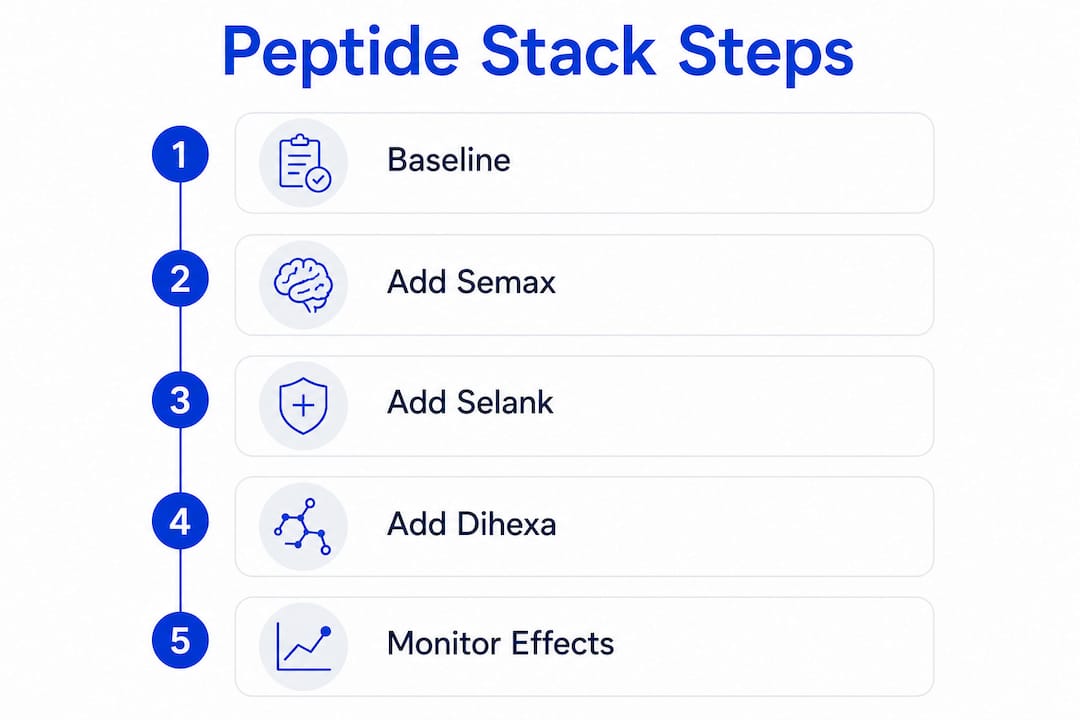
The most studied combination in research and biohacker communities is the Semax, Selank, and Dihexa stack. This stack combines BDNF/NGF upregulation from Semax, anxiolysis from Selank, and synaptogenesis from Dihexa. Each compound fills a gap the others leave open. Semax drives neurotrophic signaling. Selank reduces cortisol-driven cognitive interference. Dihexa theoretically amplifies synaptic density over time.
Stacking remains largely experimental. Protocols combining Semax, Selank, and Dihexa reflect multi-pathway approaches documented in research and biohacker communities, but no large-scale human RCTs validate combined use. Researchers should treat stack data as hypothesis-generating, not confirmatory.
A responsible approach to building a cognitive stack follows these steps:
- Define your research objective. Identify whether you are targeting memory consolidation, stress resilience, or synaptic plasticity. This determines which peptide categories to prioritize.
- Start with one peptide. Establish a baseline response before adding compounds. Running multiple new variables simultaneously makes it impossible to attribute effects accurately.
- Select complementary mechanisms. Pair a neurotrophic peptide with an anxiolytic before adding a synaptogenic compound. Avoid stacking two peptides with the same mechanism.
- Choose your administration route. Intranasal delivery works well for Semax and Selank. Dihexa is typically administered subcutaneously or orally in research settings.
- Set a defined protocol window. Most research protocols run 4–8 weeks with structured cognitive assessments at baseline, midpoint, and endpoint.
- Monitor and document. Track cognitive performance using validated tools like the MMSE or MoCA alongside subjective logs. Discontinue and reassess if unexpected effects appear.
Pro Tip: Do not add Dihexa to a stack until you have at least two weeks of baseline data on Semax and Selank separately. Dihexa’s synaptogenic effects are slow-onset and cumulative, so layering it too early obscures your ability to read individual compound responses.
What are the best practices for dosing and administration?
Administration route determines how much of a peptide actually reaches the brain. This is the single most important variable in peptide therapies for cognition, and researchers frequently underestimate it.
Intranasal delivery enables peptides like Semax and Selank to bypass the blood-brain barrier efficiently, producing rapid onset at lower doses than injectable or oral routes require. This is why both compounds are formulated as nasal sprays in their approved Russian clinical forms. Oral administration degrades most peptides before absorption. Injectable routes offer high bioavailability but introduce complexity and sterility requirements.
Key dosing reference points from clinical and preclinical research:
- Noopept: 10–30 mg/day orally or sublingually; clinical improvements observed at this range over 56 days
- Selank: 75–150 μg intranasally per dose; modulates GABA-A without sedation at these levels
- Cerebrolysin: 10–30 mL intravenously over multiple sessions; approved protocol in Eastern Europe and Asia
- Semax: Typically 200–600 μg intranasally per dose in research settings; effects on BDNF observed within hours
Pharmacokinetics vary significantly across this class. Noopept crosses the blood-brain barrier rapidly due to its small molecular size and lipophilicity. Cerebrolysin requires intravenous administration because its peptide fragments do not survive oral digestion intact. Translating animal model pharmacokinetics to humans adds another layer of uncertainty, since blood-brain barrier permeability and neurotrophic factor regulation differ meaningfully between species.
Pro Tip: For intranasal peptides, calibrated nasal spray devices matter more than most researchers expect. A standard nasal pump delivers approximately 100 μL per actuation. Verify your device’s output volume before calculating dose.
What are the safety concerns and regulatory status of cognitive peptides?
No cognitive-enhancement peptide holds FDA approval in the United States. Semax and Selank are approved in Russia, and Cerebrolysin carries approval in more than 40 countries, but none of these approvals confer legal importation rights or FDA equivalence in the US. Researchers sourcing these compounds operate in a legal gray area that varies by jurisdiction.
The safety profiles differ across the class:
- Semax and Selank show favorable tolerability in Russian clinical use, with no serious adverse events reported at standard doses
- Noopept demonstrated good safety in a 56-day trial with 53 participants, with mild headache as the most common side effect
- Cerebrolysin has the most extensive safety data, with meta-analyses confirming a good safety profile in stroke and Alzheimer’s populations
- Dihexa carries the least safety data of any compound in this group, with no human trial evidence and questions about its foundational research
Quality control is a major practical concern. Peptides sourced outside regulated pharmaceutical supply chains vary in purity, concentration, and sterility. Researchers should require certificates of analysis from independent third-party labs before using any compound.
The ethical debate around cognitive enhancement in healthy individuals centers on fairness, coercion, and long-term risk. Using peptides that lack human safety data in healthy people raises a different risk calculus than using approved compounds in patients with neurological disease. Researchers and enthusiasts should weigh that distinction carefully before designing any self-experimentation protocol.
How to start a cognitive peptide research protocol responsibly
A well-structured protocol separates useful data from noise. Starting without a clear design produces anecdotal impressions, not research-grade insights.
- Conduct a literature review first. Search PubMed and Google Scholar for the specific peptide you plan to study. Identify what human data exists, what doses were used, and what endpoints were measured.
- Source research-grade compounds. Purity and accurate concentration are non-negotiable. Request a certificate of analysis showing HPLC purity above 98% and mass spectrometry confirmation of molecular identity. Synthrolab provides research-grade peptides with documented purity for investigators who need verified starting material.
- Establish cognitive baselines. Administer validated assessments like the MoCA, Cambridge Brain Sciences battery, or Stroop test before starting any compound. Baseline data is the only reference point that makes your results meaningful.
- Design a single-variable phase. Test one peptide at a time for at least two weeks before adding another compound. This is the minimum condition for attributing observed effects to a specific agent.
- Define your monitoring schedule. Reassess cognitive performance at weeks 2, 4, and 8. Log sleep quality, mood, and any physical symptoms alongside cognitive metrics.
- Plan your exit criteria. Decide in advance what adverse effects or lack of response would trigger protocol suspension. Having this written down before you start removes bias from the decision.
| Protocol phase |
Key action |
Purpose |
| Preparation |
Literature review + compound sourcing |
Establish evidence base and verify purity |
| Baseline |
Cognitive testing before first dose |
Create a valid comparison reference |
| Single-agent phase |
One peptide, 2–4 weeks |
Isolate individual compound effects |
| Stack phase |
Add second peptide if warranted |
Test complementary mechanism interactions |
| Analysis |
Compare endpoint scores to baseline |
Determine effect size and tolerability |
Pro Tip: Use the same cognitive test at the same time of day for every assessment. Circadian variation in cognitive performance is real and large enough to confound results if you test at 8:00 AM one week and 3:00 PM the next.
If you are new to peptide research, the safe-start peptide guide at Synthrolab covers foundational principles that apply directly to cognitive peptide protocols.
Key Takeaways
Cognitive enhancement peptide research is most useful when researchers match compound selection to specific neurobiological mechanisms, use validated dosing routes, and build protocols around measurable cognitive endpoints.
| Point |
Details |
| Mechanism-based selection |
Match each peptide to its primary pathway: neurotrophic, anxiolytic, or synaptogenic. |
| Intranasal route advantage |
Semax and Selank bypass the blood-brain barrier intranasally, producing faster onset at lower doses. |
| Cerebrolysin leads in evidence |
Six RCTs with 597 participants give Cerebrolysin the strongest human clinical evidence in this class. |
| No FDA approval exists |
All cognitive peptides in this class lack US FDA approval; legal importation remains a gray area. |
| Protocol design determines data quality |
Single-variable phases, validated cognitive tests, and documented baselines separate research from guesswork. |
Where cognitive peptide research actually stands
The gap between preclinical excitement and human clinical evidence in this field is wider than most enthusiasts realize. Dihexa’s HGF/c-Met mechanism looks extraordinary on paper and in animal models. But retracted foundational research and absent human trials mean that enthusiasm is running well ahead of the evidence. That is not a reason to dismiss the compound. It is a reason to treat it as a hypothesis, not a proven intervention.
What strikes me most about this field is how much the regulatory environment shapes what gets studied. Semax and Selank have real clinical data because Russia invested in their development. The US research community has largely ignored these compounds because they cannot be patented and monetized through the FDA approval pathway. That is a structural problem, not a scientific one. The peptides are not less real because the FDA has not reviewed them.
The most productive mindset for a researcher in 2026 is to treat every cognitive peptide as a compound with a specific mechanistic hypothesis that needs human validation. Cerebrolysin has that validation. Noopept has early-stage human data. Semax and Selank have clinical use data from a different regulatory system. Dihexa has none. Calibrating your confidence to that evidence hierarchy is the difference between rigorous investigation and expensive self-experimentation with no interpretable outcome.
The field will move forward when researchers design controlled human trials with pre-registered endpoints and publish negative results alongside positive ones. Until then, the most honest thing anyone can say about most cognitive peptides is that the mechanism is plausible, the animal data is promising, and the human evidence is thin.
— Mitch
Synthrolab’s research-grade peptides for cognitive investigation
Researchers who need verified starting material for cognitive peptide protocols require compounds with documented purity and confirmed molecular identity. Synthrolab supplies research-grade peptides and laboratory compounds designed for scientific investigation into cellular signaling, neuroprotection, and related mechanisms.
Synthrolab’s catalog includes compounds relevant to neurotrophic and metabolic research pathways, backed by certificates of analysis from independent testing. For researchers building their first protocol, the peptides for beginners guide provides a structured foundation before moving into more complex cognitive stacks. Investigators expanding into related areas can also review Synthrolab’s cellular regeneration compounds for complementary research applications.
FAQ
What are cognitive enhancement peptides?
Cognitive enhancement peptides are short amino acid chains that interact with brain signaling pathways, including BDNF, NGF, and GABA systems, to support memory, focus, and neuroprotection. They differ from traditional nootropics by acting directly on neurotrophic and synaptic mechanisms.
Which cognitive peptide has the most clinical evidence?
Cerebrolysin has the strongest human clinical evidence, with six randomized controlled trials covering 597 participants showing statistically significant cognitive improvements in vascular dementia and stroke populations.
Are cognitive enhancement peptides legal in the United States?
No cognitive enhancement peptide in this class holds FDA approval in the US. Semax and Selank are approved in Russia, and Cerebrolysin is approved in 40+ countries, but importing them into the US remains a legal gray area.
What is the best route of administration for cognitive peptides?
Intranasal delivery is the most efficient route for Semax and Selank because it bypasses the blood-brain barrier directly, producing rapid onset at lower doses than oral or injectable administration requires.
How do peptide stacks for cognitive enhancement work?
Peptide stacks combine compounds with complementary mechanisms, such as pairing Semax for BDNF upregulation, Selank for anxiolysis, and Dihexa for synaptogenesis, to address multiple cognitive domains simultaneously. Stacking remains experimental and lacks large-scale human RCT validation.
Recommended