Elamipretide is a mitochondria-targeting tetrapeptide, sequence D-Arg-Dmt-Lys-Phe-NH2, that binds cardiolipin in the inner mitochondrial membrane to stabilize cristae structure and support ATP synthesis. As FORZINITY™, it received FDA accelerated approval in September 2025 for improving muscle strength in Barth syndrome patients weighing 30 kg or more, delivered by daily subcutaneous injection.
TL;DR:
- Elamipretide binds specifically to cardiolipin in the inner mitochondrial membrane, stabilizing cristae structure and supporting ATP production.
- It is formulated as a hydrochloride salt for once-daily subcutaneous injection in patients weighing 30 kg or more, with rapid absorption and breakdown by peptidases.
- FDA accelerated approval in 2025 was based on muscle strength improvements in Barth syndrome, but broader indications remain investigational with mixed results to date.
- Proof of long-term safety and efficacy is limited, requiring post-marketing surveillance and confirmatory trials to verify durable clinical benefits.
- The most reliable evidence and confirmed mechanism apply only to Barth syndrome; other uses are still at early research stages with significant translational gaps.
Table of Contents
What Is Elamipretide’s Chemical Structure?
Elamipretide, also known as SS-31, MTP-131, or Bendavia in earlier research literature, is a synthetic aromatic cationic tetrapeptide built from four residues: D-arginine, 2’,6’-dimethyltyrosine (Dmt), lysine, and phenylalanine amide. That sequence, D-Arg-Dmt-Lys-Phe-NH2, gives the molecule its molecular formula of C32H49N9O5, corresponding to PubChem CID 11764719.
What makes this arrangement useful isn’t the individual amino acids. It’s the geometry. Alternating cationic and aromatic residues produce an amphipathic structure: one face carries positive charge from the arginine and lysine side chains, while the other presents the aromatic bulk of Dmt and phenylalanine. That charge separation is what lets the peptide concentrate roughly 1,000-fold in the inner mitochondrial membrane relative to the cytosol, driven by the membrane’s unique electrostatic environment rather than by mitochondrial-targeting sequences of the kind used by TAT peptides or MitoQ.

Cardiolipin, the phospholipid almost exclusive to the inner mitochondrial membrane, carries two negative phosphate charges. Elamipretide’s cationic face pairs with those charges through electrostatic and hydrogen-bonding interactions, while the Dmt residue inserts into the membrane’s hydrophobic region. The D-amino acid at the arginine position resists common peptidases, which extends the molecule’s functional half-life compared to an all-L-amino acid analog.
Key identifiers researchers rely on for sourcing verification and literature searches include:
- PubChem CID: 11764719, with full structural and physicochemical data available through the PubChem elamipretide entry
- CAS number: used in regulatory filings and supplier documentation to confirm identity
- DrugBank accession: cross-references clinical and pharmacologic annotations tied to the FORZINITY™ label
- Synonyms in the literature: SS-31, MTP-131, and Bendavia all refer to the same molecule under different naming conventions from different research phases
| Property |
Value |
| Peptide sequence |
D-Arg-Dmt-Lys-Phe-NH2 |
| Molecular formula |
C32H49N9O5 |
| PubChem CID |
11764719 |
| Common research synonyms |
SS-31, MTP-131, Bendavia |
| Structural class |
Aromatic cationic tetrapeptide, amidated C-terminus |
| Primary binding target |
Cardiolipin (inner mitochondrial membrane) |
For labs designing binding assays or mass spectrometry protocols, the amidated C-terminus matters practically: it removes a negative charge that would otherwise be present on a free carboxylic acid, reinforcing the net cationic character that drives membrane selectivity.
How Does Elamipretide’s Mechanism of Action Work?
Elamipretide’s core action is selective, reversible binding to cardiolipin, and that single interaction cascades into most of the downstream effects reported across preclinical studies. Cardiolipin sits almost entirely in the inner mitochondrial membrane, concentrated at cristae junctions where the electron transport chain complexes cluster. When elamipretide binds it, the peptide appears to stabilize cristae architecture and protect cardiolipin from oxidative attack, according to a peer-reviewed mechanistic review.
That protection matters because cardiolipin peroxidation is a documented failure point in dysfunctional mitochondria. Peroxidized cardiolipin loses its ability to anchor cytochrome c and stabilize the supercomplexes that make up the electron transport system. Once that scaffolding degrades, electron leakage rises, reactive oxygen species accumulate, and ATP output falls. Elamipretide’s binding appears to interrupt that sequence at its earliest step rather than mopping up ROS after the fact, which is why researchers increasingly avoid calling it an antioxidant in the conventional sense.
Cardiolipin binding is the mechanistic anchor, not the whole story. Cross-linking mass spectrometry work published in PNAS identified 17 distinct cross-linked peptide pairs between elamipretide and mitochondrial proteins, clustering into two functional groups tied to ATP synthesis and 2-oxoglutarate metabolism.
That interactome finding pushes the mechanistic model beyond a simple lipid-binding story. If elamipretide only stabilized cardiolipin passively, you would expect its protein interactions to be incidental. Instead, the clustering around ATP-synthesis machinery and 2-oxoglutarate pathway components suggests the peptide’s membrane localization brings it into functional contact with specific complexes, not just lipid domains. That is a meaningful distinction for anyone designing a biomarker strategy: it means downstream readouts tied to oxidative phosphorylation efficiency may be more mechanistically informative than generic oxidative stress panels.
The reported downstream effects, drawn largely from preclinical and ex vivo human tissue studies, include:
- Reduced cardiolipin peroxidation under oxidative challenge conditions
- Preservation of cristae density and morphology in stressed mitochondria
- Improved electron transport system coupling efficiency
- Measurable reductions in reactive oxygen species output
- Increased ATP production in isolated mitochondria and cell models
Where the model gets murkier is translation from isolated mitochondria and cell culture to intact organ systems. The interactome study used biotinylated SS-31 and cross-linking chemistry in a controlled system; whether the same binding partners dominate in vivo, across tissue types with different cardiolipin content, remains an open question. Skeletal muscle, cardiac tissue, and neurons all differ in mitochondrial density and cardiolipin composition, and the peptide’s relative effect size likely varies accordingly. A 2025 review in the International Journal of Molecular Sciences explicitly flags this as an unresolved translational gap between animal protective effects and consistent human clinical outcomes, a point worth holding onto before extrapolating rodent cardioprotection data to human dosing expectations.
There’s also the question of reversibility and duration of binding. Cardiolipin binding is described as electrostatic and non-covalent, meaning the interaction is dynamic rather than permanent. That has implications for dosing frequency, since a peptide that dissociates and gets cleared quickly needs different administration timing than one that binds semi-permanently. Current daily subcutaneous dosing in the Barth syndrome label reflects this pharmacokinetic reality rather than an arbitrary convention.
FORZINITY™ is formulated as elamipretide hydrochloride, delivered by subcutaneous injection rather than oral, intravenous, or intramuscular routes. The subcutaneous path avoids first-pass hepatic metabolism and gives more predictable absorption for a peptide that would otherwise face rapid enzymatic degradation if taken orally.
Administration in the approved Barth syndrome indication follows a once-daily schedule, consistent with dosing information listed in MedlinePlus’s drug reference. The approval covers patients weighing thirty kilograms or more, a threshold that reflects both the trial population enrolled and dosing calculations tied to body weight rather than a fixed adult dose.
Practical formulation and dosing notes researchers and clinicians should keep in mind:
- Salt form: hydrochloride salt, chosen for aqueous solubility suited to subcutaneous injection
- Route: subcutaneous only; no oral bioavailability data support alternative dosing routes
- Frequency: once daily, aligned with the peptide’s binding kinetics and clearance profile
- Weight threshold: approved for patients ≥30 kg, below which dosing has not been established
- Metabolism: elamipretide is broken down into inactive peptide fragments, with no evidence of active metabolites contributing separately to pharmacologic effect
For translational researchers comparing animal and human dosing, mg/kg comparisons alone can mislead. Early human studies used markedly lower doses relative to body weight than some rodent cardioprotection studies, and exposure metrics such as area under the curve (AUC) and peak concentration (Cmax) provide a more reliable bridge between species than weight-normalized dose alone. This distinction matters when someone reads a striking rodent result and assumes it scales linearly to a clinical dose. It rarely does, and the interactome and cardiolipin-binding data referenced earlier came from concentrations that don’t map one-to-one onto approved human dosing.
Peak plasma concentration following subcutaneous injection occurs within a defined early window post-dose, consistent with rapid subcutaneous absorption kinetics typical of small, water-soluble peptides. Elimination proceeds primarily through peptidase-mediated breakdown rather than renal or hepatic clearance of an intact molecule, which is part of why the D-amino acid substitution at the arginine position was chosen during development.
What Clinical Trials Support Elamipretide’s FDA Approval?
The FDA’s accelerated approval pathway is the piece of this story every clinician needs to understand clearly, because it changes how the evidence should be read. Accelerated approval in September 2025 rested on intermediate clinical endpoints, specifically improvements in muscle strength in Barth syndrome patients, rather than on a hard clinical outcome like survival or hospitalization reduction, according to the FDA’s own press announcement.
That distinction is not a technicality. Accelerated approval exists specifically for serious or life-threatening conditions with unmet medical need, where a reasonably predicted surrogate or intermediate endpoint stands in for a clinical benefit that would take longer to confirm directly. Barth syndrome, an ultra-rare X-linked mitochondrial disorder affecting cardiolipin remodeling, qualifies on both counts: it is serious, and until FORZINITY™, it had no approved treatment. But accelerated approval also comes with post-marketing requirements. The manufacturer is obligated to conduct confirmatory trials verifying that the muscle strength improvements translate into durable clinical benefit, and the FDA retains authority to withdraw approval if those trials fail to confirm benefit.
| Regulatory milestone |
Detail |
| Indication |
Barth syndrome, muscle strength improvement |
| Approval type |
FDA accelerated approval |
| Approval date |
September 2025 |
| Patient population |
≥30 kg body weight |
| Endpoint basis |
Intermediate clinical endpoint (muscle strength) |
| Post-marketing requirement |
Confirmatory trials to verify clinical benefit |
Beyond Barth syndrome, elamipretide remains investigational in multiple conditions. Registry entries on Clinicaltrials list studies exploring the peptide in Friedreich ataxia, heart failure, and primary mitochondrial myopathy. None of these indications have FDA approval, and results have been mixed rather than uniformly positive, which is important to consider when extrapolating the Barth syndrome approval to broader mitochondrial disease treatment claims.
Clinicians and researchers should treat the following as a working summary of where the evidence currently stands:
- Barth syndrome carries the only FDA-approved indication, based on intermediate endpoint data
- Heart failure and ischemia-reperfusion trials have generated mixed clinical results despite strong preclinical signals
- Primary mitochondrial myopathy studies remain investigational, with efficacy data still accumulating
- Neurodegenerative and metabolic applications remain preclinical or early-phase, without confirmed human efficacy
The practical takeaway for anyone reading FORZINITY™’s approval as validation of elamipretide across the board: it validates the drug in one narrow, well-defined population, using one specific endpoint. Everything else is still being tested.
Where Does the Evidence Stand Across Different Indications?
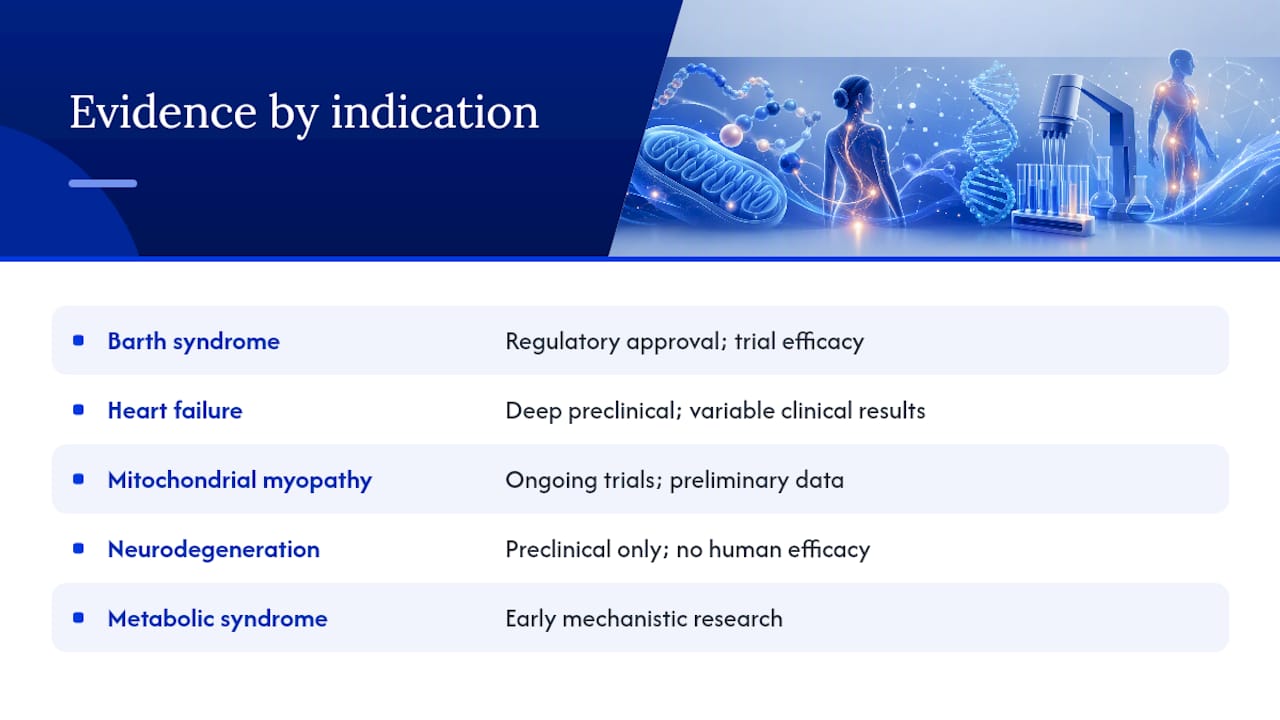
Evidence quality varies sharply depending on which condition you’re looking at, and conflating them is probably the single most common misreading of elamipretide’s clinical story.
Barth syndrome sits at the top of the evidence hierarchy simply because it’s the approved indication. Trial data supporting the accelerated approval showed measurable muscle strength improvements in this rare mitochondrial disorder, in a population defined by cardiolipin abnormalities that make the drug’s mechanism particularly relevant. The population studied is small by necessity. Barth syndrome is ultra-rare, affecting primarily males due to its X-linked inheritance pattern, so trial sample sizes are inherently limited compared to studies in common chronic diseases. That’s not a flaw in the science; it’s a structural feature of rare disease research that regulators account for through the accelerated approval framework itself.
Heart failure and ischemia-reperfusion injury represent the deepest preclinical dataset outside Barth syndrome. Animal models of cardiac ischemia consistently show elamipretide preserving mitochondrial structure and reducing infarct size when administered around the reperfusion window. That preclinical consistency is genuinely striking. But clinical trials in human heart failure populations have not reproduced the same magnitude of benefit, and results across different heart failure trial designs have been variable enough that no regulatory filing has followed. The gap here illustrates a recurring theme in mitochondrial-targeted therapeutics generally: rodent cardioprotection is comparatively easy to demonstrate, human clinical benefit is not.
Primary mitochondrial myopathy, a broader category than Barth syndrome, has ongoing investigational trials examining whether elamipretide’s mechanism generalizes to other genetic mitochondrial defects. Data here remain preliminary, and no clear efficacy signal has been confirmed at a scale that would support regulatory action. This is arguably the indication to watch most closely over the next several years, given the mechanistic plausibility and the unmet need in this patient population.
Neurodegeneration research is almost entirely preclinical. Animal models of Parkinsonian and Alzheimer’s-type neurodegeneration have shown elamipretide preserving mitochondrial function and reducing neuronal loss in specific model systems. Whether that protection holds in human neurodegenerative disease, where blood-brain barrier penetration and dosing duration present additional hurdles, is unanswered. No robust human efficacy data exist in this space yet.
Metabolic syndrome applications are similarly early-stage, with mechanistic rationale, given mitochondrial dysfunction’s role in insulin resistance, but limited direct clinical evidence specific to elamipretide’s effect on metabolic endpoints.
Across all of this, a 2025 peer-reviewed review makes a point worth repeating to any team designing a translational study: the animal-to-human translational gap in mitochondrial therapeutics is wide, and effect sizes documented in rodent models rarely predict effect sizes in human trials with the same reliability seen in, say, oncology models. Sample sizes in the human trials conducted so far tend to be small, endpoints vary between studies, and standardized biomarker panels for mitochondrial function in clinical trials are still maturing as a field-wide problem, not one specific to this molecule.
If you’re prioritizing where to place research or clinical attention, Barth syndrome is the only place with confirmed regulatory-grade evidence. Heart failure has the deepest preclinical case but the weakest clinical translation so far. Everything else is still in the hypothesis-testing phase.
What Are the Safety and Monitoring Considerations?
The safety profile reported in trials supporting FORZINITY™’s approval centers heavily on injection-site reactions, which is the most commonly observed adverse event category for a daily subcutaneous peptide. Beyond local site reactions, no serious safety signal has emerged that would flag elamipretide as high-risk in the approved population.
Cardiac safety has received particular attention given the drug’s mitochondrial mechanism and its investigational use in heart failure populations. Available data show no clinically significant QTc prolongation even at concentrations three times peak plasma levels, based on findings referenced in chemical and pharmacologic summaries. That’s a reassuring signal for a peptide being studied in cardiac-adjacent indications, though it does not eliminate the need for baseline and periodic cardiac monitoring in trial protocols, especially for patients with pre-existing arrhythmia risk.
Monitoring and population caution points relevant to clinicians and investigators include:
- Injection-site reactions are the most frequently reported adverse event and typically don’t require dose discontinuation
- No clinically meaningful QTc prolongation observed at 3x peak concentration in available data
- Safety and efficacy in patients under 30 kg body weight have not been established
- Pregnancy and lactation data remain limited; use in these populations should be approached with the same caution applied to any peptide therapeutic without established reproductive safety data
- Post-marketing pharmacovigilance is mandatory under the accelerated approval framework, meaning adverse event reporting standards are actively being built out as real-world use expands
Pro Tip: If you’re designing a trial protocol or monitoring plan involving elamipretide, build in baseline ECG assessment even though QTc data look clean so far. Accelerated approval populations are small, and cardiac monitoring standards tend to tighten, not loosen, as post-marketing data accumulate.
Because FORZINITY™’s approval is recent and based on an intermediate endpoint, the pharmacovigilance requirements attached to it are more active than they would be for a drug with a decade of real-world use behind it. Clinicians prescribing off-label or enrolling patients in investigational trials should document adverse events with the same rigor expected of a drug still generating its confirmatory evidence base.
Research Methods and Sourcing Guidance for Investigators
Reproducibility in elamipretide research hinges as much on methodology discipline as on the compound itself, and labs new to mitochondrial peptide work benefit from a few concrete calibration points.
1. Model selection and dose ranges. In vitro mechanistic work commonly uses isolated mitochondria or permeabilized cell preparations exposed to elamipretide in the low nanomolar to low micromolar range, consistent with concentrations used in the cross-linking interactome study. Animal dosing in cardioprotection and myopathy models has varied widely across published protocols, which is exactly why exposure-based comparisons (AUC, Cmax) matter more than raw mg/kg figures when planning a translational bridge to human dosing.
2. Core assay selection. ATP production assays (luciferase-based luminescence) and oxygen consumption rate measurements using a Seahorse extracellular flux analyzer remain the standard readouts for mitochondrial bioenergetic effect. Pair these with a cardiolipin peroxidation assay (commonly using fluorescent cardiolipin-binding dyes) to directly test the mechanism rather than inferring it from downstream ATP changes alone. For interactome-style mechanistic work, cross-linking mass spectrometry following the approach used in the PNAS study offers a template for identifying novel protein binding partners, though it requires specialized proteomics infrastructure most labs will need to access through a core facility.
3. Sourcing and reproducibility controls. Peptide purity variance between batches is an underappreciated confound in mitochondrial assay work, where subtle degradation products can shift oxidative stress readouts independent of the parent compound’s actual activity. Use research-grade peptide accompanied by a certificate of analysis, and document lot number, reconstitution solvent, and storage temperature in every published or internal report. Synthrolab’s approach to peptide sourcing reflects this standard: batch-specific purity testing paired with documented reconstitution guidance gives labs a verifiable starting point rather than an assumed one.
4. Biomarker and PK sampling strategy. For early human or translational studies, prioritize biomarkers tied mechanistically to the interactome findings, ATP synthesis efficiency and markers of 2-oxoglutarate pathway activity, over generic oxidative stress panels that may not capture elamipretide’s specific mode of action. Structure PK sampling around the known rapid subcutaneous absorption window to avoid missing peak concentration data.
Pro Tip: When reporting results for future meta-analysis, include raw effect sizes and confidence intervals rather than p-values alone. Given how thin the human trial dataset remains across most indications, standardized reporting is what will let future reviewers pool data meaningfully instead of discarding studies for incompatible endpoints.
How Is Elamipretide Synthesized and Manufactured?
Elamipretide is produced through solid-phase peptide synthesis (SPPS), the standard manufacturing approach for short peptides with non-natural amino acid residues. The synthesis begins by anchoring the C-terminal amino acid, phenylalanine amide in this case, to a solid resin support, then sequentially adding protected amino acids: lysine, Dmt, and D-arginine, working from C-terminus to N-terminus.
The inclusion of 2’,6’-dimethyltyrosine (Dmt), a non-standard amino acid not found in natural proteins, adds synthesis complexity compared to a purely proteinogenic peptide. Dmt must be synthesized or sourced separately as a protected building block before incorporation into the SPPS cycle, and its steric bulk requires optimized coupling conditions to avoid incomplete reactions at that position.
After chain assembly, the peptide is cleaved from the resin, globally deprotected, and purified, typically through reverse-phase high-performance liquid chromatography (HPLC), to isolate the target sequence from truncated or side-reaction byproducts. Final identity and purity confirmation relies on mass spectrometry and analytical HPLC, generating the data that feeds into a certificate of analysis.
For research applications, batch-to-batch consistency in this synthesis process is not a minor detail. Even small deviations in coupling efficiency at the Dmt position can generate deletion sequences that co-elute with the target peptide if purification isn’t rigorous, introducing impurities that can measurably skew mitochondrial assay readouts. That is precisely why documented COA data, not just a label claiming a purity percentage, matters for anyone running quantitative bioenergetic work.
Could Elamipretide Interact With Other Drugs or Compounds?
Formal drug interaction studies for elamipretide remain limited in the published literature, which is typical for a recently approved therapy in an ultra-rare disease population. No major cytochrome P450-mediated interactions have been highlighted in current labeling, consistent with the peptide’s metabolism through peptidase-driven breakdown into inactive fragments rather than hepatic enzymatic pathways that commonly drive small-molecule drug interactions.
That said, absence of documented interactions is not the same as proven safety in combination with every other medication class. Barth syndrome patients frequently take cardiac medications given the condition’s cardiomyopathy component, and any investigator or clinician working with elamipretide in this population should monitor for additive effects on cardiac parameters, particularly in patients on other agents with known QTc effects, even though elamipretide itself hasn’t shown significant QTc prolongation on its own.
For investigational use in heart failure or mitochondrial myopathy trials, protocols typically screen for concomitant use of other mitochondria-targeted or antioxidant compounds to avoid confounding mechanistic readouts, not necessarily because of a known adverse interaction, but because overlapping mechanisms make it hard to attribute effect to one agent versus another.
Researchers combining elamipretide with other investigational peptides in preclinical models should document co-administration explicitly in methods sections, since the interactome data showing specific protein binding partners raises a reasonable question about whether co-administered compounds targeting the same mitochondrial proteins could compete for binding or produce additive effects that haven’t yet been characterized.
What Do We Know About Long-Term Efficacy and Safety?
Long-term data on elamipretide remain genuinely limited, a direct consequence of FORZINITY™’s recent 2025 approval and the small, rare-disease population it serves. The accelerated approval pathway itself acknowledges this gap by requiring confirmatory trials specifically because the muscle strength endpoint used for approval is an intermediate marker, not proof of durable, years-long clinical benefit.
What exists so far comes primarily from extension phases of the trials that supported approval, tracking patients who continued therapy beyond the initial study period. Early signals suggest sustained muscle strength benefits without new safety concerns emerging over extended use, but the patient numbers involved are small enough that rare adverse events could easily go undetected until broader real-world use accumulates.
This is where post-marketing pharmacovigilance becomes functionally important rather than a regulatory formality. Every Barth syndrome patient started on FORZINITY™ post-approval effectively contributes to the long-term safety dataset the confirmatory trials are meant to build. For investigational indications like heart failure or mitochondrial myopathy, long-term data are even thinner, since those studies haven’t reached the scale or duration needed to characterize years-long outcomes.
Investigators planning extended studies should treat long-term cardiac monitoring, injection-site tolerance over repeated years of daily dosing, and any signal of immunogenicity (antibody formation against a chronically administered peptide) as priority endpoints, given how sparse this data currently is across the literature.
What Do Cost and Access Look Like for Patients?
FORZINITY™’s cost and accessibility sit within the broader pattern typical of rare-disease orphan drugs: specialized manufacturing, a small patient population, and accelerated approval status generally combine to produce a high list price relative to common chronic disease medications, though exact pricing is set by the manufacturer and typically negotiated through insurance and patient assistance channels rather than published as a fixed public rate.
Barth syndrome’s rarity means most patients will access FORZINITY™ through specialty pharmacy channels rather than a standard retail pharmacy, often coordinated through the treating mitochondrial disease specialist or genetic disease center managing the patient’s care. Insurance coverage for accelerated-approval orphan drugs varies substantially by payer, and prior authorization requirements are common given the drug’s cost profile and narrow approved population.
Patient assistance programs are typical for orphan drugs in this category, and families navigating a Barth syndrome diagnosis should expect the prescribing center to have established pathways for coverage support, given how concentrated the treating population is among a small number of specialized mitochondrial disease clinics nationally. For research use rather than patient treatment, accessing elamipretide as a compound for laboratory investigation runs through an entirely separate channel: research-grade peptide suppliers rather than pharmacy distribution, governed by research-use protocols rather than clinical prescribing rules.
The Gap Between Regulatory Milestone and Broader Promise
Elamipretide’s story right now is really two stories running in parallel, and conflating them does a disservice to both. In Barth syndrome, this is a real, working therapy with regulatory backing and a defined confirmatory path ahead. In nearly every other mitochondrial disease context, it’s still a hypothesis being tested, one with genuinely strong mechanistic grounding but a track record of preclinical promise not yet matching clinical translation, especially in heart failure.
My honest read: the field’s biggest need isn’t more rodent cardioprotection data. It’s better biomarkers. The interactome work pointing toward ATP synthesis and 2-oxoglutarate pathway involvement gives investigators something more specific to measure than generic oxidative stress panels, and that specificity should shape the next generation of trial design. Confirmatory trials for Barth syndrome, standardized mitochondrial biomarker panels, and longer safety follow-up matter more right now than expanding into new indications on preclinical enthusiasm alone.
Researchers evaluating where to invest time should weigh the confirmed Barth syndrome mechanism against the still-unproven broader claims, and tools like reliable cellular signaling primers can help teams build that mechanistic literacy before committing to a study design.
— Mitch
Rigorous elamipretide research depends on knowing exactly what’s in the vial, and that’s the problem Synthrolab is built to solve. Every batch ships with independent purity testing and a documented certificate of analysis, so lot-to-lot variability doesn’t quietly skew your ATP or ROS readouts the way unverified peptide sources often do.
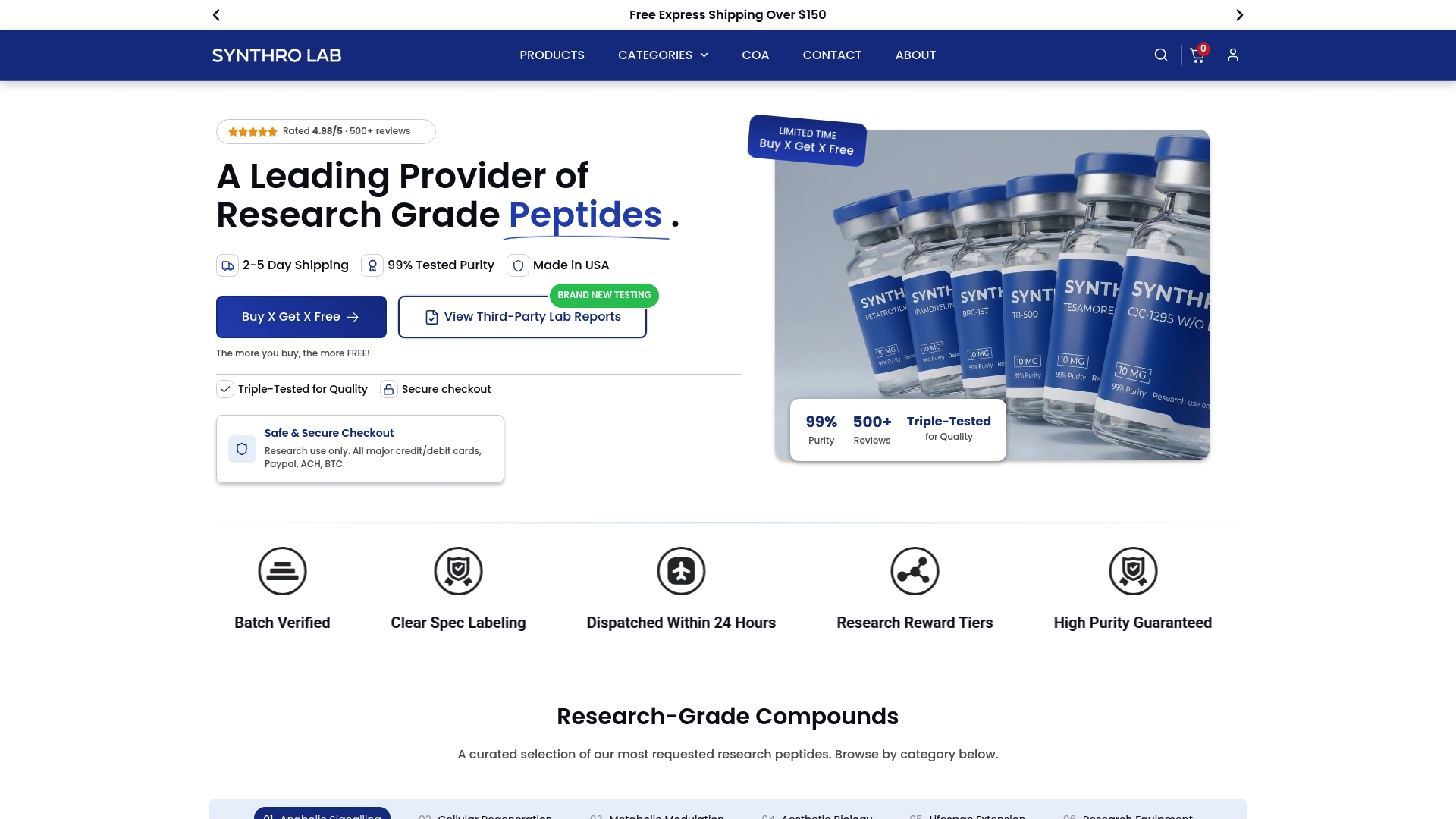
Beyond elamipretide-adjacent research, Synthrolab’s catalog covers the broader mitochondrial and metabolic research space, alongside reconstitution solutions and lab equipment suited to bioenergetic assay work. If you’re new to structuring a peptide research protocol or want a clear primer on purity standards and peptide categories before ordering, Simple Peptides Explained walks through exactly what separates research-grade product from unreliable sourcing. Labs needing bulk documentation, technical data sheets, or batch-specific COAs for a grant application or IRB submission can request that documentation directly through Synthrolab’s product pages before placing an order.
Sources
For readers who want to go straight to the primary evidence behind elamipretide’s mechanism and regulatory status, start with the FDA’s accelerated approval announcement for the regulatory record, then the PMC mechanistic review for structure and cardiolipin-binding evidence. The PNAS interactome study covers the cross-linking mass spectrometry findings in full technical detail, while PubChem’s compound entry provides verified chemical identifiers. Clinical dosing details appear in MedlinePlus’s drug reference, and investigational trial status across other indications can be tracked through ClinicalTrials.gov.
This article is general information, not a substitute for advice from a qualified doctor. Consult a qualified healthcare professional about your own circumstances before acting on anything here.
Recommended
 21+ verification