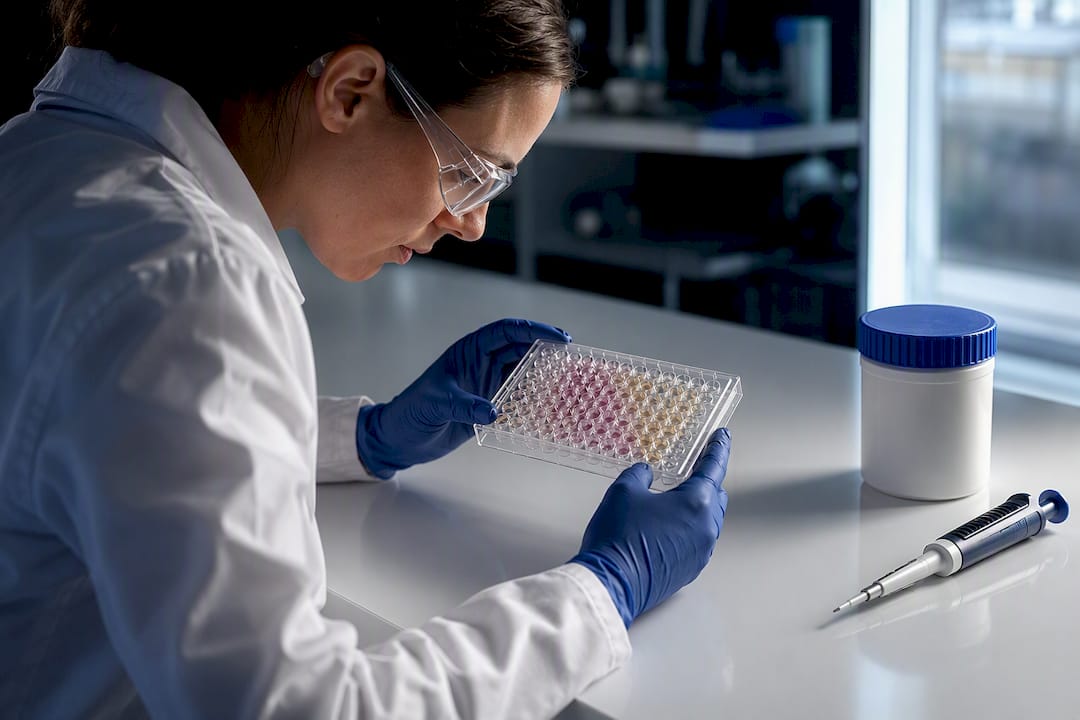
The right approach is kinetic chromogenic or turbidimetric LAL, or rFC, for endotoxin-specific quantification on peptide lots. Reserve MAT or the rabbit pyrogen test for cases where non-endotoxin pyrogens are suspected or assay interference can’t be resolved. None of these methods matter without spike-recovery inhibition/enhancement (I/E) validation on the actual peptide matrix, paired with a properly calculated maximum valid dilution (MVD).
TL;DR:
- Kinetic chromogenic and turbidimetric LAL assays detect endotoxins at levels 10 to 60 times lower than gel-clot methods, improving contamination sensitivity.
- rFC assays match the sensitivity of kinetic LAL tests and avoid false positives from β-glucans, making them preferable when β-glucan interference is suspected.
- Validating spike recovery and calculating maximum valid dilution are essential for accurate endotoxin testing in peptide matrices, preventing false negatives or positives.
- Peptide samples can carry residual endotoxin independent of sterility, affecting cell assays, animal studies, and reproducibility, requiring separate endotoxin testing from sterility checks.
- Always verify endotoxin certificate of analysis shows lot-matching, method clarity, and validation; avoid relying on blank or inconsistent results for critical assays.
Table of Contents
What Endotoxin Is and Why It Matters for Peptides
Endotoxin is lipopolysaccharide (LPS), a structural component of the outer membrane in gram-negative bacteria. It’s one of the most potent pyrogens known, capable of triggering a measurable cytokine cascade at concentrations far below what would register as a viable contamination problem. That potency is exactly why it deserves separate attention from routine sterility checks.
Here’s the part that trips people up: LPS survives autoclaving, filtration, and most standard sterilization steps. A batch can be perfectly sterile, with zero viable organisms, and still carry enough residual endotoxin to derail an experiment. That distinction matters because sterility testing detects viable organisms while endotoxin assays quantify non-viable pyrogen load — they answer different questions entirely.
For peptide work specifically, the practical consequences show up in a few predictable places:
- Cell-based assays: even trace endotoxin can activate monocytes or macrophages in culture, producing a cytokine signal that has nothing to do with your peptide’s actual biological activity.
- Animal studies: pyrogenic responses (fever, inflammatory markers) can mask or mimic the effect you’re trying to measure.
- Immunoassays: background activation from contaminated peptide stock can shift baseline readings enough to obscure a real dose-response curve.
- Reproducibility: endotoxin variance between lots is a common, underappreciated source of “my results don’t replicate” frustration in peptide research.
Sterility and endotoxin testing are complementary, not interchangeable. A peptide passing one says nothing about the other.
Three LAL formats dominate compendial endotoxin testing, and they aren’t interchangeable in sensitivity or workflow. Gel-clot is the oldest method: a qualitative, pass/fail reaction where a firm gel forms if endotoxin exceeds the lysate’s labeled sensitivity. It’s simple and cheap, but it only tells you whether you’re above or below a threshold, not how far.
Kinetic chromogenic and kinetic turbidimetric LAL are quantitative. They track a reaction rate over time, either color development or turbidity, and back-calculate an actual EU/mL value against a standard curve. Kinetic methods routinely detect endotoxin down to around 0.005 EU/mL, with some validated setups reaching 0.001 EU/mL, while gel-clot sensitivity typically runs between 0.015 and 0.06 EU/mL.
Sensitivity snapshot: Kinetic chromogenic and turbidimetric LAL can resolve endotoxin roughly 10 to 60 times finer than gel-clot, which is the difference between catching a marginal contamination event and missing it entirely.
Recombinant Factor C (rFC) is the animal-free alternative built around a single recombinant protein rather than horseshoe crab lysate. rFC assays achieve sensitivity comparable to kinetic LAL and, because they don’t rely on the full clotting cascade, resist false positives from β-glucans that plague LAL when samples contain cellulose-derived filter residues or certain buffer components.
None of these three methods, LAL or rFC, detects anything other than endotoxin. That’s a limitation, not a flaw, but it means:
- If a peptide preparation is suspected of harboring non-endotoxin pyrogens (certain fungal or viral contaminants, for instance), LAL and rFC will read clean regardless.
- The monocyte activation test (MAT) picks up a broader range of pyrogens by measuring actual cytokine release from human monocytes, and NICEATM/NTP evaluations note it can substitute for the rabbit pyrogen test in specific, validated applications.
- The rabbit pyrogen test (RPT) still appears in some regulatory monographs, though it’s increasingly viewed as a fallback rather than a first choice given its cost, variability, and animal welfare concerns.
For most peptide research applications, LAL or rFC covers the real risk. Escalate to MAT only when there’s a specific reason to suspect a pyrogen that LPS-specific assays would miss.
Sample Prep and Inhibition/Enhancement Controls for Peptide Matrices
Peptide matrices are notorious for skewing LAL results in both directions, so validation isn’t optional. The starting point is calculating your maximum valid dilution (MVD), the most dilute concentration at which your sample can still be tested while remaining under the endotoxin limit for its intended use. Dilute beyond MVD and you risk missing real contamination; stay too concentrated and matrix effects distort the reading.
A workable sample-prep and validation sequence looks like this:
- Reconstitute and dilute using Water for Bacteriostatic Endotoxin Testing (Water for BET), never generic lab water, since even trace LPS in the diluent will contaminate the whole run. Synthrolab’s peptide water guide covers reconstitution practices that avoid this exact pitfall.
- Calculate MVD based on the endotoxin limit for your application and your peptide’s labeled potency or concentration.
- Prepare a spike-recovery series: add a known quantity of endotoxin standard to diluted sample at several dilution steps around your intended test dilution.
- Run the spiked samples alongside unspiked controls and calculate percent recovery at each dilution.
- Confirm recovery falls within the accepted range, typically 50 to 200 percent per compendial guidance, before trusting any result from that dilution.
Pro Tip: Build a standing MVD worksheet for the peptide concentrations you test most often. Ad hoc math under deadline pressure is where dilution errors creep in, and a pre-validated reference table removes that risk entirely.
If I/E fails at your planned dilution, you have three real options: dilute further (if you’re still under MVD), add a glucan-blocking reagent if β-glucan interference is suspected, or switch to rFC, which sidesteps the glucan pathway altogether. Laboratory guidance treats this spike-recovery step as the single most important validation point for complex matrices like peptides, and skipping it is the most common reason peptide endotoxin data turns out to be unreliable months after the fact.
How Do You Calculate MVD and Interpret EU Results?
Endotoxin results are reported in Endotoxin Units per milliliter (EU/mL), and for peptides you’ll often need to convert that to EU per microgram of peptide (EU/μg) to compare against a potency-based limit. The conversion is straightforward: divide the EU/mL value by the peptide concentration in μg/mL at the point of testing.
The MVD formula itself is simple: MVD equals the endotoxin limit multiplied by the sample concentration, divided by the lysate sensitivity (lambda). Say you’re preparing a peptide for an in vitro cell assay with an endotoxin limit of 0.5 EU/mL, a sample concentration of 1,000 μg/mL, and a lysate sensitivity of 0.03 EU/mL. Your MVD works out to roughly 16.7, meaning you can dilute the sample up to that factor and still validly test it. For a hypothetical small-animal dosing scenario with a tighter limit, the same math applies, just with a smaller allowable dilution because the limit itself is lower.
Common interferences you’ll run into during this process include:
- β-glucans from cellulose filters or certain excipients, which false-positive standard LAL.
- Colored or turbid solutions, which distort the optical readouts that kinetic chromogenic and turbidimetric methods depend on.
- Extreme pH or high-salt buffers, which can inhibit the clotting cascade outright.
Mitigation almost always starts with dilution, since most interference is concentration-dependent and disappears once you’re diluted enough. When dilution alone doesn’t clear it, glucan-specific blocking reagents or a switch to rFC are the next steps.
How to Read and Verify Endotoxin Data on a Certificate of Analysis
A trustworthy endotoxin COA reports a specific numeric value in EU/mL or EU/μg, names the method used (gel-clot, kinetic chromogenic, kinetic turbidimetric, or rFC), and matches the lot number on the vial in your hand. It should also reference I/E validation, even briefly, confirming the matrix was checked rather than assumed clean.
Watch for these red flags before you trust a number:
When any of these show up, request third-party testing or a lot-matched retest before using the material in an assay where background cytokine activation would ruin your data. Synthrolab’s guidance on verifying COAs before ordering walks through the same lot-matching discipline in more detail.
Manufacturing and Lab Controls That Reduce Endotoxin Risk
Endotoxin control starts upstream, long before a peptide reaches a research bench. Manufacturers that take this seriously validate their water systems for BET compliance, run documented depyrogenation cycles on glassware and equipment, and monitor cleaning procedures with the same rigor they apply to identity and purity testing.
On the lab side, the controls are just as concrete:
- Use depyrogenated glassware or certified low-endotoxin disposables for anything touching a peptide solution destined for a sensitive assay.
- Reconstitute with Water for BET, not standard molecular-grade or deionized water, which can carry meaningful background endotoxin.
- Avoid reusing pipette tips or containers across peptide preps without a validated cleaning step, since residual LPS is notoriously sticky.
- Log every lot’s endotoxin data alongside its purity and sterility results, so a discrepancy is caught at intake, not mid-experiment.
Pro Tip: If a lot of tests above your acceptable limit, don’t just discard it quietly and move on. Document the failure, notify the supplier, and require corrective-action documentation before accepting a replacement lot. Suppliers that can’t explain a spike in endotoxin readings are telling you something about their process controls.
Remediation, in short, is a paper trail as much as a lab procedure. A rejected lot with no documentation just becomes next month’s unexplained anomaly.
Synthrolab’s Approach to Endotoxin-Aware Peptide Research
Synthrolab’s lab guides, including the peptide water reconstitution guide and practical notes on LL-37 handling, build endotoxin-aware habits directly into everyday sample prep rather than treating it as a separate compliance step.
A reproducible checklist worth adopting immediately: confirm Water for BET in every reconstitution step, run I/E validation before trusting any dilution series, calculate MVD as a standing SOP item rather than an afterthought, and require lot-matched COA data before a peptide touches a sensitive assay.
One caution worth repeating: endotoxin testing is narrow by design. A clean result speaks only to pyrogen load on that specific batch. It says nothing about identity or purity, which is why an orthogonal check like LC-MS analysis still belongs in the workflow.
What Should Lab Managers Prioritize Next Quarter?
If I ran a peptide research lab, I’d make three changes before the quarter ends. First, no peptide lot enters a sensitive assay without a lot-matched endotoxin value and documented I/E validation, full stop. Second, MVD calculation gets written into the SOP, not left to whoever’s on shift that day. Third, I’d default to rFC wherever β-glucan risk is plausible, and save MAT or RPT for the rare case where a non-endotoxin pyrogen is genuinely suspected.
— Mitch
Get Pre-Tested Peptides With Documentation You Can Actually Verify
If you’d rather not build an I/E validation workflow from scratch, working with peptides that already ship with a documented certificate of analysis solves the same problem from the other direction. Research-grade peptides with lot-specific COAs and lab guides built around endotoxin risks, from water selection to reconstitution handling, are provided.
If you’re evaluating a new peptide for a cell-based or in vivo protocol, request lot-matched endotoxin data before you order, and check Synthrolab’s guide to research-grade peptide quality documentation to see what a complete COA should include. Getting that verification step right before the vial arrives saves a full validation cycle later.
Primary Standards and Guidance Worth Bookmarking
This article is general information, not a substitute for advice from a qualified doctor. Consult a qualified healthcare professional about your own circumstances before acting on anything here.
Sources
Recommended
 21+ verification