Follistatin 344 (FS-344) is the longer, unprocessed transcript of the follistatin gene, and its best documented muscle-growth effects come from one-time AAV gene delivery in animals and small investigational human trials, not from injected recombinant protein. No recombinant FS-344 product has cleared human safety or efficacy testing, follistatin-class myostatin inhibitors are banned under WADA’s prohibited list, and researchers should treat vial-labeled “Follistatin-344” products with real skepticism until verified.
TL;DR:
- Human evidence for follistatin 344 muscle growth primarily comes from gene therapy studies, not from injectable protein trials, which remain unverified for safety or efficacy.
- The strongest data supporting muscle hypertrophy come from a 2008 gene therapy study showing durable, significant muscle growth in animals from a single AAV1-FS-344 injection, not from peptides.
- Commercial “Follistatin-344” vials often vary widely in actual content, requiring rigorous in-house verification like mass spectrometry and purity tests before use.
- Systemic delivery of FS-344 can cause safety issues such as eye problems, hormone disruption, and tendon strain, necessitating baseline monitoring in research protocols.
- No validated human dosing protocols exist for injectable FS-344, and animal data cannot be reliably scaled to humans without thorough pharmacokinetic, safety, and biomarker studies.
Synthrolab
Support Rigorous Follistatin Research
Synthro Lab provides research-grade peptides and laboratory compounds for investigating cellular signalling, metabolism, recovery, and longevity mechanisms.
Explore research compounds
Table of Contents
What Is Follistatin 344 and How Does It Work?
FS-344 is the 344-amino-acid precursor form of the follistatin protein encoded by the FST gene, cataloged in reference databases as NP_037541.1. Enzymatic processing clips it down to FS-315, the shorter, circulating isoform most commonly found in blood plasma. A third variant, FST-288, carries a heparin-binding domain that anchors it tightly to cell surfaces and extracellular matrix rather than letting it diffuse through tissue. That distinction matters for anyone designing an experiment: FS-344 and FS-315 behave more like freely diffusible signaling molecules, while FS-288 stays local.
Mechanistically, all follistatin isoforms work by binding and neutralizing myostatin, along with activin A, activin B, and GDF-11. These ligands normally activate the activin type II receptor (ActRII), which triggers SMAD2/3 phosphorylation and suppresses muscle protein synthesis. Follistatin acts as a decoy, sequestering the ligands before they reach the receptor, which lifts that suppression.
The downstream biology is more layered than a simple “myostatin off switch.” Research on follistatin overexpression shows that skeletal muscle hypertrophy is driven partly through Smad3 and mTOR signaling independent of myostatin itself, meaning follistatin engages growth pathways beyond the one it is best known for blocking. That has real implications for interpreting effect sizes: a molecule with two semi-independent growth levers can produce hypertrophy even in tissue with normal myostatin activity.
Distribution also drives safety. Because FS-344 and FS-315 travel systemically rather than staying put, broad activin suppression can reach tissues where activin signaling is doing something useful, like the pituitary-gonadal axis. That systemic reach is a direct line to several of the safety concerns covered later in this article.
Preclinical and Gene-Therapy Evidence for Muscle Growth
The strongest data on follistatin muscle growth comes from a single 2008 study that reshaped how the field thinks about myostatin inhibition. Haidet and colleagues delivered a single dose of AAV1 carrying the FS-344 gene directly into the muscle of mice, rats, and a nonhuman primate. The result: increased muscle mass and strength that persisted for more than two years in the study subjects, all from one injection. No repeated dosing, no ongoing administration. Local muscle expression of the transgene kept producing follistatin protein continuously at the injection site.
That durability is the headline finding, but the functional data matters just as much. Treated animals didn’t just grow bigger muscles on a scale. They showed measurable strength gains and, in some cohorts, better performance on functional tests. Histology confirmed genuine muscle fiber hypertrophy rather than fluid retention or an artifact of measurement.
Other transgenic and overexpression work in larger animals, including pigs, backs up the mouse data and reinforces the Smad3/mTOR mechanism described above. Across species, the pattern holds: sustained local follistatin expression produces meaningful, durable hypertrophy.
Here’s the piece that gets lost in casual discussion of this research: these are gene-therapy outcomes, not pharmacology outcomes. A viral vector integrating into muscle tissue and producing a steady, localized trickle of follistatin protein for years is a completely different exposure profile than injecting a bolus of recombinant peptide that peaks and clears within hours or days. The AAV approach sidesteps the pharmacokinetic problems that plague injectable peptide therapeutics, specifically short half-life and the need for frequent dosing to maintain any meaningful tissue concentration.
None of this validates an injectable FS-344 product. It validates the biological concept, delivered through a specific vehicle that grey-market vials do not replicate. Confusing “the gene therapy worked” with “the peptide works” is the single most common misreading of this literature.
Human Clinical Evidence and Where Regulators Stand
Human data on FS-344 exists, but it is thin and comes exclusively from gene-therapy programs, not injectable protein trials. Investigator-sponsored AAV1-FS344 trials, associated with the Mendell research program, have tested the approach in small cohorts of patients with muscular dystrophy under Investigational New Drug (IND) frameworks. Reported outcomes include functional improvements, such as gains on six-minute walk testing, in a subset of treated patients. Sample sizes are small, and these are early-phase, disease-specific trials, not general muscle-growth studies in healthy subjects.

What does not exist is any published Phase 1 human trial of unmodified recombinant FS-344 protein delivered by injection. Review literature on the topic consistently notes that the strongest human evidence sits with gene-delivery constructs or engineered ligand traps, not with the raw recombinant peptide sold in research-chemical channels. That gap is not a technicality. It means there is no human dose-response data, no human pharmacokinetic profile, and no human safety database for the injectable product form that most buyers actually encounter.
Regulatory status follows directly from that evidence gap. No recombinant FS-344 product carries approval from any medical regulator for any indication. The AAV1-FS344 programs remain investigational, operating under IND status for specific rare-disease indications, which is a categorically different thing from a commercially approved therapy. IND status permits controlled human testing; it does not mean the product is cleared for general use, and it certainly does not extend to the unmodified recombinant peptide.
On the anti-doping side, the line is unambiguous. Follistatin and related myostatin inhibitors sit on WADA’s prohibited list under the peptide hormones and related substances category, banned both in and out of competition. Any research program touching human athletes or samples needs to treat that classification as a fixed constraint, not a gray area.
Documented Safety Risks and What to Monitor
Three safety signals recur across the literature, and none of them are theoretical.
The first is ocular. Case reports link subcutaneous follistatin exposure to central serous chorioretinopathy (CSCR), a condition where fluid accumulates under the retina and distorts vision. The mechanism isn’t fully mapped, but the pattern has shown up often enough that ocular monitoring belongs in any protocol touching this molecule.

The second is endocrine. Broad activin suppression can knock down FSH production, since activin normally stimulates the pituitary to release it. Reproductive-axis research on activin and follistatin physiology documents this interaction directly, and it’s the biological basis for fertility concerns tied to systemic myostatin inhibitors generally.
The third is structural. Muscle can respond to myostatin inhibition faster than tendon and connective tissue can adapt. That mismatch creates a plausible mechanism for tendon strain or rupture when muscle strength outpaces the load-bearing capacity of the tissue that anchors it, a concern that shows up across the broader myostatin-inhibitor literature.
For any preclinical protocol involving FS-344, a baseline monitoring approach should include:
- Baseline and periodic ophthalmology exams, including OCT retinal imaging, before and during exposure.
- Hormone panels covering FSH, LH, and testosterone or estradiol at baseline and at regular intervals.
- Functional tendon and connective-tissue assessment alongside any strength testing.
- Predefined stopping rules tied to any visual symptom, hormone panel deviation, or musculoskeletal pain report.
Pro Tip: Treat any visual symptom, even mild blurring, as an automatic protocol pause pending ophthalmology clearance. CSCR case reports describe onset that researchers initially dismissed as unrelated eye strain.
Sourcing and Verifying Follistatin Peptide Material
The The single biggest practical problem in this space isn’t the biology. It’s the vial. Analytical work examining commercially available material labeled “Follistatin-344” found wide variability in actual content across vendor samples, meaning what’s printed on the label and what’s actually inside frequently don’t match. Some vials may contain degraded fragments, the wrong isoform, or concentrations far off from what’s stated.
Independent verification isn’t optional if the goal is reproducible data. Before any material goes near an assay:
- Confirm intact mass by mass spectrometry to check the molecule matches the expected sequence.
- Run tryptic peptide mapping to catch truncations or incorrect processing.
- Check purity by HPLC and screen for endotoxin contamination, especially before any cell-based or in vivo work.
- Require a certificate of analysis (COA) from the supplier and treat it as a starting point, not a substitute for in-house verification.
Storage matters too. Follistatin proteins are sensitive to freeze-thaw cycling and temperature excursions during shipping. Reconstituted material should be aliquoted to avoid repeated thawing, stored per the supplier’s cold-chain guidance, and used within the stability window that verification testing supports, not an assumed shelf life.
Pro Tip: Run your own binding assay against ActRII, or a comparable reporter system, before committing a full experimental cohort to a new lot. It’s the fastest way to catch a mislabeled or degraded vial before it wastes weeks of animal work.
Institutional oversight isn’t a checkbox exercise here either. Animal work requires IACUC approval, any human-adjacent research needs IRB review, and anything approaching clinical application runs into IND requirements. Biosafety classification should follow institutional guidelines for recombinant protein handling.
Why There Is No Validated Dosing Protocol
There is no validated human dosing protocol for injectable FS-344, and treating community-reported numbers as clinical guidance is a mistake with real consequences. Gene-delivery studies produce sustained local expression from a single administration; that pharmacokinetic profile has nothing in common with a bolus subcutaneous injection that peaks and clears within a day. Anecdotal dosing ranges circulating in biohacker forums are not derived from PK/PD studies and should be labeled exactly that: anecdote, not evidence.
A defensible experimental path looks like this instead:
- Start with in vitro binding and ActRII reporter assays to confirm the material is biologically active before any live-animal exposure.
- Move to rodent pharmacokinetic and pharmacodynamic studies to establish clearance rates and dose-response before scaling up.
- Layer in biomarker endpoints, including hormone panels and functional strength measures, at every dose tier.
- Set conservative stopping criteria tied to any adverse signal, and never extrapolate rodent dosing directly to larger models without an intermediate step.
What the Translational Gap Actually Means for Researchers
The gene-therapy data is genuinely strong. The injectable-peptide data is not, and pretending otherwise is where this field keeps getting ahead of itself. My priority list for anyone serious about this molecule: fund the ocular and reproductive-axis safety studies first, characterize PK/PD for any recombinant construct before touching efficacy questions, and insist on verified, sequence-confirmed material with open data sharing on what that verification found.
— Mitch
Where Synthrolab Fits Into Follistatin Research
If the biggest obstacle in this field is a mismatch between what’s on the label and what’s in the vial, the fix is verification you can actually trust before an experiment starts. Some suppliers offer research-grade peptides and lab compounds with batch testing and certificates of analysis attached to each product, built specifically for scientists who need to know what they’re putting in an assay before they run it.
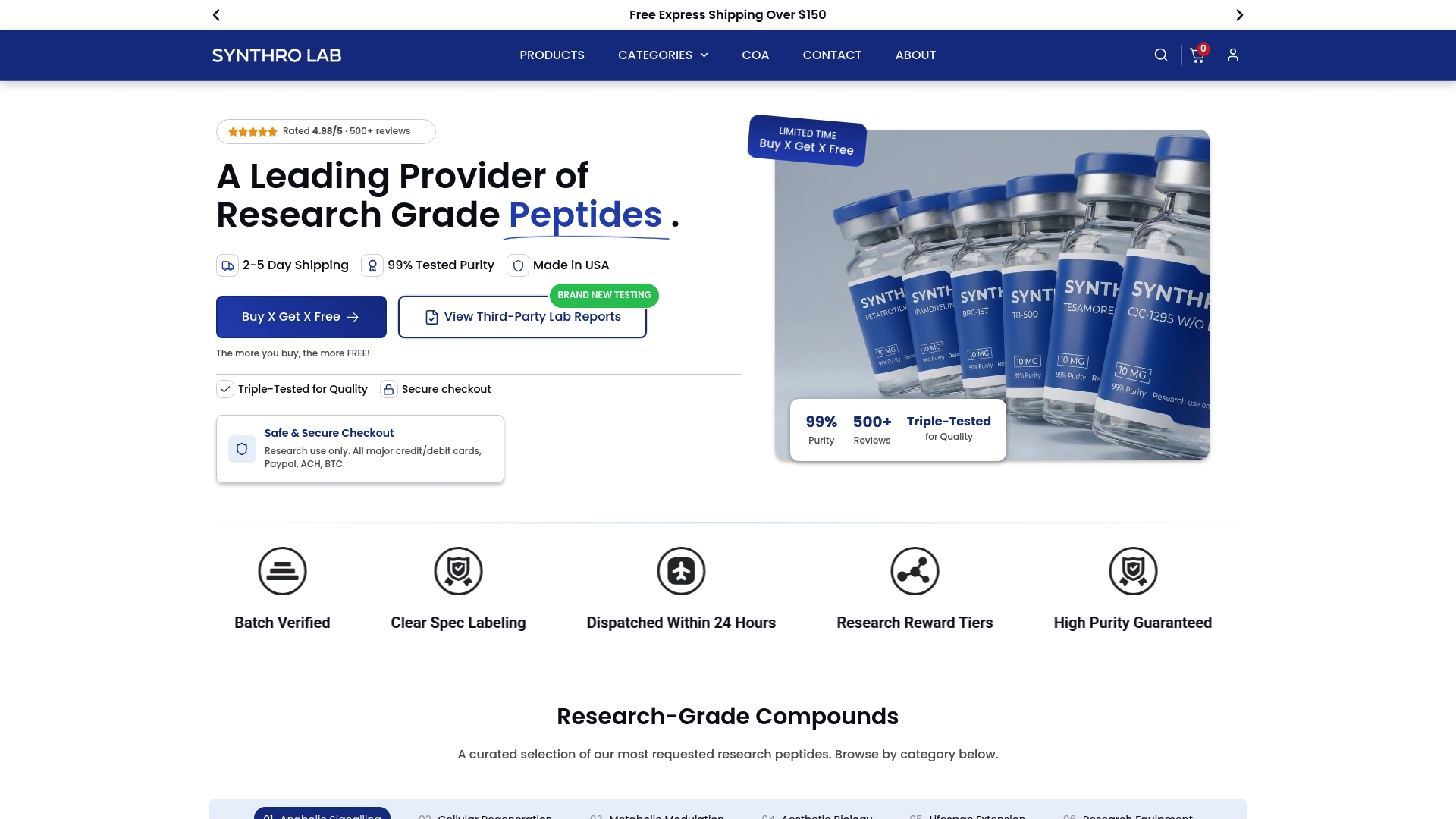
That documentation matters most on molecules like follistatin isoforms, where product variability has already been flagged in the analytical literature. Researchers designing preclinical work around myostatin-pathway inhibitors can browse Synthrolab’s growth factor peptide categories or review the muscle-repair peptide research guide to see how COA documentation is presented alongside each product listing. None of this is a clinical efficacy claim. It’s a supply and verification standard, which is exactly the gap this article has been pointing at from the start. Check the current product listings and COA documentation before your next order.
Sources
Recommended
 21+ verification