Peptides for muscle repair are short chains of amino acids that signal the body to accelerate tissue healing through processes like angiogenesis, collagen synthesis, and cell migration. The three most researched candidates are BPC-157, TB-500, and GHK-Cu, each with distinct mechanisms and evidence profiles. Animal studies show real promise, but human clinical data remains thin, and regulatory bodies including the FDA and WADA have not approved these compounds for therapeutic use. Athletes and fitness enthusiasts need to understand both the potential and the limits before considering peptide therapy.
1. Peptides for muscle repair: what they are and how they work
Peptides are defined as amino acid chains shorter than proteins, typically 2–50 residues, that act as biological signals rather than structural building blocks. In the context of muscle and tissue recovery, they work by binding to receptors that trigger repair cascades: vascular growth, inflammatory regulation, and extracellular matrix remodeling. The term “peptide therapy for athletes” is the informal label; the recognized scientific category is bioactive peptides, a term you will see in peer-reviewed literature. Understanding the distinction matters because it separates research-grade compounds from the loosely regulated supplements sold in the same category.
The three peptides with the most preclinical evidence are BPC-157, TB-500, and GHK-Cu. Each targets a different stage of the repair process, which is why researchers often study them in combination. None currently holds FDA approval for human therapeutic use, and that regulatory gap shapes every practical decision around them.
2. BPC-157: the most studied peptide for tissue healing
BPC-157 (Body Protective Compound-157) is a synthetic pentadecapeptide derived from a protein fragment found in human gastric juice. Its primary draw for athletes is its effect on connective tissue: tendons, ligaments, and muscle fascia all respond in animal models.
The mechanism is specific. BPC-157 upregulates the nitric oxide pathway and activates focal adhesion kinase-paxillin signaling, which drives vascular growth and directed cell migration to injury sites. That combination accelerates the early stages of tissue repair more than most compounds studied at the same dose range.
Preclinical results are consistent. Rodent tendon transection studies show improved collagen maturation and better histological outcomes at both 14 and 28 days post-injury. The collagen quality finding is significant because poor collagen organization is the primary reason repaired tendons re-tear.
Human evidence is a different story. Only 3 small, uncontrolled pilot studies have examined BPC-157 in people, with a combined total of 30 participants. That sample size cannot establish efficacy or long-term safety. No randomized controlled trial has been published as of 2026.
Key facts about BPC-157 for athletes:
- Origin: Synthetic fragment derived from human gastric protein
- Primary targets: Tendons, ligaments, muscle tissue
- Mechanism: NO pathway activation, FAK-paxillin signaling, angiogenesis
- Preclinical evidence: Strong in rodent models at 14 and 28 days
- Human evidence: 3 pilot studies, 30 total participants
- Regulatory status: Not FDA-approved; banned by WADA
Pro Tip: If you are a competitive athlete, check the current WADA prohibited list before considering any peptide. BPC-157 carries anti-doping consequences regardless of how it is sourced.
3. TB-500 and thymosin beta-4: actin regulation and tissue repair
TB-500 is a synthetic fragment of thymosin beta-4, a naturally occurring protein found in virtually every human cell. The full-length protein regulates actin polymerization, which is the cellular process that drives movement, wound closure, and tissue remodeling. TB-500 retains a portion of that biological activity in a smaller, more stable molecule.
Thymosin beta-4 facilitates actin dynamics critical for cell migration, and TB-500 carries enough of that sequence to promote angiogenesis and wound healing in animal models. Cardiac and dermal tissue repair studies in rodents show measurable improvements in vascularization and cell recruitment to injury sites. That evidence base is what drives interest among athletes recovering from soft tissue injuries.
The gap between TB-500 and full-length thymosin beta-4 matters. The fragment does not replicate all of the parent protein’s activity, and researchers have not yet mapped exactly which functions are preserved and which are lost. That uncertainty compounds the already limited human data.
What the research shows on TB-500:
- Biological role: Actin regulation, cell migration, angiogenesis
- Evidence base: Animal models for cardiac and dermal repair
- Human trials: No dedicated clinical trials published as of 2026
- Common use pattern: Often stacked with BPC-157 by athletes
- Regulatory status: Not FDA-approved; WADA-prohibited
No published clinical or pharmacokinetic data characterizes what happens when TB-500 and BPC-157 are co-administered, despite the combination being widely used among athletes. The BPC-157 + TB-500 combination is available as a research compound, but the interaction profile remains uncharacterized in humans.
4. GHK-Cu: the natural tripeptide with gene-level effects
GHK-Cu is a naturally occurring tripeptide-copper complex found in human plasma, saliva, and urine. Plasma levels decline significantly with age, which has driven research interest in its role in tissue maintenance and repair. Unlike BPC-157 and TB-500, GHK-Cu is not synthetic in origin; it is a compound the body already produces.
GHK-Cu modulates thousands of genes related to wound healing, collagen synthesis, and antioxidant defense. That breadth of gene expression activity is unusual for a tripeptide and explains why it appears in both cosmetic and medical research contexts. The anti-inflammatory signaling it triggers is particularly relevant for post-workout recovery, where excess inflammation slows tissue remodeling.
The evidence profile is split. Topical GHK-Cu has decades of human use data from the cosmetic industry, with consistent results for collagen stimulation and skin repair. Systemic injectable use for muscle and connective tissue repair has far less data. The jump from topical to injectable is not trivial from a pharmacokinetic standpoint, and that distinction is often lost in athlete communities.
Key points on GHK-Cu:
- Origin: Natural tripeptide-copper complex; endogenous to humans
- Mechanism: Gene expression modulation, collagen synthesis, antioxidant upregulation
- Topical evidence: Strong, decades of cosmetic human use
- Injectable evidence: Limited; no large human trials for systemic repair
- Anti-inflammatory potential: Documented in preclinical models
5. Comparing peptide mechanisms and safety for athletes
Understanding how BPC-157, TB-500, and GHK-Cu differ helps you match the right compound to the right research question. The table below compares them across the dimensions that matter most for recovery-focused investigation.
| Feature |
BPC-157 |
TB-500 |
GHK-Cu |
| Origin |
Synthetic gastric fragment |
Thymosin beta-4 fragment |
Natural tripeptide-copper |
| Primary mechanism |
NO pathway, FAK-paxillin signaling |
Actin regulation, angiogenesis |
Gene expression, collagen synthesis |
| Strongest evidence |
Rodent tendon and ligament models |
Rodent cardiac and dermal models |
Topical human cosmetic use |
| Human trial data |
3 pilot studies, 30 participants |
None published |
Topical only |
| WADA status |
Prohibited |
Prohibited |
Not listed (as of 2026) |
| FDA status |
Not approved |
Not approved |
Not approved (injectable) |
Safety is the part of this conversation that gets skipped most often. Products sold as research chemicals carry real risks: unknown contaminants, inconsistent dosing, and zero long-term human safety data. Injection site reactions are the most commonly reported adverse event, but systemic effects from uncharacterized impurities are a more serious concern.
Competitive athletes face a compounding risk. WADA prohibits BPC-157 and TB-500 regardless of therapeutic intent. A positive test carries the same consequences whether the compound came from a licensed researcher or a gray-market vendor. Regulatory status and anti-doping rules are not the same thing, and both apply simultaneously.
Pro Tip: Request a certificate of analysis (COA) from any peptide supplier before use. A COA from a third-party lab confirms purity and rules out common contaminants. Synthrolab publishes COAs for its research-grade compounds.
6. How to integrate peptides with proven recovery strategies
Peptides are experimental adjuncts, not replacements for the recovery methods with the strongest evidence base. Physical therapy, protein intake, sleep, and creatine all have randomized controlled trial support for muscle recovery. Peptides do not. That hierarchy should drive how you allocate your recovery resources.
The practical framework for athletes considering peptide research:
- Protein intake: Aim for adequate daily protein to support muscle protein synthesis. This is the single most evidence-backed recovery intervention.
- Sleep quality: Deep sleep drives growth hormone release and tissue repair. No peptide replicates this effect.
- Creatine monohydrate: Decades of RCT data support its role in reducing muscle damage and accelerating recovery between training sessions.
- Physical therapy: Structured rehabilitation after injury outperforms any single compound in restoring function and preventing re-injury.
- Peptides: Consider only after the above are in place, and only with guidance from a healthcare professional familiar with the current evidence.
Researchers consistently emphasize relying on well-evidenced interventions over peptides given the current absence of strong human trial data. Medical professionals urge caution due to contamination risks and unknown long-term effects from peptides sold outside FDA oversight. Consulting a sports medicine physician or endocrinologist before any peptide protocol is not optional; it is the minimum standard of care.
Key takeaways
The most effective approach to muscle recovery peptides is to treat BPC-157, TB-500, and GHK-Cu as research-stage compounds with real preclinical promise but insufficient human trial data to justify replacing proven recovery methods.
| Point |
Details |
| BPC-157 has the most preclinical data |
Rodent studies show improved collagen maturation at 14 and 28 days, but only 30 humans have been studied. |
| TB-500 targets actin and angiogenesis |
Animal models support tissue repair, but no dedicated human clinical trials exist as of 2026. |
| GHK-Cu has split evidence |
Topical use has decades of human data; injectable systemic use does not. |
| Safety risks are real |
Gray-market peptides carry contamination risks and no long-term human safety data. |
| Proven methods come first |
Protein, sleep, creatine, and physical therapy have stronger evidence than any current peptide therapy. |
The hype-to-evidence gap is wider than most athletes realize
The fitness community talks about BPC-157 and TB-500 as if the human data matches the animal data. It does not, and that gap matters more than most people admit.
I have watched athletes stack these compounds based on forum posts and anecdotal reports, treating rodent studies as proof of human efficacy. That is a category error. A compound that heals rat tendons in 14 days has not been shown to do the same in a 90-kilogram athlete under training load. The biology is directionally similar, but the dose, delivery, and interaction with other variables are entirely different.
What I find genuinely promising is the mechanistic specificity. BPC-157’s effect on the FAK-paxillin pathway is not vague. GHK-Cu’s gene expression modulation is measurable and reproducible. These are not placebo-level effects in animal models. The problem is that promising mechanisms in rodents have a poor track record of translating cleanly to human therapeutics. The history of sports medicine is full of compounds that looked perfect in preclinical data and failed in trials.
My honest position: use the established recovery stack first, consult a physician, and treat any peptide protocol as a research question rather than a treatment. The science is moving fast. Human trials are coming. But the 2026 evidence base does not yet justify the confidence level you see in most online discussions.
— Mitch
Research-grade peptides for serious investigators
Athletes and researchers who want to study recovery peptides need a source they can trust for purity and documentation. Synthrolab supplies research-grade BPC-157, TB-500, GHK-Cu, and related compounds with third-party verified COAs for every batch.
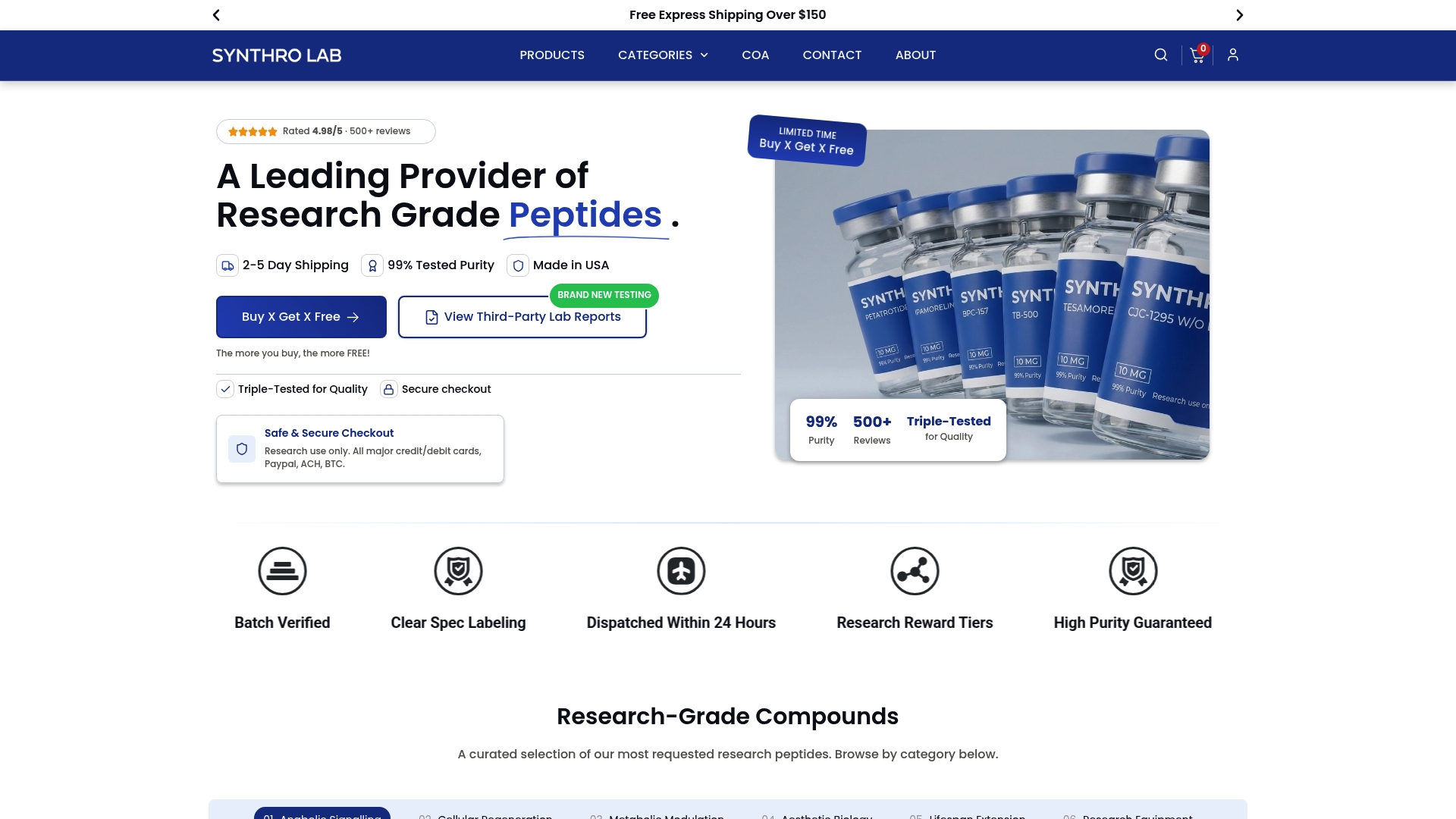
Synthrolab’s cellular regeneration catalog covers the full range of tissue repair peptides discussed in this article. For those new to peptide research, the beginners’ safe-start guide explains dosing conventions, storage, and what to look for in a COA before you order. Every compound ships with full documentation so your research starts on solid ground.
FAQ
What are the best peptides for muscle recovery?
BPC-157, TB-500, and GHK-Cu are the most researched peptides for muscle and tissue recovery. Each has distinct mechanisms, but all three lack large-scale human clinical trial data as of 2026.
How do peptides aid recovery at the cellular level?
Peptides signal repair processes including angiogenesis, collagen synthesis, and cell migration. BPC-157 specifically activates the nitric oxide pathway and FAK-paxillin signaling to drive vascular growth at injury sites.
Are recovery peptides legal for competitive athletes?
BPC-157 and TB-500 are prohibited by WADA, making them illegal for use in sanctioned competition. GHK-Cu is not currently listed, but regulatory status can change and athletes should verify before use.
What safety risks come with peptide use?
Products sold as research chemicals may contain unknown contaminants and carry no long-term human safety data. Injection site reactions are the most common reported adverse event, but systemic risks from impurities are more serious.
Should peptides replace protein and sleep for recovery?
No. Physical therapy, adequate protein intake, sleep, and creatine monohydrate all have stronger clinical evidence for muscle recovery than any current peptide therapy. Peptides are experimental adjuncts, not replacements.
Recommended