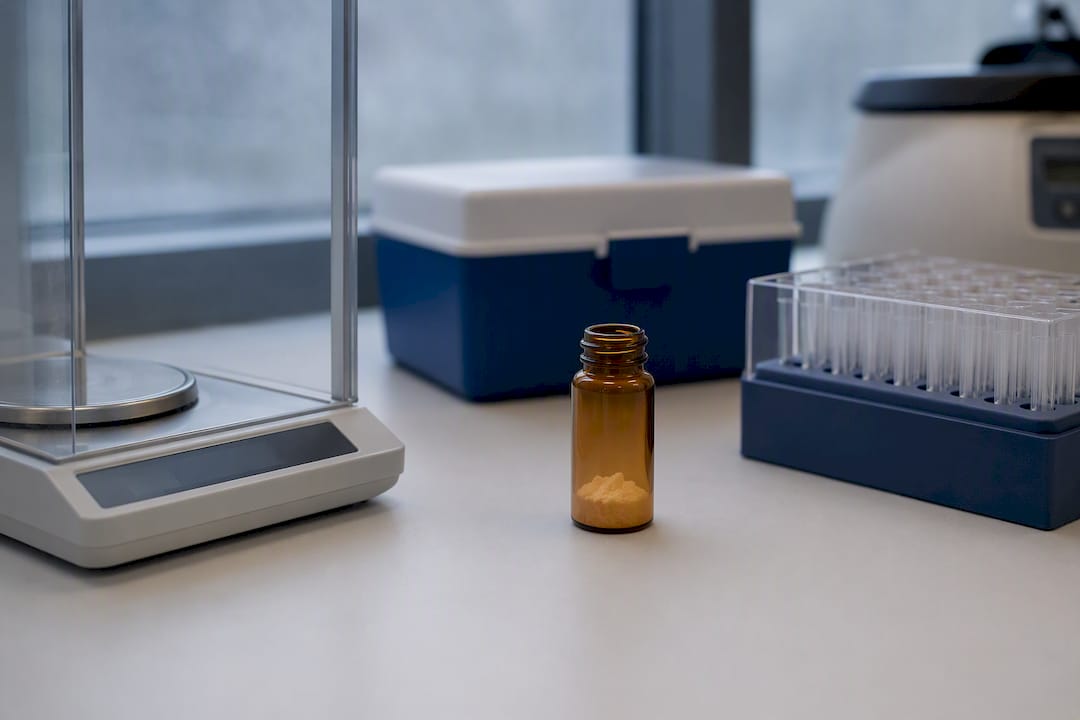
In this article, “KPV peptide” means a research-grade Lys-Pro-Val reagent supplied for in vitro and preclinical work, not a consumer or clinical product. If you’re planning lab work with it, the rule is simple: never order a lot without a lot-specific Certificate of Analysis showing an HPLC chromatogram and mass spectrometry identity confirmation.
That single requirement filters out most of the sourcing risk in this category before you ever touch a pipette.
- KPV is the tripeptide sequence Lysine-Proline-Valine, sold research-use-only (RUO).
- Require a lot-specific COA with HPLC chromatogram and MS identity before use.
- This guide covers laboratory procurement and handling only, not dosing or therapeutic use in humans or animals outside a research protocol.
Key Takeaways
Reliable KPV research starts with a lot-specific COA showing HPLC chromatogram, MS identity, and net peptide content, not a purity percentage alone.
| Point |
Details |
| Define KPV precisely |
KPV is Lys-Pro-Val, ~342.4 Da, supplied lyophilized and RUO for laboratory research only. |
| Demand a real COA |
Require lot number, HPLC chromatogram with method, and MS identity before using any batch. |
| Separate purity from content |
Net peptide content, not HPLC percent alone, determines accurate mass-based dosing. |
| Vet suppliers in tiers |
Move from COA review to independent ISO 17025 verification to transparency checks. |
| Store and document carefully |
Freeze lyophilized stock, limit freeze-thaw cycles, and keep retention samples per lot. |
| Choose documented sourcing |
Synthrolab provides lot-specific COAs with chromatogram and MS data on its research-grade KPV. |
Table of Contents
KPV is the C-terminal tripeptide of alpha-MSH, built from three amino acids: lysine, proline, and valine. Its molecular weight sits at approximately 342.4 Da, a small enough mass that it behaves differently in solution than longer-chain peptides you may be used to handling.
Most suppliers ship it as a lyophilized powder, which is the stable form for shelf storage. It dissolves readily in sterile water, saline, or acetic acid solutions depending on your protocol, though solubility can shift with pH and salt content.
Quick reference:
- Sequence: Lys-Pro-Val
- Molecular weight: ~342.4 Da
- Form: lyophilized powder
- Storage (lyophilized): frozen, ideally around -20°C, protected from light and moisture
Pro Tip: Keep the original vial’s desiccant pack if it ships with one. Reintroducing moisture during storage is one of the quieter ways peptide stock degrades before you ever open it.
Shelf life for unopened lyophilized KPV is generally long when kept frozen and dry, but once reconstituted, the clock changes entirely. Treat any reconstituted aliquot as a short-term working solution, not a long-term stock.
How Do You Evaluate a KPV Certificate of Analysis?
A COA is only as good as its detail, and a purity number by itself tells you almost nothing about what’s actually in the vial. A complete, credible peptide COA includes a lot-specific identifier, an HPLC purity report with the actual chromatogram attached, and mass spectrometry identity confirmation. Anything less is a marketing sheet dressed up as documentation.
Work through the document in this order:
- Lot number. It must match the vial label exactly. A COA with no lot number, or a generic one reused across batches, tells you the supplier isn’t tracking individual production runs.
- HPLC chromatogram and method. Look for the column type, gradient, and detection wavelength, not just a percentage. Purity percentages alone are insufficient without the underlying method details to judge whether the number is credible.
- MS identity. The observed mass should land close to KPV’s theoretical ~342.4 Da. A wide gap signals a synthesis or purification problem.
- Net peptide content. This differs from HPLC area-percent purity. Look for counter-ion disclosure, water content, and mass balance figures.
- Signature and date. An unsigned, undated COA, or one with no named analyst or testing lab, isn’t a real quality document.
Research-grade material generally falls into recognizable purity bands: ≥98% for GMP-grade work, 95 to 98% as acceptable for most research applications, and anything under 90% as substandard for serious experimental use.
Red flags that should stop an order outright: missing lot numbers, a bare purity percentage with no method attached, unsigned or undated reports, and any COA where the testing lab isn’t named. If a supplier hesitates when you ask for the underlying chromatogram data, that hesitation is itself information.
For dose-sensitive experiments, it’s worth sending a portion of an incoming batch to an independent ISO 17025 accredited lab for confirmatory HPLC and MS testing before you commit it to a critical protocol.
What’s the Right Way to Store and Reconstitute KPV?
The first thing to do on receipt has nothing to do with a freezer. Match the lot number on the vial to the lot number on the COA immediately, and file both digitally before the paperwork gets separated from the product. This sounds obvious until you’re three months into a study and can’t remember which COA belongs to which vial.
Storage rules that actually matter:
- Lyophilized powder: store frozen, around -20°C, away from light.
- Reconstituted aliquots: keep at 2 to 8°C, and use within a short working window.
- Avoid repeated freeze-thaw cycles. Each cycle risks degradation and aggregation.
- Aliquot on reconstitution rather than refreezing and rethawing a single stock vial repeatedly.
For reconstitution, sterile water or sterile saline are the standard solvents for most in vitro protocols, though your specific assay may call for a buffered solution instead. Work under sterile technique, aliquot into single-use volumes right away, and label each tube with lot number, reconstitution date, and concentration.
Pro Tip: Set aside a small retention sample from every lot before you start using it. If a result looks off six weeks later, having original material on hand to retest is the difference between a quick answer and an unresolvable question mark over your data.
If you’re shipping reconstituted material between sites, cold-chain packaging with a temperature log isn’t optional. A break in that chain during transit can undo weeks of careful handling in a single afternoon.
How Do You Vet a KPV Supplier Before Ordering?
Sourcing research peptides works best as a tiered filter, not a single gut-check. A tiered supplier-evaluation rubric moving from COA review to independent verification to organizational transparency gives you a repeatable process instead of a one-off judgment call.
- Tier 1: COA review. Does the supplier provide a lot-specific COA with method details, an attached chromatogram, and MS-confirmed identity alongside net peptide content? A supplier who can’t produce this on request fails Tier 1 and should be dropped from consideration immediately, no matter how competitive the price looks.
- Tier 2: independent verification. For anything going into a critical experiment, send a sample to a third-party lab for HPLC, MS, or MS/MS confirmation. This is where you catch the gap between what a COA claims and what’s actually in the vial.
- Tier 3: organizational transparency. Will the supplier disclose its manufacturing platform, share a method-validation package, and label products clearly as research-use-only? A team that answers technical questions promptly is telling you something about how it runs its lab.
Document each qualified supplier’s Tier 1 through 3 results in your own records. Synthrolab’s COA page outlines the documentation structure buyers should expect at Tier 1, and it’s a useful reference point when comparing what other vendors provide against it.
Why Net Peptide Content Changes Your Dosing Math
HPLC purity tells you how clean the peptide is relative to other compounds in the sample. It does not tell you how much of the vial’s weight is actually KPV. Practitioner checklists warn that HPLC area-percent purity and net peptide content are different figures entirely, and counter-ions plus residual moisture can eat up a meaningful share of that weight.
- A vial listed with high HPLC purity might have a substantially lower net peptide content once counter-ions and water are accounted for.
- If you’re weighing out material for a fixed molar dose, using the label weight instead of net peptide content skews every downstream measurement.
- Report both HPLC purity and net peptide content, when available, in your methods section rather than purity alone.
Net peptide content differs from chromatographic purity in part because of counter-ions and residual moisture. For mass-based dosing, this figure needs to be reported or determined experimentally rather than assumed. When a supplier’s COA leaves it out, factor that gap into your calculations or run confirmatory testing before treating a batch as reliable for quantitative work.
What Is the Biological Function and Mechanism of KPV?
KPV is the C-terminal tripeptide fragment of alpha-melanocyte-stimulating hormone (alpha-MSH), and preclinical research has investigated it for anti-inflammatory activity independent of the melanocortin receptor pathways that alpha-MSH itself engages. That distinction is part of what makes it interesting as a research tool: it appears to retain a chunk of the parent hormone’s activity without needing the full-length structure.
Much of the published interest centers on modulation of inflammatory signaling, particularly around NF-kB pathway activity in cell and tissue models. Researchers studying gut barrier function, dermal inflammation models, and cytokine signaling have used KPV as a probe compound to explore how a short peptide sequence can influence inflammatory cascades without the receptor-binding profile of larger melanocortin peptides.
It’s worth being precise here: mechanism-of-action data on KPV comes largely from in vitro and animal-model work, not human clinical trials. When you’re designing a protocol around it, treat proposed mechanisms as working hypotheses supported by preclinical literature rather than settled pharmacology. The small size of the peptide, its stability profile, and its apparent receptor-independent activity are exactly why it shows up so often in comparative studies alongside other short bioactive peptides. If your research question involves inflammatory signaling at the cellular level, KPV’s mechanism profile is worth mapping against your specific assay before you commit resources to a full study design.
What Research Applications and Models Commonly Use KPV?
KPV shows up most often in cell-culture and animal-model studies focused on inflammatory and barrier-function biology. Common experimental contexts include:
- In vitro inflammation models: cultured epithelial or immune cells challenged with an inflammatory stimulus, then treated with KPV to observe changes in cytokine output or signaling markers.
- Gut barrier and colitis models: rodent models of induced colitis are a frequent setting for studying peptide effects on intestinal inflammation and barrier integrity.
- Dermal and wound-healing models: skin-focused preclinical work exploring inflammatory modulation in cultured keratinocytes or animal skin models.
- Comparative peptide studies: researchers sometimes run KPV alongside other short peptides to compare relative potency or mechanism in the same assay.
A frequent point of comparison in the field is KPV versus BPC-157, another short peptide studied for tissue-related effects; the two get discussed together often enough that it’s worth being clear they’re structurally distinct sequences with different proposed mechanisms, not interchangeable reagents. If your study design references both, keep separate COAs, separate reconstitution logs, and separate labeling for each, since mixing up vials between structurally different short peptides is an easy error in a busy lab.
Whatever model you’re running, the experimental value of the result depends entirely on knowing exactly what was in the vial. That circles back to the COA question: a result generated with an unverified lot isn’t reproducible by anyone, including you, six months later.
What Is the Safety Profile for KPV in Research Settings?
Safety data on KPV comes from preclinical and in vitro sources, not human clinical trials, and that distinction should shape how you frame any safety statement in your own research documentation. There is no established human safety profile because KPV, in this research-grade RUO form, is not approved or intended for human administration.
At the bench, the practical safety considerations are more about handling than pharmacology. Work with lyophilized peptide powders under appropriate fume containment or a fume hood when weighing dry material, since fine powders can become airborne. Standard laboratory personal protective equipment, gloves, eye protection, and a lab coat, applies as it would to any bioactive research compound.
Batch-to-batch variability is itself a safety-adjacent issue in the sense that it affects reproducibility. A poorly characterized lot with unknown impurities introduces variables into your experiment that have nothing to do with KPV’s actual biological activity, and that’s a data-integrity risk as much as anything else. This is another reason the COA requirement matters beyond simple due diligence: an incomplete or unreliable analysis document means you’re working blind on exactly the kind of variable that safety and reproducibility both depend on.
Any adverse observations in animal or cell-based work should be documented and reported through your institution’s standard research protocols, the same as with any other investigational compound. There is no consumer-safety framework to lean on here, because this material was never intended to enter one.
What Dosing Ranges and Administration Routes Apply in Lab Research?
Published preclinical studies on KPV use a range of doses and administration routes depending on the model, and there is no single standardized dose that applies across experimental contexts. In vitro work typically involves concentration ranges applied directly to cultured cells, measured in micromolar amounts, while animal-model studies have used systemic or topical administration depending on whether the research question centers on gut, skin, or systemic inflammatory endpoints.
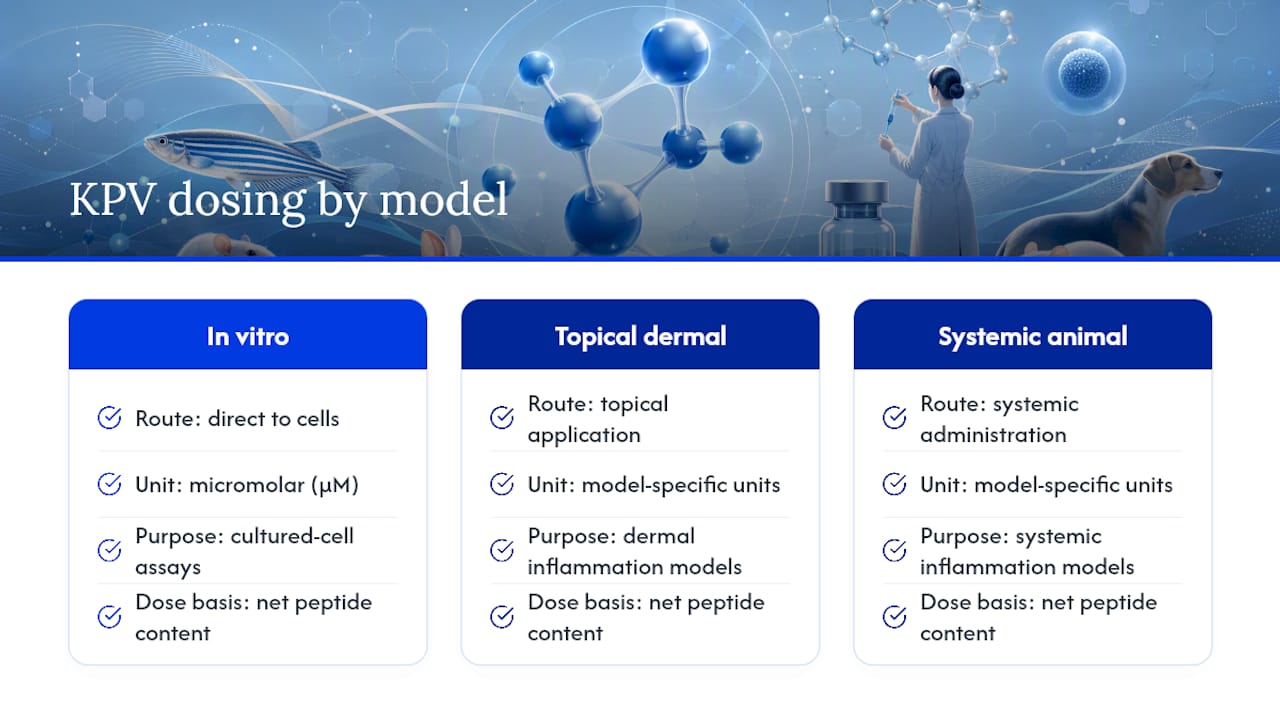
Because this variability is wide and model-dependent, the right approach for your own protocol is to base dosing on the specific published study design closest to your research question, not on a generic range pulled from an unrelated model. A concentration used in a cultured-cell inflammation assay tells you very little about what an appropriate dose would look like in a rodent colitis model, and vice versa.
For any dose calculation, work from net peptide content rather than the raw vial weight, for the same mass-balance reasons covered earlier in this guide. A vial you assume is 5 mg of active peptide might actually deliver less once counter-ions and residual moisture are accounted for, which throws off molarity calculations for cell-culture work in particular.
Administration route in laboratory settings is determined entirely by your experimental design and species model, whether that’s direct application to cultured cells, injection in an animal model under an approved protocol, or topical application in a dermal study. None of this constitutes guidance for human use of any kind. This section describes how researchers structure dosing in published preclinical literature, not a recommendation for personal administration.
What Is the Regulatory Status of KPV Peptide?
KPV sold for research purposes carries a research-use-only (RUO) designation, meaning it’s intended exclusively for laboratory investigation, not for human or animal consumption, diagnostic use, or therapeutic administration. That designation isn’t a marketing formality. It reflects the fact that KPV has not gone through the regulatory approval pathway required for clinical use in the United States, and RUO labeling should appear clearly on both the product packaging and its accompanying documentation.
Purchasing and handling RUO peptides for legitimate laboratory research is standard practice across academic and private research settings. The obligation on the buyer’s side is straightforward: use the material within an appropriate research context, maintain documentation of its RUO status, and avoid any framing, internal or external, that suggests the material is intended for consumption or treatment.
Institutions running federally funded or IRB-governed research should apply their own institutional biosafety and material-use policies on top of the RUO designation, since those internal rules often set additional documentation and handling requirements beyond what a supplier’s labeling covers. If you’re operating outside an institutional setting, as many independent biohackers and longevity researchers do, the RUO label still applies. It’s a legal and practical boundary on intended use, not a suggestion.
Keep your COAs, purchase records, and lot documentation on file. If your research involves shared lab space, institutional review, or eventual publication, that paper trail is what lets you demonstrate the material’s provenance and intended use if anyone asks.
What Best Practice Actually Looks Like in the Lab
The gap between a good peptide supplier and a mediocre one rarely shows up in the price. It shows up six weeks later, when an experiment doesn’t replicate and you’re trying to figure out whether the biology failed or the reagent did. That’s the entire reason Synthrolab treats lot-specific documentation as non-negotiable rather than as an upsell. Traceability isn’t a compliance checkbox. It’s what lets you trust your own data.
Keep retention samples from every lot you use in a study that matters, and document provenance the way you’d document any other experimental variable. If you’re weighing a purchasing decision or interpreting a chromatogram that doesn’t look quite right, Synthrolab’s technical team is a resource, not a sales funnel. Ask the question before you run the experiment, not after.
— Mitch
Where to Source Research-Grade KPV With Verified Documentation
Sourcing KPV from a supplier that treats COA transparency as an afterthought puts the burden of verification entirely on you, and that’s a burden most labs don’t have the bandwidth to carry on every order. Synthrolab supplies research-grade peptides, including KPV, with lot-specific certificates of analysis covering HPLC chromatograms, mass spectrometry identity, and net peptide content, so the documentation work is already done before the vial reaches your bench.
Every product ships as research-use-only, clearly labeled, with documentation built for researchers who need to cite provenance in their own methods sections. If you’re new to evaluating peptide quality more broadly, Synthrolab’s guide to peptide types and quality standards is a useful starting point, and the reasons researchers choose Synthrolab page details the testing and support practices behind every order. Lot-specific COAs and direct technical support are available on request. Browse Synthrolab’s product catalog to check current KPV availability and request documentation before you place your order.
Sources
Recommended
 21+ verification