Liquid chromatography separates peptide mixtures by hydrophobicity or polarity, and electrospray tandem mass spectrometry then supplies the structural and quantitative data you need. Get accurate numbers by pairing stable-isotope-labeled (SIL) internal standards with a stationary phase matched to your peptide’s polarity, not a default C18 method.
A few decisions determine whether your data holds up:
- Choose intact quantification over digestion when sensitivity matters more than proteomic coverage.
- Favor low flow rates into the source; sensitivity drops sharply as flow increases.
- Switch to HILIC when peptides are too polar to retain on reversed-phase.
- Confirm LLOQ, linearity, and system suitability before you trust a single data point from the run.
Key Takeaways
Accurate peptide quantification by LC-MS depends on matching chromatography to peptide polarity, using SIL internal standards, and validating LLOQ before trusting any result.
| Point |
Details |
| Match column to polarity |
Use C18 for typical hydrophobic peptides and zwitterionic HILIC for short, polar ones that won’t retain on reversed-phase. |
| Choose intact over digestion when possible |
Intact analysis can lower LLOQ roughly fivefold compared with tryptic digestion for the same analyte. |
| Use SIL internal standards |
Stable-isotope-labeled peptides correct for matrix effects and digestion variability better than analogue standards. |
| Run flow rates low |
Lowering flow into the MS source is one of the most reliable ways to boost peptide signal intensity. |
| Verify materials before method work |
Synthrolab provides batch-tested peptides with certificates of analysis for use in method development and validation. |
Table of Contents
How Does LC-MS Work for Peptide Analysis?
Liquid chromatography does the heavy lifting first: it resolves peptides by hydrophobicity (or, on HILIC, polarity) so co-eluting isomers and matrix components don’t collide in the source. Electrospray ionization then converts eluting peptides into gas-phase ions, typically at emitter voltages of 2 to 4 kV, and flow rate has an outsized effect on how efficiently that ionization happens. MS/MS isolates a precursor ion and fragments it, producing the sequence ladder that identifies or quantifies the peptide.
Acquisition mode shapes what you get out of that fragmentation step:
- SRM/MRM: targeted, highly sensitive, ideal for quantifying known peptides against calibration curves.
- PRM: targeted with full fragment-ion spectra retained, useful when you need confirmatory evidence alongside quantification.
- DDA vs. DIA: DDA drives discovery work by selecting the most abundant ions on the fly; DIA fragments everything in defined windows, trading some targeted sensitivity for comprehensive, reproducible coverage.
Where digestion enters this chain matters. Digesting a protein into signature peptides adds complexity upstream of the column, which is exactly why intact-peptide workflows often outperform digestion-based ones on raw sensitivity.
How Do You Prepare Peptide Samples for LC-MS?
Intact peptide quantification wins on sensitivity and simplicity. One analytical study found an LLOQ of 10 pg/mL for intact salmon calcitonin versus 50 pg/mL after tryptic digestion, a fivefold sensitivity loss purely from digestion-added complexity. Digestion still makes sense for bottom-up proteomics or when no intact-peptide antibody or method exists, since signature peptides let you infer protein-level information indirectly.
Cleanup strategy depends on the peptide’s charge profile:
- Protein precipitation removes bulk matrix but rarely gets you clean enough for trace quantification alone.
- Solid-phase extraction (SPE) with C18 or mixed-mode sorbents desalts and concentrates the analyte before injection.
- For basic peptides, add ion-pairing agents like TFA or HFBA to the SPE elution solvent. This breaks nonspecific binding to plastics and stationary phases that otherwise tanks recovery.
- Antibody capture or PTM-specific enrichment (e.g., phospho or glyco resins) pulls low-abundance targets out of a complex matrix before the LC step even starts.
Document pH, solvent composition, SPE cartridge lot, and elution volume every time. Peptides stick to tubes, degrade on freeze-thaw, and adsorb to filters, and small protocol drift is often the real culprit behind a failed recovery check.
Which Chromatography Column Works Best for Peptides?
Reversed-phase C18 remains the default because most peptides are amphipathic enough to retain predictably, and gradient optimization (shallower slopes for short peptides, steeper ones for hydrophobic clusters) usually solves resolution problems without changing chemistry.
Polar or highly charged peptides are a different story. When a peptide elutes near the void volume on C18, no amount of gradient tweaking fixes it. Zwitterionic HILIC columns are validated for retaining and separating short, polar peptides that reversed-phase simply can’t hold. Biphenyl and polar-embedded phases sit in between, offering selectivity for aromatic residues or subtle isomer separations that plain C18 misses.
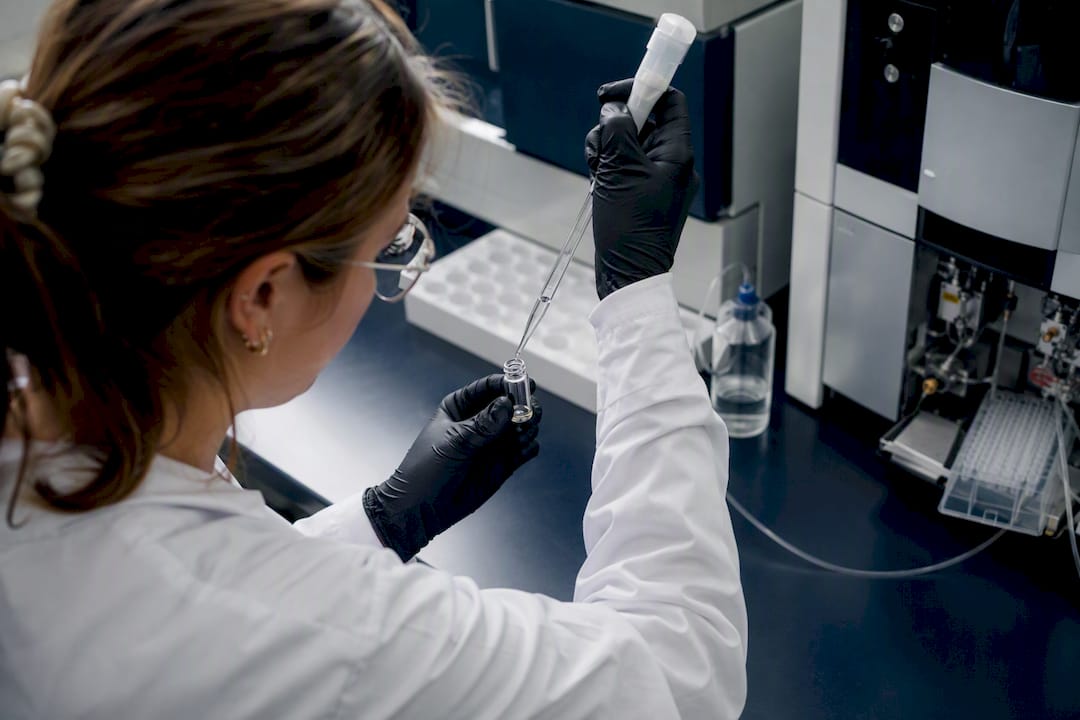
Column temperature and flow rate both affect peak shape more than most methods account for. Elevated temperature (40 to 60°C) sharpens peaks for larger peptides by speeding mass transfer kinetics.
Pro Tip: On zwitterionic HILIC, retention depends heavily on the interplay between mobile phase pH and buffer strength, not just organic content. A small pH shift near a peptide’s isoelectric point can move retention time by minutes, so map that relationship before you finalize a gradient.
Why Do Peptides Behave Differently Under Ionization?
Electrospray ionization performs best at low flow, and that single variable explains more sensitivity problems than any other in peptide LC-MS. Vendor sensitivity testing shows signal per unit analyte climbs as flow rate drops, which is why nanoflow sources dominate low-abundance proteomics work despite the added plumbing complexity.
Peptides also ionize across multiple charge states simultaneously, and that spreads your total signal thin:
- A peptide splitting evenly across 2+ and 3+ states effectively halves the signal available at any single m/z you monitor.
- Ion-pairing reagents and source tuning can shift the charge-state distribution toward a dominant species, concentrating signal where you need it.
- Matrix components compete for charge in the ESI droplet, which is a major driver of ion suppression in biological samples.
Fragmentation mode should match the peptide, not the default method template. CID/HCD handles small-to-medium peptides efficiently and is the workhorse for SRM/MRM quantification. ETD preserves labile post-translational modifications and larger peptide backbones that HCD tends to strip clean, making it the better choice when a PTM’s exact site matters more than raw throughput.
What Internal Standards Give the Most Accurate Peptide Quantification?
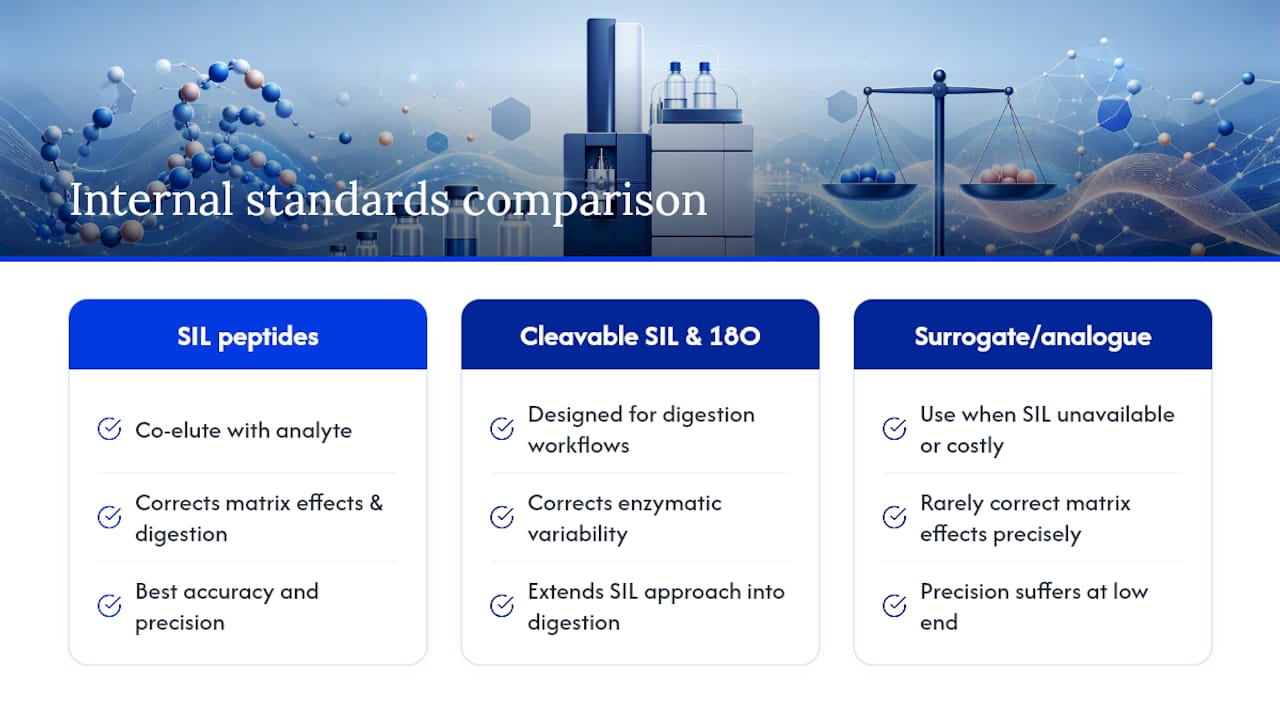
Stable-isotope-labeled (SIL) peptides are the standard against which everything else gets judged, because they co-elute with the native analyte and correct for both matrix effects and digestion variability in a way no chemical analogue can match. The same salmon calcitonin study that found the fivefold LLOQ gap between intact and digested workflows also confirmed SIL versions of the analyte outperformed other internal standard choices across every workflow tested. Cleavable SIL standards and 18O-labeled peptides extend this approach into digestion-based methods, correcting for enzymatic variability that a simple structural analogue can’t track.
Surrogate or analogue standards still have a place when a true SIL peptide isn’t commercially available or budget won’t stretch to a custom synthesis. Accept the tradeoff consciously: analogues rarely correct for matrix effects as precisely, and precision at the low end of your curve usually suffers first.
LLOQ callout: Intact-peptide methods can reach single-digit pg/mL detection limits; tryptic digestion of the same analyte can push that limit up fivefold, a gap documented directly in comparative LC-MS/MS method validation work.
Build calibration curves in matrix-matched surrogate matrix wherever possible, include QC samples at three levels spanning the curve, and set acceptance criteria before you run a single sample, not after you see the numbers.
What Validation Metrics Matter for a Peptide LC-MS Method?
A defensible method reports LOD and LLOQ, a linear range with an acceptable correlation coefficient, intra-day and inter-day precision, accuracy at each QC level, and a documented matrix-effect assessment. Skip any one of these and reviewers (or your own future self troubleshooting a discrepancy) will ask why.
Ion suppression is the most common silent failure mode. Post-column infusion experiments, where you infuse the analyte continuously while injecting blank matrix, reveal exactly where in the chromatogram suppression hits hardest. Matrix factor calculations (comparing response in matrix versus neat solvent) quantify how bad it is.
Before trusting a batch of data, run these checks:
- Confirm system suitability with a known standard mix at the start of the sequence.
- Run a solvent blank immediately after the highest-concentration sample to catch carryover.
- Verify dilution integrity if any samples required dilution to fit the calibration range.
- Reject the batch and re-run if QC samples fall outside preset accuracy and precision windows.
How Does Preparative LC-MS Purify Synthetic Peptides?
Preparative purification starts with an analytical-scale screen to nail down resolution and peak spacing before you scale anything up. Maintaining linear velocity as you move to a wider column, rather than just increasing flow proportionally, keeps that resolution intact at preparative scale.
The purity gain comes from triggering collection on both UV and MS signals together. Combining both detectors excludes co-eluting impurities that either detector alone would miss, since a UV-invisible impurity can still show up on MS, and vice versa.
- Split a small fraction of preparative flow to the mass spectrometer with make-up flow to keep MS sensitivity usable at high loading.
- Reinject collected fractions on the analytical flowpath to confirm purity; never assume the preparative chromatogram alone tells the full story.
- Method development software that models gradient shape ahead of the run saves column time when scaling a new peptide.
What Is System Suitability Testing for Peptide LC-MS?
System suitability confirms retention time reproducibility, peak shape, sensitivity, and mass accuracy are all within specification before you trust the sequence that follows. Running it cold, without a defined acceptance threshold, defeats the purpose.
Labs commonly include a commercial peptide mix, such as the Sigma-Aldrich/MilliporeSigma LC/MS peptide system suitability standard, as a daily or per-sequence control rather than relying only on the analyte itself.
A system suitability failure caught before the sequence starts costs you twenty minutes. The same failure caught after processing forty samples costs you the whole batch.
Re-calibrate or service the instrument when retention time drift exceeds your defined window or when sensitivity on the suitability mix drops below threshold across consecutive runs.
What Do Experienced Analysts Wish They Knew Sooner?
Small, unglamorous choices tend to separate a robust method from a fragile one:
- Run the lowest flow rate your source and throughput requirements can tolerate. The sensitivity gain from lower flow is one of the most underused levers in the field.
- Match ion-pairing chemistry between your SPE elution solvent and your mobile phase. HFBA or TFA in extraction solvents can rescue recovery on basic peptides that otherwise stick to everything in the pathway.
- For preparative fractionation, combine UV and MS triggers by default; drop to MS-only triggering only when the target has no meaningful UV chromophore.
Pro Tip: If a basic peptide method has erratic recovery despite a clean SPE protocol, check whether the ion-pairing reagent in your extraction solvent matches what’s in your mobile phase. A mismatch here quietly kills recovery more often than any column choice does.
How We Weigh These Tradeoffs in Practice
Sensitivity, robustness, and traceability drive every method decision here: intact analysis when the assay allows it, HILIC when polarity demands it, and SIL standards without exception when accuracy is on the line. Every peptide gets a certificate-of-analysis check and a system-suitability run before it touches real samples.
Where to Source Peptides and Standards for Method Development
Method performance is only as good as the material you start with. A batch with unverified purity or an inaccurate concentration will corrupt your calibration curve before the LC column ever sees it, no matter how well-tuned your gradient is.
Synthrolab supplies research-grade peptides with independent batch testing and a certificate of analysis for every lot, so the concentration and purity you assume going into a calibration curve is the concentration and purity you actually have. The peptide quality guide breaks down how COA verification, storage stability, and sourcing decisions affect downstream method performance, useful reading before you commit a peptide lot to a validation run. Every product sold is intended strictly for laboratory research use, not human or animal consumption, and researchers should confirm COA specifications against their own method requirements before use. Check the current catalog and verify a certificate of analysis before your next batch order.
Frequently Asked Questions
What does LC-MS actually measure in a peptide sample?
LC-MS measures both identity and quantity: liquid chromatography separates peptides by retention time, and the mass spectrometer records their mass-to-charge ratio and fragmentation pattern, which together confirm sequence and allow quantification against a calibration curve.
Why do peptides need different LC methods than small molecules?
Peptides carry multiple ionizable groups, so they distribute across several charge states and interact with column surfaces and plastics differently than small molecules do. That behavior demands specific stationary phases like HILIC for polar peptides and ion-pairing strategies for basic ones.
Is intact peptide analysis always better than digestion for LC-MS?
Not always. Intact analysis wins on sensitivity, with LLOQs that can run fivefold lower than digestion-based methods, but digestion remains necessary for bottom-up proteomics or when no intact-peptide assay exists for the target protein.
What is the biggest source of error in peptide LC-MS quantification?
Matrix effects and ion suppression cause most quantification errors, which is exactly why SIL internal standards, which co-elute with the native peptide and experience identical suppression, are considered the most reliable correction method.
Sources
- High-Sensitivity LC-MS/MS Quantification of Peptides and Proteins in Complex Biological Samples: The Impact of Enzymatic Digestion and Internal Standard Selection on Method Performance (Analytical Chemistry)
- PubMed: 24010948
- Exploring the sensitivity differences for peptide quantification (SCIEX tech note)
- Multi-Step Preparative LC–MS Workflow for Peptide Purification (ChromatographyOnline)
- PubMed: 20135706
Recommended
 21+ verification