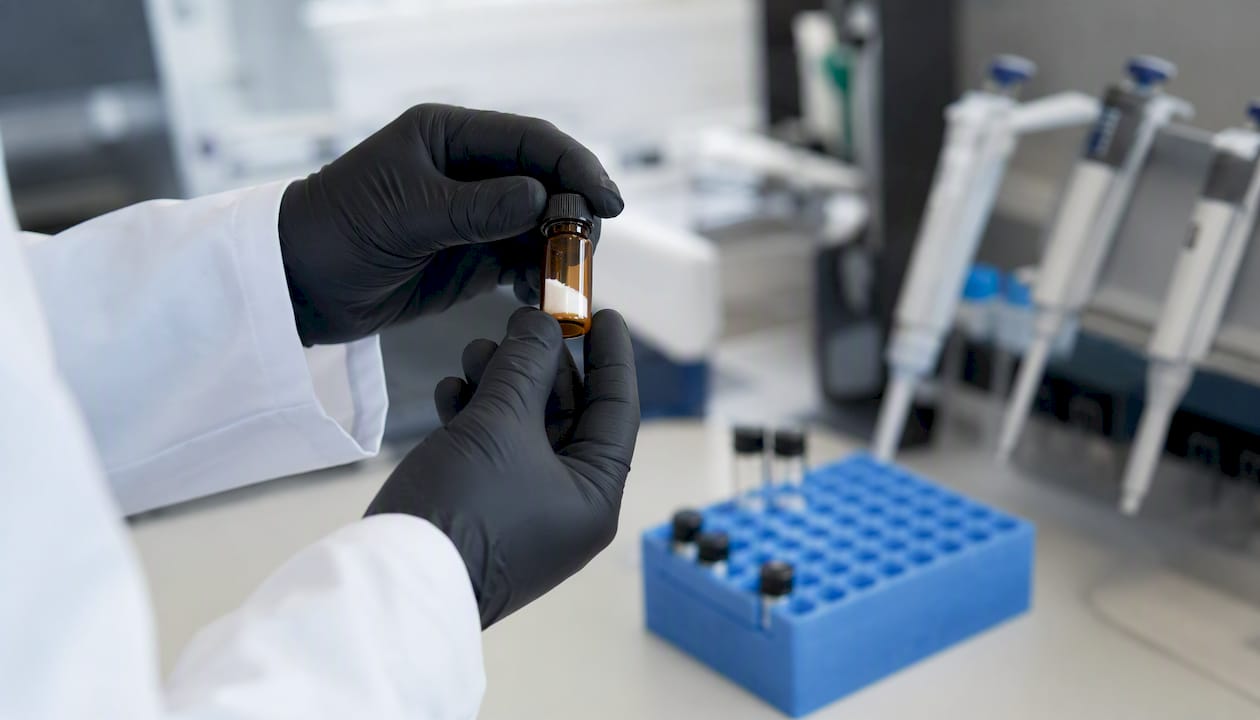
Store lyophilized peptides frozen, dry, and dark, ideally at −20 °C or colder, and they will hold their potency for years. That single rule covers most of what goes wrong in a research freezer. The physics behind it is straightforward: removing water from a peptide removes the main pathway for degradation, and cold temperatures slow down whatever reactions are still possible in the solid state. Review-level evidence confirms lyophilized peptides degrade far more slowly than their reconstituted counterparts, and temperature is the biggest lever you control. Once a peptide goes into solution, that shelf life collapses to weeks or months depending on the sequence and buffer.
On receipt, a few moves protect that stability:
- Transfer vials to the freezer immediately; don’t let them sit on a bench overnight, “to get to it later.”
- Keep the original seal intact until you’re ready to weigh or reconstitute.
- Let a frozen vial equilibrate to room temperature before opening it, so moisture from the air doesn’t condense inside.
Pro Tip: If a shipment arrives during a heat wave or gets delayed at customs, don’t panic. Properly lyophilized, sealed peptides tolerate brief ambient exposure during transit; the risk comes from prolonged heat, not a day or two in a warehouse.
Key Takeaways
Lyophilized peptide storage works because removing water eliminates the main degradation pathway, and cold, dark, dry conditions preserve the protective glass transition state for years.
| Point |
Details |
| Default to −20 °C or colder |
Standard lyophilized stock belongs in a manual-defrost freezer, not the fridge, for anything beyond a few weeks. |
| Control residual moisture |
Desiccants and sealed packaging keep the glass transition temperature high enough to resist degradation. |
| Equilibrate before opening |
Let vials warm to room temperature sealed to prevent condensation from ruining the dried cake. |
| Aliquot after reconstitution |
Single-use, low-binding polypropylene tubes prevent repeated freeze-thaw damage to solutions. |
| Verify with documentation |
Synthro Lab ships batch-tested peptides with Certificates of Analysis so storage problems and batch issues aren’t confused. |
Table of Contents
Why Lyophilized Peptide Storage Beats Storing Peptides In Solution
Lyophilization removes water from a peptide solution under vacuum, leaving behind a dry, porous “cake” that looks fragile but behaves like a fortress at the molecular level. Water is the reactant in hydrolysis, one of the most common ways peptide bonds break down, so pulling it out removes that failure mode almost entirely.
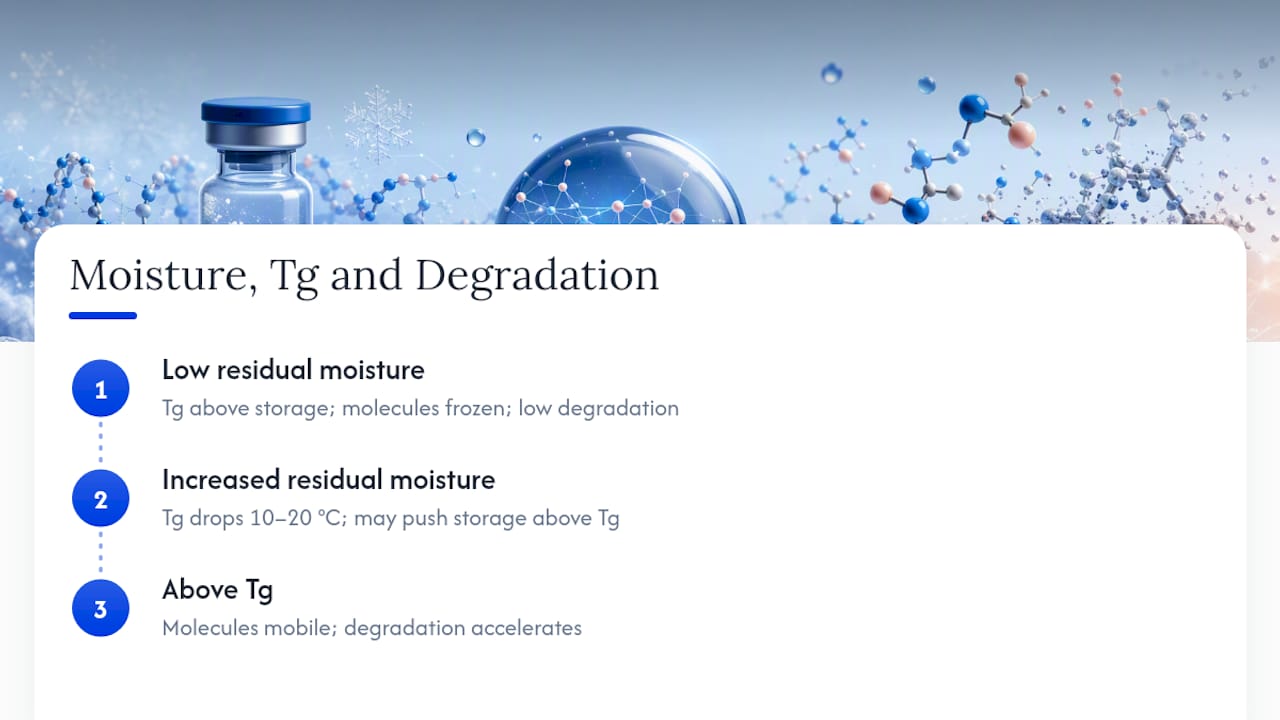
The dried cake also forms an amorphous glass, and that glass has a specific glass transition temperature (Tg): below it, molecules are essentially frozen in place; above it, they gain mobility and degradation accelerates. Residual moisture is the enemy here. Formulation research shows that a small increase in leftover water can drop the Tg by 10 to 20 °C, pulling your storage conditions above that threshold without you realizing it.
Getting Storage Conditions Right: Temperature, Moisture, and Light
Temperature does most of the work, but it’s not the only variable. Get the environment right, and a lyophilized peptide can outlast the grant cycle it was ordered for.
Temperature by use case:
- Room temperature: fine for a few hours during handling, not for storage.
- Refrigerator (2 to 8 °C): acceptable for a few weeks if the freezer is genuinely inconvenient, but not a long-term solution.
- −20 °C: the standard for routine long-term lyophilized stock. Institutional repository guidance recommends keeping lyophilized peptides below −15 °C with desiccation and sealed packaging.
- −80 °C: reserved for archival master stocks you can’t afford to lose, where you want maximum safety margin.
Moisture control matters almost as much as temperature. Residual moisture above roughly 1 to 2% starts eroding that protective glass transition, so desiccant packs inside the storage container are cheap insurance, not an afterthought. Vacuum-sealed or argon-purged packaging pushes that protection further for oxidation-sensitive sequences, and supplier guidelines commonly recommend pairing desiccants with amber vials and sealed secondary containers as the highest-impact, lowest-cost intervention available.
Light and oxygen do slower damage than heat or moisture, but they still add up over months of storage. Amber glass vials block UV exposure. Crimp seals with minimal headspace limit the oxygen available for oxidative side reactions, which matters most for methionine, cysteine, and tryptophan-containing sequences. Wrap the vial in a labeled secondary bag or small box before it goes into the freezer; it’s a second barrier against humidity if the primary seal ever fails.
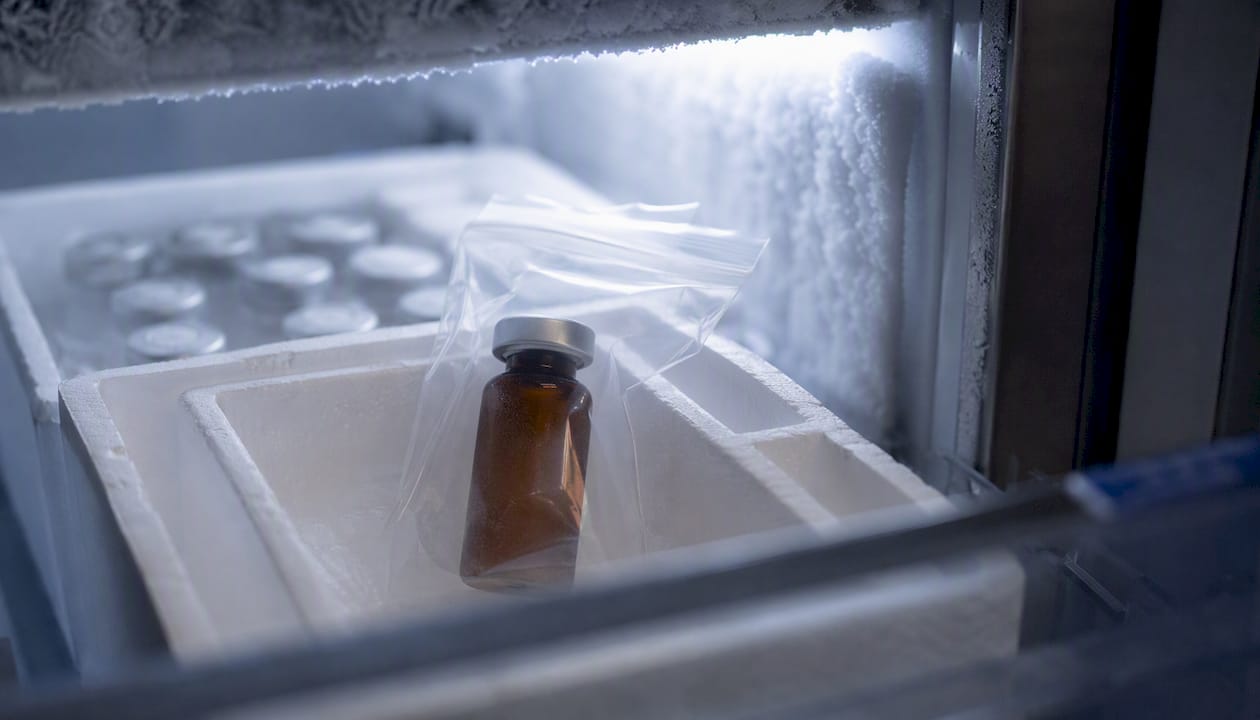
Where you place vials inside the freezer matters too. Frost-free (auto-defrost) units cycle through periodic warming phases that quietly stress your samples every single day. If a frost-free freezer is your only option, insulate vials inside a small foam or thermal box to buffer against those swings.
Pro Tip: A cheap styrofoam shipping box repurposed as an internal freezer liner does more for thermal stability than most people expect. It buffers the defrost cycle’s temperature swing enough to matter for sensitive sequences.
Choosing Between the Fridge, −20 °C, and −80 °C
Match the storage tier to how soon you’ll actually use the material:
- Fridge (2 to 8 °C): working stock you’ll use within days to a few weeks. Convenient, but not where lyophilized peptide should live long-term.
- −20 °C: the default for standard lyophilized stock you’ll draw from over months to years. This is where most research inventories should sit.
- −80 °C: archival master stocks, rare or expensive sequences, or anything you can’t reorder easily.
Here’s the part that surprises newer researchers: when moisture is properly controlled, the marginal benefit of −80 °C over −20 °C for lyophilized material is often small. Formulation studies show diminishing returns for the colder temperature once residual moisture and sealing are handled correctly. The extra cold buys you a safety margin, not a dramatically longer shelf life.
Frost-free freezers deserve real skepticism. Their temperature oscillation is exactly the kind of stress that accelerates degradation and aggregation in peptide materials, lyophilized or not. If a manual-defrost chest freezer isn’t available, a secondary insulated container and placement away from the door minimize the swing. Label every vial with the date, batch, and reconstitution status, and store master stocks away from thaw zones near the door or fan vents.
How To Handle And Reconstitute Without Losing Potency
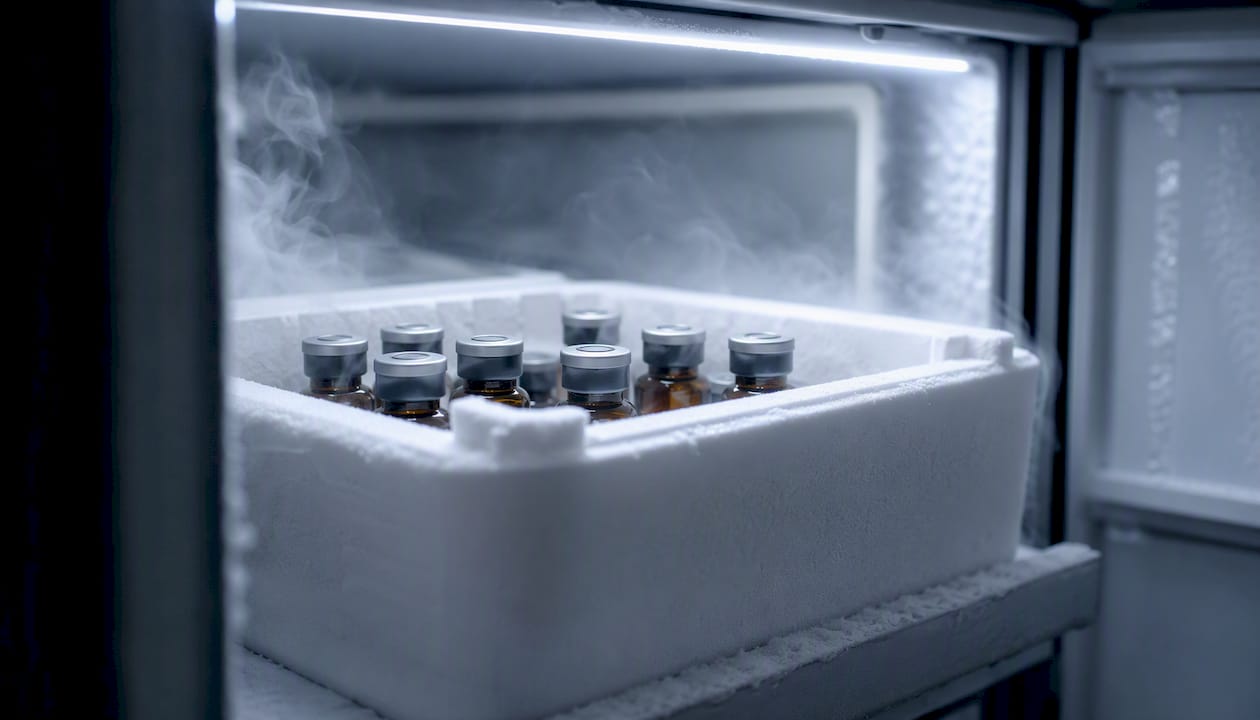
Opening a frozen vial the wrong way is where a lot of otherwise well-stored peptide gets ruined in about thirty seconds. Here’s the sequence that avoids it:
- Remove the vial from the freezer and let it equilibrate to room temperature, sealed, for 15 to 20 minutes before opening. This prevents atmospheric moisture from condensing on the cold glass and seeping into the cake.
- Weigh or inspect the material quickly once open; don’t leave the vial exposed to air longer than necessary.
- Choose your solvent deliberately. Bacteriostatic water works for most sequences; poorly soluble peptides may need a small amount of DMSO as a co-solvent, added first, before diluting into the final aqueous buffer.
- Mix gently by swirling or gentle inversion. Avoid vortexing when you can. Formulation research links aggressive mixing and poor solubilization to increased aggregation risk.
- Aliquot immediately into single-use volumes using low-binding polypropylene tubes, sized to whatever your typical assay or dose requires. This is the step people skip and regret.
Repeated freeze-thaw cycling is one of the most reliable ways to degrade a peptide solution that was otherwise stored correctly. A single freeze-thaw event contaminates data less than the fifth one from the same aliquot does.
Store reconstituted solutions at 2 to 8 °C if you’ll use them within a few days; freeze single-use aliquots at −20 °C or colder for anything longer, and treat the −80 °C option as reasonable for particularly labile sequences. Every thaw cycle you avoid protects the material’s integrity.
Pro Tip: Bacteriostatic water (with benzyl alcohol) is fine for most reconstitution work, but if your protocol requires sterile, preservative-free water, filter through a 0.22-micron filter afterward rather than assuming the vial is sterile straight out of the box.
Recognizing Degraded Peptide Before It Wastes An Experiment
A cloudy solution, an unusual odor, visible pellets that won’t dissolve, or a color shift toward yellow or brown are all warning signs worth stopping for. Reduced solubility on reconstitution, where material that used to dissolve cleanly now leaves visible particulate, often signals aggregation or chemical breakdown.
When in doubt, verify rather than guess:
- Run a quick HPLC or UV check if your lab has access to one.
- Mass spectrometry confirms whether the molecular weight still matches the expected sequence.
- A basic solubility test alone can flag a problem before you commit reagents to a full assay.
If a batch fails these checks, request a fresh Certificate of Analysis from your supplier before assuming your storage was at fault; sometimes the problem started before the vial ever reached your freezer.
A Bench-Ready Checklist For Lyophilized Peptide Storage
Pin this near your freezer:
- On receipt: move directly to −20 °C or colder; don’t leave vials at room temperature “for later.”
- Label every vial with peptide name, batch number, and receipt date.
- Store with desiccant, sealed in a labeled secondary bag or box.
- Equilibrate to room temperature before opening; never open a cold, sealed vial straight from the freezer.
- Aliquot immediately after reconstitution; avoid refreezing partially used tubes.
- Log any freezer alarm or door-open event; documented thermal excursions explain unexpected assay variability later.
Shipping data suggests most lyophilized preparations tolerate brief ambient transit, but the moment they arrive, cold storage should start.
Using CoAs And In-Lab Checks To Confirm Stability Claims
A Certificate of Analysis should list purity percentage, the assay method used to determine it (typically HPLC or mass spec), the test date, and the supplier’s storage recommendation. If any of those four are missing, ask for them before trusting the batch for sensitive work.
Before pulling an older vial back into active use, a quick in-lab HPLC or mass check plus a basic solubility test catches problems a CoA from months ago can’t. Temperature logs and freezer alarm records matter more than most labs treat them.
Reproducibility problems that look like a bad batch are, more often than researchers admit, an undocumented thermal excursion nobody caught in real time.
Pairing supplier documentation with your own verified purity records closes the gap between what a label claims and what’s actually in the vial.
What Synthro Lab Sees Go Wrong In Real Research Freezers
We package every batch with independent purity testing because we’ve seen how often storage failures trace back to packaging that wasn’t sealed properly in the first place, not user error. The most common mistake customers report isn’t temperature. It’s opening a cold vial too soon and never noticing the condensation that got in.
Our own lab habit: label the aliquot count on the vial cap, not just the body, so you’re not hunting through a frost-covered box to find how many doses are left. Check the Certificate of Analysis on any GLOW 50 10 10 blend or similar multi-peptide product before storing it, since blends can have different stability profiles than single sequences.
Where Synthro Lab Fits Into Your Storage Plan
Every batch Synthro Lab ships comes with independent purity testing and a documented Certificate of Analysis, so the “was it stored wrong or was it bad from the start” question has an answer before you even open the vial.
That documentation matters more than most suppliers let on. A CoA that lists the assay method, purity percentage, and test date gives you a real baseline to compare against if a batch ever looks questionable months into storage. Synthro Lab’s peptide category guide breaks down what quality markers to check before you commit a sequence to your freezer rotation, and product pages list storage recommendations specific to that compound rather than generic advice. If you’re setting up a new research inventory or replacing stock that’s aged past its practical window, check the Certificate of Analysis on the product page first, then order with storage conditions already planned out.
Frequently Asked Questions
What temperature should lyophilized peptides be stored at?
Most lyophilized peptides should be stored at −20 °C or colder for routine long-term stock, with −80 °C reserved for archival master stocks or particularly sensitive sequences.
How long do lyophilized peptides last compared to reconstituted ones?
Lyophilized peptides frozen under proper conditions often remain stable for years, while reconstituted solutions typically hold potency for only weeks to months depending on the sequence and buffer.
Can lyophilized peptides be stored in the refrigerator instead of a freezer?
A refrigerator at 2 to 8 °C works for a few weeks of active use, but it’s not a substitute for freezer storage if the peptide needs to last months or years.
Why do frost-free freezers damage peptide stability?
Frost-free units cycle through periodic warming to prevent ice buildup, and that repeated thermal oscillation accelerates degradation and aggregation over time.
How do I know if a lyophilized peptide has degraded?
Watch for color changes, unusual odor, cloudiness on reconstitution, or reduced solubility. An HPLC or mass spec check can confirm whether the molecular structure is intact.
Sources
Recommended
 21+ verification