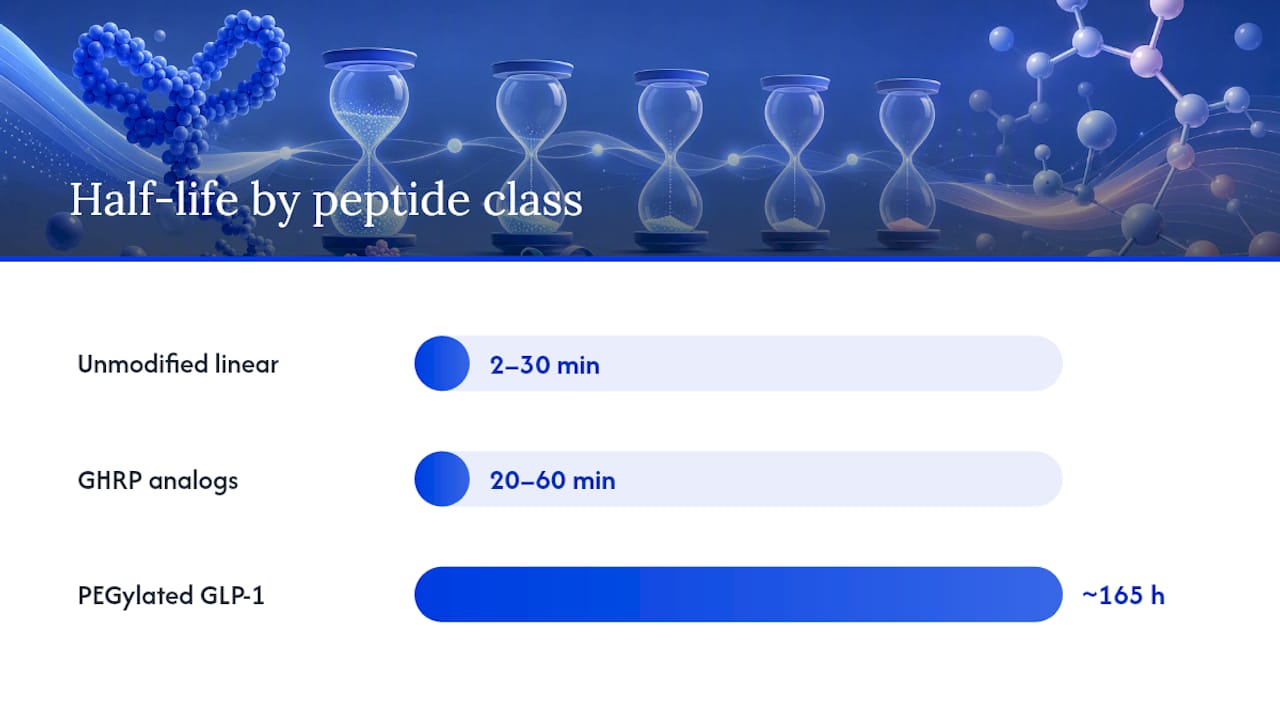
Peptide half-life is the time it takes plasma concentration of a peptide to fall by half, and it splits the field into two camps: unmodified peptides, which often clear in 2 to 30 minutes, and engineered analogs like semaglutide, which persist for roughly 165 hours. That gap of minutes versus days is the single number that should drive your dosing interval, your sampling schedule, and how you interpret an “undetectable” result in an assay.
TL;DR:
- Peptide half-life varies widely across classes, from minutes in native peptides like insulin to nearly a week in engineered analogs like semaglutide.
- Sequence motifs such as Asp-Pro and Asn-Gly can significantly decrease peptide stability by increasing susceptibility to hydrolysis and deamidation.
- Strategies like PEGylation, lipidation, and fusion with serum albumin or IgG extend half-life by reducing degradation or clearance, with semaglutide reaching approximately 165 hours.
- Estimating dosing intervals requires multiplying the half-life by four or five to reach steady state, with longer half-lives demanding careful schedule planning to prevent accumulation.
- Proper storage, handling, and assay selection are crucial for accurate half-life measurement, as variations in formulation, reconstitution, and detection methods can skew results.
Table of Contents
Peptide Half-Life Quick-Reference Chart By Class
Half-life values swing wildly across peptide classes, and the range within a single class can be just as wide as the range between classes. Insulin, for example, has a circulating half-life measured in minutes once it hits the bloodstream, largely because it gets cleared fast by the liver and kidneys and degraded by insulin-degrading enzyme. Compare that to semaglutide, a GLP-1 receptor agonist engineered specifically to resist that kind of rapid clearance, and you get a nearly 1,000-fold difference in circulating time between two peptides that both touch metabolic signaling.
The chart below groups commonly studied peptide classes with approximate half-life ranges. Treat every number without a specific citation as a working estimate, not a lab-verified constant, since actual values shift with species, assay method, and formulation.
| Peptide class |
Example compound |
Approximate half-life |
Data quality |
| Rapid-acting hormone peptides |
Insulin |
Minutes (short circulating half-life) |
Estimate, varies by formulation |
| Unmodified linear peptides |
Most native bioactive peptides |
2 to 30 minutes |
Sourced |
| Growth hormone secretagogues |
Native GHRP analogs |
Roughly 20 to 60 minutes |
Estimate |
| PEGylated/lipidated GLP-1 analogs |
Semaglutide |
~165 hours |
Sourced |
| Stapled or conformationally constrained peptides |
Hydrocarbon-stapled analogs |
Hours to significantly longer than linear counterparts |
Sourced |
| Fc-fusion or albumin-binding peptides |
Various long-acting biologics |
Longer half-life range |
Estimate, compound-dependent |
A few things matter when you read a chart like this. First, plasma half-life and duration of pharmacological effect are not the same thing. A peptide can clear from circulation in twenty minutes and still produce a receptor-mediated effect that lasts hours, because the downstream signaling cascade it triggers outlives the parent molecule. Second, published half-life figures almost always come from a specific dosing route and species, so extrapolating a human intravenous number to your rodent subcutaneous protocol is a guess, not a fact. Third, when a source doesn’t specify assay method or sampling window, assume some uncertainty and design your own pilot PK curve rather than trusting a single number from a product insert.
Pro Tip: When you can’t find a sourced half-life for a specific peptide, look for structurally similar analogs with published PK data. Sequence homology in the protease-sensitive regions is often a better predictor than assuming your peptide of interest behaves like the whole class.
What Factors Affect Peptide Half-Life?
Half-life isn’t a fixed property of a molecule so much as a description of how fast the body dismantles it, and several variables push that clock faster or slower.
Sequence-level vulnerability is the first place to look. Certain amino acid pairings, particularly Asp-Pro, Asp-Gly, and Asn-Gly motifs, act as chemical and enzymatic hotspots that make a peptide backbone prone to hydrolysis or deamidation. Researchers who screen a sequence for these motifs before synthesis can often predict instability problems before they show up as a frustrating PK curve.
Beyond sequence, a handful of physiological and formulation factors matter:
- Renal filtration threshold: peptides under roughly 60 kilodaltons get filtered by the kidney quickly unless something protects them from filtration.
- Albumin binding: peptides that bind serum albumin get effectively hidden from renal clearance, which is part of why carrier binding reduces elimination rate.
- Volume of distribution: a peptide that partitions heavily into tissue looks like it has a longer half-life in plasma sampling, even though the total clearance rate hasn’t changed.
- Route of administration: intravenous dosing skips absorption entirely, while subcutaneous or intramuscular routes introduce an absorption phase that can make the “apparent” half-life look longer than the true elimination half-life.
- Patient-specific variables: renal or hepatic impairment slows clearance, and concomitant medications can compete for the same degradation enzymes.
Formulation excipients round out the list. Buffers, pH adjustments, and co-solvents can meaningfully change degradation rates in aqueous solution, which is one reason two labs running what looks like the same peptide can get different stability results.
How Do Researchers Extend Peptide Half-Life?
Every extension strategy works by attacking one of two problems: proteolytic degradation or renal clearance. Most published techniques target both at once.
PEGylation attaches polyethylene glycol chains to a peptide, which increases its hydrodynamic size past the renal filtration threshold and physically shields cleavage sites from proteases. Lipidation, or fatty-acid conjugation, works differently: it gives the peptide an affinity for serum albumin, and that binding is a major reason semaglutide’s half-life reaches roughly seven days instead of minutes. Glycosylation adds sugar groups that can slow enzymatic recognition, though its effect on half-life is generally more modest than PEGylation or lipidation.
Sequence-level engineering is a separate toolbox. Substituting D-amino acids for their natural L-amino acid counterparts makes a peptide resistant to proteases that only recognize the natural stereochemistry. Retro-inverso peptides flip the sequence direction and swap stereochemistry so the molecule maintains its side-chain topology while presenting an unrecognizable backbone to proteolytic enzymes. Hydrocarbon stapling locks a peptide into a fixed alpha-helical conformation using a synthetic crosslink, and studies comparing stapled analogs to linear versions have shown substantial half-life increases, with one cited example showing roughly a 20-fold jump.
Carrier and fusion strategies extend half-life without touching the peptide’s active sequence at all:
- Albumin-binding domains fused to a peptide borrow albumin’s naturally long half-life in circulation.
- Fc fusion attaches an antibody fragment that gets recycled by the neonatal Fc receptor instead of degraded, dramatically extending circulation time.
- Formulation depots, like sustained-release microspheres or gels, don’t change the peptide at all but slow its release into circulation, producing a longer apparent half-life at the population level.
Semaglutide remains the clearest real-world illustration of what’s achievable: fatty-acid conjugation plus albumin binding took a native GLP-1-like peptide with a half-life of minutes and pushed it to nearly a week, which is exactly why it supports once-weekly dosing instead of multiple daily injections. For deeper detail on one of these mechanisms, our guide to PEG-MGF peptide engineering covers PEGylation specifically, and our piece on stapling and stacking techniques walks through conformational stabilization in more detail.
Translating Half-Life Into Dosing and Steady-State Timing
The math behind dosing intervals is simpler than most people expect, and it starts with one rule: a compound reaches steady-state plasma concentration after roughly four to five half-lives of consistent dosing, regardless of the dose size.
- Estimate your compound’s half-life from published data or your own pilot PK sampling.
- Multiply by four to five to get the time to steady state. A peptide with a 20-minute half-life reaches steady state in under two hours; one with a 165-hour half-life takes about a month.
- Choose a dosing interval based on your desired trough-to-peak ratio. Shorter intervals relative to half-life produce flatter concentration curves; longer intervals produce more pronounced peaks and troughs.
- Calculate washout time the same way, roughly four to five half-lives, before assuming a compound has cleared for a follow-up experiment or before interpreting a new baseline measurement.
- Flag accumulation risk for anything dosed more frequently than one half-life interval, since missed-dose corrections and protocol timing errors compound faster on long half-life agents.
A short-acting peptide dosed every few hours behaves nothing like a long-acting engineered agent dosed weekly, even if both are nominally “the same drug class” on paper. Get the interval wrong on a long half-life compound and you’re not looking at a minor dosing error. You’re looking at weeks of unintended accumulation before the concentration curve corrects itself.
Storage and Reconstitution Rules That Affect Usable Life
Lyophilized peptide powder is remarkably stable when stored correctly, often holding potency for years at -20°C to -80°C. The moment you reconstitute it, the clock changes entirely.
- Reconstituted solutions have a limited usable window, commonly cited around 28 days under refrigeration, and that limit is driven mostly by bacteriostatic water’s sterility rating, not by chemical breakdown of the peptide itself.
- Aliquot before freezing. Splitting a reconstituted batch into single-use portions avoids repeated freeze-thaw cycles, which is one of the fastest ways to degrade an otherwise stable peptide solution.
- Avoid frost-free freezers for long-term storage. Their automatic defrost cycles introduce temperature swings that accelerate degradation even when the display reads a constant temperature.
- Dissolve stepwise, adding solvent slowly down the vial wall rather than injecting it directly onto the lyophilized cake, which reduces foaming and localized concentration spikes that can denature sensitive sequences.
Pro Tip: Label every aliquot with reconstitution date, not just the original vial date. A batch that’s technically “within 28 days” on the box can already be past its usable window if it sat reconstituted for two weeks before you split it into aliquots.
For a full walkthrough of temperature ranges and container choices, see our guide on lyophilized peptide storage rules, and for the broader question of what actually shortens shelf life across peptide types, our article on how long peptides last before degrading goes deeper into sequence-specific factors.
Assay and Measurement Considerations for PK Sampling
Your choice of assay determines whether your half-life number reflects reality or just the limits of your detection method.
- LC-MS offers the specificity and sensitivity needed to distinguish a parent peptide from its metabolites, which matters enormously when a degradation product retains partial biological activity.
- Immunoassays can cross-react with fragments or related sequences, sometimes overstating apparent concentration in later timepoints.
- Sampling density should match the half-life regime: short-acting peptides need dense early sampling in the first minutes to hours, while long-acting agents like semaglutide tolerate spaced sampling over days to weeks.
- “Undetectable” isn’t the same as “biologically inactive.” A peptide can drop below an assay’s limit of quantification while downstream signaling effects persist well past that point.
Our breakdown of LC-MS method choices covers sensitivity trade-offs in more depth for researchers building their own sampling protocol.
What Synthrolab Recommends Checking Before You Run an Assay
Before any half-life study or dosing protocol, verify the batch. A certificate of analysis confirming purity matters because stability is sequence-dependent, and unverified batches introduce variables that make your PK data uninterpretable. Check storage history too: was the compound kept lyophilized at consistent cold temperature, or reconstituted and refrozen before it reached you? Synthrolab publishes handling guidance alongside product listings, and researchers who need compound-specific stability data beyond what’s listed can reach out directly for batch documentation rather than assuming standard values apply.
Why Half-Life Gets Oversimplified in Practice
The conventional shorthand, that short half-life means “weak” and long half-life means “better,” misses what actually matters for research design. A twenty-minute half-life isn’t a flaw. It’s information about how tightly you need to control your sampling window, and treating it as a defect leads researchers to over-engineer stability into compounds where rapid clearance is actually part of the biology being studied.
The bigger gap I see in how people talk about half-life is the conflation of plasma clearance with biological effect. Teams design entire dosing protocols around a published t½ number without asking whether that number came from plasma sampling or from a functional readout, and those two things drift apart constantly. A peptide can vanish from circulation and still be doing work at the receptor level for hours.
If there’s one thing worth prioritizing first, it’s sequence-level screening before you ever get to a PK study. Knowing your compound carries an Asp-Pro or Asn-Gly hotspot tells you more about expected behavior than any generic half-life chart, because it explains why the number is what it is instead of just reporting that it is.
— Mitch
Get Research-Grade Peptides With Verified Purity Data
Half-life predictions only mean something if the peptide you’re testing is what the label says it is. Synthrolab supplies research-grade peptides with independent batch testing and certificates of analysis, so the PK curve you generate reflects the compound’s actual behavior instead of an unaccounted-for impurity skewing your results.
Product listings include purity documentation, and researchers running stability or PK work can contact support for batch-specific data when a protocol calls for tighter specifications than what’s published. If you’re setting up a dosing study or need a stable starting reagent for a half-life comparison, review the current peptide catalog and match a compound to your experimental design before you order.
This article is general information, not a substitute for advice from a qualified doctor. Consult a qualified healthcare professional about your own circumstances before acting on anything here.
Sources
Recommended
 21+ verification