PGC-1 alpha is defined as the master transcriptional coactivator that controls mitochondrial biogenesis and energy metabolism in high-energy tissues. Formally known as peroxisome proliferator-activated receptor gamma coactivator 1-alpha, it coordinates nuclear and mitochondrial gene expression by docking onto transcription factors such as NRF1, NRF2, and ERRα. This makes the PGC-1 alpha pathway explained not just as a single switch, but as a master regulatory hub active in skeletal muscle, cardiac tissue, and brown adipose tissue. Understanding how it works matters for researchers studying metabolic disease, aging, and mitochondrial function.
What molecular mechanisms govern the PGC-1 alpha pathway?
PGC-1 alpha does not bind DNA directly. Instead, it functions exclusively as a coactivator, docking onto transcription factors that already occupy gene promoters. This distinction is critical. It means PGC-1 alpha’s activity depends entirely on the availability and activation state of its partner proteins.
Its key transcription factor partners include NRF1, NRF2, ERRα, MEF2, and CREB. Each partner controls a distinct subset of genes. NRF1 and NRF2 drive expression of mitochondrial respiratory chain subunits and TFAM, the protein responsible for mitochondrial DNA replication. ERRα governs fatty acid oxidation genes. Together, these partnerships give PGC-1 alpha broad control over cellular energy output.
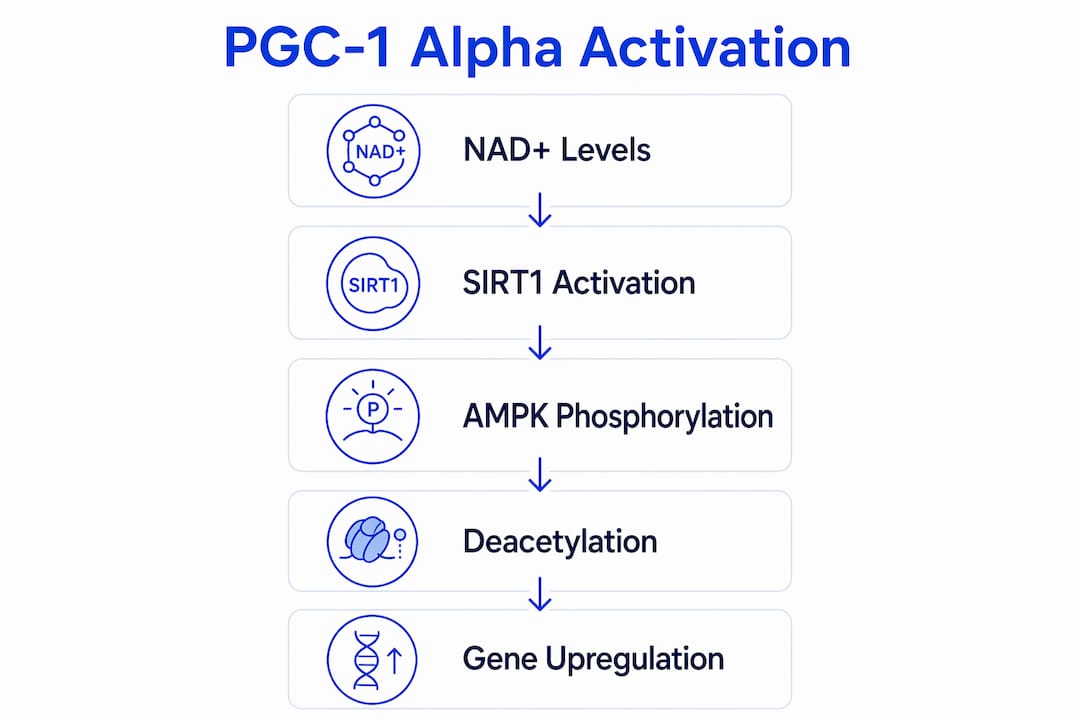
PGC-1 alpha’s activity is tightly regulated by post-translational modifications. The most studied include:
- Phosphorylation by AMPK: Activated under low energy conditions, AMPK phosphorylates PGC-1 alpha to increase its transcriptional coactivation capacity.
- Deacetylation by SIRT1: SIRT1 removes acetyl groups from PGC-1 alpha using NAD+ as a cofactor, which amplifies its activity.
- Ubiquitination: Tags PGC-1 alpha for proteasomal degradation, limiting its half-life under resting conditions.
- Methylation and O-GlcNAcylation: Fine-tune activity in a context-dependent manner, adding another regulatory layer.
PGC-1 alpha’s intrinsically disordered structure creates a major challenge for drug developers. Unlike enzymes with well-defined binding pockets, PGC-1 alpha lacks a stable three-dimensional shape. This means conventional small-molecule design strategies do not apply directly. Pharmacological targeting must focus on protein-protein interfaces and post-translational modification sites instead.
Pro Tip: When designing experiments to study PGC-1 alpha activity, measure both AMPK phosphorylation status and SIRT1 deacetylase activity together. Relying on only one marker underestimates the full activation state of the pathway.
Which upstream signals activate PGC-1 alpha?
Three physiological conditions reliably activate PGC-1 alpha: endurance exercise, caloric restriction, and cold exposure. Each imposes a distinct form of metabolic stress, but all converge on the same core signaling nodes.
- Endurance exercise depletes cellular ATP and raises the AMP/ATP ratio. This activates AMPK, which phosphorylates PGC-1 alpha and initiates mitochondrial biogenesis. Calcium release from contracting muscle also activates CaMKII, adding a parallel activation signal.
- Caloric restriction lowers NADH production and raises the NAD+/NADH ratio. Higher NAD+ availability activates SIRT1, which deacetylates and activates PGC-1 alpha. This links nutrient availability directly to mitochondrial output.
- Cold exposure activates the sympathetic nervous system, releasing norepinephrine. This triggers cAMP signaling and activates CREB, a transcription factor that drives PGC-1 alpha gene expression in brown adipose tissue, promoting adaptive thermogenesis.
NAD+ levels critically regulate SIRT1 activity and therefore PGC-1 alpha function. Without sufficient NAD+, PGC-1 alpha cannot reach full activation even when AMPK phosphorylation is present. This makes cellular redox balance a genuine checkpoint in the pathway, not a secondary consideration.
AMPK phosphorylates PGC-1 alpha while SIRT1 deacetylates it, and these two modifications act synergistically. Researchers studying mitochondrial biogenesis need to account for both arms of this regulatory system. Measuring one without the other produces an incomplete picture of pathway activity.

The downstream result of full PGC-1 alpha activation is coordinated upregulation of hundreds of genes. These include subunits of the electron transport chain, proteins for fatty acid import and oxidation, and antioxidant enzymes. The cell effectively builds more mitochondria and upgrades the ones it already has.
What are the physiological roles and disease implications of PGC-1 alpha?
PGC-1 alpha determines muscle fiber type, governing whether fibers adopt a slow-twitch oxidative or fast-twitch glycolytic identity. This is not a minor metabolic detail. Fiber type composition affects fatigue resistance, insulin sensitivity, and long-term metabolic health. Disrupting PGC-1 alpha signaling shifts muscle toward glycolytic fibers, reducing oxidative capacity.
The physiological roles of PGC-1 alpha span multiple organ systems:
- Skeletal muscle: Drives mitochondrial biogenesis, fatty acid oxidation, and slow-twitch fiber specification. Loss of PGC-1 alpha activity accelerates muscle atrophy.
- Brown adipose tissue: Activates uncoupling protein 1 (UCP1) to dissipate energy as heat during cold exposure, a process called adaptive thermogenesis.
- Cardiac tissue: Maintains the high mitochondrial density the heart requires for continuous contraction. Decreased PGC-1 alpha associates with ischemic heart damage.
- Brain: Supports neuronal energy demands and mitochondrial quality control. Reduced activity links to neurodegeneration.
| Condition |
PGC-1 alpha status |
Consequence |
| Sepsis-acquired weakness |
Decreased |
Muscle degeneration and impaired recovery |
| Spinal and bulbar muscular atrophy |
Dysregulated |
Myofiber specification failure |
| Ischemic heart disease |
Reduced |
Impaired cardiac energy metabolism |
| Aging |
Progressive decline |
Reduced mitochondrial output and tissue repair |
Targeting the AMPK/SIRT1/PGC-1 alpha axis alleviates muscle weakness and degeneration in sepsis models. This finding positions PGC-1 alpha not just as a metabolic regulator but as a therapeutic target in critical illness. The implication is that restoring pathway activity, rather than treating downstream symptoms, may be the more effective clinical strategy.
PGC-1 alpha dysfunction contributes to the mitochondrial decline seen in aging. Aging correlates with decreased PGC-1 alpha expression, lower NAD+ availability, and reduced AMPK signaling. The combined effect is impaired biogenesis, increased oxidative damage, and reduced energy output across tissues.
What pharmacological and practical approaches modulate this pathway?
Lifestyle interventions remain the most validated way to activate PGC-1 alpha. Exercise, caloric restriction, and cold exposure all increase PGC-1 alpha expression and activity through AMPK, SIRT1, and calcium signaling. These are not placeholders until better drugs arrive. They are mechanistically understood activators with decades of supporting evidence.
Pharmacological modulation is advancing, though the structural disorder of PGC-1 alpha makes it harder than conventional drug targets. Current approaches include:
- ZLN005: A small-molecule transcriptional activator that increases PGC-1 alpha gene expression. Under evaluation for metabolic disease applications.
- SR18292: A small-molecule inhibitor that reduces PGC-1 alpha activity. Relevant in cancer research contexts where PGC-1 alpha supports tumor cell metabolism.
- NAD+ precursors: Compounds that raise cellular NAD+ levels, supporting SIRT1 activity and downstream PGC-1 alpha deacetylation. Synthrolab supplies research-grade NAD+ compounds for investigators studying this axis.
- AMPK activators: Compounds that mimic the energy-depleted state and trigger the phosphorylation cascade.
Small-molecule activators like ZLN005 represent a shift toward precision pharmacological intervention from purely lifestyle-based modulation. The challenge is tissue specificity. A systemic activator may produce different effects in muscle versus liver versus brain, requiring targeted delivery strategies.
Researchers exploring metabolic modulation compounds for PGC-1 alpha studies need reagents with verified purity and documented activity. The quality of the compound directly affects the reproducibility of results.
Pro Tip: When using NAD+ precursors in cell culture experiments, measure intracellular NAD+/NADH ratios at baseline and post-treatment. This confirms the compound is actually shifting redox state before attributing downstream PGC-1 alpha changes to the intervention.
Key Takeaways
PGC-1 alpha is the central regulator of mitochondrial biogenesis, and its activity depends on AMPK phosphorylation, SIRT1 deacetylation, and sufficient NAD+ availability across all target tissues.
| Point |
Details |
| PGC-1 alpha does not bind DNA |
It docks onto transcription factors like NRF1, NRF2, and ERRα to drive gene expression. |
| AMPK and SIRT1 are the primary activators |
Both phosphorylation and deacetylation are required for full pathway activation. |
| NAD+ is a rate-limiting cofactor |
Without adequate NAD+, SIRT1 cannot fully activate PGC-1 alpha regardless of AMPK status. |
| Dysregulation drives multiple diseases |
Reduced PGC-1 alpha links to muscle atrophy, cardiac damage, and accelerated aging. |
| Pharmacological targeting is structurally constrained |
PGC-1 alpha’s disordered structure requires targeting protein interfaces, not classic binding pockets. |
Why PGC-1 alpha research is more nuanced than most reviews admit
What strikes me after spending time deep in this literature is how often PGC-1 alpha gets reduced to “the mitochondria gene.” That framing misses most of what makes it scientifically interesting. PGC-1 alpha is a metabolic identity regulator. It does not just build more mitochondria. It decides what kind of cell a muscle fiber becomes, how a cardiomyocyte handles energy stress, and whether a neuron can sustain its activity over decades.
The tissue specificity problem is underappreciated. A systemic PGC-1 alpha activator will not produce uniform effects. Muscle, liver, and brain each have different transcription factor landscapes, different NAD+ dynamics, and different downstream gene targets. Researchers who treat PGC-1 alpha as a single dial they can turn up or down will get confusing results. The pathway is better understood as a context-sensitive amplifier.
The structural disorder issue is also more consequential than it sounds. Most drug discovery pipelines are built around proteins with defined binding pockets. PGC-1 alpha does not have one. That forces researchers toward protein-protein interface targeting, which is technically harder and less mature as a field. The compounds currently in development, including ZLN005 and SR18292, are early-stage tools, not clinical solutions. They are valuable for mechanistic research, but the gap between a useful research probe and a therapeutic is still wide.
What I find genuinely promising is the convergence of lifestyle and pharmacological approaches. NAD+ precursors combined with exercise training produce additive effects on PGC-1 alpha activity in preclinical models. That kind of combination strategy, where you prime the pathway with lifestyle and then amplify with targeted compounds, is where the field is heading. The researchers who will make the most progress are the ones who treat PGC-1 alpha as a system to be understood in context, not a single target to be hit.
— Mitch
Researchers investigating the PGC-1 alpha pathway need compounds that perform consistently across experimental conditions. Synthrolab supplies research-grade peptides and laboratory compounds designed for work in cellular signaling, mitochondrial function, and metabolic modulation.
For investigators new to this area, Synthrolab’s peptides for beginners guide provides a practical starting point for understanding which compound classes are relevant to mitochondrial and metabolic pathways. Researchers already working in this space can browse the cellular regeneration catalog for compounds relevant to mitochondrial quality control and biogenesis research. Every compound ships with documented purity data to support reproducible results.
FAQ
What is PGC-1 alpha and what does it do?
PGC-1 alpha is a transcriptional coactivator that regulates mitochondrial biogenesis and energy metabolism in tissues like skeletal muscle, heart, and brown adipose tissue. It does not bind DNA directly but docks onto transcription factors including NRF1, NRF2, and ERRα to drive gene expression.
How does PGC-1 alpha get activated?
AMPK phosphorylates PGC-1 alpha under low-energy conditions, while SIRT1 deacetylates it when NAD+ levels are high. Both modifications are required for full activation, and physiological triggers include endurance exercise, caloric restriction, and cold exposure.
Why does NAD+ matter for PGC-1 alpha function?
NAD+ is the cofactor SIRT1 requires to deacetylate and activate PGC-1 alpha. Without sufficient NAD+, PGC-1 alpha remains partially acetylated and its transcriptional activity is limited, even when AMPK phosphorylation is present.
What diseases are linked to PGC-1 alpha dysregulation?
Reduced PGC-1 alpha activity associates with sepsis-acquired muscle weakness, spinal and bulbar muscular atrophy, ischemic heart disease, and the mitochondrial decline seen in aging. Restoring AMPK/SIRT1/PGC-1 alpha axis activity has shown protective effects in preclinical models.
Can small molecules target the PGC-1 alpha pathway?
Yes, though the protein’s intrinsically disordered structure makes conventional drug design difficult. ZLN005 activates PGC-1 alpha gene expression, while SR18292 inhibits it. Both are research tools under evaluation for metabolic and oncology applications rather than approved therapeutics.
Recommended
 21+ verification