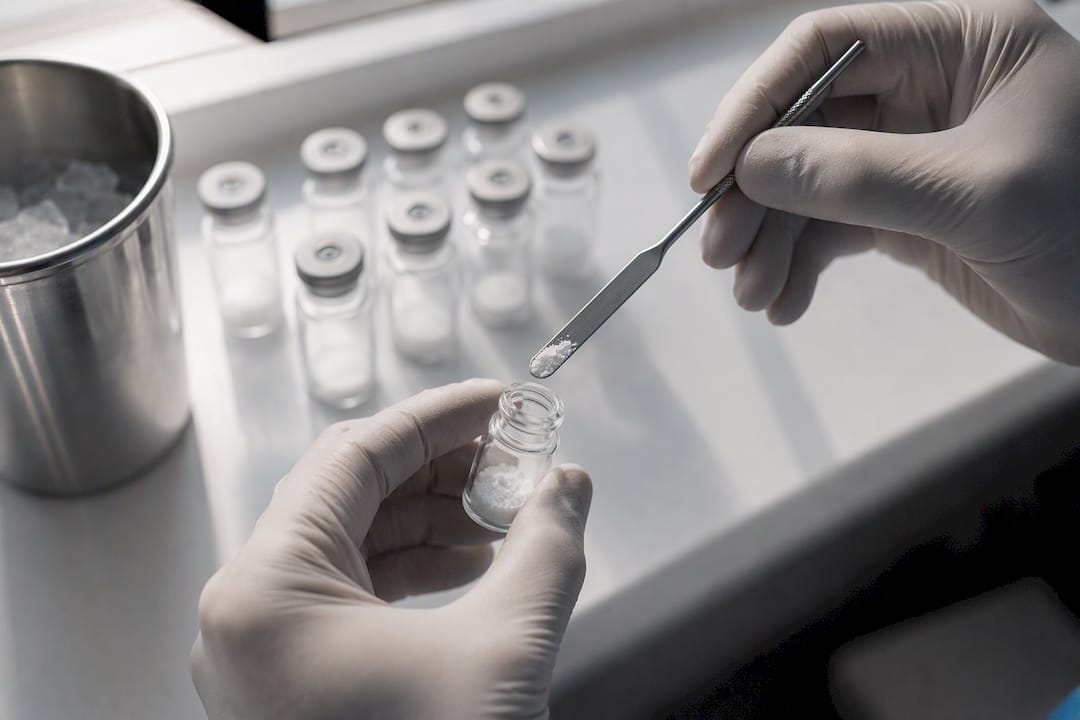
PT-141 (bremelanotide) is a cyclic heptapeptide melanocortin receptor agonist studied for its activity at MC3 and MC4 receptors. As a research compound, it should arrive with a batch-specific Certificate of Analysis (COA) confirming purity and identity before it goes anywhere near an assay or an animal protocol.
TL;DR:
- Always verify that the COA’s lot number matches the vial’s batch ID and review the full chromatogram and mass spectrometry data before use.
- Maintain lyophilized PT-141 at -20°C and reconstitute with sterile water or bacteriostatic water, using aliquots to prevent degradation from freeze-thaw cycles.
- Use doses based on literature examples, like micrograms-per-kilogram ranges in rodents, and choose administration routes (subcutaneous, intraperitoneal, intravenous) according to your experimental goals.
- For research accuracy, document lot numbers and sample reconstitution dates and consider independent testing if critical for publications or compliance.
- Prioritize vendor-supplied batch-specific certificates with high purity standards (95-99%) to ensure peptide integrity and avoid confounding results from impurities.
Table of Contents
What is PT-141 in a research context?
PT-141 is the common research shorthand for bremelanotide, a synthetic analog of alpha-melanocyte-stimulating hormone (α-MSH). It’s not a novel scaffold engineered from scratch. It’s a stabilized cyclic derivative of a naturally occurring signaling peptide, which is part of why it shows up so often in melanocortin pathway research.
Database entries from the Guide to Pharmacology list bremelanotide alongside its synonyms and confirm its identity as a cyclic heptapeptide with defined activity at melanocortin receptor subtypes. That ligand entry matters for researchers because it grounds mechanistic claims in a verifiable dataset rather than vendor marketing copy. For lab purposes, treat PT-141 the way you’d treat any peptide reagent: confirm what’s actually in the vial, understand what it’s reported to do at the receptor level, and design your protocol around published, reproducible parameters rather than assumptions carried over from unrelated compounds.
Mechanism and chemical properties relevant to lab work
PT-141’s cyclic structure is what gives it a longer functional half-life than a linear peptide of similar size. Cyclization protects the backbone from rapid exopeptidase degradation, a property that matters when you’re planning sampling windows for a pharmacodynamic study. Review literature on the melanocortin pathway summarizes bremelanotide’s activity across MC1R, MC3R, MC4R, and MC5R, with functional relevance concentrated at MC3 and MC4. Those two receptor subtypes are heavily implicated in central nervous system and energy-homeostasis signaling, which is why PT-141 shows up in both behavioral neuroscience protocols and metabolic research designs.
A few structural and practical points shape how you should handle it on the bench:
- The cyclic heptapeptide backbone confers reasonable resistance to enzymatic breakdown compared to linear analogs.
- Receptor affinity data from GtoPdb and ChEMBL show activity ranges that vary by assay system, so binding results from one lab’s functional assay won’t always map cleanly onto another’s.
- Lyophilized powder is markedly more stable than reconstituted solution, and most degradation you’ll see in practice happens after reconstitution, not before.
For CNS or behavioral assays, the MC3/MC4 activity profile is the relevant lens. For peripheral or metabolic signaling work, keep in mind that melanocortin receptor expression patterns differ by tissue, so a result in one system doesn’t automatically generalize to another.
Verifying a PT-141 vial: sourcing and COA checks that matter
The single biggest quality-control failure point for research peptides isn’t the synthesis. It’s the paperwork. Anyone can print a certificate; the question is whether it’s tied to the actual lot in your hand.

For research applications, HPLC purity guides recommend a baseline of 95% or higher for general use, and 98–99% purity when you’re running receptor-binding or signaling assays where trace impurities can skew dose-response curves. Below that threshold, you’re introducing a confound you can’t easily control for.
Run every COA through this checklist before you open the vial:
- Lot number match. The COA’s batch or lot ID must match the number printed on the vial itself, not just a generic product-line certificate.
- Full chromatogram, not a summary. You want the actual HPLC trace, not a single purity percentage pulled out of context.
- Mass spec identity confirmation. MS data confirming molecular weight is what distinguishes “we think this is PT-141” from “we’ve confirmed this is PT-141.”
- Named testing lab and method. A defensible COA states which lab ran the analysis and what method it used (reverse-phase HPLC, MS ionization mode, and so on).
- Dated documentation with traceable task IDs. Independent verification is strongest when a third-party lab’s task ID lets you look up the raw analysis independently of the vendor’s own claims.
Watch for the red flags: a COA PDF that’s reused across multiple product listings, missing or generic lot numbers, or a chromatogram that looks suspiciously identical to one from a different batch.
Pro Tip: If a result matters for a publication or a grant deliverable, send a small sample of your vial to an independent lab for confirmatory testing rather than relying solely on the vendor’s documentation, even when that documentation looks solid.
Reconstitution, storage, and solution stability
Lyophilized PT-141 is chemically stable for extended periods when kept cold and protected from light. The instability risk starts the moment you add solvent.
Practical protocol guidance recommends reconstituting with sterile water or bacteriostatic water, depending on whether the solution needs to remain viable across multiple uses. Bacteriostatic water’s benzyl alcohol content helps inhibit microbial growth in solutions you’re drawing from repeatedly over days rather than using in one session.
A few handling rules keep your reconstituted material usable and your data clean:
- Store lyophilized powder at -20°C or lower until you’re ready to reconstitute.
- Once reconstituted, keep the solution at 2–8°C and plan to use it within a short window rather than stretching it across weeks.
- Aliquot immediately after reconstitution if you anticipate needing the peptide across multiple sessions. This avoids repeated freeze-thaw cycles, which degrade peptide integrity faster than almost anything else in the workflow.
- PT-141 solutions tend to be stable around pH 4 to 6. A visibly cloudy or particulate solution is a sign something’s gone wrong, either with the reconstitution water or with degradation, and shouldn’t go into an assay.
Pro Tip: Label each aliquot with reconstitution date and lot number, not just concentration. When something looks off three weeks into a study, that timestamp is what lets you trace the problem back to a specific prep rather than guessing.
Designing PT-141 experiments: dosing, routes, and controls
Preclinical literature gives you a starting reference point, not a protocol to copy verbatim. A well-cited rodent study on melanocortin receptor agonists reported dose-dependent facilitation of proceptive behavior in female rats following subcutaneous administration, with doses reported in micrograms-per-kilogram ranges. Treat that as a literature example illustrating the dose-response relationship researchers have documented, not as a number to plug into your own protocol without adjustment for your specific strain, sex, and study endpoint.
Route selection depends heavily on what you’re measuring:
- Subcutaneous (s.c.) dosing is the most commonly reported route in behavioral studies, offering a slower, more sustained systemic exposure than intravenous administration.
- Intraperitoneal (i.p.) dosing shows up frequently in rodent pharmacology work where researchers want faster onset than s.c. without the technical demands of i.v. access.
- Intravenous (i.v.) administration is used when precise pharmacokinetic sampling matters more than convenience.
Timepoints for behavioral readouts should account for the peptide’s absorption profile at the chosen route. For signaling assays, sampling windows need to be tight enough to catch peak receptor activation rather than a flattened average.
On reproducibility: the same rodent study cited above used blinded observers to score behavioral outcomes, a design choice worth replicating in any study reporting subjective or observational endpoints. Document lot numbers alongside your results. If a finding doesn’t replicate later with a different batch, that documentation is the first place you’ll look. It’s also worth noting that some early industry-funded studies in this space disclosed financial ties to peptide manufacturers, a detail that underscores why independent replication and transparent methodology matter more than any single paper’s conclusions.
Safety and regulatory notes for lab handling
PT-141 sold through research channels carries a research-use-only label, and that label means what it says. This guide covers laboratory investigation exclusively, not clinical dosing or therapeutic protocols.
Standard peptide-handling safety practices apply: wear appropriate PPE when weighing or reconstituting powder, screen for endotoxin contamination if your downstream application is sensitive to it (particularly relevant for any in-vivo work), and confirm the COA before the vial goes anywhere near a bench. Dispose of unused material and sharps according to your institution’s biosafety protocols, not household waste procedures.
If your work involves live animals, your protocol needs IACUC approval before you start, full stop. Cell-based or human-tissue work typically falls under IRB oversight depending on your institution’s structure. Regulatory and legal questions about sourcing, importing, or using research peptides vary by institution and jurisdiction. When in doubt, your institution’s research compliance office is the right first call, not a forum thread or a vendor’s FAQ page.
An editorial take on where research rigor actually breaks down
Most of the failures I see in peptide research don’t come from bad science. They come from skipped verification steps that felt unnecessary until they weren’t. A COA that matches the product line but not the lot. A reconstituted solution left in a fridge for six weeks because “it’s probably fine.” A dosing decision borrowed from a study without checking whether the strain, sex, or administration route actually lines up.
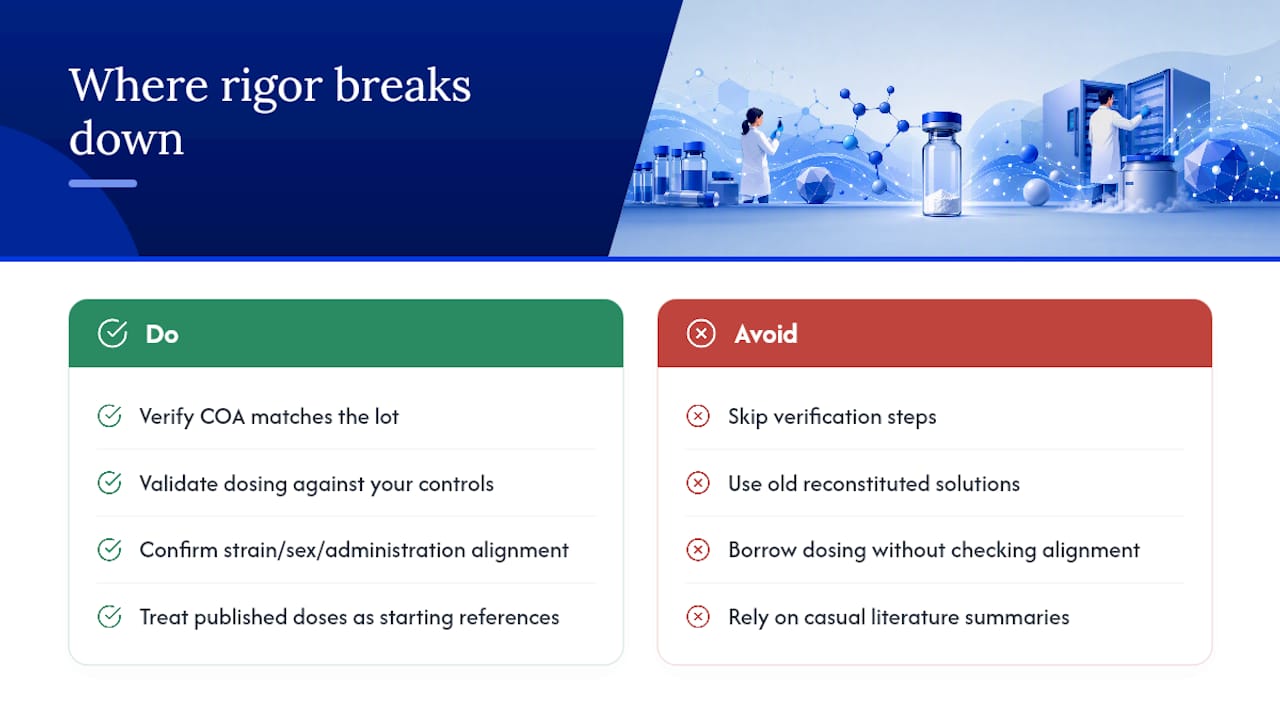
The uncomfortable truth is that melanocortin pharmacology is genuinely intricate. MC3 and MC4 receptor activity interacts with CNS and metabolic pathways in ways that are still being mapped, and a lot of the literature reflects that complexity poorly in casual summaries. Treat any dosing figure you find, including the ones in this guide, as a starting reference to be validated against your own controls, not a shortcut around them.
Synthro Lab builds its research-grade peptide catalog around the same principle: cellular signaling research doesn’t tolerate shortcuts, whether that’s in metabolism work, recovery pathways, or mitochondrial function studies. For readers digging into related melanocortin compounds, the Peptide MT2 research guide covers receptor mechanics from a different angle, and the LL-37 mechanistic guide is a solid model for how deep a lab protocol writeup should go.
— Mitch
Getting research-grade PT-141 with documentation you can actually verify
Sourcing PT-141 for a study shouldn’t mean gambling on whether the COA in your inbox actually matches the vial on your bench. Synthro Lab supplies research-grade peptides with batch-specific Certificates of Analysis, and third-party testing documentation is available on request for researchers who need an independent verification layer for publication or institutional review.
When you place an order, note the specific lot number and any COA task IDs you need referenced in your order notes. That makes it straightforward to trace documentation back to the exact material you received, which matters if a reviewer or lab partner asks for verification down the line. If you’re new to evaluating peptide quality standards more broadly, the peptide quality and buying guide walks through what separates a defensible research purchase from a guess. Check current PT-141 availability and documentation options directly through Synthro Lab before your next order.
This article is general information, not a substitute for advice from a qualified doctor. Consult a qualified healthcare professional about your own circumstances before acting on anything here.
Sources
Recommended
 21+ verification