TB-500 is a synthetic version of a fragment of thymosin beta-4, sold under the chemical shorthand Ac-LKKTETQ, and it carries real preclinical evidence for tissue repair but zero validated human dosing and no completed clinical trials of its own. It is not FDA-approved for any use, and the World Anti-Doping Agency bans it at all times for competitive athletes. Regulatory materials also flag immunogenicity risks and an absence of human exposure data for this exact fragment.
That gap between plausible biology and proven outcome is the whole story here, and it matters before you read another word about dosing or benefits.
Three things to keep in mind as you go:
- TB-500 is a fragment, not the full thymosin β4 protein, and the two do not have identical evidence bases.
- Community dosing figures are anecdotal, not clinical guidance, and no standardized human protocol exists.
- Athletes, cancer patients, and pregnant or breastfeeding individuals face specific, elevated risk categories worth understanding before anything else.
Key Takeaways
TB-500 shows real preclinical promise through its actin-binding mechanism, but no validated human dosing exists, and WADA bans it outright for competitive athletes.
| Point |
Details |
| Fragment, not full protein |
TB-500 replicates only the actin-binding motif of thymosin beta-4, not the complete 43-amino-acid protein. |
| Evidence gap is real |
Claimed benefits rest on animal and in-vitro studies; no completed human trials exist for the TB-500 fragment itself. |
| Metabolites may drive effects |
A 2024 study found the metabolite Ac-LKKTE, not intact TB-500, produced measurable wound-healing activity in fibroblast assays. |
| Regulatory status is unambiguous |
The FDA flags safety-data gaps, and WADA prohibits TB-500 for athletes at all times, in and out of competition. |
| Verify before you research |
Synthrolab supplies TB-500 as a single-compound, COA-backed product for research-use-only laboratory work. |
This article is general information, not a substitute for advice from a qualified doctor. Consult a qualified healthcare professional about your own circumstances before acting on anything here.
Table of Contents
What Is TB-500, and How Does It Differ From Thymosin Beta-4?
TB-500 refers to a synthesized peptide fragment representing amino acids 17 through 23 of thymosin beta-4, with an acetyl group added to the N-terminus. Chemically, it is listed in databases like PubChem under CID 62707662, which gives researchers a way to confirm they are looking at the correct compound rather than a mislabeled analog. The sequence itself, Ac-LKKTETQ, is short enough to synthesize cheaply but long enough to retain some of the parent protein’s biological activity.
Full-length thymosin β4 is a 43-amino-acid protein that has been studied in registered human trials for wound healing and cardiac repair. TB-500, the seven-amino-acid fragment, has not gone through that same clinical pipeline. Vendors sometimes blur this distinction, citing full-length Tβ4 trial data to imply TB-500 has equivalent human evidence behind it. It doesn’t. Reviews of the available literature note that data on the fragment itself remain limited to animal and in-vitro work, while human trials involve a different, larger molecule entirely.
A few identity issues worth flagging:
- Some sellers list “TB-500” and “Thymosin Beta-4” interchangeably, even though they are structurally distinct compounds with different evidence bases.
- The acetylation at the N-terminus (the “Ac” in Ac-LKKTETQ) affects stability and is a detail worth confirming on any certificate of analysis.
- Because the fragment is inexpensive to synthesize, counterfeit or under-dosed vials are common in the unregulated research-chemical market.
Understanding the different thymosin peptide variants matters if you’re comparing published research against what’s actually in a vial.
What Are the Claimed Benefits of TB-500?
Ask around research forums and you’ll hear the same short list of claims repeated: faster tendon and ligament healing, reduced post-surgical downtime, and quicker recovery between hard training blocks. The honest answer is that these claims rest almost entirely on animal models and cell-culture work, not controlled human studies of the fragment itself.
- Soft-tissue repair. Preclinical models suggest thymosin-beta-4-related peptides can accelerate cell migration to injury sites, a mechanism tied to faster healing in animal wound models. Human confirmation for the TB-500 fragment specifically is absent.
- Post-surgical recovery. Some researchers and biohackers report smoother post-operative healing timelines, but this is anecdotal self-report, not data from any registered trial.
- Training recovery. Athletes cite reduced soreness and faster turnaround between sessions. No published human trial has tested this outcome for TB-500.
- Reduced inflammation. Animal studies hint at anti-inflammatory signaling tied to the actin-binding activity of the fragment, though this hasn’t been isolated and confirmed in human tissue.
A pattern shows up across nearly every independent review of the evidence: strong biological plausibility, thin human confirmation. One academic Q&A piece bluntly cautions readers to be skeptical of trending peptide injections precisely because hype tends to outrun the data.
It’s also common to see TB-500 mentioned alongside BPC-157 in recovery stacks, a pairing driven more by shared community use than by any trial testing the combination directly. More on that comparison below.
How Does TB-500 Work in the Body?
The biological argument for TB-500 rests on one structural feature: the LKKTETQ sequence sits inside the actin-binding domain of full-length thymosin beta-4. Actin is the scaffolding protein cells use to move, and thymosin β4’s ability to bind actin monomers is thought to support cell migration, a process relevant to wound closure and blood vessel formation (angiogenesis).
Here’s where the fragment’s limits become important. Full-length thymosin β4 has 43 amino acids and multiple functional regions beyond the actin-binding motif, including domains implicated in anti-inflammatory signaling and stem cell mobilization. TB-500 only replicates the short actin-binding stretch, meaning any biological activity tied to the rest of the protein isn’t necessarily present in the fragment. Extrapolating full-length results onto the fragment is a common but scientifically shaky leap.
- The actin-binding motif (LKKTETQ) is well characterized in analytical chemistry work on the fragment’s synthesis and structure.
- Domains outside this seven-amino-acid stretch, present in full-length Tβ4, are absent from TB-500 entirely.
- This structural gap is a big part of why researchers caution against assuming equivalent outcomes between the two molecules.
Statistic callout: A 2024 metabolite study found that Ac-LKKTE, a breakdown product of TB-500, showed measurable wound-healing activity in fibroblast assays while the intact parent fragment did not produce the same effect under identical test conditions. That finding suggests some of the biological activity attributed to TB-500 may actually come from what the body converts it into, not the injected molecule itself, an important nuance for anyone designing a study around this compound.
There is no FDA-approved or clinically validated dosing schedule for TB-500 in humans, full stop. What circulates online is a patchwork of self-reported protocols, not medical guidance, and treating them as such is a mistake.
- Loading phase approach. Some protocols describe a higher total weekly amount, often in the 2 to 5 mg per week range split across two to three injections, used for several weeks before dropping to a lower maintenance amount.
- Frequent low-dose approach. Others favor smaller, more frequent doses on the theory that steadier exposure supports ongoing tissue signaling, though this hasn’t been tested against the loading approach in any controlled setting.
- Route selection. Subcutaneous injection into the abdomen or thigh is the most commonly described route; some protocols describe intramuscular injection closer to an injury site, on the theory that local delivery concentrates the peptide where it’s needed.
None of these numbers come from a clinical trial. They’re crowd-sourced patterns, and treating them as a prescription is a category error researchers should avoid.
Before using any research compound, a short verification checklist matters more than the dosing number itself:
- Request a certificate of analysis (COA) showing mass spectrometry confirmation of identity and purity.
- Verify the product is supplied as a single, individually tested compound rather than a pre-blended stack, since blended vials make it impossible to confirm each component’s actual concentration.
- Confirm sterility testing and proper lyophilized storage conditions before reconstitution.
Pro Tip: Ask any supplier for the raw LC-MS spectra behind their COA, not just a summary certificate. A one-page purity claim without the underlying spectra tells you almost nothing about what’s actually in the vial.
What Side Effects and Safety Concerns Come With TB-500?
Self-reported adverse effects from TB-500 use tend to be mild and localized: injection-site redness or swelling, occasional headache, and fatigue in the days following a dose. These reports come from unregulated, uncontrolled community use, not from any monitored clinical study, so the true rate and severity of side effects remain unknown.
The bigger concern sits at the regulatory level. FDA materials specifically flag that compounded products containing the thymosin beta-4 fragment lack adequate human exposure data, and raise the possibility of immunogenicity, meaning the body could mount an immune response against the peptide itself over repeated exposure. That’s not a hypothetical footnote. It’s the primary reason regulators have been unwilling to treat this compound as safe for general use.
Statistic callout: The FDA’s Pharmacy Compounding Advisory Committee met in July 2026 specifically to weigh compounding nominations that included the thymosin beta-4 fragment, a sign that scrutiny of this substance is active and ongoing, not settled.
Several groups face elevated risk and should treat any TB-500 research with extra caution:
- Anyone with active or prior cancer, since peptides that promote angiogenesis and cell migration carry theoretical tumor-growth concerns that haven’t been ruled out.
- Pregnant or breastfeeding individuals, given the total absence of reproductive safety data.
- Competitive athletes subject to drug testing, since WADA prohibits thymosin beta-4 and its derivatives at all times, not just in-competition.
TB-500 vs. BPC-157: What’s the Real Difference?
These two peptides get mentioned together so often that people assume they do the same thing. They don’t, at least not by the mechanisms proposed in preclinical research.
BPC-157 is derived from a protective protein found in gastric juice, and preclinical work ties it to angiogenesis and gut-lining repair through pathways distinct from thymosin beta-4’s actin-binding activity. TB-500’s proposed mechanism runs through cell migration via actin regulation, a different biological lever entirely, even though both compounds get lumped into the same “recovery peptide” conversation.
- Both have preclinical evidence in animal models for tissue repair, but neither has completed human trials under its own name.
- People stack them on the theory that hitting two different repair pathways simultaneously produces a bigger effect than either alone, though no controlled study has tested that combination directly.
- Stacking introduces a real verification problem: pre-blended vials marketed as “BPC-157 + TB-500” make it far harder to confirm the actual concentration of each individual peptide, since a single COA on a mixed product often can’t isolate each component’s purity.
If you’re studying either compound, or the more common pairing of the two, working with individually verified vials rather than pre-mixed blends is the only way to know what you’re actually dosing. Synthrolab’s guide on peptides for muscle repair breaks down the evidence quality across several compounds in this category side by side.
Where Do Regulators and Anti-Doping Bodies Stand on TB-500?
The regulatory picture is unambiguous even where the science is not. The FDA has publicly identified the thymosin beta-4 fragment as a substance with unresolved safety-information gaps for compounded use, citing a lack of human exposure data as a central concern in its bulk drug substance guidance. The agency’s Pharmacy Compounding Advisory Committee reviewed nominations involving this fragment as recently as July 2026, which tells you this isn’t old, settled business.
On the sport side, WADA lists thymosin beta-4 and its derivatives, TB-500 included, as prohibited substances at all times under its anti-doping code, not just during competition windows. Detection science backs up the ban: scientific research into TB-500 metabolism has advanced enough that testing labs can identify the compound and its metabolites with reasonable confidence.
Practical implications:
- Athletes in any tested sport should treat TB-500 as a career-ending risk, not a gray area.
- Clinicians and consumers should not treat TB-500 as an approved or clinically validated therapeutic; it currently has no FDA-approved human indication.
- Anyone purchasing TB-500 should assume products fall under research-use-only status, with sourcing and legal risk resting on the buyer.
What Does a Sound Research Protocol for TB-500 Look Like?
If TB-500 is going into a legitimate research setting, whether cell-culture work or an animal model, the quality of the compound matters as much as the study design around it. Synthrolab built its Tissue Repair Peptide Research Protocol around exactly this problem: too many labs and independent researchers were working with unverified material and getting inconsistent, unreproducible results.
A reasonable product-quality checklist for any tissue-repair peptide study:
- Confirm identity and purity via a batch-specific certificate of analysis backed by mass spectrometry data, not a generic template.
- Use single-compound vials rather than pre-blended stacks so purity and concentration can be isolated per peptide.
- Verify sterility testing and proper cold-chain storage before reconstitution.
- Build in appropriate vehicle controls and dose-response arms, and define clear, measurable endpoints (wound closure rate, cell migration assays) before starting.
Pro Tip: If your institution requires IRB or animal-care committee approval, confirm that approval covers the exact peptide and dose range before ordering, not after. Research-use-only compounds carry zero human-use approval, and that status shapes what protocols are even permissible.
Is TB-500 Worth Investigating, and What’s the Smarter Path Forward?
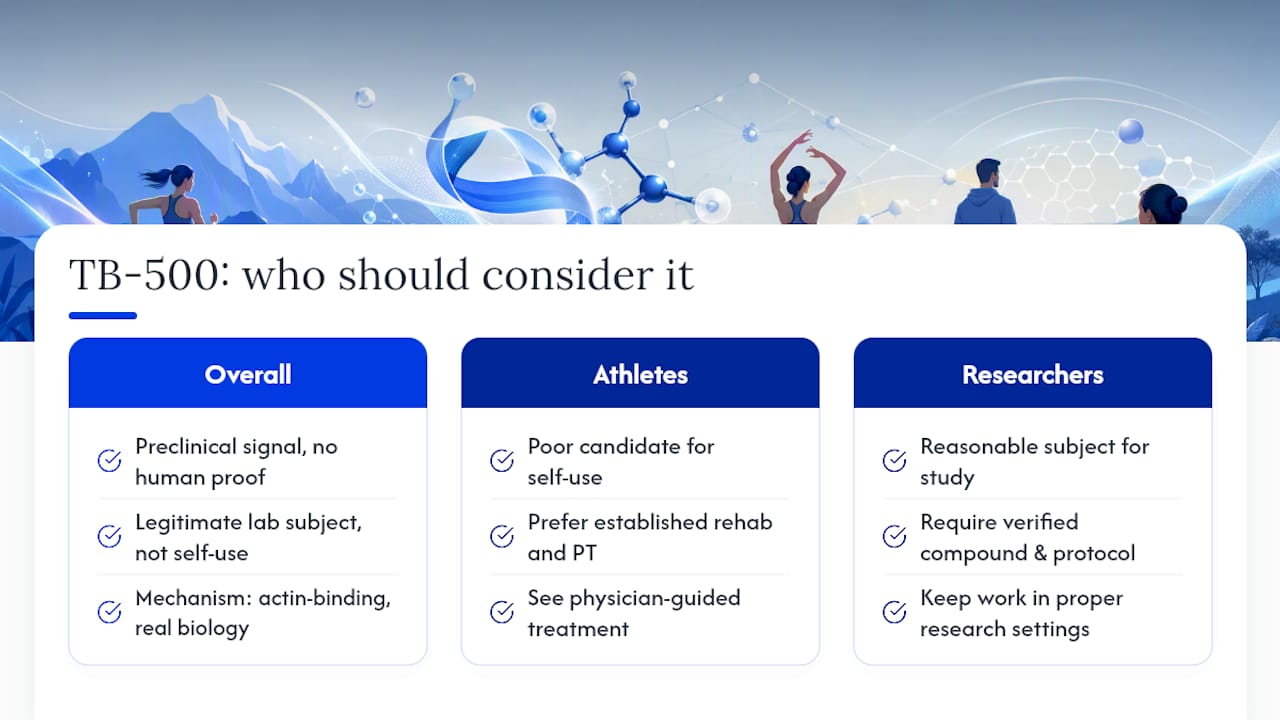
TB-500 sits in a strange spot: mechanistically interesting, backed by real preclinical signal, and completely unproven at the human clinical level. That combination makes it a legitimate subject for laboratory research and a poor candidate for anyone hoping to self-administer their way to faster tendon healing. The actin-binding mechanism is real biology, not marketing fluff, but real biology and a validated human therapy are two very different things.
For athletes chasing faster recovery, established rehab protocols, physical therapy, and where appropriate, physician-guided treatment carry far more human evidence than any unregulated peptide. For researchers, the fragment remains a reasonable subject of study, provided the compound is verified, the protocol is sound, and the work stays confined to appropriate research settings rather than human self-experimentation.
— Mitch
Where to Source Research-Grade TB-500 for Laboratory Work
If you’re a researcher who’s read this far, you already know the real bottleneck isn’t the biology, it’s trusting what’s actually in the vial. Synthrolab’s TB-500 10mg is supplied as a single-compound, batch-tested product with a certificate of analysis backing purity and identity for every lot, not a generic template shared across products.
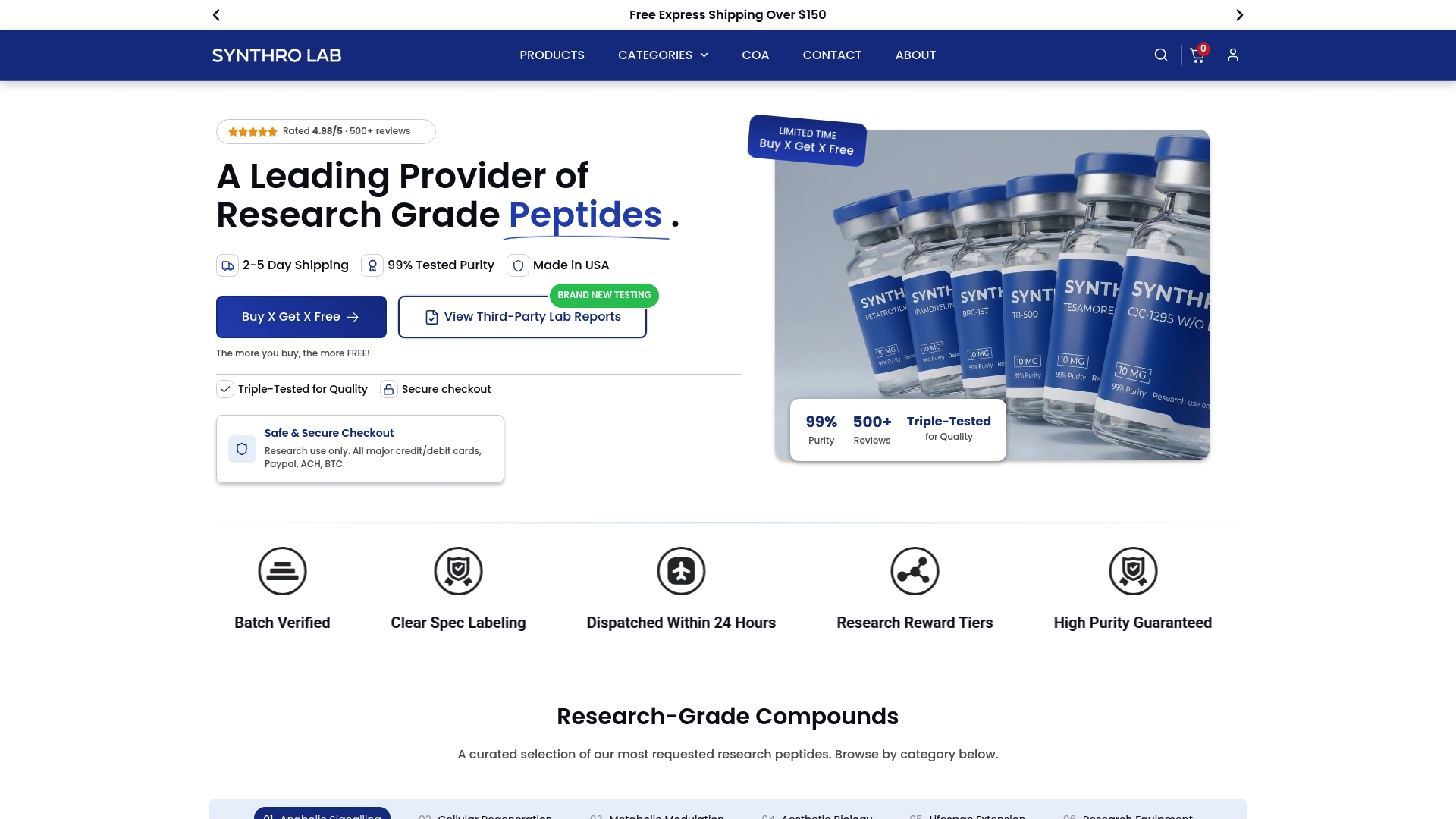
Every batch ships with documentation researchers can check before it ever reaches the bench: mass spec confirmation, purity data, and storage guidance built around the Tissue Repair Peptide Research Protocol referenced above. That protocol exists because too much of the peptide market sells first and documents later. Synthrolab flips that order. For labs studying TB-500 alongside BPC-157, the combined GHK-Cu, BPC-157, and TB-500 research bundle keeps each compound individually verified rather than pre-blended, so purity tracking per peptide stays intact. All products are strictly for laboratory research use, not human consumption. Start by pulling the COA on the alpha peptides research page and confirming it matches your study’s documentation requirements before placing an order.
Sources
Recommended
 21+ verification