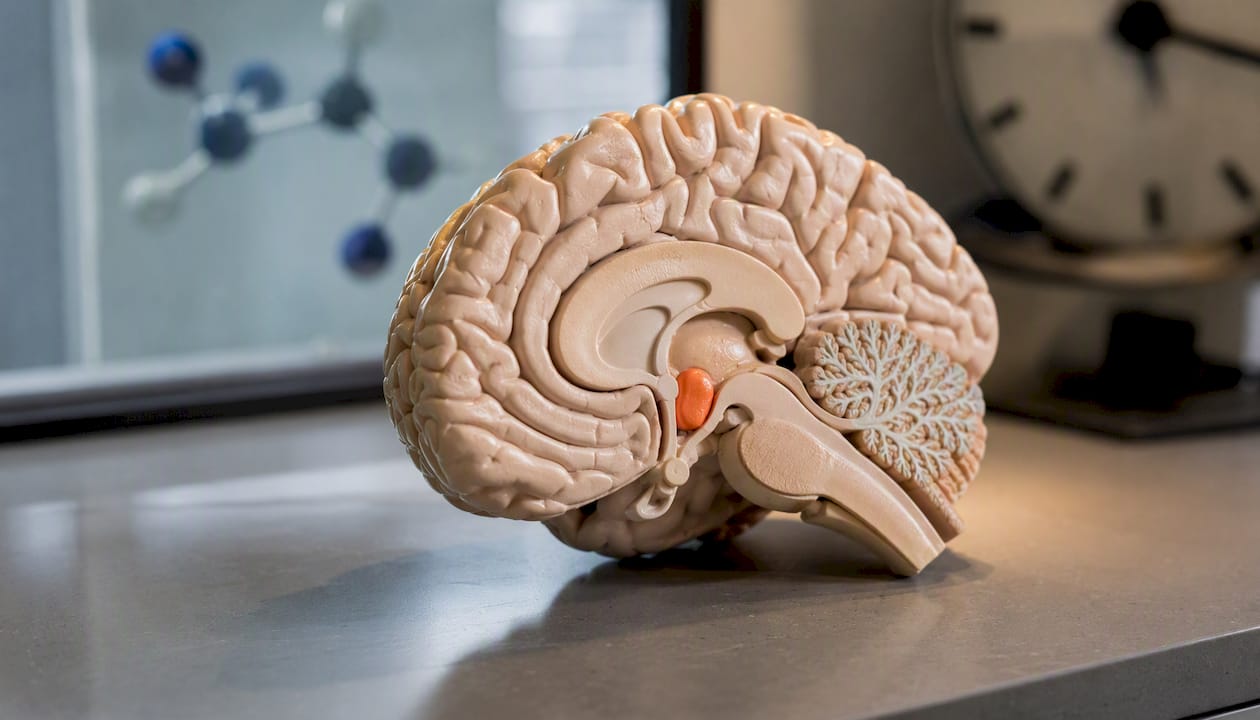
Circadian rhythm is your body’s endogenous, roughly 24-hour internal clock, and it runs the timing of sleep, hormones, temperature, and metabolism whether you pay attention to it or not. It’s coordinated by the suprachiasmatic nucleus (SCN), a cluster of cells in the hypothalamus that acts as your body’s master timekeeper. Three things follow directly from that:
- Your sleep timing and daytime alertness track a built-in schedule, not just how tired you feel.
- Hormones like melatonin and cortisol, plus your core body temperature, rise and fall on a predictable daily curve.
- Chronic misalignment between that internal clock and your actual behavior is tied to metabolic and cardiovascular problems, not just grogginess.
The Cleveland Clinic and the National Institute of General Medical Sciences (NIGMS) both treat this clock as a foundational piece of human physiology, not a wellness buzzword. Understanding how it works explains a lot about why jet lag wrecks you, why shift work is genuinely hard on the body, and why “just go to bed earlier” is only part of the fix.
Key Takeaways
Circadian rhythm disruption drives measurable metabolic and cardiovascular risk, and morning light plus a consistent wake time are the two highest-leverage fixes available to anyone.
| Point |
Details |
| Definition |
Circadian rhythm is an endogenous, roughly 24-hour clock run by the SCN, not just a sleep habit. |
| Master and peripheral clocks |
The SCN syncs to light, but liver, muscle, and fat tissue clocks respond strongly to meal timing. |
| Health stakes |
Chronic disruption is linked to obesity, type 2 diabetes, cardiovascular dysfunction, and mood disorders. |
| Fastest fixes |
Morning light exposure and a consistent wake time outperform most other single interventions. |
| Reset takes time |
Shifting your clock happens gradually over days, not instantly, even with melatonin support. |
Table of Contents
What Is Circadian Rhythm at the Cellular Level?
Here’s a distinction most explainers skip: circadian rhythms are endogenous, meaning they are generated internally and would keep cycling even if you removed every external time cue. Diurnal rhythms, by contrast, are just patterns driven by outside behavior, active by day because that’s when you happen to do things. Circadian health depends on keeping those two aligned.
The National Cancer Institute defines circadian rhythm as the natural cycle of physical, mental, and behavioral changes across roughly 24 hours. What’s less commonly said is that this cycle isn’t confined to your brain. Nearly every tissue in your body, liver, muscle, pancreas, fat cells, runs its own local clock. Melatonin rises in the evening as light fades; cortisol climbs before you wake to help mobilize energy. Those two hormones are basically readouts of what time your body thinks it is.
Three features define a true circadian rhythm:
- Endogenous: generated internally, not just a reaction to light or activity.
- Entrainable: it can be reset daily by external cues.
- Free-running: left alone in constant conditions, it drifts on its own timeline, called tau, which in humans runs slightly longer than 24 hours.
How Does Circadian Rhythm Work in the Body?
The SCN sits in the hypothalamus and functions as the master pacemaker, but it doesn’t work alone. Light hits your retina, travels a direct neural path to the SCN, and the SCN then sends synchronizing signals outward to peripheral clocks in your organs and tissues. It looks something like this:
Light → retina → SCN → hormonal and neural signals → peripheral clocks in liver, muscle, gut, fat tissue
Scientists call an external time cue a zeitgeber, German for “time giver,” and the process of syncing your internal clock to it is entrainment. Light is the dominant zeitgeber by a wide margin. But it’s not the only one.
Secondary cues that shape your rhythm include:
- Meal timing and regularity
- Physical activity schedule
- Social interaction patterns
- Environmental temperature
That last point matters more than most people realize. The NIGMS notes that peripheral clocks in organs like the liver respond strongly to metabolic signals, meaning when you eat can shift those local clocks even if your sleep schedule stays rock solid. Eat dinner at 11 p.m. every night, and your liver’s clock may drift out of sync with your SCN’s, even if you’re still hitting your normal bedtime.
How Circadian Rhythms Change Across Life Stages
Your clock isn’t fixed from birth. It develops, shifts, and stabilizes over decades, and knowing where you or your kid falls on that arc changes what “normal” sleep looks like.
Newborns have essentially no circadian rhythm yet, sleeping and waking in short, scattered bursts around the clock. By three to six months, most infants consolidate into longer nighttime sleep stretches as their SCN matures and starts responding to light and routine. Adolescence brings a well-documented phase delay: teenagers’ internal clocks genuinely shift later, making early school start times a biological mismatch, not just teenage laziness. Adults typically stabilize into a consistent rhythm that gradually shifts earlier again with age.

Pro Tip: For infants, consistent daytime light exposure and a predictable nap and bedtime routine help the clock mature faster. For teenagers, protect morning light exposure and a fixed wake time even on weekends. It anchors the shifted clock more than an earlier bedtime ever will.
What Affects Circadian Rhythm? Common Disruptors
Some disruptors you can control. Others you can’t. Both matter.
- Light at night: phone screens, overhead lighting, and streetlights suppress melatonin and delay your clock.
- Shift work: forces wakefulness during your body’s biological night, fighting the SCN directly.
- Irregular sleep or meal timing: sends conflicting signals to the SCN and peripheral clocks simultaneously.
- Late-night eating: can desynchronize liver and metabolic clocks from the master clock in your brain.
- Caffeine and alcohol: caffeine delays sleep onset; alcohol fragments sleep architecture later in the night.
- Illness or chronic stress: the relationship runs both ways. Stress disrupts the clock, and a disrupted clock tends to worsen stress and metabolic strain.
- Travel across time zones: creates a direct mismatch between your internal clock and local light cues, which is jet lag in a sentence.
Pro Tip: If you only fix two things, fix these: get outside for morning light within an hour of waking, and keep your wake time consistent even on weekends. Those two habits do more heavy lifting than almost any other single change.
What Happens When Circadian Rhythm Is Disrupted?
Short term, disruption looks familiar: daytime sleepiness, foggy concentration, irritability. Anyone who’s pulled an all-nighter or flown through six time zones knows that part.
The long-term picture is where it gets serious. Chronic circadian disruption, the kind seen in rotating shift workers, is associated with meaningfully elevated risk across several major disease categories. A PubMed review on circadian disruption and health outcomes links irregular light, meal, and activity timing to higher rates of:
- Obesity and impaired glucose regulation
- Cardiovascular dysfunction
- Mood disorders, including depression and anxiety
Epidemiological research consistently connects shift work and irregular schedules to elevated cardiometabolic and mood risk, though it’s worth being precise about what that evidence actually shows: these are strong population-level associations built from observational and controlled studies, not proof that disrupted sleep alone causes any single person’s diabetes or heart disease. The mechanism runs through hormone timing, metabolism, and behavior, all of which the clock influences simultaneously.
That distinction between association and causation matters for how you think about your own risk, but it doesn’t make the pattern any less worth taking seriously.
Common Circadian Rhythm Sleep-Wake Disorders
Several recognized conditions stem specifically from circadian misalignment rather than sleep quality alone. Diagnosis typically relies on sleep diaries, standardized questionnaires, actigraphy (wrist-worn movement tracking), or, in specialized cases, melatonin timing measurement.
- Delayed sleep phase disorder: falling asleep and waking hours later than desired, common in teens and young adults. Try consistent morning light first; see a sleep specialist if it doesn’t budge in a few weeks.
- Advanced sleep phase disorder: falling asleep and waking unusually early, more common with age. Evening light exposure can help; a clinician can confirm the diagnosis.
- Non-24-hour sleep-wake disorder: the internal clock drifts and fails to entrain to the 24-hour day, most common in individuals who are blind. This generally needs specialist management.
- Shift work disorder: persistent sleep disruption tied to non-standard work hours. Strategic light exposure and scheduled naps help; a sleep specialist can build a tailored plan.
How to Reset or Maintain a Healthy Circadian Rhythm
None of this requires overhauling your life. It requires being deliberate about a handful of signals your body is already listening for.
- Get bright light, ideally outdoors, within an hour of waking.
- Keep your wake time consistent, including weekends.
- Dim lights and avoid screens for an hour or two before bed.
- Eat your last substantial meal earlier in the evening rather than close to bedtime.
- Time exercise for daytime or early evening rather than right before sleep.
- Cut caffeine by early-to-mid afternoon.
Pro Tip: Morning sunlight does more to anchor your clock than any supplement. If you use melatonin, a low dose taken one to two hours before your desired sleep time works better than a large dose taken right at bedtime. It’s a timing signal, not a sedative. Check with a clinician first if you take other medications, since melatonin can interact with blood thinners and some diabetes drugs.
For an acute reset, like jet lag or a stubborn delayed sleep phase, a simple three-step approach works better than trying to force an overnight fix:
- Set your target wake time and get morning light immediately upon waking, even if you slept poorly.
- Shift meals and exercise earlier, in the direction of your new target schedule, rather than keeping old meal times.
- Consider short-term, low-dose melatonin under a clinician’s guidance to reinforce the new timing, especially for larger time-zone shifts.
The StatPearls physiology reference notes that circadian shifts happen gradually, not instantly. Give any reset several days before judging whether it’s working.
When to See a Healthcare Provider or Sleep Specialist
Persistent daytime impairment, an inability to shift your sleep schedule despite weeks of consistent effort, or suspected conditions like sleep apnea or restless legs syndrome all warrant professional evaluation. So do severe mood changes or metabolic symptoms that track with poor sleep.
Clinicians typically start with a sleep diary or actigraphy, and escalate to polysomnography or dim-light melatonin onset testing when a deeper circadian or sleep disorder is suspected. Primary care can screen and manage straightforward cases; a sleep specialist becomes worthwhile for persistent or complex disruptions.
How Scientists Measure Circadian Rhythm in Humans
Researchers rely on a small set of reliable biomarkers to track where someone’s internal clock actually sits, which often differs from their behavioral sleep schedule.
| Marker |
What It Measures |
| Melatonin (saliva or plasma) |
Timing of “internal night,” when the body believes it should be dark |
| Core body temperature |
A stable phase marker that dips during biological night and rises before waking |
| Actigraphy |
Real-world sleep-wake patterns via wrist-worn movement sensors |
| Sleep diaries |
Self-reported timing, useful alongside objective measures |
| Gene expression sampling |
Research-grade tool tracking clock-gene activity over time |
Actigraphy and sleep diaries are common in both clinical and research settings. Dim-light melatonin onset testing and gene expression sampling are largely research-grade tools, requiring specialized labs and timed sample collection to be meaningful. If your work involves designing studies around these markers, a structured approach to test selection, like the framework in Synthrolab’s Test Builder, can help organize which biomarkers actually answer your research question.
The Gap Between Circadian Advice and Circadian Reality
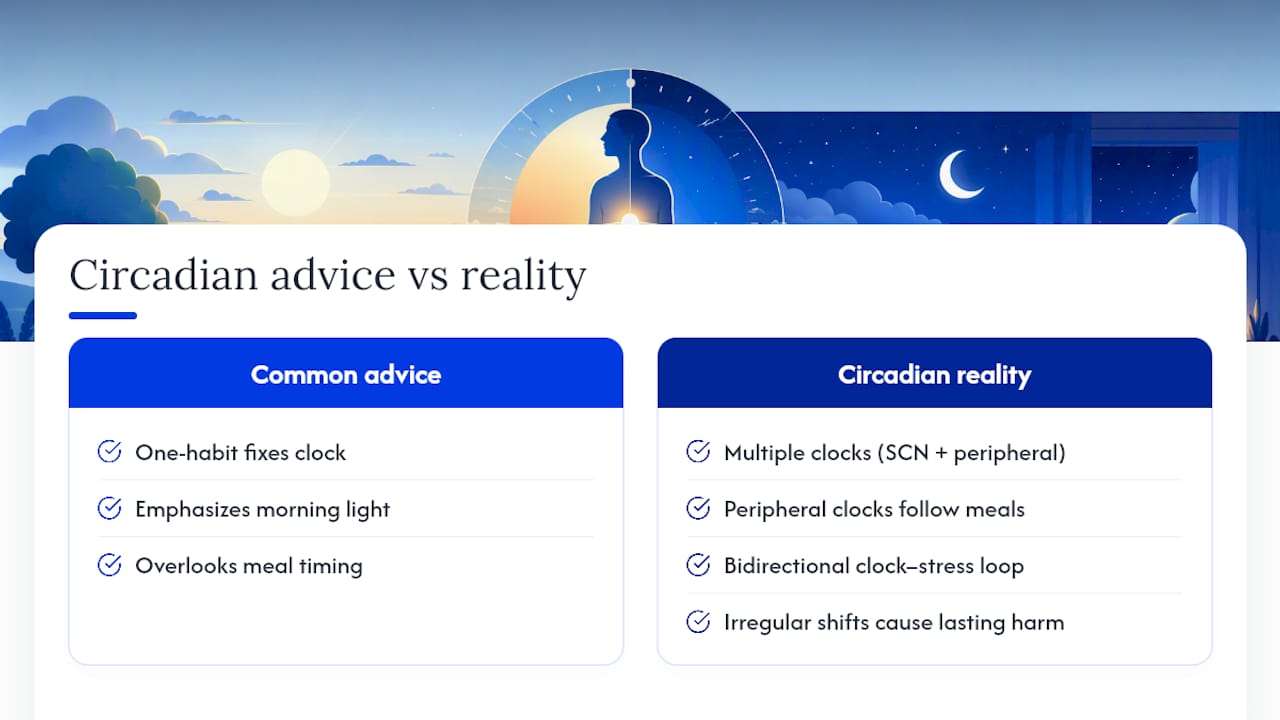
Most circadian rhythm advice treats the clock like a single dial you can turn with one good habit: get more morning light, problem solved. That’s incomplete. Your SCN might be perfectly entrained to daylight while your liver’s clock is running three hours behind because you eat dinner at midnight. Peripheral clocks respond to their own signals, and meal timing is a bigger lever there than most sleep advice acknowledges.
The other underappreciated piece is the feedback loop between the clock and chronic stress or illness. People treat circadian disruption as a downstream symptom of a busy, stressful life. It’s more accurate to say the relationship runs both directions: a disrupted clock actively worsens metabolic and mood strain, which then makes the clock harder to fix. That’s why a single all-nighter is forgettable, but months of irregular shifts compound into something your body struggles to recover from even after the schedule normalizes.
If you’re researching cellular timing mechanisms rather than just trying to sleep better, it’s worth looking at how circadian signaling intersects with metabolic and regenerative pathways, an area Synthrolab covers in its research on how metabolism affects energy levels and cellular signaling tied to longevity. The clock isn’t just about sleep. It’s a coordination system for nearly every repair and metabolic process running in the background.
For researchers investigating circadian and metabolic signaling at the cellular level, Synthrolab supplies batch-tested, research-grade peptides and compounds with certificates of analysis, built for exactly this kind of laboratory work. Explore Synthrolab’s research-grade peptide options to see how purity testing and documentation support rigorous circadian and metabolic research.
A Publisher’s Note on the Science
The evidence here comes from established physiology, not trend science: the SCN, melatonin timing, and peripheral clock research are decades deep and well replicated. Trust the mechanisms, question the shortcuts, and consult a clinician for anything beyond basic sleep hygiene.
Frequently Asked Questions
What is circadian rhythm in simple terms?
It’s your body’s internal 24-hour clock, run by the SCN in your brain, that times sleep, hormone release, temperature, and metabolism.
What is the main factor that affects circadian rhythm?
Light is the dominant zeitgeber, though meal timing, activity, social cues, and temperature all play secondary roles.
Can you reset a disrupted circadian rhythm?
Yes, but gradually. Consistent morning light and a fixed wake time typically produce a shift within several days, not overnight.
Is melatonin safe to use for circadian rhythm problems?
Low-dose, short-term use timed appropriately is generally considered safe for most adults, but check with a clinician if you take other medications.
How do I know if I have a circadian rhythm disorder versus just poor sleep habits?
If sleep problems persist despite a consistent schedule and good sleep hygiene, a sleep specialist can evaluate for delayed sleep phase, shift work disorder, or other circadian conditions using tools like actigraphy or sleep diaries.
This article is general information, not a substitute for advice from a qualified doctor. Consult a qualified healthcare professional about your own circumstances before acting on anything here.
Sources
Recommended
 21+ verification