A senescent cell is a living cell that has permanently stopped dividing but remains metabolically active, continuing to secrete signaling molecules that can alter the surrounding tissue environment. According to the NCI Dictionary of Cancer Terms, senescence is a process where a cell ages and permanently stops dividing but does not die — and when these cells accumulate, they release substances that cause inflammation and damage nearby healthy cells. Short-term, senescent cells serve real biological purposes: tumor suppression, wound repair, and embryonic development. Long-term, their accumulation is one of the more credible mechanisms linking cellular biology to aging and age-related disease.
The three features researchers look for when identifying senescent cells:
- SASP (senescence-associated secretory phenotype): a cocktail of pro-inflammatory cytokines, proteases, and growth factors the cell secretes into surrounding tissue
- Persistent DNA damage response: ongoing signaling from unresolved DNA breaks, particularly at telomeres
- Elevated p16/p21 expression: proteins that enforce cell-cycle arrest through the p53/p21 and p16INK4a/Rb pathways
Pro Tip: The popular media term “zombie cells” captures the basic idea — alive but dysfunctional — but misses the nuance that senescence is biologically necessary. The problem is persistence and accumulation, not senescence itself.
Table of Contents
What makes a normal cell become senescent?
Senescence is not a single event. Research on cellular senescence shows it is a gradual, multistep process — in laboratory culture, cells can take multiple weeks to fully adopt the senescent phenotype. Several distinct biological stressors can trigger the transition.
Several distinct biological stressors can trigger the transition, including telomere shortening, DNA damage, oncogene activation, oxidative stress, and therapy-induced senescence.
- Oncogene activation: — paradoxically, activating a cancer-driving gene like RAS can trigger senescence as a protective brake — this is called oncogene-induced senescence (OIS)
Two molecular pathways enforce the arrest once a trigger fires. The p53/p21 axis responds rapidly to acute stress, activating p21 to block CDK2 and halt the cell cycle. The p16INK4a/Rb axis provides a more durable lock, with p16 inhibiting CDK4/6 so that Rb stays active and keeps E2F transcription factors suppressed. Many senescent cells activate both pathways, making the arrest remarkably stable.
How the SASP reshapes tissue around senescent cells
The senescence-associated secretory phenotype is the defining functional feature of a senescent cell. Rather than simply sitting dormant, a senescent cell actively broadcasts a complex mix of molecules into its local environment — and that broadcast can change tissue function at a distance.
SASP components include:
- Growth factors: — including TGF-β and VEGF, which can paradoxically promote tumor progression in neighboring cells
The downstream consequences matter clinically. Persistent SASP-driven inflammation is associated with fibrotic diseases, including conditions like idiopathic pulmonary fibrosis, where senescent cells contribute to progressive, irreversible scarring of lung tissue. The same secretory activity that recruits immune cells to clear a wound can, when sustained, remodel tissue in ways that impair organ function.
Pro Tip: SASP composition is not fixed. The specific cytokines and proteases a senescent cell secretes depend heavily on the cell type, the triggering stressor, and the tissue context. A senescent lung fibroblast has a meaningfully different secretome than a senescent epithelial cell — which is why blanket “anti-senescence” claims deserve skepticism.

When senescence helps and when it becomes a problem
Senescence is not inherently pathological. The biology is more interesting than the “zombie cell” framing suggests, and any serious therapeutic strategy has to account for both sides.
| Context |
Senescence role |
Outcome |
| Embryonic development |
Transient senescence shapes tissue patterning |
Normal organ formation |
| Wound healing |
Senescent fibroblasts limit excess fibrosis, then are cleared |
Controlled repair |
| Tumor suppression |
OIS arrests pre-cancerous cells before they proliferate |
Cancer prevention |
| Acute liver injury |
Senescent hepatic stellate cells limit fibrosis progression |
Reduced scarring |
| Chronic aging tissue |
Persistent senescent cells accumulate, SASP drives inflammation |
Tissue dysfunction, organ decline |
| Age-related disease |
Senescent cells contribute to atherosclerosis, neurodegeneration, diabetes |
Disease progression |
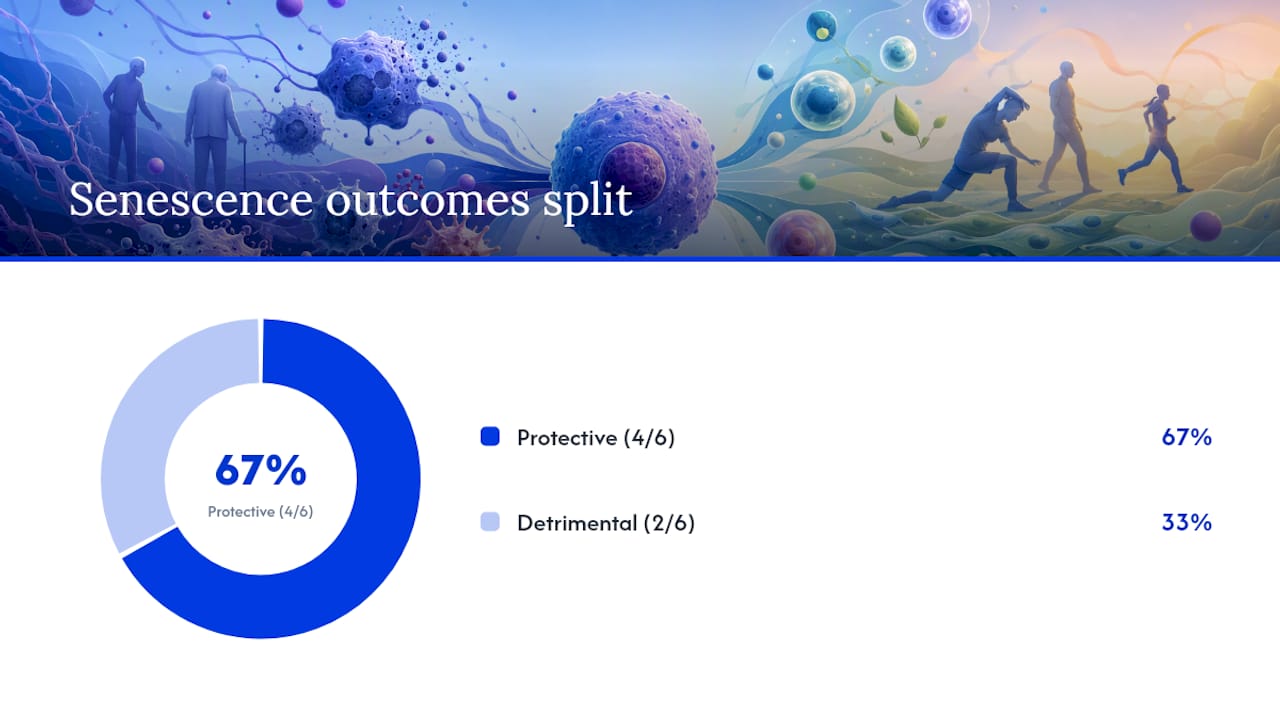
The key variable is clearance. When the immune system efficiently removes senescent cells after they have served their purpose, the net effect is protective. When clearance fails — as it increasingly does with age and immune decline — the same cells become a source of sustained damage. Nature Reviews Nephrology frames this precisely: senescence prevents damaged cells from proliferating and supports wound healing, but persistent accumulation drives age-related tissue decline and disease.
Where senescence research still has major gaps
The field is moving fast, but several foundational questions remain unanswered — and they matter for whether any therapy will actually work.
The most pressing open questions:
- Tissue-specific heterogeneity: the SenNet Consortium is actively mapping senescent cell types across human tissues precisely because a senescent signature in one organ does not predict what senescence looks like in another
- Large human trials: most senolytic data come from small pilot studies or animal models; the translational gap between promising preclinical results and confirmed human benefit has not been closed
Pro Tip: When you read a senotherapeutics headline, check two things before updating your priors: Was this a randomized human trial with a validated biomarker endpoint? If the answer to either is no, treat it as hypothesis-generating, not practice-changing.
Key Takeaways
Senescent cells are biologically necessary in the short term but harmful when they accumulate with age, making selective modulation — not blanket clearance — the most promising research direction.
| Point |
Details |
| Core definition |
A senescent cell permanently stops dividing but stays metabolically active and secretes SASP molecules. |
| SASP drives harm |
Pro-inflammatory cytokines, MMPs, and growth factors from SASP alter tissue and fuel age-related disease. |
| Biomarkers are imperfect |
No single marker identifies senescent cells universally; researchers use panels (SA-βgal, p16, p21, γH2AX). |
| Therapies are experimental |
Senolytics and senomorphics show animal promise; human trials are early-stage with open safety questions. |
| Practical steps now |
Exercise, weight management, and avoiding genotoxic exposures are the best-supported current options. |
The biology is real — but the hype is running ahead of the evidence
The senescence field is one of the more intellectually honest corners of aging research, which makes the supplement-industry noise around it particularly frustrating. The underlying biology is genuinely compelling: a cell that stops dividing but keeps broadcasting inflammatory signals is a plausible mechanism for why tissues deteriorate with age, and the animal data on senolytics are among the more reproducible results in longevity science. But “reproducible in mice” and “ready for human use” are separated by a gap that has swallowed many promising interventions before.
What I find most underappreciated in public discussions is the heterogeneity problem. Senescent cells are not one thing. A senescent cell in a lung fibroblast, a kidney tubule, and an adipose macrophage look different, secrete different things, and likely require different approaches to modulate safely. The SenNet Consortium exists specifically because the field recognized this — you cannot design a selective therapy without first mapping what you are targeting. That work is ongoing, and it is the prerequisite for anything that follows.
For researchers investigating these pathways, Synthrolab’s lifespan extension research compounds and cellular regeneration resources offer research-grade tools for studying the molecular mechanisms that intersect with senescence biology, including peptides relevant to tissue repair and cellular signaling. The science deserves rigorous investigation — and rigorous investigation requires quality starting materials.
Authoritative sources and further reading
Recommended
 21+ verification