Growth hormone peptides are compounds that stimulate the pituitary gland to release growth hormone in a natural pulsatile pattern, and the benefits of growth hormone peptides span lean muscle gain, visceral fat reduction, improved sleep quality, and long-term metabolic health. Unlike synthetic HGH injections, these peptides work upstream in the hormonal axis, preserving the body’s own feedback mechanisms. The industry standard terms are growth hormone secretagogues (GHS) and GHRH analogs. Synthrolab supplies research-grade versions of these compounds for scientific investigation into exactly these pathways.
1. What are the main benefits of growth hormone peptides?
Growth hormone peptides produce measurable effects across four core domains: body composition, sleep architecture, metabolic health, and tissue repair. Each benefit traces back to a single mechanism: amplifying the body’s own pulsatile GH secretion rather than replacing it. That distinction matters because pulsatile GH release preserves the negative feedback loop that keeps IGF-1 within a safe physiological range.

The advantages of growth hormone secretagogues over exogenous HGH are not subtle. Synthetic HGH suppresses endogenous GH production and can cause receptor desensitization. Peptides avoid both problems by working at the hypothalamic and pituitary level, triggering natural release episodes rather than flooding the system continuously.
2. Key peptide types and how they work
Three peptides dominate current research: CJC-1295, Ipamorelin, and Tesamorelin. Understanding their mechanisms clarifies why combinations outperform single agents.
GHRH analogs (CJC-1295, Tesamorelin)
- CJC-1295 is a synthetic GHRH analog that extends the half-life of natural GHRH, producing sustained GH pulses over 24–48 hours.
- Tesamorelin is a stabilized GHRH analog approved for visceral fat reduction, with a strong clinical record in HIV-associated lipodystrophy and broader metabolic research.
- Both act on GHRH receptors in the pituitary, increasing the amplitude of GH pulses.
GHRPs (Ipamorelin)
- Ipamorelin is a selective growth hormone-releasing peptide (GHRP) that activates the ghrelin receptor without significantly raising cortisol or prolactin.
- This selectivity makes it the cleanest GHRP in current research use.
Why combinations work better
Combining CJC-1295 with Ipamorelin activates two distinct receptor pathways simultaneously, producing a synergistic GH pulse roughly 54-fold above baseline, compared to 20-fold or 47-fold when either peptide is used alone. That synergy is the reason most research protocols pair a GHRH analog with a GHRP.
Pro Tip: Ipamorelin’s low side-effect profile makes it the preferred GHRP for first-time users. Pair it with CJC-1295 NO DAC for a shorter, more controllable pulse duration.
3. How growth hormone peptides improve body composition
Body composition is the most studied application of GH secretagogues, and the clinical data is specific. CJC-1295 combined with Ipamorelin produces a 3–5% increase in lean muscle mass over 12 weeks in adults with GH deficiency. That gain reflects IGF-1-mediated protein synthesis and improved nitrogen retention, not water retention.
Visceral fat responds even faster. Tesamorelin over 26 weeks reduces visceral adipose tissue by 15–18% while keeping IGF-1 levels within the physiological range. Visceral fat is metabolically active and drives insulin resistance, so reducing it has downstream effects on glucose regulation and cardiovascular risk.
Connective tissue also benefits. IGF-1 stimulates collagen synthesis in tendons and ligaments, which explains the joint health improvements many adults over 45 report during GH peptide protocols. Recovery between training sessions shortens because tissue repair accelerates.
| Peptide |
Primary effect |
Timeline |
| CJC-1295 + Ipamorelin |
3–5% lean mass gain |
8–12 weeks |
| Tesamorelin |
15–18% visceral fat reduction |
26 weeks |
| Ipamorelin (solo) |
Improved recovery, sleep quality |
2–4 weeks |
Pro Tip: Sleep and recovery benefits typically appear within 2–4 weeks, well before visible body composition changes. Use that early signal to confirm the protocol is working before adjusting dose.
GHRH analogs directly influence sleep architecture through hypothalamic action. Episodic GHRH administration increases stage 4 slow-wave sleep more effectively than continuous infusion. That finding is significant because slow-wave sleep is when the largest natural GH pulse of the day occurs, and it is the phase most responsible for tissue repair and memory consolidation.
The cognitive effects follow from sleep quality, not from GH itself acting directly on the brain. Adults who restore slow-wave sleep report improvements in executive function, working memory, and reaction time. These are not placebo effects. They reflect the well-established relationship between GH secretion, sleep depth, and neural recovery.
Practical implications for dosing timing:
- Administer peptides 30–60 minutes before sleep to align with the natural nocturnal GH pulse.
- Avoid eating within 2 hours of dosing, as elevated insulin blunts GH release.
- Consistent nightly dosing produces cumulative sleep architecture improvements over 4–8 weeks.
- Synthetic HGH disrupts sleep architecture by maintaining continuous supraphysiological levels. Peptides avoid this by preserving pulsatility.
The metabolic effects of GH secretagogues extend well beyond body composition. Long-term GH axis stimulation over more than 3 years produces significant reductions in total cholesterol, LDL (particularly in women), triglycerides (particularly in men), and inflammatory markers. These are cardiovascular risk factors, and reducing them through hormonal restoration rather than statins represents a fundamentally different approach to longevity medicine.
The mechanism behind these lipid improvements is metabolic flexibility. GH promotes lipolysis, the breakdown of stored fat for energy, while preserving lean mass. Over time, this shifts the body’s fuel preference toward fat oxidation, which reduces circulating triglycerides and improves insulin sensitivity.
Key metabolic benefits supported by current research:
- Reduced visceral adiposity, the fat depot most strongly linked to metabolic syndrome.
- Lower oxidized LDL, a more accurate cardiovascular risk marker than total LDL.
- Improved insulin sensitivity through reduced ectopic fat accumulation.
- Balanced IGF-1 levels that reduce insulin resistance risk compared to exogenous HGH.
- Restoration of hormonal patterns that decline with age, particularly in adults over 45.
The longevity angle is straightforward. GH secretion declines roughly 15% per decade after age 30. Restoring physiological GH pulses through secretagogues addresses one of the most consistent biomarkers of biological aging. The goal is not supraphysiological GH levels. The goal is restoring the pattern that existed at age 25.
6. What safety considerations should you know?
Growth hormone peptides carry a meaningfully different safety profile than synthetic HGH. Preserving the GH axis feedback loop prevents the supraphysiological IGF-1 spikes that raise concerns about insulin resistance and cell proliferation with exogenous HGH. That said, peptides are not risk-free, and the unregulated market creates real hazards.
Critical safety points:
- Product purity is the single biggest variable. Third-party COA verification is non-negotiable. Impure products cause site inflammation, allergic reactions, and hormonal imbalance.
- Avoid high-dose chronic use. Lower, frequent doses combining GHRH analogs with GHRPs prevent receptor saturation and tachyphylaxis, the diminishing response that comes from overuse.
- Monitor IGF-1 and lipid panels. Lab values guide dose adjustments and confirm the protocol stays within physiological ranges.
- Professional supervision reduces adverse events and ensures dosing matches individual hormonal status, not generic protocols from online forums.
- Cycle length matters. Most research protocols run 8–12 weeks, followed by a break to prevent axis desensitization.
The safe-start approach for new users is to begin with the lowest effective dose of a single peptide, establish baseline IGF-1, and add a second peptide only after confirming tolerability. This is not overcaution. It is how you get clean data on what is actually working.
Key Takeaways
Growth hormone peptides produce their most durable benefits when used to restore physiological GH pulsatility, not to push levels beyond the body’s natural range.
| Point |
Details |
| Pulsatility is the mechanism |
Peptides preserve the GH feedback loop; synthetic HGH suppresses it. |
| Body composition changes take time |
Lean mass gains appear at 8–12 weeks; sleep improvements arrive within 2–4 weeks. |
| Combinations outperform solo use |
CJC-1295 plus Ipamorelin produces a 54-fold GH pulse vs. 47-fold for either alone. |
| Metabolic benefits compound over years |
Long-term GH axis stimulation reduces LDL, triglycerides, and inflammatory markers. |
| Purity determines safety |
Third-party COA verification is the minimum standard for any research-grade peptide. |
Why I think most people misread what these peptides actually do
The framing I see most often treats GH peptides as performance enhancers, something you stack with a training program to get bigger faster. That framing is wrong, and it leads to poor outcomes.
What these compounds actually do is restore a hormonal pattern that the body ran perfectly well at 25 and has been degrading since. For adults over 45 with declining IGF-1, that restoration produces real, measurable changes in body composition, sleep depth, and metabolic markers. For a 28-year-old with normal GH secretion, the marginal benefit is much smaller and the risk-to-reward calculation shifts.
The biohackers I find most credible are the ones who get baseline labs first. They know their IGF-1, their fasting insulin, their lipid panel. They use that data to select a protocol, run it for 12 weeks, and retest. That is not a complicated process. It is just the scientific method applied to your own physiology.
The other thing I would push back on is the idea that peptides replace lifestyle factors. They do not. Sleep quality, resistance training, and nutrition determine whether the GH pulse your peptides generate actually drives tissue repair. A peptide protocol on top of poor sleep and a high-sugar diet is a waste of money and a potential health risk.
The GH secretagogue mechanism is genuinely interesting science. Treat it that way. Use evidence-backed peptide combinations, verify purity, monitor labs, and work with a physician who understands the axis. That approach produces results. Everything else is noise.
— Mitch
Synthrolab’s research-grade peptides for GH support
Synthrolab supplies research-grade peptides with verified purity for investigators studying GH axis restoration, body composition, and longevity mechanisms. Every compound ships with a certificate of analysis, and the COA verification process is publicly accessible so researchers can confirm what they are working with before use.
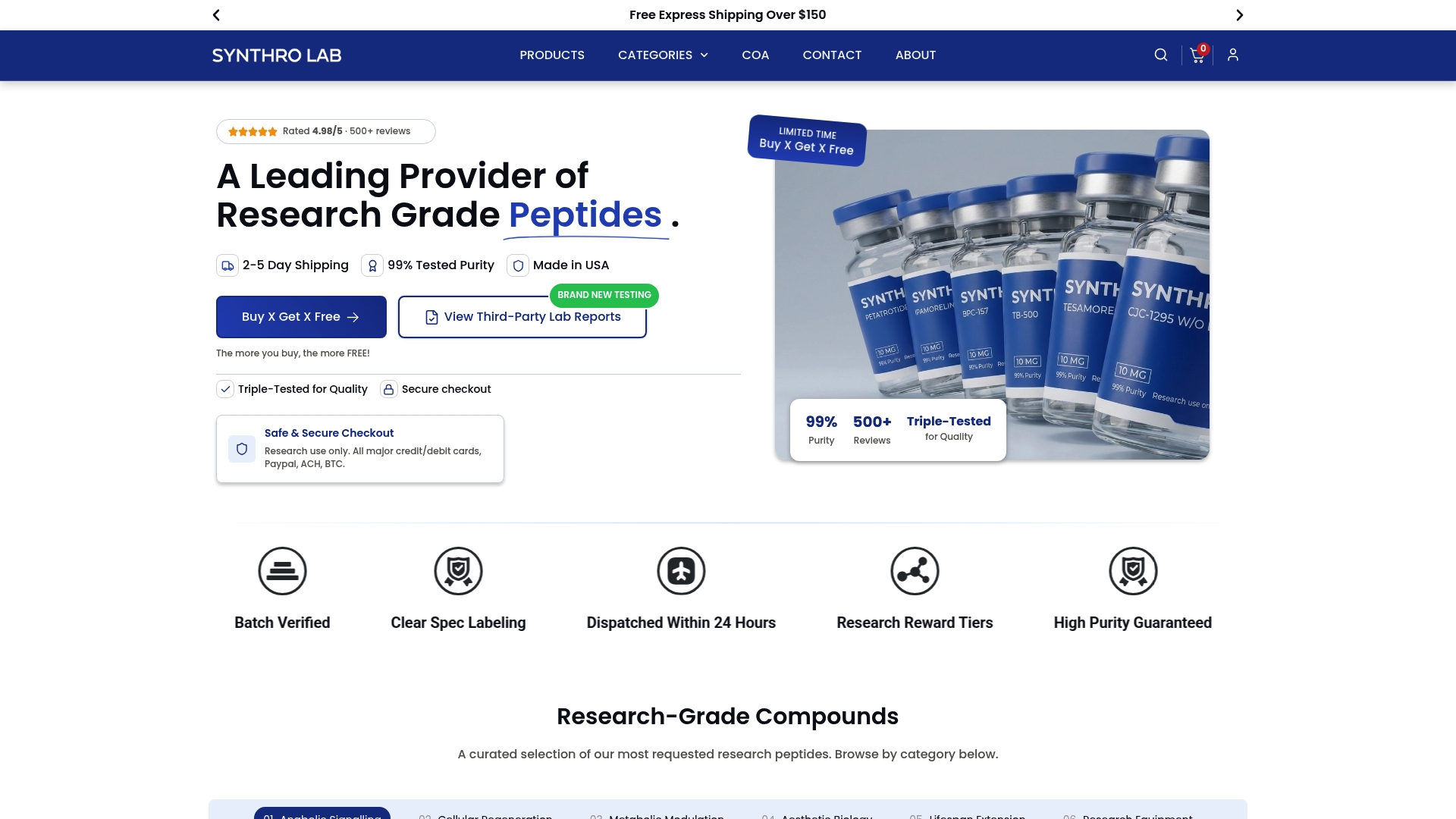
For those new to GH secretagogue research, the beginner’s safe-start guide covers baseline lab protocols, dosing frameworks, and cycle structure. Researchers studying the CJC-1295 and Ipamorelin combination can find the paired compound set in Synthrolab’s anabolic signaling catalog. The full range of GH-related compounds is available through the anabolic signaling archive for broader protocol design.
FAQ
What are the main benefits of growth hormone peptides for adults?
Growth hormone peptides increase lean muscle mass, reduce visceral fat, improve slow-wave sleep, and support long-term metabolic health by restoring the body’s natural pulsatile GH secretion pattern. Clinical research shows measurable body composition changes within 8–12 weeks.
How do growth hormone peptides differ from synthetic HGH?
Peptides stimulate the pituitary to release GH naturally, preserving the hormonal feedback loop, while synthetic HGH bypasses that loop and suppresses endogenous production. This distinction makes peptides a safer option for physiological restoration.
How long does it take to see results from GH peptides?
Sleep quality and recovery improvements typically appear within 2–4 weeks. Lean mass gains and visible body composition changes require 8–12 weeks of consistent use.
Are growth hormone peptides safe to use long-term?
When dosed correctly with verified, pure compounds and monitored through regular IGF-1 and lipid panel testing, GH peptides maintain physiological hormone levels and avoid the risks associated with exogenous HGH. Professional supervision significantly reduces adverse event risk.
What is the best peptide combination for GH release?
CJC-1295 combined with Ipamorelin is the most researched pairing, producing a synergistic GH pulse that exceeds what either peptide achieves alone. This combination activates two distinct receptor pathways for maximum pulse amplitude within physiological limits.
Recommended
 21+ verification