Growth factor peptides are defined as short amino acid chains that bind to cell surface receptors and trigger growth, repair, and regeneration pathways in muscle, connective tissue, and bone. The types of growth factor peptides most relevant to fitness fall into three broad functional categories: growth hormone secretagogues, IGF-1 analogs, and tissue repair peptides. The FDA has approved over 80 peptides by 2024, yet growth factor analogs like IGF-1 LR3 and Mechano Growth Factor remain largely experimental research compounds. That distinction matters enormously before you decide how to use them.
1. What are growth hormone secretagogue peptides?
Growth hormone secretagogues, or GHS peptides, stimulate the pituitary gland to release endogenous growth hormone. They do not supply GH directly. Instead, they amplify the body’s own production signal, which is a meaningful biological difference from exogenous GH administration.

GHS peptides split into two subtypes. Growth hormone releasing peptides, or GHRPs, activate the ghrelin receptor. GHRH analogs mimic growth hormone releasing hormone and bind the GHRH receptor. Both pathways converge on increased GH pulse amplitude, but they do so through different receptor systems.
Common examples include:
- Ipamorelin: A selective GHRP with minimal cortisol or prolactin side effects
- GHRP-2: A potent ghrelin receptor agonist with stronger GH release but more appetite stimulation
- Sermorelin: A GHRH analog that mirrors the first 29 amino acids of endogenous GHRH
- CJC-1295: A long-acting GHRH analog with a modified half-life for sustained GH elevation
The GH-IGF-1 axis connects GH release to downstream IGF-1 production in the liver. That downstream IGF-1 drives most of the anabolic and recovery effects fitness researchers associate with GHS peptides. For a detailed breakdown of how Ipamorelin and Sermorelin compare in practice, the Ipamorelin vs Sermorelin guide covers the key mechanistic differences.
Pro Tip: Combining a GHRP with a GHRH analog, such as Ipamorelin with CJC-1295, produces a synergistic GH pulse because both receptor pathways fire simultaneously. Researchers studying GH optimization frequently use this stacking approach.
None of these peptides carry FDA approval for muscle growth or recovery. Their regulatory status is experimental, and human safety data beyond short-term studies remains limited.
2. How do IGF-1 analogs function in muscle repair?
Insulin-like growth factor 1, or IGF-1, is the primary downstream mediator of GH’s anabolic effects. Synthetic IGF-1 analogs take that signal further by bypassing the liver and acting directly on muscle tissue.
IGF-1 LR3 is an 83-residue analog engineered to avoid binding to IGF binding proteins, or IGFBPs. Endogenous IGF-1 spends most of its circulating time bound to IGFBPs, which limits receptor access. IGF-1 LR3 sidesteps that limitation entirely. The result is sustained, potent receptor stimulation and a significantly altered safety profile compared to natural IGF-1.
Mechano Growth Factor, or MGF, works differently. MGF is a splice variant expressed locally in muscle in response to mechanical load, not systemic hormonal signals. It activates satellite cells, the muscle stem cells responsible for fiber repair and growth, at the site of damage. That local action makes MGF functionally distinct from systemic IGF-1 signaling.
Both analogs drive anabolic effects through the PI3K-Akt-mTOR pathway. That pathway governs protein synthesis, cell survival, and muscle hypertrophy. The PEG-MGF researcher’s guide explains how pegylation extends MGF’s notoriously short half-life for more stable systemic delivery.
Key risks to understand:
- Hypoglycemia: IGF-1 analogs share structural similarity with insulin and can lower blood glucose
- Pro-tumor potential: Synthetic analogs bypass IGFBPs, increasing free receptor stimulation that could theoretically accelerate existing tumor growth
- Delivery instability: Short half-life and rapid metabolic degradation reduce efficacy without chemical modification
Pro Tip: MGF’s satellite cell activation is time-sensitive. Research protocols typically time administration within the post-exercise window when mechanical damage and local expression are highest.
3. What are tissue repair and healing peptides?
Tissue repair peptides do not primarily stimulate GH or IGF-1. They regulate inflammation, promote collagen synthesis, and support angiogenesis, the formation of new blood vessels, to accelerate structural healing.
BPC-157 is the most studied peptide in this category. Animal studies show it promotes tendon-to-bone healing, reduces inflammation, and supports gut mucosal repair. TB-500, a synthetic fragment of thymosin beta-4, promotes actin polymerization and cell migration, both critical for wound closure. GHK-Cu is a copper-binding tripeptide that stimulates collagen and elastin production.
The healing evidence is notable. Animal studies show 70% faster collagen deposition and a sevenfold increase in hydroxyproline levels with peptide-based interventions post-surgery. Hydroxyproline is a direct marker of collagen synthesis, so that increase signals genuine structural repair acceleration.
- BPC-157: Promotes tendon, ligament, and gut tissue repair; anti-inflammatory via nitric oxide pathways
- TB-500: Supports cell migration and tissue remodeling; systemic distribution makes it useful for widespread injuries
- GHK-Cu: Stimulates collagen and glycosaminoglycan synthesis; widely used in topical formulations for skin repair
Human clinical data for all three remains sparse. The animal evidence is compelling, but fitness researchers should treat these compounds as experimental until controlled human trials confirm efficacy and safety.
Delivery route determines how much of a peptide reaches its target receptor intact. Growth factor peptides face a fundamental challenge: the digestive system degrades them before they reach systemic circulation.
Subcutaneous and intramuscular injection are the primary delivery routes for systemic growth factor peptides. They bypass gastrointestinal degradation and achieve measurable plasma concentrations. Topical application works for skin-targeted peptides like GHK-Cu, where local tissue penetration is sufficient. Oral delivery of growth factor peptides is generally ineffective without specialized encapsulation technology because peptide bonds break down rapidly in stomach acid.
Systemic delivery faces degradation and unstable half-life challenges. Pegylation, the attachment of polyethylene glycol chains to a peptide, improves stability and extends circulation time. PEG-MGF is the clearest example of this modification applied to a fitness-relevant growth factor peptide.
Topical versus systemic peptide use differs significantly in both risk profile and evidence base. Systemic longevity peptides like MOTS-c carry early-phase risks including hepatotoxicity, while topical peptides present a far more contained safety picture. That gap in risk profile is not widely understood by fitness enthusiasts who assume all peptides carry similar risk.
| Delivery Route |
Bioavailability |
Primary Use Case |
Key Risk |
| Subcutaneous injection |
High |
GHS peptides, IGF-1 analogs |
Injection site reactions, hypoglycemia |
| Intramuscular injection |
High |
MGF, TB-500 |
Localized pain, infection risk |
| Topical application |
Low to moderate |
GHK-Cu, cosmetic peptides |
Minimal systemic risk |
| Oral |
Very low |
Not recommended for growth factors |
Gastrointestinal degradation |
5. Which growth factor peptides matter most for muscle growth and recovery?
For fitness researchers focused on muscle growth and recovery, the most experimentally supported peptides fall into two tiers. The first tier includes GHS peptides like Ipamorelin and CJC-1295, which have the most human research data and the most predictable safety profiles among experimental compounds. The second tier includes IGF-1 analogs and MGF, which show stronger direct anabolic effects but carry greater risk and less human safety data.
Large-scale human clinical trials are absent for muscle growth peptides despite significant social media attention. Animal and laboratory studies suggest real benefits, but the translation to human physiology is not confirmed at scale. That is not a reason to dismiss the research. It is a reason to approach it with appropriate rigor.
Practical considerations for fitness researchers:
- GHS peptides carry the most favorable risk-to-evidence ratio for GH-related recovery support
- IGF-1 LR3 and MGF offer direct anabolic signaling but require careful dosing due to hypoglycemia risk
- BPC-157 and TB-500 are the leading options for connective tissue and injury recovery research
- Peptides can have pleiotropic effects affecting multiple systems simultaneously, so understanding the full systemic profile of any compound matters
The most common mistake fitness researchers make is treating growth factor peptides as interchangeable. GHS peptides, IGF-1 analogs, and tissue repair peptides work through entirely different mechanisms. Stacking them without understanding those mechanisms does not multiply benefits. It multiplies variables and risk.
Legal status varies by jurisdiction. Most growth factor peptides are not approved for human use and are sold strictly for research purposes. Regulatory compliance is a non-negotiable part of responsible use.
Key Takeaways
Growth factor peptides fall into three distinct functional categories, and choosing the right type requires understanding the mechanism, not just the claimed benefit.
| Point |
Details |
| Three core categories |
GHS peptides, IGF-1 analogs, and tissue repair peptides each work through different receptor pathways. |
| GHS peptides are lowest risk |
Ipamorelin and CJC-1295 have the most human data and the most predictable safety profiles among experimental options. |
| IGF-1 analogs carry real risks |
IGF-1 LR3 bypasses IGFBPs, increasing potency but also raising hypoglycemia and theoretical tumor risk. |
| Delivery route changes outcomes |
Injection achieves systemic bioavailability; oral delivery degrades growth factor peptides before they reach circulation. |
| Human trial data is scarce |
Animal studies show strong results, but large-scale human trials for muscle growth peptides do not yet exist. |
What I’ve learned about growth factor peptides that most guides skip
The fitness community treats growth factor peptides like a menu. Pick the one that matches your goal, dose it, and wait for results. That framing misses the biology entirely.
What I’ve found after years of following peptide research is that the mechanism gap between GHS peptides and IGF-1 analogs is wider than most people realize. GHS peptides work upstream. They nudge your own hormonal system. IGF-1 analogs work downstream and bypass the body’s natural regulatory checkpoints entirely. Those are not equivalent risk profiles, and they should not be treated as such.
The tissue repair category is where I think the most underappreciated research lives. BPC-157’s effects on tendon healing and gut integrity have implications well beyond bodybuilding. The problem is that the human data is still catching up to the animal data, and that gap gets glossed over in fitness circles.
My honest recommendation is to start with the mechanism, not the compound name. Understand what receptor you are targeting, what downstream pathway activates, and what the known risks are at that level. The beginner’s safety guide is a good starting point for building that foundation before moving into more complex compounds.
The future of growth factor peptide therapy in fitness is real. But it requires the same rigor you would apply to any experimental intervention.
— Mitch
Synthrolab’s research-grade peptides for serious investigators
Synthrolab supplies research-grade peptides across the full spectrum of growth factor categories, from anabolic signaling compounds to cellular regeneration peptides, all manufactured to strict purity standards with certificates of analysis available for every batch.
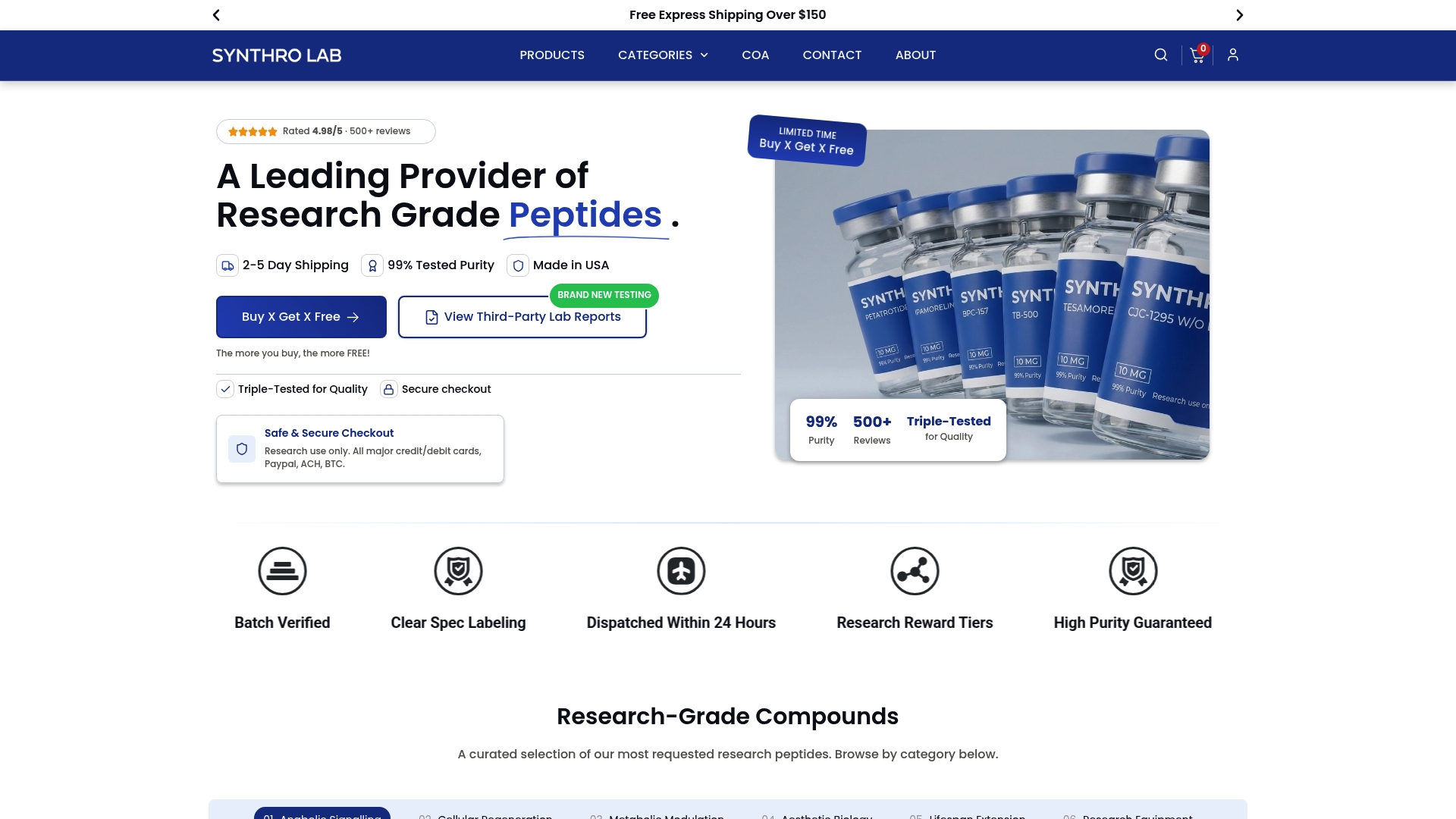
Every compound in the Synthrolab catalog is intended for laboratory and research use. The educational library covers GHS mechanisms, IGF-1 analog profiles, and delivery method comparisons in depth. Researchers who want a structured starting point can use the peptides for beginners guide to build a solid foundation before working with more advanced growth factor compounds. Synthrolab exists to support rigorous, evidence-based peptide research.
FAQ
What are the main types of growth factor peptides?
The three main types are growth hormone secretagogues, IGF-1 analogs, and tissue repair peptides. Each category works through a different receptor pathway and produces distinct physiological effects.
How do growth factor peptides differ from cytokines?
Growth factor peptides primarily stimulate cell proliferation and tissue repair through specific receptor binding, while cytokines regulate immune responses and inflammation. There is functional overlap, but growth factors focus on structural growth and cytokines on immune signaling.
Are growth factor peptides safe for fitness use?
Most growth factor peptides are experimental compounds without FDA approval for muscle growth. Human trial data is limited, and risks including hypoglycemia and hepatotoxicity are documented for certain classes.
What is the difference between IGF-1 LR3 and MGF?
IGF-1 LR3 acts systemically and bypasses IGF binding proteins for sustained anabolic signaling. MGF acts locally in muscle in response to mechanical load and activates satellite cells at the site of damage.
Which growth factor peptide is best for recovery?
GHS peptides like Ipamorelin carry the most favorable evidence-to-risk ratio for general recovery support. BPC-157 and TB-500 are the leading experimental options for connective tissue and injury-specific recovery research.
Recommended
 21+ verification