mTOR inhibitors block the mechanistic target of rapamycin, a serine/threonine kinase that sits at the center of cellular decisions about growth, protein synthesis, autophagy, and immune activation. Three agents are FDA-approved in the United States for clinical use: sirolimus (rapamycin), everolimus, and temsirolimus. Beyond those three, dozens of investigational compounds spanning rapalogs, ATP-competitive kinase inhibitors, and dual PI3K/mTOR agents are in various stages of clinical development. The core clinical challenge is that mTOR pathway inhibitors rarely work as single agents in cancer for long — compensatory signaling through PI3K/AKT blunts their effect, and acquired resistance is common. Understanding which inhibitor class you are working with, and why it behaves differently from the others, is the starting point for rational study design or clinical decision-making.
FDA-approved mTOR inhibitors in the US:
- Sirolimus (rapamycin): Organ transplant immunosuppression; also approved for lymphangioleiomyomatosis
- Everolimus: Renal cell carcinoma, tuberous sclerosis complex (TSC), subependymal giant cell astrocytoma (SEGA), HR+ breast cancer (with exemestane), pancreatic neuroendocrine tumors
- Temsirolimus: Advanced renal cell carcinoma (IV formulation)
Key Takeaways
mTOR inhibitors divide into mechanistically distinct classes, and selecting the right class for the molecular context of your model or patient is the single most consequential decision in mTOR-targeted research or therapy.
| Point |
Details |
| Three FDA-approved agents |
Sirolimus, everolimus, and temsirolimus are the only mTOR inhibitors approved in the US, each with distinct indications and routes. |
| Rapalogs are mTORC1-selective |
Rapalogs spare mTORC2, leaving AKT Ser473 phosphorylation intact and enabling compensatory PI3K/AKT feedback. |
| TORKinibs inhibit both complexes |
ATP-competitive inhibitors like INK128 and AZD2014 suppress both mTORC1 and mTORC2, blocking AKT reactivation but raising distinct metabolic toxicity concerns. |
| Monitoring is non-negotiable |
CBC, lipid panel, fasting glucose, and pulmonary symptom assessment are required at baseline and at regular intervals during treatment. |
| Synthrolab for signaling research |
Synthrolab provides batch-tested, COA-documented research compounds for mTOR pathway, metabolic modulation, and longevity mechanism studies. |
Table of Contents
How mTOR signaling works: mTORC1 vs mTORC2
mTOR exists in two structurally and functionally distinct complexes, and that distinction drives nearly every mechanistic difference between inhibitor classes. The mTOR pathway regulates growth, metabolism, autophagy, and mitochondrial function across virtually every mammalian cell type, making it a central node in cancer, metabolic disease, neurodegeneration, and immune dysregulation.
mTORC1 is defined by its scaffold protein Raptor. It senses nutrient availability, growth factor signals, and energy status, then phosphorylates S6 kinase 1 (S6K1) and 4E-BP1 to drive ribosome biogenesis and cap-dependent translation. It also suppresses autophagy through ULK1 phosphorylation. mTORC1 activity promotes mitochondrial fission and supports anabolic biosynthesis. Inhibiting it shifts cells toward autophagy and altered mitochondrial dynamics. Rapamycin and rapalogs bind FKBP12 and then interact with the FRB domain of mTOR, allosterically suppressing mTORC1 — but incompletely, because kinase-dependent mTOR functions remain partially intact.
mTORC2 is defined by Rictor. Its substrates are different: AKT (Ser473), SGK1, and PKCα. Through AKT phosphorylation, mTORC2 regulates cell survival, glucose metabolism, and cytoskeletal organization. Critically, mTORC2 is largely rapamycin-insensitive under acute conditions, which is why rapalogs fail to suppress AKT Ser473 phosphorylation and why compensatory AKT activation is such a persistent clinical problem.
Upstream inputs converge on both complexes through PI3K/AKT (growth factors), TSC1/2-Rheb (energy and oxygen sensing), AMPK (low ATP), and amino-acid sensors including the Ragulator-Rag GTPase system at the lysosomal surface. Downstream, mTORC1 drives protein synthesis, lipid synthesis via SREBP, and suppression of autophagy. mTORC2 primarily feeds back into AKT-dependent survival signaling.
A note on nomenclature: the original name “mammalian target of rapamycin” was updated to “mechanistic target of rapamycin” to reflect its conservation across species and to avoid implying the pathway is mammalian-exclusive. For cross-species work in yeast or Drosophila models, the mechanistic framing matters.
The three classes of mTOR inhibitors you need to know
Inhibitors fall into mechanistically distinct classes with different target profiles, and that difference has direct clinical and experimental consequences.
By class:
- Rapalogs (first generation): Sirolimus, everolimus, temsirolimus, ridaforolimus. Allosteric, FKBP12-dependent, primarily mTORC1-selective. Oral (sirolimus, everolimus) or IV (temsirolimus as prodrug). FDA-approved.
- mTOR kinase inhibitors / TORKinibs (second generation): INK128 (sapanisertib/MLN0128), AZD2014 (vistusertib), Torin1, Torin2. ATP-competitive, inhibit both mTORC1 and mTORC2. Investigational.
- Dual PI3K/mTOR inhibitors (second generation): BEZ235 (dactolisib), XL765 (voxtalisib), GDC-0980. Target PI3K catalytic subunits and mTOR kinase simultaneously. Investigational.
- Third-generation bifunctional agents (rapalinks): Rapalink-1 and related compounds link a rapalog to a TORKinib pharmacophore, targeting both the FRB allosteric site and the ATP-binding pocket. Preclinical/early investigational.
| Class |
Representative examples |
Clinical status / typical route |
| Rapalogs |
Sirolimus, everolimus, temsirolimus |
FDA-approved; oral or IV |
| TORKinibs |
INK128, AZD2014, Torin1 |
Phase I/II trials; oral |
| Dual PI3K/mTOR |
BEZ235, XL765, GDC-0980 |
Phase I/II trials; oral |
| Bifunctional (rapalinks) |
Rapalink-1 |
Preclinical / early investigational |
The mechanistic split matters most for AKT. Rapalogs suppress mTORC1 but leave mTORC2 active, so AKT Ser473 phosphorylation persists or even increases through feedback relief. TORKinibs bind the mTOR ATP site and inhibit both mTORC1 and mTORC2, producing more complete catalytic inhibition and stronger anti-proliferative effects in preclinical models. The PMC review of first- and second-generation inhibitors documents this rationale clearly: the development of kinase inhibitors was driven specifically by the need to overcome rapalog-induced AKT feedback.
FDA-approved mTOR inhibitors in the US and their indications
Three agents carry FDA approval for clinical use in the United States, each with distinct formulations, routes, and approved indications.
Sirolimus (rapamycin): Originally approved for kidney transplant immunosuppression, sirolimus is an oral macrolide with a long half-life that allows once-daily or every-other-day dosing in transplant protocols. It received a separate FDA approval for lymphangioleiomyomatosis (LAM), a rare lung disease driven by TSC2 mutations. Off-label use in TSC and in longevity-focused research contexts is documented, though the immunosuppression risks limit broad chronic use.
Everolimus: The most clinically versatile of the three. FDA-approved indications include advanced renal cell carcinoma (RCC) after VEGF-targeted therapy failure, SEGA associated with TSC, pancreatic neuroendocrine tumors (pNET), and HR+/HER2-negative advanced breast cancer in combination with exemestane. The breast cancer approval was supported by the BOLERO-2 trial. Everolimus is oral and is also used in cardiac transplant immunosuppression.
Temsirolimus: An IV prodrug of sirolimus, approved specifically for advanced RCC. The pivotal phase III trial showed improved overall survival in poor-prognosis RCC patients compared with interferon-alfa. Its IV formulation distinguishes it from the oral rapalogs and is relevant for patients with GI absorption concerns.
Combination use has become standard in several settings. Lenvatinib plus everolimus in advanced RCC showed improved outcomes compared with single-agent approaches, and this combination is reflected in NCCN guidelines. Everolimus combined with exemestane in HR+ breast cancer represents another guideline-recognized combination where single-agent rapalog activity is modest but the combination improves progression-free survival.
Why mTOR inhibitors often fail: feedback loops and resistance
Inhibiting mTORC1 alone frequently relieves a critical negative feedback loop, producing compensatory AKT activation that limits single-agent efficacy. This is the dominant mechanistic reason rapalogs underperform as cancer monotherapies.
The S6K1-IRS1 feedback loop is central. Under normal conditions, mTORC1-activated S6K1 phosphorylates and degrades IRS1, dampening upstream PI3K signaling. Block mTORC1 with a rapalog, and S6K1 activity drops, IRS1 accumulates, PI3K signaling rebounds, and AKT Ser473 phosphorylation increases through mTORC2. The net result: you suppress one arm of the pathway and activate another. This compensatory signaling is a major translational challenge for mTOR-targeted therapies across tumor types.
Practical combination strategies that address this feedback:
- Dual PI3K/mTOR inhibitors (BEZ235, XL765): Block PI3K upstream and mTOR kinase simultaneously, preventing AKT reactivation. Phase I/II data show tolerability challenges.
- TORKinibs (INK128, AZD2014): Inhibit mTORC2 directly, suppressing AKT Ser473 phosphorylation. Stronger anti-proliferative effect in preclinical models.
- RTK co-targeting: Combining mTOR inhibitors with VEGFR inhibitors (lenvatinib + everolimus) or EGFR inhibitors addresses upstream receptor tyrosine kinase reactivation.
- MAPK pathway co-targeting: RAS/RAF/MEK pathway activation is a documented escape mechanism, particularly in tumors with RAS mutations.
Beyond feedback, acquired resistance involves additional mechanisms: activating mutations in mTOR itself (particularly in the kinase domain or FRB domain), loss of PTEN, amplification of PI3K catalytic subunits, and downstream effector rewiring. These are covered in detail in the resistance mechanisms section below.
Many rapalogs bind FKBP12 and are oral or IV formulations with CYP3A4-mediated metabolism and narrow therapeutic indices in transplant settings.
Sirolimus and everolimus are both oral agents with high volume of distribution and extensive tissue binding. Both are CYP3A4 and P-glycoprotein substrates, which creates clinically significant drug-drug interaction (DDI) potential. Strong CYP3A4 inhibitors (azole antifungals, certain macrolides, grapefruit) can increase rapalog exposure several-fold. Strong inducers (rifampin, carbamazepine, St. John’s wort) can reduce exposure to sub-therapeutic levels. Temsirolimus is given IV and is rapidly converted to sirolimus in vivo, so the same CYP interactions apply to its active metabolite.
In transplant settings, the interaction between sirolimus and calcineurin inhibitors (tacrolimus, cyclosporine) requires careful management. Cyclosporine inhibits CYP3A4 and P-gp, raising sirolimus levels; dosing is typically separated by four hours to reduce this interaction. Therapeutic drug monitoring of trough levels is standard practice.
Clinician-facing monitoring checklist:
- Baseline and interval CBC (cytopenias, particularly thrombocytopenia and anemia)
- Fasting lipid panel (hypertriglyceridemia and hypercholesterolemia are common)
- Fasting glucose and HbA1c (hyperglycemia, new-onset diabetes)
- Pulmonary symptoms assessment (noninfectious pneumonitis — can be insidious)
- Wound-healing status before and after surgical procedures
- Renal function and urinalysis in transplant patients
- Oral mucosa inspection (stomatitis/mucositis is dose-limiting for some patients)
Consult current FDA prescribing information and institutional protocols for specific dose thresholds, adjustment algorithms, and management of grade 3/4 toxicities.
Key efficacy data and the clinical trial landscape
Approved agents showed clinically meaningful benefit in specified indications, while many kinase inhibitors show promising preclinical potency but mixed clinical translation.
| Trial |
Agent |
Indication |
Phase |
Main outcome |
| BOLERO-2 |
Everolimus + exemestane |
HR+/HER2- breast cancer |
Phase III |
Improved PFS vs exemestane alone |
| RECORD-1 |
Everolimus |
Advanced RCC (post-VEGF) |
Phase III |
Improved PFS vs placebo |
| Global ARCC |
Temsirolimus |
Poor-prognosis advanced RCC |
Phase III |
Improved OS vs interferon-alfa |
| NCT01196429 |
Everolimus combinations |
Various solid tumors |
Phase I/II |
Tolerability and PK characterization |
| — |
Rapalog + chemotherapy |
Solid tumors |
Phase I/II |
Combination safety and dosing |
The lenvatinib plus everolimus combination in advanced RCC was supported by a phase II trial (Study 205) that showed markedly improved progression-free survival compared with everolimus monotherapy, leading to FDA approval of the combination. For TSC-related SEGA, everolimus showed tumor volume reduction in the EXIST-1 trial. For pNET, the RADIANT-3 trial supported the everolimus approval.
Investigational TORKinibs and dual PI3K/mTOR inhibitors have shown strong preclinical signals but face tolerability challenges in the clinic. BEZ235 (dactolisib) and INK128 (sapanisertib) have both been tested in phase I/II trials across multiple tumor types; GI toxicity and metabolic effects have been dose-limiting in several cohorts. AZD2014 (vistusertib) showed activity in ER+ breast cancer in combination settings. Researchers can search Clinicaltrials for current active trials using these agents.
Safety profile and monitoring for mTOR inhibitors
mTOR inhibitors commonly cause immunosuppression-related risks, metabolic effects, mucositis, pneumonitis, and wound-healing concerns — and the pattern varies somewhat by agent and indication.
Common adverse effects requiring active monitoring:
- Stomatitis/mucositis: Dose-limiting for many patients on everolimus; steroid-based mouthwash (dexamethasone solution) reduces severity
- Hyperlipidemia: Hypertriglyceridemia and hypercholesterolemia occur frequently; statin therapy may be needed
- Hyperglycemia: New-onset diabetes or worsening glycemic control; monitor fasting glucose at baseline and regularly during treatment
- Cytopenias: Thrombocytopenia and anemia are common; neutropenia less so but clinically relevant
- Noninfectious pneumonitis: Can present as dyspnea, cough, or radiographic infiltrates without infection; requires dose interruption or discontinuation in severe cases
- Impaired wound healing: Rapalogs inhibit fibroblast proliferation and collagen synthesis; hold therapy perioperatively per institutional protocol
- Increased infection risk: Immunosuppression raises susceptibility to opportunistic infections, particularly Pneumocystis jirovecii pneumonia in high-risk patients
Rapamycin’s long-term safety profile in longevity research contexts is an active area of investigation. Strategies to separate metabolic benefits from systemic immunosuppression include intermittent dosing regimens and tissue-targeted delivery approaches. For any clinical application, consult FDA labels and institutional protocols for specific management thresholds.
Where mTOR inhibitor research is headed
Future progress focuses on dual-target strategies, selective catalytic inhibitors to avoid feedback, predictive biomarkers, and safer metabolic modulation for longevity or chronic indications.
The most active research fronts involve three converging priorities. First, TORKinibs and dual PI3K/mTOR inhibitors are being refined for better tolerability — the preclinical potency of agents like INK128 and BEZ235 is well-established, but dose-limiting toxicity in early trials has pushed researchers toward intermittent dosing schedules and combination strategies that allow lower individual doses. Second, biomarker development is critical: PIK3CA mutation status, PTEN loss, and pathway activation signatures (phospho-S6K1, phospho-4E-BP1, phospho-AKT) are being validated as predictive markers, though no single biomarker has achieved prospective clinical validation across tumor types. Third, for longevity and metabolic applications, the goal is dissociating mTORC1 inhibition from immunosuppression — rapalink compounds and tissue-selective delivery are two experimental approaches.
Prioritized research questions for translational teams:
- Which tumor genotypes (PIK3CA-mutant, PTEN-null, TSC1/2-mutant) predict durable response to rapalogs vs TORKinibs?
- What dosing schedules (intermittent vs continuous) minimize immunosuppression while preserving antiproliferative or metabolic benefit?
- Can phosphoproteomic pathway signatures serve as dynamic pharmacodynamic biomarkers in early-phase trials?
- What are the optimal combination partners for TORKinibs by tumor molecular subtype?
- How do mTOR inhibitors interact with mitochondrial regulation pathways relevant to longevity research?
Recent trials exemplifying these strategies include NCT01196429 (combination approaches in solid tumors) and ongoing phase I/II studies of sapanisertib in hematologic malignancies. Researchers should check clinicaltrials.gov directly for current enrollment status and updated results.
Structural biology of mTOR complexes and inhibitor binding sites
mTOR is a 289-kDa atypical serine/threonine kinase belonging to the phosphatidylinositol 3-kinase-related kinase (PIKK) family. Its kinase domain shares structural homology with PI3K, which is why ATP-competitive inhibitors of mTOR often show cross-reactivity with PI3K isoforms. The catalytic core contains the activation loop, the catalytic loop, and the FRB (FKBP12-rapamycin binding) domain, which sits adjacent to the kinase domain and acts as a gatekeeper for rapamycin’s allosteric mechanism.
Cryo-EM structures of mTORC1 and mTORC2 have clarified how Raptor and Rictor reshape the kinase’s substrate-binding surface. Raptor positions substrates containing a TOS (TOR signaling) motif — present in S6K1 and 4E-BP1 — into the active site. Rictor, by contrast, recruits AKT and SGK1 through a different docking mechanism. This structural difference explains substrate selectivity: a drug that blocks the ATP pocket inhibits both complexes, while rapamycin’s FRB interaction sterically occludes only TOS-motif substrate recruitment, leaving Rictor-mediated substrate access largely intact.
The ATP-binding pocket of mTOR is the target for TORKinibs. Compounds like Torin1, INK128, and AZD2014 occupy this pocket and prevent phosphotransfer to all mTOR substrates regardless of complex context. The pocket’s shape — particularly the hydrophobic spine and the hinge region — has guided medicinal chemistry efforts to improve selectivity over PI3K. Dual PI3K/mTOR inhibitors like BEZ235 deliberately exploit the structural homology, binding both the mTOR ATP pocket and PI3K catalytic subunit pockets with a single scaffold.
Molecular mechanisms that distinguish mTORC1 from mTORC2 inhibitor selectivity
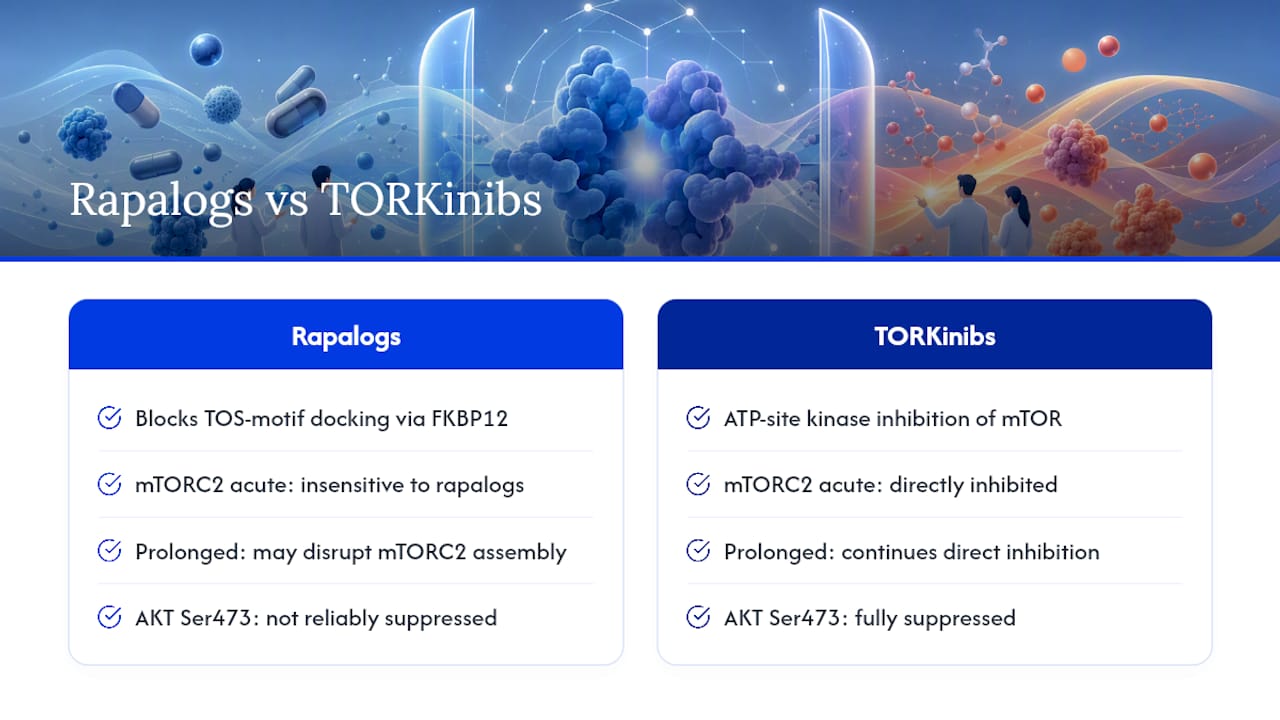
The functional divergence between mTORC1 and mTORC2 goes deeper than substrate lists. mTORC1 is acutely sensitive to rapamycin because the FKBP12-rapamycin complex physically blocks TOS-motif substrate docking without directly inhibiting the kinase’s catalytic activity. This partial inhibition model explains why some mTORC1 substrates (S6K1) are more sensitive to rapalogs than others (4E-BP1), and why 4E-BP1 phosphorylation can persist even at saturating rapalog concentrations.
mTORC2 insensitivity to rapamycin under acute conditions reflects the absence of an accessible FRB-equivalent regulatory site. Prolonged rapamycin exposure can disrupt mTORC2 assembly in some cell types by sequestering free mTOR before it can be incorporated into new mTORC2 complexes, but this effect is cell-type dependent and unreliable as a therapeutic mechanism.
TORKinibs achieve genuine dual-complex inhibition by targeting the shared ATP pocket. The consequence is full suppression of AKT Ser473 phosphorylation, which rapalogs cannot reliably achieve. This matters clinically because AKT Ser473 phosphorylation is a survival signal in many tumor types. The tradeoff is that mTORC2 inhibition disrupts insulin signaling through AKT, contributing to the metabolic toxicity (hyperglycemia, dyslipidemia) seen with TORKinibs. Rapalogs, by sparing mTORC2, have a somewhat more favorable metabolic profile in this specific respect, though they still cause hyperglycemia through mTORC1-mediated effects on insulin receptor signaling.
Inhibitor selectivity also has implications for autophagy. mTORC1 suppresses autophagy initiation through ULK1 phosphorylation; both rapalogs and TORKinibs relieve this suppression and induce autophagy. Whether autophagy induction is pro-survival or pro-death in a given tumor context depends on the metabolic state of the cell, which is one reason autophagy modulation as a combination strategy with mTOR inhibitors remains an active research question.
Pharmacokinetics and pharmacodynamics of key mTOR inhibitors
The PK/PD profiles of approved and investigational mTOR inhibitors differ in ways that directly affect dosing strategy and biomarker selection.
Whole-blood trough monitoring is standard because of the high red blood cell partitioning. CYP3A4 and P-gp govern its metabolism and efflux.
Everolimus is structurally similar to sirolimus but has a shorter half-life (approximately 30 hours), which supports once-daily dosing in oncology. Its oral bioavailability is also CYP3A4-dependent, and food effects are modest. Trough monitoring is used in transplant settings; in oncology, fixed dosing at 10 mg daily is standard with dose reductions for toxicity.
Temsirolimus is given IV at 25 mg weekly in RCC. It is rapidly hydrolyzed to sirolimus in vivo, so the PD effects are largely attributable to sirolimus. The IV route bypasses first-pass metabolism and GI absorption variability.
INK128 (sapanisertib) and AZD2014 (vistusertib) are oral TORKinibs with half-lives in the range of several hours, supporting twice-daily dosing in trials. Their PD effect — suppression of both S6K1 and AKT Ser473 phosphorylation — is used as a pharmacodynamic endpoint in early-phase studies. The degree and duration of target suppression in tumor biopsies versus surrogate tissues (PBMC, skin) is an active methodological question.
For BEZ235 (dactolisib), GI tolerability has been a limiting factor in clinical development despite favorable preclinical PK. Formulation changes (spray-dried dispersion) were explored to improve absorption and reduce GI exposure.
Biomarkers predicting response and resistance to mTOR inhibitors
No validated predictive biomarker has been prospectively confirmed across tumor types for mTOR inhibitors, but several candidates show consistent signals in retrospective and exploratory analyses.
TSC1/TSC2 mutations are the strongest predictive signal for rapalog sensitivity. TSC-mutant tumors have constitutively active Rheb and mTORC1, making them particularly dependent on mTOR signaling. The approved indications for everolimus in TSC-related SEGA and LAM reflect this biology directly.
PIK3CA mutations and PTEN loss are frequently cited as potential predictors, but the relationship is complex. PTEN loss increases PI3K/AKT signaling upstream of mTOR, which might suggest sensitivity, but it also primes the compensatory AKT reactivation that limits rapalog efficacy. PIK3CA-activating mutations show a similar paradox. Prospective trials using these as selection biomarkers have had mixed results.
Phosphoproteomic signatures — specifically phospho-S6K1 (T389), phospho-4E-BP1 (T37/46), and phospho-AKT (S473) — are used as pharmacodynamic markers to confirm target engagement in early-phase trials. They are not yet validated as predictive of clinical response, but they are standard endpoints in dose-finding studies.
eIF4E expression and 4E-BP1 phosphorylation status have been explored as markers of translational dependency, with the hypothesis that tumors highly dependent on cap-dependent translation would be more sensitive to 4E-BP1 dephosphorylation. This remains investigational.
For researchers designing studies, the PGC-1 alpha pathway and mitochondrial metabolic signatures are emerging as relevant context for interpreting mTOR inhibitor effects in metabolic and longevity models, where the biomarker framework differs substantially from oncology.
Acquired resistance mechanisms beyond PI3K/AKT feedback
Compensatory PI3K/AKT activation is the most studied resistance mechanism, but acquired resistance to mTOR inhibitors involves several additional molecular events that operate independently.
Activating mutations in mTOR itself have been identified in tumors progressing on rapalog therapy. Mutations in the FRB domain (e.g., F2108L, D2357N) reduce FKBP12-rapamycin binding affinity, directly impairing the allosteric mechanism of rapalogs. Kinase domain mutations can alter the ATP-binding pocket geometry, potentially reducing TORKinib binding as well. These gain-of-function mTOR mutations have been catalogued in renal cell carcinoma and other tumor types.
Upstream RTK amplification or mutation — including MET amplification, EGFR mutation, and IGF1R upregulation — can sustain PI3K/AKT signaling even when mTOR is inhibited. These events are often selected for under treatment pressure.
MAPK pathway activation is a well-documented escape route. RAS/RAF/MEK/ERK signaling can drive cell proliferation independently of mTOR, and cross-talk between the two pathways means that mTOR inhibition can paradoxically increase ERK phosphorylation in some contexts through relief of S6K1-mediated negative feedback on RAS.
Autophagy as a survival mechanism deserves mention separately from the feedback loops. In nutrient-deprived or stressed tumor cells, mTOR inhibitor-induced autophagy can be cytoprotective rather than cytotoxic. Combining mTOR inhibitors with autophagy inhibitors (chloroquine, hydroxychloroquine) has been explored in clinical trials to block this escape.
Downstream effector mutations — including amplification of eIF4E, mutations in 4E-BP1 that prevent dephosphorylation, or S6K1 amplification — can maintain translational output even when mTOR activity is suppressed. These are less common than upstream resistance mechanisms but have been documented in cell line models and patient samples.
How different mTOR inhibitor classes compare across cancer types
The comparative efficacy picture across tumor types reflects both the biology of each cancer and the mechanistic limitations of each inhibitor class.
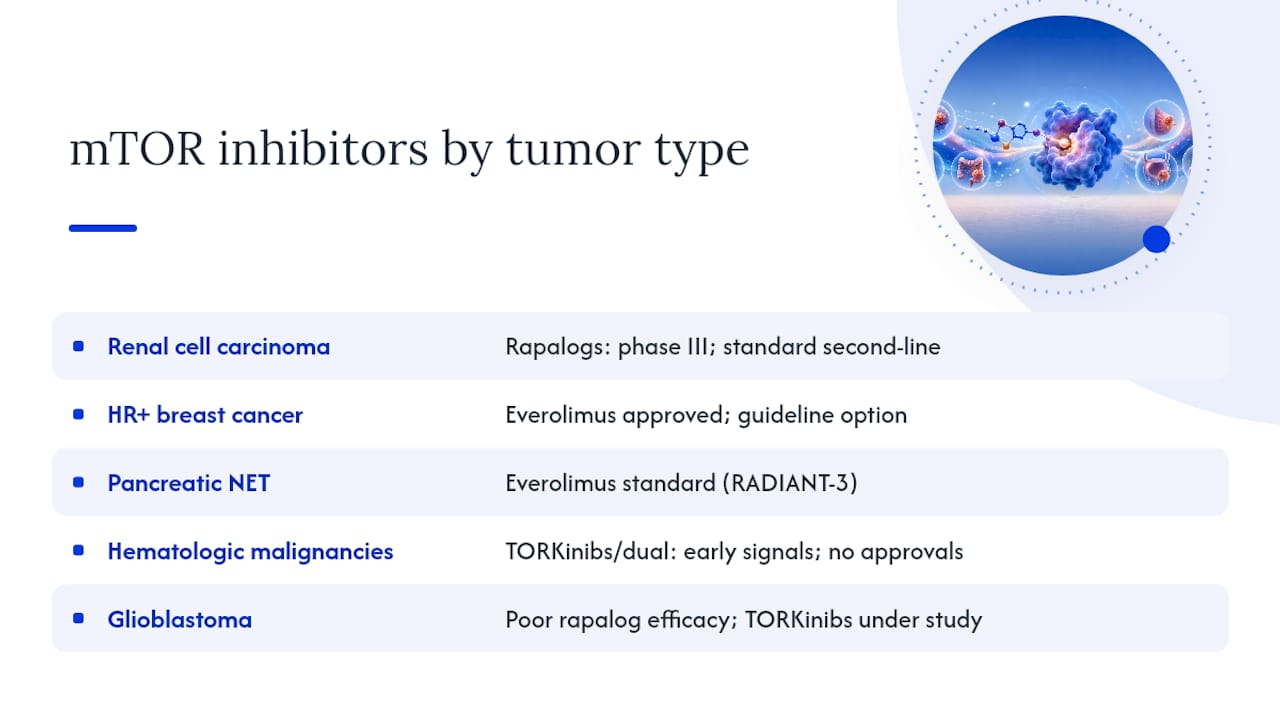
Renal cell carcinoma is where rapalogs have the strongest clinical track record. Both everolimus and temsirolimus have phase III data in RCC, and the lenvatinib-everolimus combination has become a standard second-line option. The high frequency of mTOR pathway alterations (VHL loss, TSC1/2 mutations, PTEN loss) in clear-cell RCC provides a biological rationale. TORKinibs have been tested in RCC but have not yet displaced rapalogs in this setting.
HR+ breast cancer is the other major approved indication for everolimus, where it works primarily by overcoming endocrine resistance driven by PI3K/mTOR pathway activation. The BOLERO-2 trial established the everolimus-exemestane combination. PIK3CA-mutant breast cancer has since been addressed more directly by PI3K-specific inhibitors (alpelisib), but everolimus remains a guideline option.
Pancreatic neuroendocrine tumors show consistent rapalog sensitivity, likely because of the high frequency of TSC2 and PTEN alterations in this histology. The RADIANT-3 trial data support everolimus as a standard option.
Hematologic malignancies — particularly mantle cell lymphoma, diffuse large B-cell lymphoma, and certain leukemias — have been targets for TORKinibs and dual PI3K/mTOR inhibitors in early-phase trials. The rationale is strong (PI3K/mTOR pathway dependency in B-cell malignancies), and some signals of activity exist, but no TORKinib has reached approval in hematology.
Glioblastoma is a case where the biology is compelling (PTEN loss is near-universal) but clinical results have been disappointing. Blood-brain barrier penetration, intratumoral heterogeneity, and rapid resistance development have limited rapalog efficacy. TORKinibs with better CNS penetration are under investigation.
The pattern across tumor types is consistent: rapalogs work where the tumor is highly mTORC1-dependent and lacks robust upstream PI3K/AKT activation. TORKinibs and dual inhibitors are most relevant where AKT reactivation is the dominant resistance mechanism, but their tolerability profile has so far limited their clinical advancement.
A researcher’s perspective on prioritizing mTOR inhibitor strategies
Mechanism-driven inhibitor selection and rigorous pharmacodynamic monitoring are the two decisions that most often separate informative mTOR studies from inconclusive ones.
The field spent a decade learning that rapalogs are not pan-mTOR inhibitors, and that lesson still hasn’t fully propagated into study design. Researchers who choose a rapalog for a tumor model with documented PTEN loss or PIK3CA mutation, without a plan to measure AKT Ser473 reactivation, are setting up for a result that confirms the feedback loop rather than tests the hypothesis. The inhibitor class has to match the molecular context of the model.
For clinicians, the monitoring infrastructure matters as much as the drug choice. Noninfectious pneumonitis is underdiagnosed because its early presentation overlaps with infection, and delayed recognition leads to unnecessary treatment interruption or, worse, continued dosing in a patient developing grade 3 toxicity. Building a systematic pulmonary symptom check into every clinic visit is not optional.
Three-point checklist for study design or clinical application:
- Confirm pathway activation status before selecting inhibitor class: TSC1/2 mutation or PTEN loss favors rapalogs; PIK3CA mutation or documented AKT reactivation favors TORKinibs or dual inhibitors.
- Build pharmacodynamic endpoints into the protocol: phospho-S6K1 and phospho-AKT Ser473 in accessible tissue (PBMC or tumor biopsy) confirm target engagement and reveal compensatory signaling early.
- Establish toxicity monitoring at baseline: CBC, lipid panel, fasting glucose, and a pulmonary baseline before the first dose, then at defined intervals — not just when symptoms appear.
Synthrolab supports your mTOR and cellular signaling research
Researchers investigating mTOR pathway biology need compounds that perform consistently across experiments. Batch-to-batch variability in research reagents is one of the most common sources of irreproducible results in signaling studies, and it’s a problem that certificate-of-analysis documentation directly addresses.
Synthrolab supplies research-grade peptides and laboratory compounds independently batch-tested for purity, with certificates of analysis available for every lot. For researchers working at the intersection of mTOR signaling, mitochondrial function, and longevity mechanisms, the metabolic modulation compound catalog covers reagents relevant to autophagy, energy sensing, and cellular metabolism research. The GHK-Cu + BPC-157 + TB-500 research bundle is one example of a combinatorial reagent set suited to researchers studying recovery and cellular signaling pathways adjacent to mTOR biology. Browse the full catalog at Synthrolab and request lot-specific documentation at checkout.
Authoritative resources for deeper reading
Peer-reviewed reviews, FDA prescribing information, and clinicaltrials.gov are the primary sources for mTOR inhibitor data — not secondary summaries.
This article is for general scientific and educational purposes only. It is not a substitute for professional medical advice, clinical judgment, or current FDA prescribing information. Consult institutional protocols and qualified clinicians for patient-specific decisions.
Sources
Recommended
 21+ verification