AOD-9604 is a tyrosine-modified fragment of human growth hormone, built from residues 176 to 191 of the GH molecule, and studied for decades as a possible fat-loss agent without the receptor effects of full GH. The verdict: early trials showed a modest short-term weight-loss signal, but the pivotal 24-week Phase 2b trial failed its primary endpoint, and the compound has never won FDA approval for any use. Today it exists almost exclusively as a research-grade material sold for laboratory investigation, not as an approved therapy.
TL;DR:
- The 12-week trial showed a modest weight loss of about 2.6 kg, but the larger 24-week phase 2b trial failed to confirm this effect with 536 participants.
- Despite a plausible mechanism and a strong safety profile in short-term studies, no evidence supports long-term fat-loss benefits of AOD-9604.
- Controlled trials used oral doses of up to 1 mg daily, while community reports mostly mention subcutaneous injections at 250 to 500 micrograms without supporting efficacy data.
- AOD-9604 is not FDA-approved, and regulatory or safety concerns arise from potential product quality issues due to sourcing outside regulated environments.
- Verification through certificates of analysis, including HPLC purity and mass spectrometry, is essential for laboratory use, as official safety and efficacy data remain limited.
Table of Contents
What Is AOD-9604? Quick Facts and Molecular Profile
If you’re comparing vendor listings or cross-checking a paper’s methods section against product literature, you need the numbers that don’t change: sequence, mass, registry IDs. AOD-9604’s identity is precise and well documented, which is part of why it keeps showing up in obesity pharmacology literature even after its clinical setback.
The peptide carries the sequence YLRIVQCRSVEGSCGF, an N-terminal tyrosine addition to the native 177 to 191 fragment of hGH, giving it a molecular formula of C78H123N23O23S2 and a mass of roughly 1,815 Daltons, according to PubChem’s compound record. That registry entry, along with the EPA’s CompTox Dashboard listing, gives researchers a way to confirm they’re looking at the same molecule across different sources.
A few identifiers and practical details worth knowing:
- PubChem CID 71300630 is the canonical reference for the compound’s chemical structure and properties.
- Literature sometimes labels it as “HGH fragment 176-191 (Tyr)” or simply “AOD9604,” reflecting its origin as a modified hGH fragment 176-191.
- Research-grade vials typically come in 2 mg, 5 mg, or 10 mg lyophilized powder formats, meant to be reconstituted before use.
- A legitimate certificate of analysis should report HPLC purity (usually above 98%), confirmed mass by mass spectrometry, and endotoxin levels below research-use thresholds.
Anyone ordering the peptide for lab work should treat the sequence and mass as the baseline check against any certificate of analysis that arrives with the product.
How Does AOD-9604 Work in the Body?
The appeal of AOD-9604 rests on a fairly elegant idea: isolate the part of the growth hormone molecule believed to drive fat metabolism, and leave behind the part that triggers the receptor binding responsible for GH’s growth-promoting and insulin-modulating effects. Whether that isolation delivers on its promise in humans is a separate question from whether the mechanism is real.
Preclinical work links AOD-9604 to beta-3 adrenergic receptor activity, a pathway involved in triggering lipolysis, the breakdown of stored fat into free fatty acids for use as energy. In animal models, this activity showed measurable effects on fat metabolism without the receptor-binding characteristics of intact growth hormone.
That last point matters enormously for safety framing. Full-length hGH binds the GH receptor and raises IGF-1, a hormone tied to cell growth and, at excess levels, to metabolic and safety concerns. AOD-9604 does not show meaningful GH receptor binding or IGF-1 elevation in the human studies reviewed in the obesity pharmacotherapy literature, which is a large part of why it advanced through early trials with a clean tolerability profile.
Here’s the catch: a clean mechanism and a favorable safety signal don’t guarantee a clinical outcome. This is one of the more instructive gaps in obesity drug development.
- Animal potency data can look compelling and still fail to translate into human weight loss at meaningful scale.
- A compound that avoids GH receptor activation avoids GH’s risks, but it also forfeits GH’s potent metabolic effects, which may explain why AOD-9604’s clinical effect size stayed small.
- Mechanism papers explain plausibility, not proof. Only controlled human trials establish whether a fat-loss pathway produces a fat-loss result worth calling a therapy.
That distinction between plausible biology and demonstrated outcome is exactly where AOD-9604’s story gets more complicated.
What Do the Human Clinical Trials Show?
AOD-9604 moved through six randomized controlled trials during its development for obesity, and the honest summary is a split verdict: real short-term signal, followed by failure at the scale that mattered most.
An early 12-week trial testing oral doses gave a specific and often-cited result. Participants receiving 1 mg per day lost more weight than those in the placebo group over the 12-week period, according to the PMC review of obesity pharmacotherapy. That’s a real, statistically detectable difference over a short window, and it’s the number most often quoted by advocates of the compound.
The problem is what happened next. The company sponsoring development ran a larger, longer Phase 2b trial known as OPTIONS, enrolling 536 subjects over 24 weeks. This was the pivotal study designed to confirm the earlier signal at a scale regulators would actually consider. It failed to meet its primary endpoint for statistically significant weight loss, and obesity development for AOD-9604 was discontinued afterward.
That sequence, a positive 12-week trial followed by a negative 24-week trial in ten times as many participants, is worth sitting with. It illustrates something researchers see across drug development generally: short trials often overstate durability, and small samples often overstate effect size. The insight here isn’t unique to AOD-9604, but it’s rarely as visible as it is here, because both the promising trial and the disappointing one are published and citable.
A few things to weigh when reading claims about this evidence:
- The 2.6 kg figure is real, but it comes from a 12-week window in a study smaller than the pivotal trial that followed.
- A failed primary endpoint in a 536-subject, 24-week RCT is a stronger and more relevant data point for anyone asking “does this work for sustained weight loss.”
- No published trial after OPTIONS has reversed that conclusion or established a maintained clinical benefit.
- Any claim about AOD-9604 for fat loss that omits the Phase 2b failure is presenting an incomplete picture of the evidence.
Researchers designing follow-up studies or comparing AOD-9604 to other lipolytic compounds should treat the 12-week result as hypothesis-generating, not confirmatory. That’s a standard the compound’s own trial history sets, not an opinion layered on top of it.
There’s a real gap between what was tested in controlled trials and what circulates in community-reported protocols, and researchers should treat these as two entirely separate evidence tiers.
Clinical trials used oral administration with doses up to 1 mg per day. Oral dosing was the route studied, the route measured, and the route tied to every published efficacy number for this compound.
Community-reported protocols look nothing like that. Most anecdotal use describes subcutaneous injection at 250 to 500 mcg per day, often over 8 to 12 week cycles. There is no controlled human trial data supporting subcutaneous administration at these doses for any outcome. That’s not a minor technicality: route of administration changes absorption, bioavailability, and potentially the entire pharmacokinetic profile that produced the trial results in the first place.
For researchers working with reconstitution at the lab level, the process follows standard peptide-handling steps:
- Confirm the vial’s peptide mass (commonly 2, 5, or 10 mg) against the certificate of analysis before opening.
- Reconstitute using bacteriostatic water or another sterile diluent appropriate for peptide research, added slowly down the vial wall rather than injected directly onto the lyophilized powder.
- Calculate concentration precisely. A 5 mg vial reconstituted with 2 mL of diluent yields 2.5 mg/mL, a common reference point for research dilution math.
- Store the reconstituted solution refrigerated and use it within the short-term window appropriate for peptide stability, consistent with the practices outlined in a research peptide injection site rotation SOP.
- Log lot numbers, reconstitution dates, and storage conditions for traceability, particularly if results will be compared across sessions or shared in documentation.
Pro Tip: Never assume a subcutaneous community dose is a direct substitute for an oral clinical dose. Different routes of administration are not interchangeable data points, and treating them as equivalent is one of the most common misreadings of this compound’s literature.
Cycle lengths reported anecdotally cluster around 8 to 12 weeks, but there’s no controlled trial data establishing an optimal cycle duration or confirming that cycling itself changes outcomes. That’s a real evidence gap, not a settled protocol.
Is AOD-9604 Safe? What the Trial Data Shows
The safety data from AOD-9604’s clinical program is genuinely one of its stronger features, even though the efficacy program fell short. Across the RCTs, adverse events occurred at rates comparable to placebo, and researchers found no clinically significant IGF-1 elevation or glucose intolerance in participants, according to the PMC review. That tracks with the mechanism: without meaningful GH receptor engagement, the compound simply doesn’t produce the metabolic side effects associated with GH excess.
That clean trial safety record exists alongside an unambiguous regulatory reality.
- AOD-9604 is not FDA-approved for any therapeutic indication, including weight loss.
- It has been part of ongoing discussions around the FDA’s 503A bulk drug substances list for compounding pharmacies, a debate that remains unresolved as of this writing.
- Some jurisdictions have permitted the compound under nutraceutical or cosmetic-ingredient pathways, including self-affirmed GRAS (Generally Recognized As Safe) status for non-therapeutic uses as detailed in a Journal of Endocrinology and Metabolism review. GRAS status for a food or cosmetic ingredient is not the same as drug approval, and it says nothing about efficacy for fat loss.
What remains genuinely unknown is where the caution should live. The published trials didn’t run long enough to establish long-term safety data, and immunogenicity, the possibility of an immune response building against a repeatedly administered peptide, has not been systematically studied for this compound over extended use. Add to that the practical risk facing anyone sourcing it outside a controlled trial setting: impure synthesis, incorrect sequence, or mislabeled concentration are realistic hazards with any peptide obtained without rigorous testing. The pharmacology risk from AOD-9604 itself looks low based on trial data. The quality-control risk from an unverified product is a separate and arguably larger concern for anyone working with it in a lab setting.
How to Verify Research-Grade AOD-9604 Quality
Given that trial-documented safety and product-level quality are two different issues, the practical question for any researcher is how to confirm what’s actually in the vial. This is where certificate of analysis standards and independent verification matter more than marketing copy.
A legitimate COA for AOD-9604 should report several specific data points, not a vague purity claim:
- HPLC purity, typically expected above 98% for research-grade material.
- Mass spectrometry confirmation that the measured mass matches the expected ~1,815 Da for the correct sequence.
- Endotoxin testing, reported in EU/mL, particularly relevant for any material intended for solution-based lab work.
- Sterility data for the batch, along with a batch or lot number that ties the COA to the specific vial in hand.
Reading a COA is only half the process. Independent confirmatory testing, sending a sample to a third-party analytical lab for mass spec identity confirmation and HPLC purity verification, is the step that catches mislabeled or degraded product before it compromises a research protocol. This matters more for peptides than for many other lab reagents because sequence errors and truncated synthesis products aren’t visible without instrumentation.
Pro Tip: Keep a standing folder, digital or physical, of every COA received with a shipment. If a result looks anomalous months later, having the original purity and mass spec data on hand lets you rule out (or confirm) a product-quality explanation immediately.
Beyond the paperwork, basic SOP discipline protects both data integrity and safety: store lyophilized peptide frozen and reconstituted solution refrigerated, document every reconstitution event, and maintain a clear chain of traceability from vial to bench, similar to the standards outlined for alpha peptides research protocols. Materials sourced this way are intended strictly for laboratory research, not for human or animal consumption outside a controlled study.

Our Take on AOD-9604’s Research Value
We think the AOD-9604 story gets misrepresented more often by omission than by outright false claims. Cite the 12-week 2.6 kg result without mentioning the failed 536-subject Phase 2b trial, and you’ve told half a true story. The compound is neither a debunked failure nor a hidden fat-loss breakthrough. It’s a peptide with a clean short-term safety record, a plausible but unconfirmed mechanism, and a pivotal trial that didn’t hold up. Synthrolab lists AOD-9604 with that full history intact, backed by batch-specific certificates of analysis, because researchers investigating this compound deserve the failed trial data as much as the promising one. This material is supplied strictly for laboratory research, not for therapeutic use.
— Mitch
Where to Source Research-Grade AOD-9604
If you’re working with AOD-9604 or comparing it against other lipolytic peptides in your research protocol, product quality is the variable you actually control. Synthrolab supplies research-grade peptides with batch-specific certificates of analysis covering HPLC purity, mass spectrometry identity confirmation, and endotoxin testing, so you’re not troubleshooting a protocol against an unverified sample.
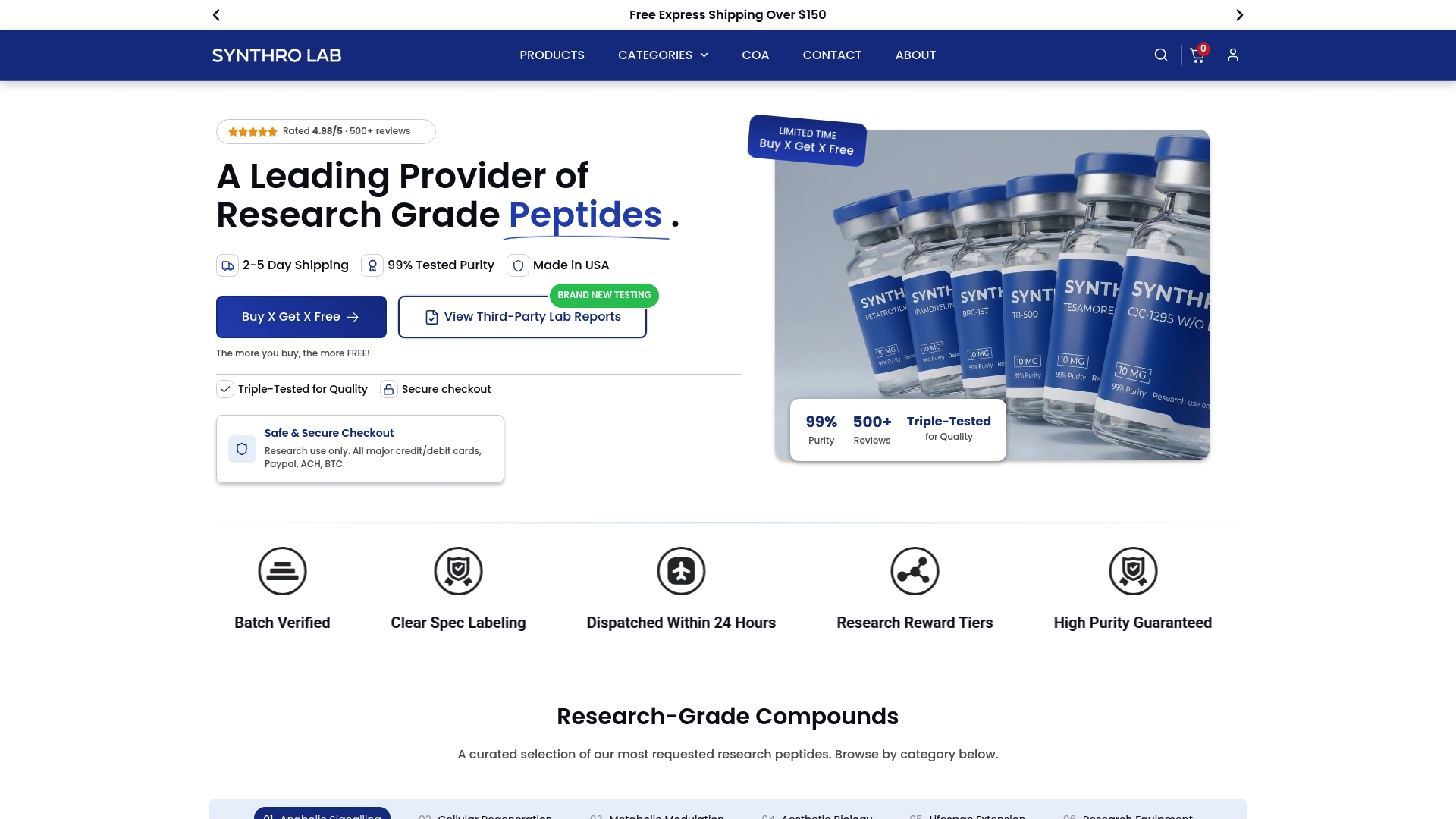
Beyond AOD-9604 itself, Synthrolab’s team supports reconstitution guidance and helps researchers build out testing plans when a project calls for cross-referencing purity claims against independent lab results. If you’re new to peptide handling generally, the peptides for beginners safe-start guide walks through SOP basics before you place an order. For a broader look at how purity standards and sourcing decisions affect research outcomes, the simple peptides quality guide breaks down what separates a documented batch from a guess. All materials are sold strictly for laboratory research, with no therapeutic claims attached. Browse current batches and COA documentation on the Synthrolab product catalog to find the research-grade material your protocol needs.
Sources
The clinical and regulatory claims in this article draw from a small set of primary sources worth reading directly if you’re citing this compound in your own work.
This article is general information, not a substitute for advice from a qualified doctor. Consult a qualified healthcare professional about your own circumstances before acting on anything here.
Recommended
 21+ verification