Peptide fragment 176-191 is the 16-amino-acid C-terminal segment of human growth hormone (HGH), and its defining characteristic is what it does not do. Unlike full-length HGH, it does not activate growth hormone receptors, does not stimulate IGF-1 production, and carries none of the diabetogenic risks associated with exogenous HGH administration. What it does do is selectively stimulate lipolysis, the breakdown of stored fat, through a distinct receptor pathway. That specificity is exactly why it has attracted serious attention in metabolic research.
Key facts at a glance:
- Sequence position: Amino acids 176 through 191 of the 191-amino-acid HGH molecule
- Primary action: Selective lipolysis via beta-3 adrenergic receptor activation
- Growth effects: None. No IGF-1 stimulation, no cell proliferation
- Regulatory status: Research compound only; not approved for human therapeutic use in the United States
- Key derivative: AOD-9604, a tyrosine-modified version with improved stability and the only form tested in human clinical trials
Table of Contents
What is the biochemical structure of peptide fragment 176-191?
The amino acid sequence of fragment 176-191 runs Leu-Arg-Ile-Val-Gln-Cys-Arg-Ser-Val-Glu-Gly-Ser-Cys-Gly-Phe, with a molecular weight of approximately 1,817 Da. Two cysteine residues form an intramolecular disulfide bond that locks the peptide into a specific three-dimensional conformation. That structural constraint is not cosmetic. Without it, the fragment loses biological activity, which is why synthesis quality and storage conditions matter so much in research settings.
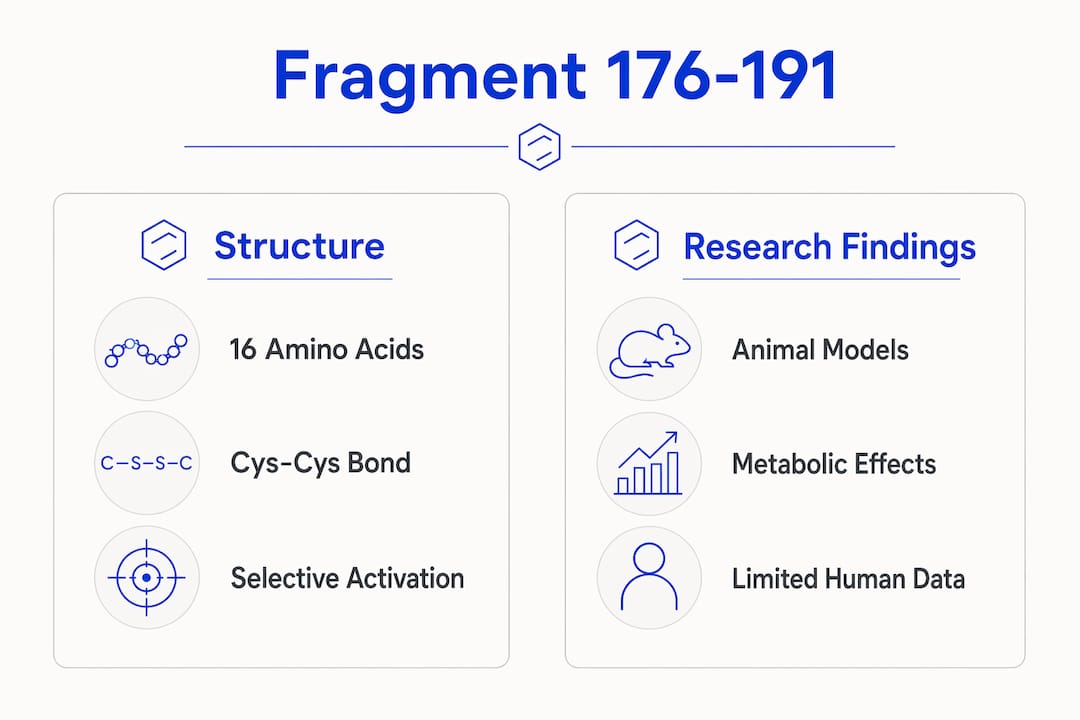
What the fragment lacks is just as telling as what it contains. Full-length HGH binds its receptor at two distinct sites, Site 1 and Site 2, triggering receptor dimerization and downstream IGF-1 signaling. Fragment 176-191 retains only a partial Site 1 region, which is insufficient for full receptor activation. The result is a peptide that can engage adipose tissue pathways without triggering the growth axis.
| Property |
Fragment 176-191 |
AOD-9604 |
| Sequence length |
16 amino acids |
16 amino acids |
| Molecular weight |
~1,817 Da |
Slightly higher (N-Tyr added) |
| N-terminal modification |
None |
Tyrosine substitution |
| Disulfide bond |
Yes (Cys-Cys) |
Yes |
| GH receptor activation |
Partial / absent |
Partial / absent |
| Proteolytic stability |
Lower |
Higher |
| Half-life (subcutaneous) |
~0.5–1 hour |
Longer |
The mechanism runs through the beta-3 adrenergic receptor on adipocytes. Activation of that receptor triggers a cAMP/PKA cascade, which in turn activates hormone-sensitive lipase. That enzyme cleaves stored triglycerides into free fatty acids and glycerol, the core process of lipolysis. Simultaneously, the fragment appears to inhibit lipogenesis, the synthesis of new fat, though the precise signaling pathway for that inhibitory effect is less characterized. Researchers studying fat metabolism pathways will recognize this as a relatively clean pharmacological tool for isolating adrenergic-driven lipolysis from the broader HGH signaling network.
What does the current research actually show?
The preclinical data on fragment 176-191 is genuinely interesting, and the human data is almost nonexistent for the unmodified form. That gap is the single most important thing to understand before interpreting any efficacy claim.

In rodent models, the fragment produces clear metabolic effects. Obese mice treated with the peptide showed nearly 50% reduction in weight gain over the study period, while lean mice showed no weight change. That selectivity for obese phenotypes suggests the fragment’s lipolytic effect depends on the metabolic state of the animal, not a blanket fat-burning action. Animal work has also shown potential in cartilage regeneration: weekly injections combined with hyaluronic acid increased cartilage growth metrics and reduced osteoarthritis symptoms in rabbit models, pointing to research applications beyond fat metabolism.
The human trial picture is more complicated. All six clinical trials involving fat loss and safety were conducted with AOD-9604, the tyrosine-modified derivative, not the unmodified fragment 176-191. Those trials enrolled 893 participants and generated the safety and pharmacokinetic data that researchers often cite when discussing “fragment 176-191.” Applying that data to the unmodified peptide is a category error. The two compounds differ in stability, bioavailability, and dosing requirements in ways that make direct extrapolation unreliable.
Key limitations of the current evidence base:
- No published human pharmacokinetic studies on unmodified fragment 176-191
- Rodent lipolysis data does not reliably translate to human metabolic responses
- Beta-3 adrenergic receptor expression varies considerably across human populations
- Cartilage and cancer-targeting findings are early-stage and require independent replication
- Emerging work on nanoparticle drug delivery using fragment 176-191 to enhance doxorubicin toxicity against MCF-7 breast cancer cells is promising but remains in vitro
How do researchers approach dosing and administration?
The practical challenge with unmodified fragment 176-191 is its short half-life. Subcutaneous injection produces a plasma half-life of approximately 0.5 to 1 hour, which means a single daily injection is unlikely to sustain meaningful receptor engagement. Most research protocols use twice-daily subcutaneous injections, but as there are no published human pharmacokinetic studies on unmodified fragment 176-191, dosing remains largely empirical and is based only on animal data. Timing relative to meals and activity is often factored in, since lipolytic signaling interacts with insulin levels.
Pro Tip: Because pharmacokinetics for subcutaneous fragment 176-191 have not been characterized in human studies, dosing strategies in research settings remain largely empirical and based on preclinical animal data. Design your protocols accordingly and document variables carefully.
AOD-9604 sidesteps some of these challenges. The N-terminal tyrosine substitution improves proteolytic resistance, extending the effective half-life and reducing dosing frequency. It also confers better oral bioavailability, though subcutaneous delivery remains the standard in experimental settings. For researchers comparing the two compounds, the practical dosing burden of unmodified fragment 176-191 is a real experimental design consideration, not just a convenience issue. More frequent dosing introduces more variables and more opportunities for protocol deviation.
Safety profile considerations for research use:
- Mild injection-site reactions are the most commonly reported adverse effect
- No evidence of IGF-1 elevation or growth-promoting activity at research doses
- No documented hyperglycemia at typical research doses, unlike full-length HGH
- Long-term safety data in humans does not exist for the unmodified fragment
- Peptide purity and contamination risk from unverified suppliers represent a genuine research confound
Researchers sourcing this compound should prioritize suppliers with documented certificate of analysis data and third-party purity verification. Contaminated or degraded peptide will not produce reproducible results, and in a compound with this short a half-life, even partial degradation during storage can meaningfully affect experimental outcomes.
What do experts get wrong about fragment 176-191?
The most persistent misconception is treating AOD-9604 clinical data as evidence for unmodified fragment 176-191. The two peptides share a sequence but differ in ways that matter pharmacologically. Researchers who cite the 893-participant AOD-9604 trial database as support for fragment 176-191 efficacy are conflating two distinct compounds. That conflation shows up in biohacking forums, supplement marketing, and even some secondary literature.
A second misconception involves the beta-3 adrenergic receptor itself. In rodents, beta-3 receptors are densely expressed in brown adipose tissue and play a central role in thermogenesis and lipolysis. In humans, beta-3 receptor expression is lower, more variable, and distributed differently across adipose depots. That biological difference is one reason why rodent lipolysis data has not translated cleanly to human outcomes across multiple research programs, not just this peptide. Assuming the mouse data predicts human response is an extrapolation that the evidence does not currently support.
Pro Tip: When reviewing fragment 176-191 literature, always check whether the study used the unmodified peptide or AOD-9604. The distinction is rarely flagged prominently in abstracts, but it determines whether the findings are even relevant to your research question.
The third area of confusion involves the peptide’s expanding research applications. Work published in PMC demonstrates that fragment 176-191 can enhance doxorubicin toxicity against MCF-7 breast cancer cells when loaded into chitosan nanoparticles, with molecular docking simulations showing high-affinity binding to Ki-67 and the estrogen receptor. This is genuinely novel territory. Researchers focused solely on fat metabolism may be missing the broader molecular signaling applications that are now emerging. For anyone working in peptide-based research, this expansion of the fragment’s known receptor interactions is worth tracking closely.
Key Takeaways
Fragment 176-191 selectively stimulates lipolysis through beta-3 adrenergic receptor activation without triggering IGF-1 production or growth hormone receptor dimerization, making it biochemically distinct from full-length HGH.
| Point |
Details |
| Structural specificity |
The 16-amino-acid sequence with a Cys-Cys disulfide bond is required for biological activity; degraded peptide loses function. |
| No human clinical data |
All human trials used AOD-9604, not unmodified fragment 176-191; the two compounds are not interchangeable for evidence purposes. |
| Short half-life |
A plasma half-life of approximately 0.5–1 hour requires twice-daily subcutaneous dosing in research protocols. |
| Rodent data limitations |
Nearly 50% weight gain reduction in obese mice does not reliably predict human metabolic outcomes due to beta-3 receptor expression differences. |
| Synthrolab |
Synthrolab supplies research-grade fragment 176-191 and related metabolic peptides with documented purity for experimental use. |
Synthrolab supports serious peptide research
Researchers who need research-grade metabolic peptides with verified purity get exactly that from Synthrolab. The compound quality problem in peptide research is real: degraded or contaminated material produces noise, not data, and a peptide with a half-life under one hour has no margin for poor handling. Synthrolab provides laboratory compounds specifically for scientific investigation into metabolism, cellular signaling, and longevity-related pathways, with certificate of analysis documentation to support reproducible experimental design.
If you are working with fragment 176-191 or its derivatives, Synthrolab’s metabolic modulation catalog covers the compounds relevant to lipolysis and fat metabolism research. For researchers newer to peptide protocols, the safe-start peptide guide lays out the foundational considerations before you begin. Browse the full catalog at synthrolab.com and check the COA documentation before committing to a research design.
Recommended