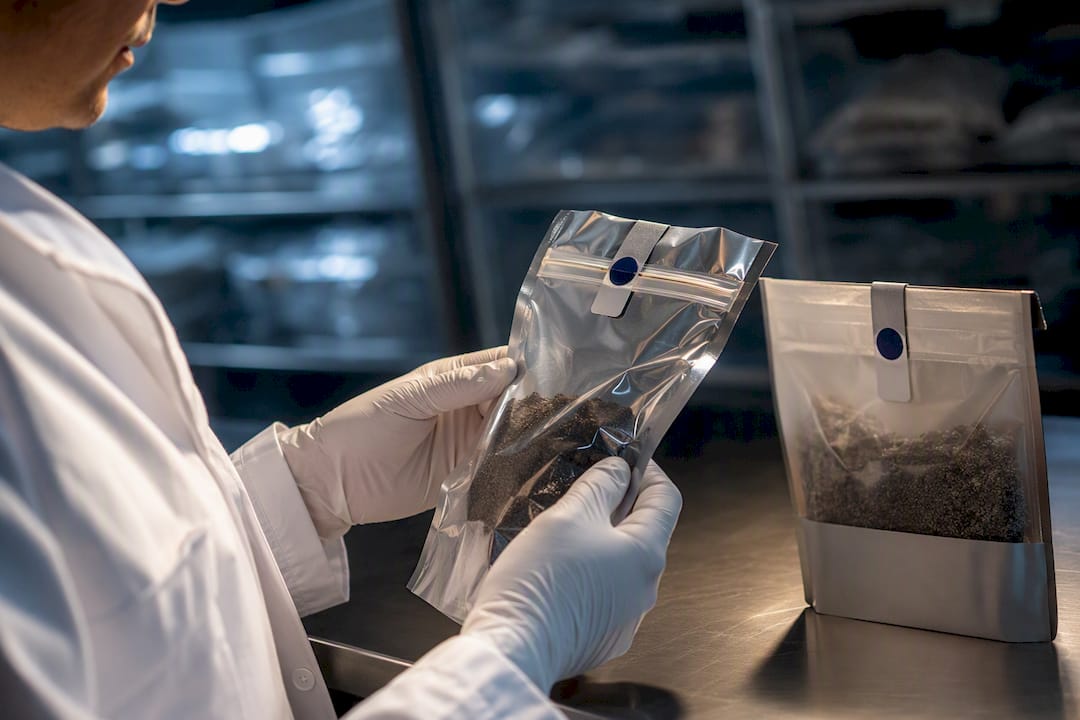
Third-party testing is the practice of sending a product sample to an independent laboratory, unaffiliated with the manufacturer, to verify its identity, purity, and safety through documented methods. The value isn’t the label claim “third-party tested.” It’s the traceable report behind it: a Certificate of Analysis (COA) with a lot number, named methods, and a lab whose accreditation you can check against bodies like ISO/IEC 17025, the CPSC, or FDA 21 CFR Part 111.
TL;DR:
- Only accredited third-party labs with scope-specific testing verify key properties such as identity, purity, and contamination, unlike supplier-issued COAs that can be manipulated.
- Accreditation under ISO/IEC 17025 must explicitly cover the specific testing methods listed on the COA to ensure reliability, especially for regulated products like children’s items and supplements.
- Verifying a COA’s authenticity requires checking lot numbers, accreditation scope, test methods, and directly confirming report details with the lab via phone or online lookup tools.
- For research-grade peptides and high-risk products, sourcing from labs that provide lot-matched COAs and shipping protection enhances reliability and reduces liability.
Synthrolab
Choose Research-Grade Compounds
Synthro Lab provides research-grade peptides and laboratory compounds for investigating cellular signalling, metabolism, recovery, and longevity mechanisms.
Visit Synthro Lab
Table of Contents
What Third-Party Testing Actually Means
Independence is the entire point. NIST defines third-party testing as testing performed by an organization not involved in designing or using the product being tested. That excludes the manufacturer’s own quality control team and any lab owned or contracted directly by the seller to produce marketing copy rather than an audit trail.
A supplier COA, generated in-house or by a lab the supplier hand-picks and controls the relationship with, isn’t the same document as one from an accredited lab working from a blind sample. The distinction matters because supplier-issued paperwork can be selectively shared, edited, or simply never re-tested once it’s published.
Independent labs typically test for:
- Identity: confirming the substance is actually what the label claims
- Purity: measuring the percentage of the target compound versus contaminants
- Heavy metals and residual solvents: contamination from synthesis or processing
- Sterility and endotoxin levels: critical for injectable or research materials
- Microbial contamination: bacteria, mold, or yeast presence
Each of these is a separate test, run with a separate method, and a COA should say so explicitly rather than bundling them into a vague “passed.”
Why Independent Verification Actually Matters
Bias removal is the practical benefit, but it shows up differently depending on who’s asking. A procurement manager gets a document they can put in a file and defend later. A researcher gets data clean enough to survive peer review. A retailer gets liability protection if a regulator ever asks questions.
The gap between marketing claims and lab reality is wider than most buyers assume. One independent testing lab reported that only 27% of supplier COAs exactly matched independent re-testing across more than 1,400 samples. That’s not a rounding error. It means roughly three out of four supplier-issued reports didn’t hold up when a third party ran the same sample through its own equipment.
Why third-party testing pays for itself:
- Removes the seller’s financial incentive to under-report contamination or overstate purity
- Creates a document trail that satisfies retailers, regulators, and journal reviewers
- Reduces liability exposure if a batch is later found to be substandard
- Lets research findings hold up to scrutiny because the input material was independently verified
For anyone running experiments meant to be reproducible or published, unverified inputs are a silent variable that can undermine an otherwise sound protocol.
Standards That Define a Legitimate Lab
ISO/IEC 17025 is the standard that matters most, and it’s frequently misunderstood. Accreditation under 17025 isn’t a blanket credential. It’s scope-specific, meaning a lab can be accredited for HPLC purity testing but not accredited for endotoxin testing, or accredited for one product category but not another. Checking that a lab’s accreditation scope actually covers the exact test listed on your COA is the single most overlooked verification step.
For children’s products, the rules are stricter and codified in federal law. The CPSC requires testing by a CPSC-accepted laboratory, and the responsible firm must issue a Children’s Product Certificate (CPC) based on passing results. Not every accredited lab is CPSC-accepted. The agency maintains its own acceptance and scope requirements, separate from general ISO/IEC 17025 accreditation.
For dietary supplements, FDA rules under 21 CFR Part 111 put the burden on manufacturers to establish specifications for identity, purity, strength, and composition. The FDA doesn’t mandate third-party testing outright, but ISO/IEC 17025 lab results have become the practical way manufacturers demonstrate compliance, and retailers increasingly ask for them before stocking a product.
- ISO/IEC 17025: competence standard, scope-specific accreditation
- CPSC: mandatory for many children’s products, requires CPC issuance
- FDA 21 CFR Part 111: compliance framework for supplements, third-party testing is the common proof method
Reading a COA: What HPLC, Mass Spec, and Other Methods Actually Prove
Method names on a COA aren’t interchangeable, and each one answers a different question.
HPLC (High-Performance Liquid Chromatography) measures purity by separating a sample into its components and comparing peak areas. It tells you how much of the target compound is present relative to detectable impurities. It does not, on its own, confirm identity.
Mass spectrometry fills that gap by confirming molecular identity based on mass-to-charge ratio. It’s strong on identity, weaker as a standalone purity metric unless paired with a separation method like HPLC.
LAL (Limulus Amebocyte Lysate) testing detects bacterial endotoxins, a critical check for anything intended for injectable or sterile research use. It says nothing about chemical purity or identity.
ICP-MS (Inductively Coupled Plasma Mass Spectrometry) detects heavy metals and trace elements at extremely low concentrations, useful for contamination screening but irrelevant to organic purity questions.
- HPLC: purity, not identity
- Mass spectrometry: identity, limited standalone quantification
- LAL/endotoxin: sterility signal, not a purity test
- ICP-MS: heavy metal detection, not organic contamination
A COA listing only one of these methods is answering only one question. A complete picture usually needs at least two.
How to Verify a COA and Match It to Your Lot
A COA is only as good as its traceability. Before trusting one, run through this checklist:
- Confirm the report number is unique and matches the batch you actually received.
- Check the lab’s name and contact details against a real, findable business, not just a logo.
- Verify the accreditation number and scope through the accrediting body’s public directory, and confirm the scope covers the specific method listed.
- Read the named methods (HPLC, LC-MS, LAL) rather than accepting a generic “passed” statement.
- Match the sample or lot number on the COA to the lot number on your product packaging.
- Check dates, both when the sample was tested and when the report was issued, and note how far that is from your purchase date.
- Look for a signature or authorized reviewer name, not just a company stamp.
Many labs now publish verifiable QR codes or online lookup pages tied to each report, letting you cross-check a document against the lab’s own database rather than trusting a PDF that could have been altered after issuance.
Pro Tip: Call the lab directly and ask them to confirm they issued the exact report number on your COA. Legitimate labs answer this in under a minute. Labs that can’t, or won’t, are a red flag worth taking seriously.
Red flags include COAs with no report number, generic “in-house” lab names with no findable address, accreditation numbers that don’t resolve in any public directory, and dates that predate the product’s manufacturing by months.
When Independent Testing Is Required, Not Optional
Some categories don’t leave testing to discretion. For children’s products, federal law mandates testing by a CPSC-accepted lab, with additional rules for component and composite testing when a product’s materials change.
Dietary supplements fall under a softer but still consequential mandate. Manufacturers must meet identity and purity specifications under FDA 21 CFR Part 111, and most retailers now refuse shelf space without documented, accredited testing behind a product.
Research settings have their own version of “required.” A study built on unverified starting material isn’t reproducible, and peer reviewers increasingly expect documentation of input quality.
- Children’s products: legally mandated, CPC required
- Supplements: compliance-driven, retailer-enforced in practice
- Research materials: publication and reproducibility driven
- Material changes to a formula or supplier typically trigger re-testing, not just the first batch
What Testing Actually Costs and How Long It Takes
Costs vary by method complexity and how many properties you’re testing. A basic identity-and-purity bundle through an accredited lab commonly runs in the low hundreds of dollars per sample, with turnaround in the range of a few business days to two weeks depending on the lab’s queue and whether rush processing is available.
Price and speed both move with a few variables:
- Number of methods requested (a single HPLC purity run is cheaper than a full panel with endotoxin and heavy metal screening)
- Whether the lab is accredited for the specific test, since accredited testing generally costs more than non-accredited screening
- Blind versus disclosed submission, where blind testing (samples submitted without revealing the expected result) adds credibility but sometimes adds a small fee
An audit of U.S. peptide vendors found verifiable, independently checkable COAs for only 71% of the 51 vendors reviewed, which tells you something about how many sellers skip this step entirely to save time and money. For sample submission, keep a documented chain of custody: label the lot, photograph the packaging, and if possible, submit blind so the lab has no incentive to read your expectations into the result.
How Synthro Lab Approaches Verification
The company batch-tests peptides and publishes Certificates of Analysis tied to specific lot numbers, enabling a report to be matched directly to the product in hand rather than a generic reference sample. Orders also include shipping protection to reduce the risk of degradation or tampering between the lab and your bench.
A practical workflow looks like this: place an order, review the COA tied to that lot, confirm the listed methods against what your research actually requires, and independently verify the lab’s accreditation scope if the work demands that level of rigor. Researchers building out a testing protocol can use the test builder to specify methods before committing to a sample submission, and the guide to interpreting lab findings walks through reading a report line by line.
Third-Party, Second-Party, and Internal Testing Are Not the Same Thing
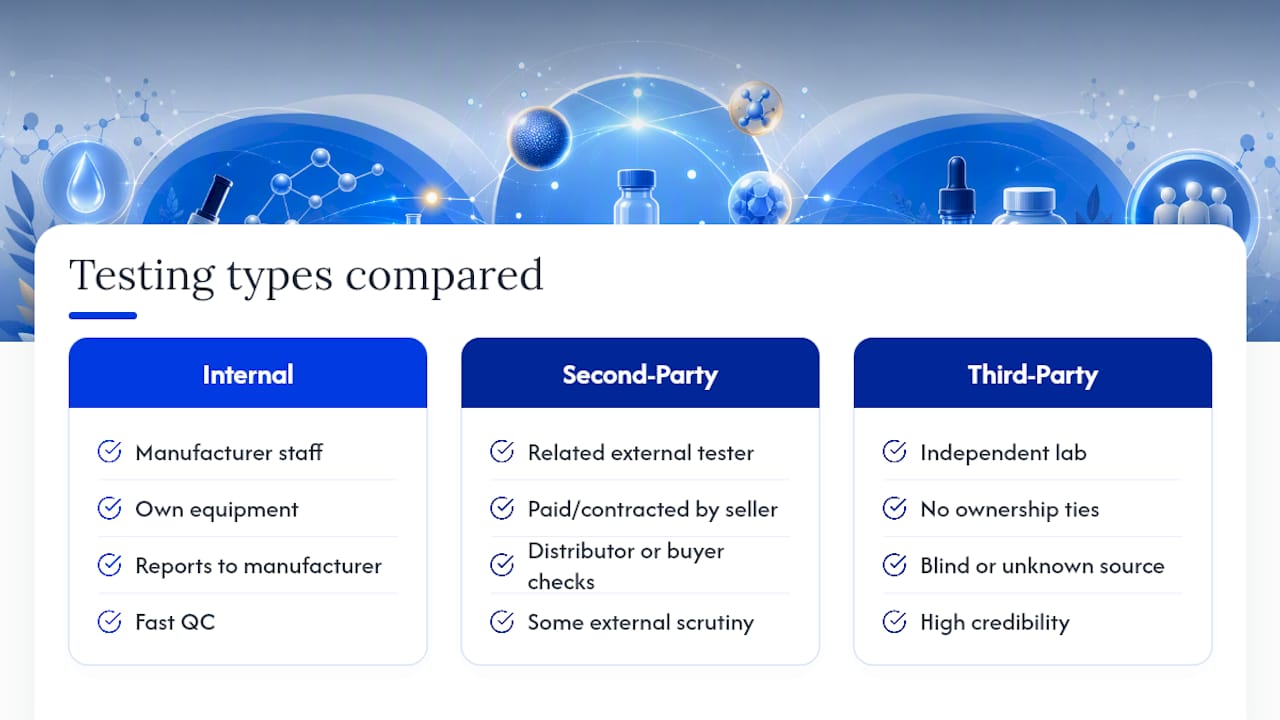
Internal testing is quality control run by the manufacturer’s own staff, using the manufacturer’s own equipment, reporting to the manufacturer’s own management. It’s fast and useful for catching production errors early, but it carries an obvious conflict of interest when used as proof of quality to an outside buyer.
Second-party testing sits in the middle. It’s testing done by, or on behalf of, a party with a direct business relationship to the manufacturer, a contracted lab paid by the seller, a distributor’s in-house check, or a buyer’s own verification before accepting a shipment. It’s more credible than pure internal testing because someone outside the manufacturing chain is looking at the sample, but the financial relationship between the tester and the tested party still creates room for selective reporting.
Third-party testing removes that relationship entirely. The lab has no ownership stake, no contract tied to favorable results, and often no knowledge of who ultimately manufactured the product. That’s the independence criterion NIST’s definition centers on, and it’s why regulators like the CPSC specifically require CPSC-accepted labs rather than accepting any lab a manufacturer chooses.
The practical takeaway for buyers: ask which category a COA falls into before trusting it. A glossy report from a lab the seller pays directly and controls the sample chain for isn’t automatically worthless, but it’s not equivalent to a blind, independently sourced result. When the stakes are high, whether that’s a supplement going on retail shelves or a compound going into a published study, insist on the third-party version and verify it independently rather than taking the label at face value.
Where Third-Party Testing Falls Short
Independent testing isn’t a guarantee of perfection, and treating it that way sets buyers up for false confidence. The most common gap is scope mismatch: a lab can run a flawless HPLC purity test and still miss a contaminant nobody asked it to check for.
False negatives happen too, though not usually because a lab is careless. Detection limits vary by method and by equipment calibration, so a contaminant present below a lab’s detection threshold won’t show up on the report even though it’s technically there. This is why the accreditation scope matters as much as the accreditation itself: a lab accredited for one sensitivity range on one instrument might miss what a more sensitive setup would catch.
Sample handling introduces another gap. A COA only proves what that specific sample, at that specific time, measured. If a lot degrades in shipping, gets contaminated after testing, or simply isn’t the same batch as what’s currently on a shelf, the COA is technically accurate and practically useless. This is the core reason lot matching matters more than most buyers realize; a beautiful report attached to the wrong batch number is worse than no report at all, because it creates false confidence.
Timing is the last blind spot. A single test at one point in time doesn’t account for degradation over a product’s shelf life. Materials tested fresh out of synthesis can behave differently six months later, which is part of why periodic or material-change re-testing exists in regulated categories rather than a one-time check being considered sufficient forever.
How Testing Documentation Shapes Recalls and Liability
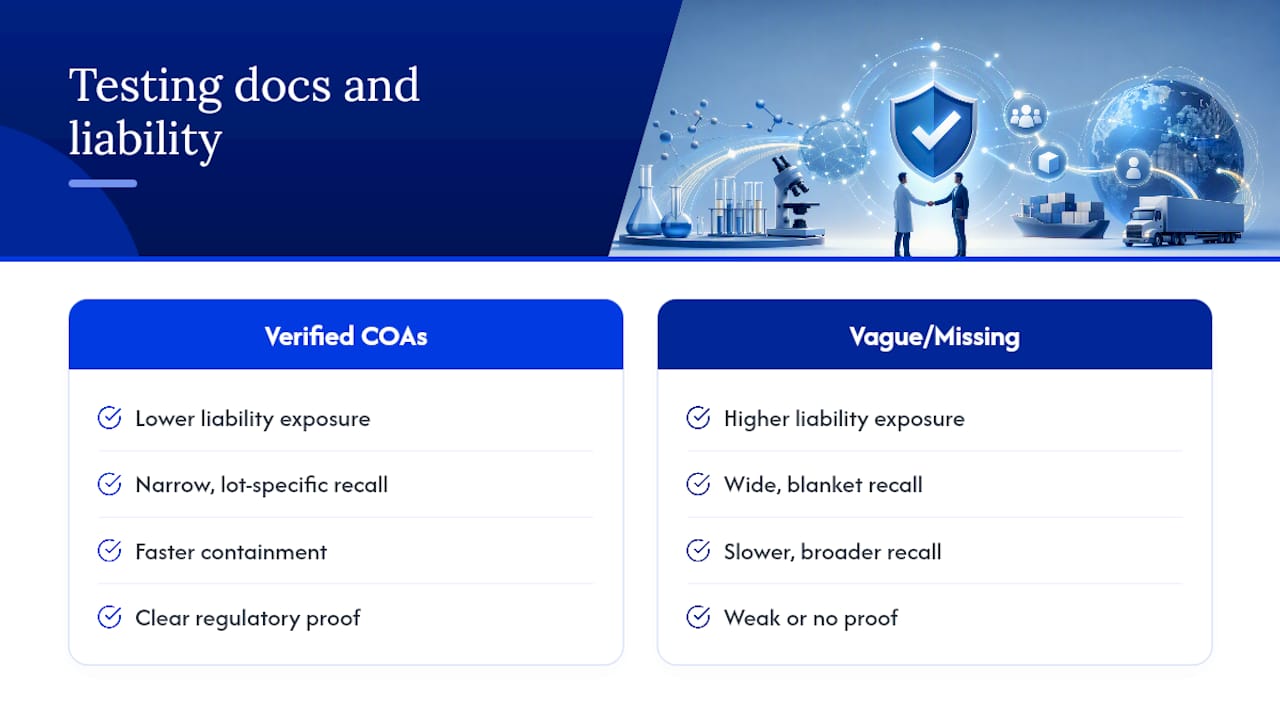
When a product fails in the field, the first document regulators and attorneys ask for is the testing paper trail. A company with lot-matched, independently verified COAs on file can typically demonstrate it took reasonable steps to verify quality before shipping, a fact that materially affects liability exposure if something goes wrong downstream.
Recalls move faster and stay narrower when testing records are specific. If a COA is tied to an exact lot number, a problem discovered in one batch can be isolated to that batch rather than triggering a blanket recall across every unit a company has ever sold. Vague or missing lot documentation forces a wider, more expensive recall because there’s no way to prove which units are actually affected.
The CPSC’s mandatory testing framework for children’s products exists largely because of this dynamic. A Children’s Product Certificate tied to a passing third-party test result gives regulators a clear standard to check against, and gives the manufacturer a defensible record if a claim is made after the fact. Without that record, a company is relying entirely on its own word.
For businesses buying research materials or supplements to resell, the same logic applies on a smaller scale. Retailers that ask for third-party documentation aren’t being bureaucratic; they’re protecting themselves from inheriting liability for a supplier’s quality failure. A buyer who skips that step and later discovers a contamination issue has far less legal and reputational cover than one who insisted on independent verification up front and kept the paperwork on file.
Industries Where Independent Testing Is Non-Negotiable
Some categories carry consequences severe enough that skipping independent verification isn’t a reasonable cost-saving move.
Children’s products sit at the top of that list because federal law mandates it, not just industry best practice. Infant formula, toys, and children’s apparel all fall under CPSC oversight specifically because the population at risk can’t evaluate the product themselves.
Dietary supplements and nutraceuticals are close behind. The FDA’s compliance framework under 21 CFR Part 111 puts the identity and purity burden on manufacturers, and the supplement industry’s history of contamination issues has made third-party testing close to a market requirement rather than a differentiator.
Research-grade peptides and laboratory compounds carry a version of the same risk in a smaller, more specialized market. A researcher building a protocol on a compound that turns out to be misidentified or under-pure has wasted time, money, and potentially compromised results that were meant to be reproducible or published.
Injectable and sterile-use materials add endotoxin and sterility testing to the list of non-negotiables, since a contamination issue in that category isn’t a quality complaint, it’s a safety event. Cosmetics and topical products, food ingredients, and pharmaceutical intermediates round out the categories where the cost of skipping verification routinely exceeds the cost of paying for it.
How to Choose a Lab That Actually Covers Your Needs
Picking a lab starts with matching accreditation scope to the exact tests you need, not just checking whether a lab holds accreditation in general. A lab can be legitimately accredited under ISO/IEC 17025 and still lack scope coverage for the specific method your product requires, which is the single most common mismatch buyers overlook.
Start by listing every property you need verified, purity, identity, sterility, heavy metals, and check that each one appears explicitly in the lab’s published scope of accreditation, not just its marketing page. A lab that lists “purity testing” broadly without naming HPLC specifically may be running a less rigorous method than you assume.
Confirm the lab is accepted for your specific regulatory category if one applies. A lab that’s excellent at general chemical analysis isn’t automatically a CPSC-accepted laboratory, and using an unaccepted lab for a children’s product doesn’t satisfy the legal requirement no matter how good the science is.
Ask about sample handling and blind testing options. A lab willing to accept blind samples, meaning it doesn’t know what result you expect or who manufactured the product, gives you a cleaner signal than one that only tests disclosed samples where bias can creep in unintentionally.
Finally, check whether the lab publishes verifiable reports, ones with report numbers, dated signatures, and either a public lookup tool or a phone number that reaches a real person who can confirm the document’s authenticity. A lab that resists this kind of verification is telling you something, even if it never says it directly.
What Actually Moves the Needle on Verification
Three habits separate people who catch problems from people who get burned by them. First, insist on lot-matched COAs, not generic ones. A report that doesn’t tie to your specific batch number is a marketing document, not a verification document. Second, check accreditation scope against the exact method listed, not just whether the lab holds accreditation somewhere. Third, call the lab. A five-minute phone call confirming a report number is real catches more fraud than any amount of reading fine print.
— Mitch
Get Research-Grade Peptides With Lot-Matched Testing You Can Verify
Synthrolab batch-tests every compound and ties each Certificate of Analysis to a specific lot number, so the report in your hand matches the product on your bench instead of a generic reference sample from somewhere else in the supply chain.
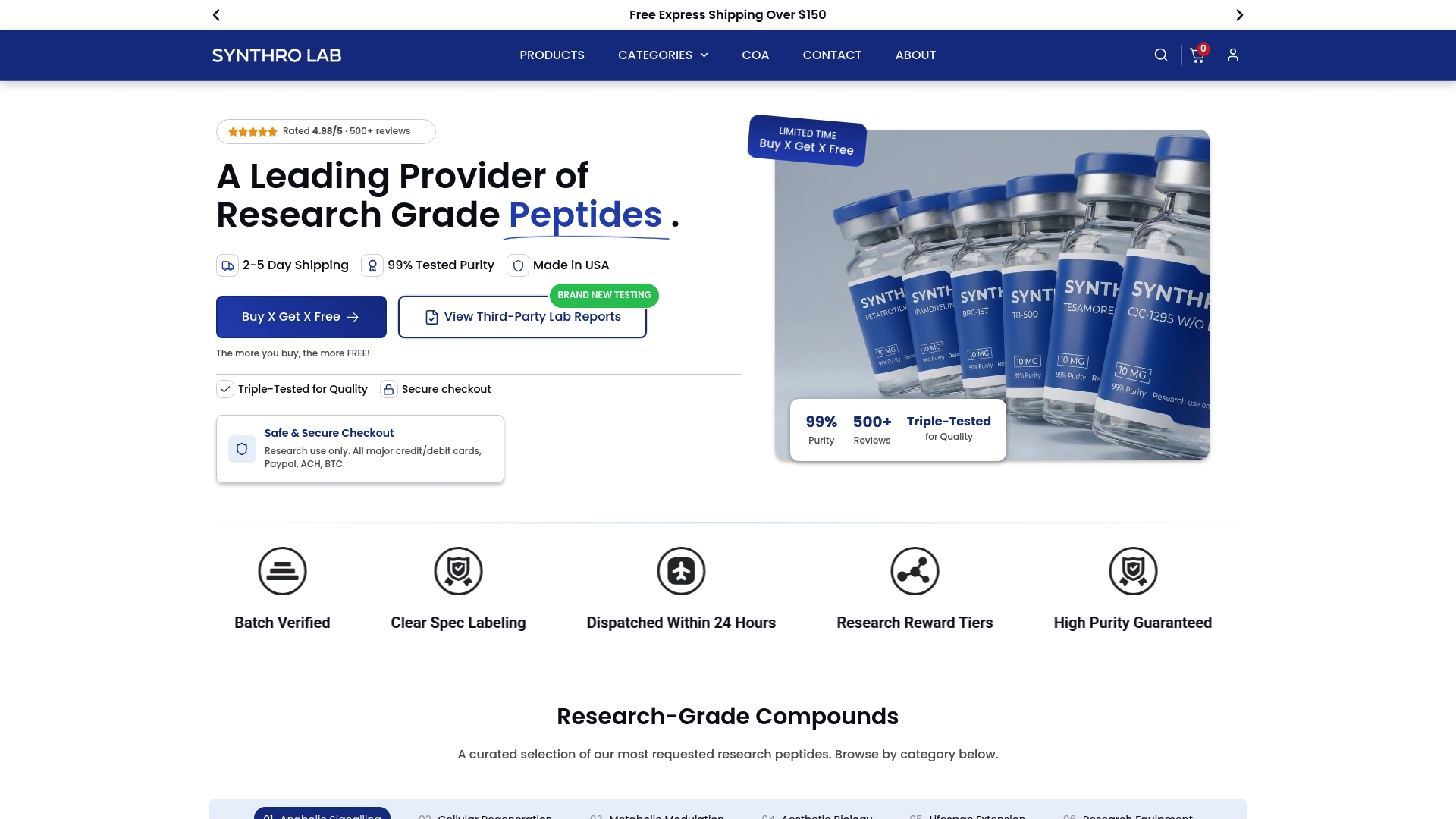
That traceability is the difference this article has been building toward: independent verification only means something when you can match the paperwork to the product. Every order ships with shipping protection to guard sample integrity in transit, and the COA page lets you check methods and lot numbers before you commit a sample to your protocol. If sourcing research-grade peptides for cellular signaling or metabolic research, start with the peptide quality guide to learn about documentation of purity and identity, then review a lot’s COA before ordering.
Sources
Recommended
 21+ verification