Telomere length research gives scientists three things they didn’t have thirty years ago: a measurable biomarker for biological aging, a genetically validated set of disease targets, and early evidence for interventions that might slow cellular decline. That’s the direct payoff. The evidence base is uneven, though. Mendelian randomization studies now support causal links between telomere length and specific cancers and cardiovascular outcomes, but the leap from “genetically shorter telomeres predict earlier mortality” to “a therapy that lengthens telomeres will extend your life” remains unproven and, in some cases, actively risky.
Here’s what the research actually delivers:
- A biomarker with genuine predictive power. Large biobank studies tie shorter leukocyte telomere length to measurable differences in life expectancy.
- A causal, not just correlational, disease map. Mendelian randomization separates telomere length from confounders like smoking and stress, revealing which disease links are real.
- A translational target with a catch. Preclinical telomerase-activation studies show healthspan gains in animals, but longer telomeres also raise cancer risk in humans.
Measurement method matters enormously here, and so does understanding why the shortest telomere in a cell, not the average, often drives the biology. Both get covered in detail below.
Key Takeaways
Telomere-length research provides a genetically validated, causally supported biomarker for disease risk, but translating that insight into safe human therapies remains unresolved because longer telomeres also raise cancer risk.
| Point |
Details |
| Biomarker with real predictive power |
UK Biobank data ties >1 SD shorter telomere length at 40 to about 2.5 years lower life expectancy. |
| Causality confirmed, not just correlation |
Mendelian randomization across 310 outcomes shows both protective and harmful causal links, not a uniform pattern. |
| Measurement method changes conclusions |
qPCR suits large cohorts; STELA and Telo-seq resolve the shortest telomere for mechanistic questions. |
| Longer telomeres carry real cancer risk |
Genetically longer telomere length is linked to elevated risk for melanoma, glioma, and osteosarcoma. |
| Lifestyle effects are real but modest |
Smoking, BMI, and alcohol influence telomere length, but mediation of lifespan effects is limited and trait-specific. |
Table of Contents
What Are Telomeres, and Why Does Their Length Matter?
Telomeres are repetitive DNA sequences capping the ends of chromosomes, protecting genetic material the way a shoelace aglet keeps a lace from fraying. Every time a cell divides, telomeres shorten slightly. Once they hit a critical threshold, the cell typically stops dividing (senescence) or self-destructs, which is a built-in defense against uncontrolled replication.
A protein complex called shelterin binds to telomeric DNA and keeps chromosome ends from being mistaken for damaged DNA needing repair. Without shelterin, cells trigger DNA-damage alarms constantly, leading to genomic instability. Telomerase, an enzyme that rebuilds telomeric DNA, is active in stem cells and germ cells but largely switched off in most adult somatic tissue, which is precisely why telomeres shorten over a lifetime in the first place.
One distinction researchers increasingly treat as non-negotiable: mean telomere length across a cell population is not the same signal as the length of the single shortest telomere in that population. Emerging single-molecule assays show it’s often that one critically short telomere on an individual chromosome arm, not the average, that triggers senescence. A cell can carry a perfectly respectable average length and still be pushed into senescence by one outlier.
- Telomeres protect chromosome ends from degradation and improper repair signaling.
- Shelterin proteins prevent chromosome ends from triggering false DNA-damage responses.
- Telomerase rebuilds telomere length but is inactive in most adult tissues.
- Shortest-telomere length, not population average, may better predict cellular fate.
Pro Tip: If you’re designing a mechanistic study rather than a population survey, don’t default to average telomere length as your primary readout. The shortest-telomere metric tends to correlate more tightly with senescence onset, and ignoring it can mask the effect you’re actually looking for.
What the Evidence Shows: Observational Data, Mendelian Randomization, and Population Genetics
Observational studies have linked shorter telomere length to cardiovascular disease, metabolic syndrome, select neurodegenerative conditions, and reduced pulmonary function for over two decades. The problem with observational data alone is confounding: people with shorter telomeres also tend to smoke more, exercise less, and carry more chronic stress, so it’s never clear whether telomere length is a cause or simply a passenger.
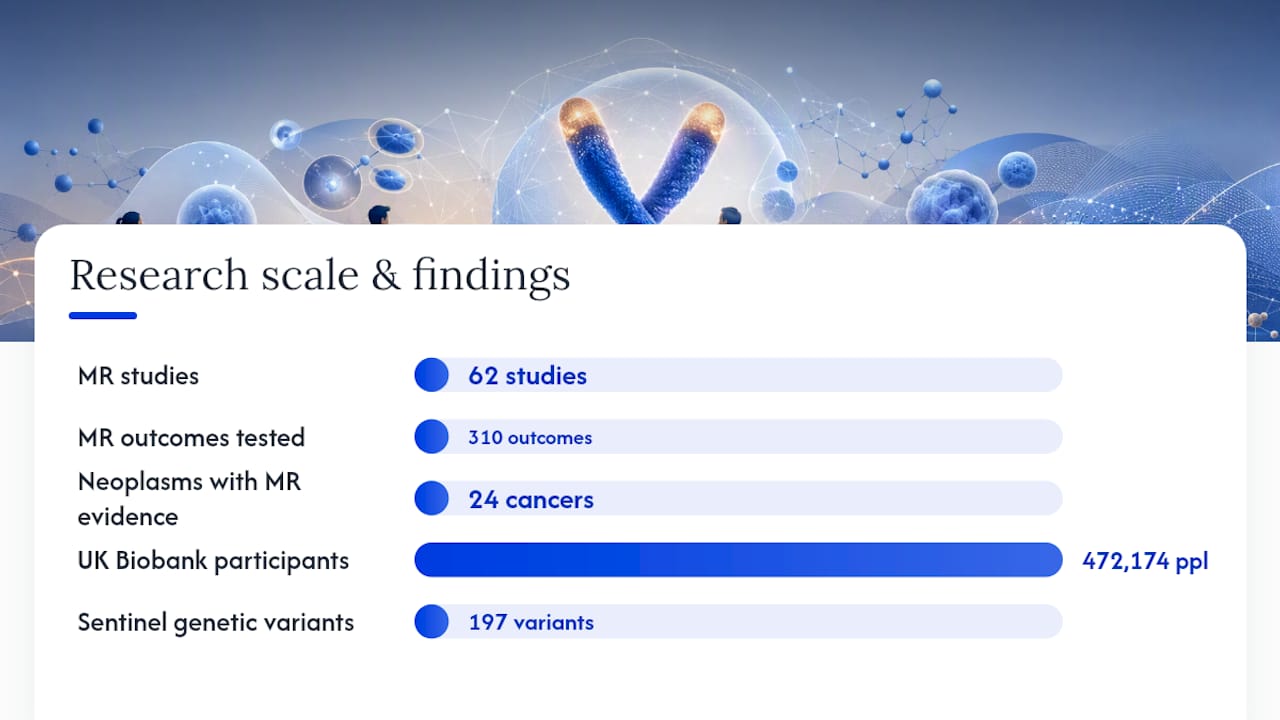
Mendelian randomization (MR) solves part of that problem by using genetic variants associated with telomere length as a proxy, since your inherited genetic variants aren’t influenced by your smoking habits or job stress. A systematic review and meta-analysis covering 62 MR studies and 310 distinct outcomes found robust evidence linking genetically determined leukocyte telomere length to 24 different neoplasms and multiple nonneoplastic conditions, with associations running in both directions depending on the disease. Longer genetically determined telomere length raised risk for several cancers, while shorter length showed an inverse relationship with coronary heart disease risk in some analyses. That bidirectionality is the single most important nuance in this entire field: telomere length isn’t uniformly “good when long” or “bad when short.” It depends entirely on the outcome you’re asking about.
Population-genetics work adds scale to that picture. A UK Biobank analysis of 472,174 participants identified 197 sentinel genetic variants across 138 loci tied to leukocyte telomere length, and estimated that people with telomere length more than one standard deviation shorter than average at age 40 had roughly 2.5 years lower life expectancy than those with telomere length one standard deviation longer.
Multivariable MR work has also mapped a bidirectional network between lifestyle traits and telomere length: smoking, body mass index, and alcohol intake both influence telomere length and are partly mediated by it, though the mediation proportions are modest and vary substantially by trait. Don’t expect telomere length to explain most of the lifespan effect of any single behavior. It’s one variable in a crowded causal network, not the master switch.
- Observational studies flag associations; they cannot establish causation on their own.
- MR studies confirm causal links for specific outcomes, some protective, some harmful.
- UK Biobank data ties telomere length variation to measurable life-expectancy differences.
- Lifestyle factors both shape and are partly explained by telomere length, but mediation is limited.
How Researchers Measure Telomere Length, and Where the Limits Are
Choosing an assay is not a minor technical footnote. It determines what question you can actually answer.
- Quantitative PCR (qPCR). The workhorse of large population studies because it’s cheap and scalable, but it measures relative average length across all chromosomes pooled together, losing resolution on any single short outlier.
- Southern blot (terminal restriction fragment analysis). Considered a historical gold standard for absolute length measurement, though it requires more DNA and higher labor input than qPCR, limiting its use in large cohorts.
- Fluorescence in situ hybridization (FISH), including quantitative FISH (Q-FISH). Allows chromosome-by-chromosome visualization, useful for cytogenetic and cell-biology work, though throughput is lower than PCR-based methods.
- STELA and Telo-seq. Provide nucleotide-level, chromosome-arm-specific resolution, making them the preferred choice when the shortest telomere is the biological question, not the population average.
DNA extraction method and tissue type introduce their own confounders. A meta-analysis pooling 414 study samples and 743,019 individuals found telomere shortening is nonlinear across the lifespan, with median shortening rates of about 23 base pairs per year in cross-sectional data and 38 base pairs per year in longitudinal data, and noted that measurement method and tissue type materially shift the telomere-age correlation. Blood-derived leukocyte DNA remains the most common sample source, but it doesn’t necessarily reflect telomere dynamics in other tissues like skin or muscle.
Pro Tip: Match the assay to the question, not the budget. If you’re running a large epidemiological cohort, qPCR or sequencing-based methods make sense. If you’re chasing a mechanistic hypothesis about senescence triggers, STELA or Telo-seq will give you the resolution qPCR simply cannot.
Do Interventions That Target Telomeres Actually Work?
The honest answer is: partially, and mostly in animals so far. Preclinical work on telomerase gene therapy and small-molecule telomerase activation has produced measurable healthspan and lifespan extension in mouse models, but researchers reviewing this literature consistently flag the same translational gap: what works safely in a mouse doesn’t automatically translate to a human, particularly given the carcinogenesis risk that comes with reactivating telomerase in tissues where it’s normally silenced.

Pharmacologic telomerase activators exist and have been studied in small early-phase human contexts, but robust, adequately powered clinical trials establishing safety and efficacy for healthspan outcomes are still lacking. That’s a meaningfully different evidence tier than the population-genetics findings covered earlier: MR and UK Biobank data describe what naturally occurring telomere length variation predicts, while intervention data describes what happens when you deliberately manipulate it, and the second category carries far more uncertainty.
Lifestyle and behavioral factors show more consistent, if modest, signals:
- Smoking cessation is associated with slower telomere attrition rates in longitudinal cohorts.
- Regular aerobic exercise correlates with longer leukocyte telomere length in multiple observational studies.
- Chronic psychological stress and sustained cortisol elevation associate with accelerated telomere shortening.
- Alcohol intake and elevated body mass index both show bidirectional relationships with telomere length, per multivariable MR analyses.
None of these lifestyle levers move telomere length dramatically on their own. Think of them as contributing factors within a larger, still partially mapped causal network, not standalone interventions capable of reversing biological age by themselves.
For researchers working at the mechanistic end of this question, testing how specific signaling peptides influence senescence pathways or mitochondrial function can complement telomere-length data. Synthrolab’s archive on senescent cells, SASP, and related therapies covers the downstream biology that shortened telomeres ultimately trigger.
The Telomere Paradox: When Longer Isn’t Better
Here’s the part that surprises people outside the field: telomere length research doesn’t support a simple “longer is healthier” model. Genetically determined longer telomere length is associated with increased risk for several specific cancers, including melanoma, glioma, and osteosarcoma, in Mendelian randomization analyses. That’s not a fringe finding. It shows up consistently enough across MR studies that researchers now treat it as one of the field’s central trade-offs.
The mechanism is straightforward once you think it through: a cell’s replicative lifespan is partly capped by telomere attrition, since senescence acts as a brake on uncontrolled division. Cells with longer telomeres retain more replicative potential, which is exactly the property a cell needs to become cancerous. Clinical case reports have described families with unusually long telomeres developing both benign and malignant tumors along with clonal blood cell expansions, prompting researchers to reconsider ultra-long telomeres as a genuine health signal rather than an unambiguous marker of youth.
Longer telomeres aren’t a fountain of youth. In certain genetic and tissue contexts, they’re a mechanism that removes one of the body’s natural checks against runaway cell division.
- Genetically longer telomeres associate with elevated risk for melanoma, glioma, and osteosarcoma.
- Extended replicative capacity is a double-edged trait: useful for tissue repair, dangerous for tumor suppression.
- Trial designs targeting telomere extension need built-in cancer surveillance and long-term follow-up, not just short-term safety checks.
How Telomere Length Data Gets Used in Research Today
Right now, telomere length functions mainly as a research tool rather than a clinical decision-making metric, and that distinction matters. It shows up in cohort studies as an exposure or outcome variable, in risk-prediction models alongside other biomarkers, and increasingly as an exploratory endpoint in early-phase longevity trials.
It is not yet validated for individual clinical decisions like adjusting a patient’s screening schedule based on a single telomere-length test. Variability between labs, tissue types, and assay platforms remains too high, which is why the Telomere Research Network has pushed for standardized reporting of extraction method and tissue source alongside every measurement.
- Cohort and epidemiological studies use LTL as an exposure or outcome variable to map disease risk.
- Early-phase longevity and senolytic trials use telomere-length change as an exploratory, not primary, endpoint.
- Standardized extraction and tissue-reporting protocols remain a priority for cross-study comparability.
- Integrating LTL with other aging biomarkers (epigenetic clocks, inflammatory markers) is an active research priority, not a solved problem.
Where Synthrolab Fits Into Telomere and Longevity Research
Synthrolab supplies research-grade peptides and laboratory compounds with independent batch testing and certificates of analysis, built for exactly this kind of mechanistic work. Researchers studying senescence pathways, mitochondrial function, or cellular-repair mechanisms adjacent to telomere biology can draw on the lifespan-extension research archive and peptide resources like the GHK-Cu research collection, which touches on cellular-repair pathways relevant to aging studies.
- Batch-tested research peptides with certificates of analysis for reproducibility.
- Reconstitution solutions and lab equipment to support assay setup.
- Documentation resources, including a guide to interpreting lab research findings, for teams building out telomere-adjacent protocols.
Pro Tip: Pair lab-grade reagents with a measurement protocol you’ve validated in advance. The methodological literature is clear that extraction method and tissue type shift your results, so lock down your assay choice before you commit reagent budget to a study.
Ready to Support Your Longevity Research?
Telomere biology doesn’t operate in isolation. It intersects with senescence, mitochondrial function, and cellular-repair signaling, all areas where the compound you choose for a mechanistic study matters as much as the assay you run. Synthrolab’s research-grade peptide catalog is built for researchers who need batch-tested purity and documented certificates of analysis, not consumer-grade guesswork. If you’re mapping cellular-repair pathways alongside telomere dynamics, the GHK-Cu, BPC-157, and TB-500 combination is one option worth reviewing for mechanism-focused study designs.
The Case for Taking This Seriously, Not Literally
The strongest case this research makes isn’t for telomere length as a wellness metric. It’s for Mendelian randomization as the method that finally separates real causal signals from decades of confounded observational noise. That’s the part researchers should weight most heavily, and it’s also the part popular coverage tends to skip in favor of the simpler “shorter telomeres equal faster aging” narrative.
Where conventional advice falls short is in treating telomere length as a single dial you can turn. It’s not. The same genetic variants that shorten your risk for coronary disease can raise your risk for melanoma. That’s not a footnote, it’s the central finding of this field, and it should shape how skeptically anyone reads a telomerase-activator claim.
If you’re a researcher, prioritize measurement rigor before intervention enthusiasm. Match your assay to your question, report your extraction method, and treat any therapeutic claim about telomerase activation as preliminary until human cancer-surveillance data catches up with the mouse studies.
Frequently Asked Questions
What are the main benefits of telomere length research for human health?
The benefits of telomere length research include a genetically validated biomarker for biological aging, causal evidence linking telomere biology to specific diseases through Mendelian randomization, and early therapeutic targets for slowing cellular senescence, though clinical translation remains limited.
Can telomere length actually extend lifespan if you lengthen it artificially?
Not reliably in humans yet. Preclinical studies show lifespan gains from telomerase activation in animal models, but human application is constrained by cancer risk, since longer telomeres also raise replicative potential in cells that shouldn’t keep dividing.
How do telomeres affect aging at the cellular level?
Telomeres shorten with each cell division until they hit a critical threshold, triggering senescence or cell death. This acts as a natural limit on cell replication, but the shortest single telomere in a cell, not the average, often determines when that limit is reached.
Why do researchers study telomere length instead of just tracking chronological age?
Chronological age doesn’t capture individual variation in biological aging rate. Telomere length, especially when analyzed through Mendelian randomization, offers a way to separate genuine causal aging mechanisms from lifestyle confounders like smoking or stress.
What is the biggest risk associated with telomere length research and interventions?
The clearest risk is the telomere paradox: genetically longer telomere length is associated with increased risk for cancers including melanoma, glioma, and osteosarcoma, meaning any intervention that lengthens telomeres needs rigorous cancer surveillance built into its design.
This article is general information, not a substitute for advice from a qualified doctor. Consult a qualified healthcare professional about your own circumstances before acting on anything here.
Sources
Recommended
 21+ verification