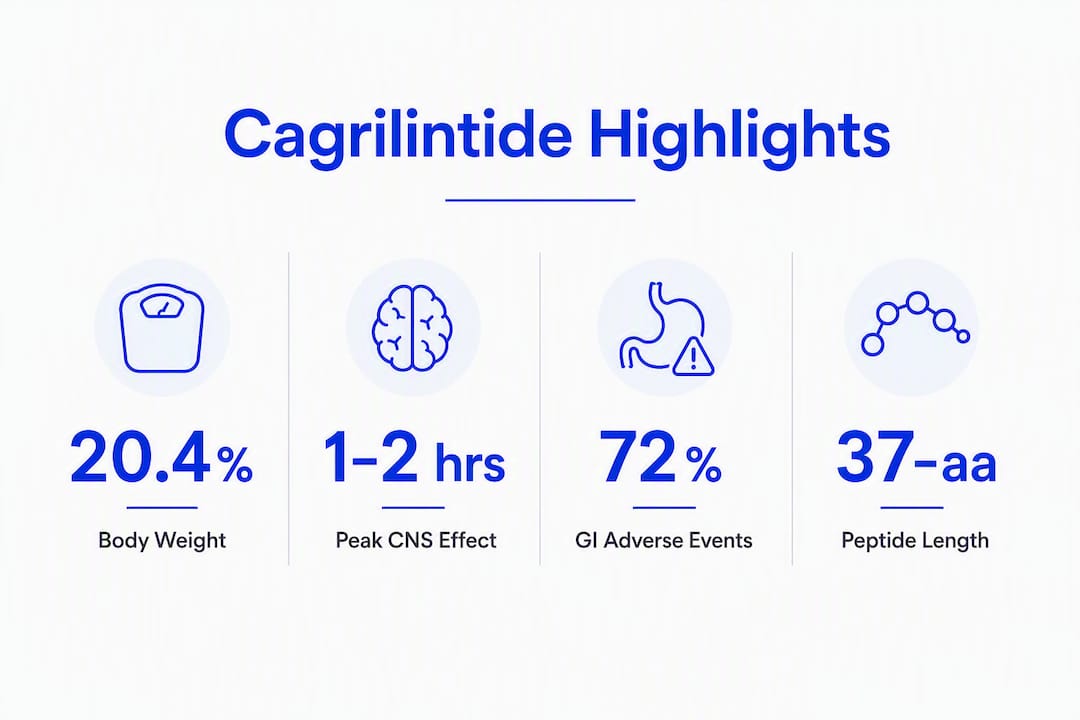
Cagrilintide is a long-acting acylated amylin analog that acts as a non-selective dual agonist at amylin receptor subtypes AMY1–3 and the calcitonin receptor (CTR). In phase 3 trials, its combination with semaglutide (CagriSema, 2.4 mg each once weekly) produced a mean body-weight reduction of 20.4% at week 68 versus 3.0% for placebo (n=3,417; P<0.001), the largest mean weight loss reported in a phase 3 obesity trial to date. Three things researchers need to know immediately:
-
Efficacy: CagriSema’s 20.4% mean weight reduction exceeds what semaglutide or tirzepatide monotherapy achieved in their respective pivotal trials, driven by additive amylin/GLP-1 mechanisms.
-
Dominant AE class: Gastrointestinal adverse events (nausea, vomiting, constipation) affect the majority of participants on combination therapy and are the primary tolerability challenge to build into any protocol.
-
Regulatory status: Cagrilintide and CagriSema remain investigational in the United States. Neither is FDA-approved for general clinical use; all research use requires RUO-grade material and appropriate institutional approvals.
Synthrolab supplies research-grade cagrilintide with batch-specific certificates of analysis (COA) for investigators working in metabolic and obesity-related research. Semaglutide and tirzepatide appear throughout this guide as clinical comparators.
Table of Contents
What does the cagrilintide peptide actually do at the receptor level?
Cagrilintide’s pharmacology starts at two receptor families. Amylin receptors (AMY1, AMY2, AMY3) are heterodimers formed by the calcitonin receptor paired with receptor activity-modifying proteins RAMP1, RAMP2, and RAMP3, respectively. Cagrilintide engages all three subtypes without selectivity, plus the CTR itself, making it a dual amylin/calcitonin receptor agonist (DACRA). Cryo-EM structural work published in Nature Communications shows it induces distinct conformational dynamics at calcitonin-family receptors compared to native amylin, which likely underlies its superior clinical potency.
The downstream physiology matters for study design. AMY/CTR signaling in the area postrema and nucleus tractus solitarius suppresses appetite and reduces food intake. Gastric emptying slows, glucagon secretion falls, and energy intake decreases. These effects are mechanistically distinct from GLP-1 receptor agonism (semaglutide’s primary pathway) and from the dual GIP/GLP-1 mechanism of tirzepatide. Pairing cagrilintide with semaglutide therefore engages complementary satiety circuits, which is why combination therapy produces additive effects on appetite regulation and metabolic outcomes.
Key pharmacodynamic markers to measure in mechanistic studies:
- Food intake (24-hour recall or metabolic chamber)
- Gastric emptying rate (acetaminophen absorption or scintigraphy)
- Fasting and postprandial glucagon
- c-Fos immunoreactivity in area postrema and NTS nuclei
- Plasma insulin and glucose during mixed-meal tolerance tests
Pro Tip: Amylin-specific CNS effects peak within 1–2 hours of injection in rodent models. Schedule c-Fos tissue collection and acute food-intake measurements within that window; collecting at 4–6 hours will underestimate CTR-mediated brainstem activation and conflate it with the slower GLP-1 satiety arc.
Chemical structure, acylation, and pharmacokinetics you need for study design
Cagrilintide’s backbone is a 37-amino acid amylin analog. The critical engineering difference from native human amylin is a C18 fatty diacid attached via a glutamic acid linker, which enables reversible albumin binding and dramatically extends circulating half-life. Additional residue substitutions, including a P37 modification and an intra-peptide ionic lock, stabilize the bypass conformation at CTR and reduce aggregation risk.

The result: a reported half-life of approximately 160–195 hours in research models, compared to native amylin’s roughly 13-minute half-life. Once-weekly subcutaneous dosing follows directly from that PK profile. In phase 2 and phase 3 trials, the dose used in combination arms was 2.4 mg subcutaneously once weekly, titrated over approximately 16 weeks to the maintenance dose. Steady state requires several weeks of dosing, which has direct implications for when to schedule PK/PD sampling in longitudinal studies.
Practical PK notes for researchers:
-
Route: Subcutaneous injection; abdominal, thigh, or upper arm sites used in trials
-
Dose (phase 2/3 combination): 2.4 mg cagrilintide + 2.4 mg semaglutide once weekly
-
Time to steady state: Multiple weeks; plan PK sampling to span both early titration and steady-state windows
-
Formulation: Lyophilized powder for research-grade material; reconstitute in sterile water or acetic acid buffer per supplier COA guidance
-
Storage: Lyophilized powder at −20°C or lower; avoid repeated freeze-thaw cycles after reconstitution
Pro Tip: For PK sampling in research studies, immunoassay-based detection of cagrilintide can cross-react with endogenous amylin fragments. LC-MS/MS offers better specificity for quantifying the intact acylated peptide and its deacylated metabolite separately. Build the assay validation into your study timeline before the first dosing visit.
What do the phase 2 and phase 3 trials actually show?
The headline number is the 20.4% mean weight reduction with CagriSema (2.4 mg each) at week 68 in the non-diabetic overweight/obesity population (n=3,417; P<0.001). In the parallel trial enrolling adults with type 2 diabetes, the combination arm produced −13.7% mean weight change at week 68, with HbA1c reductions of up to −2.33 percentage points over 40 weeks as an add-on to insulin. The REIMAGINE 1 phase 3a study in early-stage type 2 diabetes (n=189; 40 weeks) reported a mean HbA1c change of −1.8 percentage points with CagriSema 2.4 mg each versus −0.1 percentage points for placebo (treatment difference −1.7 pp; 95% CI −2.0 to −1.3; P<0.0001), alongside a −13.8% mean body-weight change.
Key figure: CagriSema 2.4 mg each produced a mean body-weight reduction at week 68 substantially greater than placebo (P<0.001) in the pivotal non-diabetic phase 3 trial.
| Trial / Arm |
N |
Mean % Weight Change |
HbA1c Change |
GI AE Incidence |
| CagriSema 2.4 mg (non-diabetic, wk 68) |
3,417 |
−20.4% |
N/A |
~79.6% |
| CagriSema 2.4 mg (T2D, wk 68) |
Not reported separately |
−13.7% |
Up to −2.33 pp |
Majority |
| REIMAGINE 1 CagriSema 2.4 mg (T2D, wk 40) |
— |
−13.8% |
−1.8 pp |
79% |
| Placebo (non-diabetic, wk 68) |
Matched |
−3.0% |
N/A |
~34–40% |
For sample-size planning: the 17+ percentage-point treatment difference in the non-diabetic trial gives investigators substantial power at moderate N for mechanistic endpoints. Glycemic endpoints in diabetic populations require longer durations and careful stratification by baseline HbA1c.
What safety signals should researchers build into their protocols?
Gastrointestinal adverse events are the dominant safety finding across all cagrilintide and CagriSema trials. In the pivotal non-diabetic phase 3 trial, GI AEs occurred in approximately 72–79.6% of participants on combination therapy versus 34–40% on placebo. Nausea, vomiting, constipation, and diarrhea account for most events. Critically, the majority are classified as mild-to-moderate and tend to cluster during the titration phase, not at maintenance.

Serious GI events and discontinuations occur but are less common. Hypoglycemia risk is low in non-diabetic populations but warrants monitoring when cagrilintide is combined with insulin or sulfonylureas in diabetic study arms. Standard clinical precautions apply for participants with a history of pancreatitis, severe gastroparesis, or pregnancy; these populations are typically excluded from trials.
Protocol-level safety monitoring checklist:
- Pre-specified GI AE grading using CTCAE criteria at each visit
- Dietary counseling initiated at enrollment, not at first AE report
- Antiemetic rescue plan documented in the protocol before dosing begins
- Fasting glucose and insulin at each visit when combining with insulin secretagogues
- Pancreatic enzyme monitoring if pancreatitis risk factors are present
Pro Tip: Conservative titration schedules are the single most effective protocol-level tool for reducing GI AE severity and dropout. Extending the titration period by 4 weeks beyond the standard schedule is a reasonable pre-specified modification for high-risk subgroups — document it as a protocol amendment before enrollment, not as a post-hoc deviation.
How does cagrilintide compare to semaglutide and tirzepatide?
The comparison below uses generic mechanism labels and sourced datapoints. No agent here is presented as categorically superior; the goal is to help researchers select comparators and interpret combination effects.
| Dimension |
Cagrilintide monotherapy |
CagriSema (2.4 mg each) |
Semaglutide monotherapy |
Tirzepatide |
| Mean % weight loss |
Modest (phase 2 data; lower than combo) |
−20.4% at wk 68 (non-diabetic) |
−13.7% at week 68 |
−13.7% at week 68 |
| HbA1c change |
Modest reduction |
Up to −2.33 pp (T2D add-on) |
~−1.5–2.0 pp (T2D trials) |
~−2.0–2.3 pp (T2D trials) |
| GI AE rate |
Lower than combo |
~72–79.6% |
72–79.6% |
72–79.6% |
| Mechanism |
Amylin/CTR agonist (DACRA) |
Amylin/CTR + GLP-1 RA |
GLP-1 RA |
GIP/GLP-1 dual agonist |
| US regulatory status |
Investigational (RUO only) |
Investigational (RUO only) |
FDA-approved (obesity/T2D) |
FDA-approved (obesity/T2D) |
The CagriSema weight-loss numbers are additive rather than purely synergistic: amylin/CTR signaling reduces food intake via brainstem satiety circuits, while GLP-1 agonism slows gastric emptying and acts on hypothalamic pathways. These are parallel, not redundant, mechanisms. For mechanistic endpoint studies, that distinction matters: a crossover design that isolates each component’s contribution to a specific biomarker (glucagon, gastric emptying rate, c-Fos density) will yield cleaner interpretable data than a parallel-group design measuring only body weight.
Preclinical models and experimental endpoints for mechanistic work
Rodent diet-induced obesity (DIO) models are the most common preclinical platform for cagrilintide. Standard readouts include body weight, cumulative food intake, oral glucose tolerance test (OGTT) area under the curve, and gastric emptying rate via phenol red or acetaminophen methods. Acute food-intake studies in lean rodents are useful for isolating CNS satiety effects from metabolic adaptations.
Dose scaling from rodents to humans requires attention to allometric differences in clearance. Cagrilintide’s albumin-binding PK means that free-fraction estimates differ across species with different albumin concentrations. Pilot PK/PD studies in the target species before committing to a full efficacy study will save significant resources.
Assays suited to mechanistic work:
- cAMP accumulation assay: Confirms receptor activation at AMY1–3 and CTR in transfected cell lines
- Receptor-binding competition assay: Quantifies affinity relative to native amylin and calcitonin
- Receptor internalization (confocal/flow): Distinguishes agonist-driven trafficking from biased signaling
- c-Fos IHC in area postrema and NTS: Maps CNS engagement after acute dosing
- Glucagon and insulin ELISA: Captures islet-level pharmacodynamics during OGTT
Pro Tip: The area postrema lacks a complete blood-brain barrier, making it accessible to peripherally administered peptides. However, cagrilintide’s albumin binding significantly reduces free-peptide concentration at the fenestrated capillaries of the area postrema. When designing CNS endpoint studies, measure both total and free plasma concentrations and correlate them with c-Fos density — otherwise you risk misattributing dose-response relationships.
Sourcing research-grade cagrilintide in the United States
Cagrilintide and CagriSema are investigational in the United States and are not FDA-approved for general clinical use. Research use requires RUO-grade material, institutional biosafety committee (IBC) approval where applicable, and compliance with your institution’s controlled-substance and peptide-handling policies. This is a concise regulatory statement, not legal advice; confirm current requirements with your IBC and compliance office.
When evaluating a supplier, request the following documentation before placing an order:
- Batch-specific COA showing purity (HPLC, target ≥95%), identity (LC-MS), and endotoxin level (LAL assay, target <1 EU/mg for in vivo use)
- Lot number, synthesis date, and recommended expiry
- Recommended reconstitution solvent and concentration
- Storage temperature specification (lyophilized: −20°C or lower; −80°C preferred for long-term)
On receipt, run your own QC before any in vivo use. A minimal QC panel:
| Test |
Method |
Acceptance Criterion |
| Identity |
LC-MS (intact mass) |
Matches theoretical MW |
| Purity |
Reverse-phase HPLC |
≥95% area |
| Endotoxin |
LAL (gel-clot or kinetic) |
<1 EU/mg (in vivo); <0.1 EU/mg (CNS use) |
| Potency |
Cell-based cAMP assay (AMY1/CTR) |
EC50 within twofold of reference standard |
For storage after reconstitution, aliquot into single-use volumes immediately. Avoid more than two freeze-thaw cycles; acylated peptides can aggregate at the air-water interface during repeated thawing. Short-term stability in solution (4°C, 24–48 hours) is generally acceptable for same-day use, but verify with your supplier’s stability data for the specific formulation.
Pro Tip: Document chain-of-custody from receipt through each experiment: supplier name, lot number, COA date, reconstitution date and solvent, aliquot ID, and storage location. This level of documentation is what separates reproducible published data from results that cannot be replicated — and it is exactly what reviewers and IBC auditors will ask for.
What research questions remain unanswered?
Despite the phase 3 data, several mechanistic and clinical gaps remain open for investigators:
- Receptor subtype contributions: Which AMY subtype (AMY1, AMY2, AMY3) drives the dominant satiety signal, and does the CTR contribution vary by tissue? Selective tools to dissect this are not yet widely available.
- Long-term cardiovascular outcomes: No dedicated CVOT data for cagrilintide or CagriSema has been published. This is the most clinically significant gap given the obesity-cardiovascular disease relationship.
- Special populations: Renal impairment alters amylin clearance; dose-adjustment guidance for moderate-to-severe CKD is not established. Elderly populations are underrepresented in current trial cohorts.
- PD biomarkers distinguishing CTR vs AMYR engagement: No validated plasma or imaging biomarker cleanly separates CTR-mediated from AMYR-mediated effects in humans. Developing one would substantially improve mechanistic trial design.
- Combinatorial regimens beyond semaglutide: Whether cagrilintide adds meaningfully to tirzepatide or other dual agonists is untested. The mechanistic rationale exists; the clinical data do not yet.
- Translational endpoint validation: Preclinical c-Fos and gastric emptying readouts have not been formally validated as surrogates for clinical weight-loss outcomes.
Priority study designs: mechanistic crossover PD studies isolating amylin vs GLP-1 contributions; long-term safety registries; stratified trials in CKD and elderly populations; and biomarker development studies pairing receptor occupancy imaging with functional endpoints.
Key Takeaways
CagriSema (cagrilintide 2.4 mg + semaglutide 2.4 mg once weekly) produced a mean 20.4% body-weight reduction at week 68 in phase 3, driven by additive amylin/CTR and GLP-1 mechanisms, with GI adverse events as the primary tolerability challenge.
| Point |
Details |
| Phase 3 efficacy (CagriSema) |
Mean −20.4% body weight reduction at week 68 vs −3.0% placebo (P<0.001; n=3,417). |
| Dominant safety signal |
GI AEs in ~72–79.6% of combination-arm participants; mostly transient and mild-to-moderate. |
| PK implications for study design |
Half-life ~160–195 hours supports once-weekly dosing; plan PK/PD sampling across titration and steady-state windows. |
| Regulatory and procurement status |
Investigational in the US (not FDA-approved); source RUO-grade material with batch COA, HPLC purity ≥95%, and endotoxin data. |
| Synthrolab research supply |
Synthrolab provides batch-tested, COA-documented research-grade cagrilintide for metabolic and obesity studies. |
Why the combination data changes how you should think about amylin research
The conventional framing of amylin analogs as modest weight-loss agents, useful mainly as insulin co-secreted peptides, does not survive the CagriSema phase 3 data. A 20.4% mean weight reduction is not an incremental improvement over GLP-1 monotherapy. It is a different magnitude of effect, and the mechanism explains why: brainstem satiety circuits engaged by amylin/CTR agonism operate largely in parallel with the hypothalamic and gastric pathways that GLP-1 agonists target. You are not getting more of the same signal; you are adding a second, anatomically distinct input.
What that means practically for researchers: mechanistic studies that treat cagrilintide as a simple add-on to GLP-1 therapy and measure only body weight will miss the most interesting biology. The CTR-specific conformational dynamics identified in cryo-EM work suggest that cagrilintide’s receptor engagement is qualitatively different from native amylin, not just quantitatively better. Designing studies that isolate those receptor-level differences, using c-Fos mapping, receptor internalization assays, and selective antagonist tools, will produce the kind of translational data the field actually needs.
The GI tolerability data should not be dismissed as a nuisance finding. The 72–79.6% GI AE rate in combination trials is a signal about the additive burden of engaging two satiety pathways simultaneously. Understanding the mechanistic basis of that tolerability ceiling, whether it is dose-dependent, receptor-subtype-specific, or driven by gastric emptying kinetics, is itself a high-value research question.
Synthrolab research-grade cagrilintide for investigators
Researchers who need RUO-grade cagrilintide for metabolic studies need a supplier whose documentation holds up to institutional review, not just one that ships quickly. Synthrolab provides research-grade peptides with batch-specific COAs covering HPLC purity, LC-MS identity, and endotoxin levels, the exact documentation your IBC and lab records require. Every batch is independently tested before it ships.
For investigators setting up a new cagrilintide protocol, Synthrolab’s metabolic modulation peptide catalog covers the compounds most relevant to obesity and metabolic research. COA documentation for each batch is available directly at Synthrolab’s COA page. If you are new to peptide procurement or need guidance on handling and storage standards, the peptide quality and testing guide covers the essentials. Place your order or request batch documentation at synthrolab.com.
Pro Tip: When starting with a newly sourced batch, run a small pilot PK/PD experiment (3–5 animals or a single cell-based cAMP dose-response) before committing the full batch to a powered efficacy study. This catches potency drift between lots and gives you a within-study reference point for interpreting your main results.
Selected primary sources for follow-up
- Coadministered Cagrilintide and Semaglutide in Adults with Overweight or Obesity (NEJM, phase 3) — Primary phase 3 efficacy and safety data for CagriSema in non-diabetic population; source for the 20.4% weight-loss figure and GI AE incidence.
- CagriSema in Adults with Overweight/Obesity and Type 2 Diabetes (NEJM) — Phase 3 data in diabetic population; source for −13.7% weight change and HbA1c outcomes.
- REIMAGINE 1 Phase 3a Study (PubMed) — Randomized trial of CagriSema in early-stage T2D; HbA1c and weight endpoints at 40 weeks.
- CagriSema as Add-On to Insulin in T2D (PubMed) — Source for the −2.33 pp HbA1c reduction and glycemic control without increased hypoglycemia.
- Structural and Dynamic Features of Cagrilintide Binding (Nature Communications) — Cryo-EM structural analysis; explains distinct CTR conformational dynamics and their pharmacological implications.
- Cagrilintide: A Long-Acting Amylin Analog for the Treatment of Obesity (PubMed) — Review covering additive amylin/GLP-1 mechanisms and rationale for combination therapy.
- PK/PD Characterization of Cagrilintide (PubMed) — Source for the 160–195 hour half-life data and PK sampling guidance.
- Synthrolab COA Documentation — Batch-specific certificates of analysis for research-grade peptide procurement.
This article is general scientific information for research purposes and does not constitute medical or legal advice. Confirm current regulatory requirements and institutional approvals with your compliance office and the FDA before initiating any research use.
Recommended
 21+ verification