Lyophilized peptides sealed and kept cold last months to years; once reconstituted, that window collapses to weeks. Sterility, not chemistry, usually sets the real deadline. Sequence and solvent shift both numbers, sometimes dramatically.
The rules of thumb researchers actually use:
- Dry, sealed, frozen at −20°C: stability commonly runs into years, particularly with proper desiccation.
- Reconstituted in bacteriostatic water, refrigerated at 2–8°C: a practical ceiling of about 28 days, driven largely by preservative sterility limits rather than raw peptide chemistry.
- Short ambient exposure during shipping: most sealed lyophilized vials tolerate a few days at room temperature without meaningful loss.
- Verification tools worth knowing: HPLC and LC–MS confirm purity and mass; a Certificate of Analysis (COA) documents batch-specific data your vendor already ran.
Peptide shelf life isn’t a fixed number stamped on a label. It’s a set of conditional rules that shift with the peptide’s sequence, the solvent you reconstitute it in, and how disciplined your lab is about temperature control.
Key Takeaways
Peptide shelf life depends on physical state, storage temperature, and sequence chemistry, with sterility rather than raw chemical stability setting the practical limit for reconstituted material.
| Point |
Details |
| Lyophilized lasts longest |
Sealed, desiccated powder at −20°C commonly remains stable for months to years. |
| Reconstituted has a shorter clock |
Bacteriostatic water solutions carry a practical 28 day discard window tied to sterility. |
| Never freeze multi-dose vials |
Aliquot into single-use cryovials before freezing to avoid ice damage and preservative redistribution. |
| Temperature excursions hurt fast |
Modest excursions can cut potency by 30 to 60 percent within weeks, per peer-reviewed data. |
| Verify before critical use |
Check the COA and run HPLC or LC–MS confirmation through resources like Synthrolab’s Alpha Peptides line before high-stakes experiments. |
Table of Contents
Peptide Shelf Life at a Glance: Temperature Tiers and Realistic Ranges
Storage conditions fall into four practical tiers, and the difference between them is not subtle.
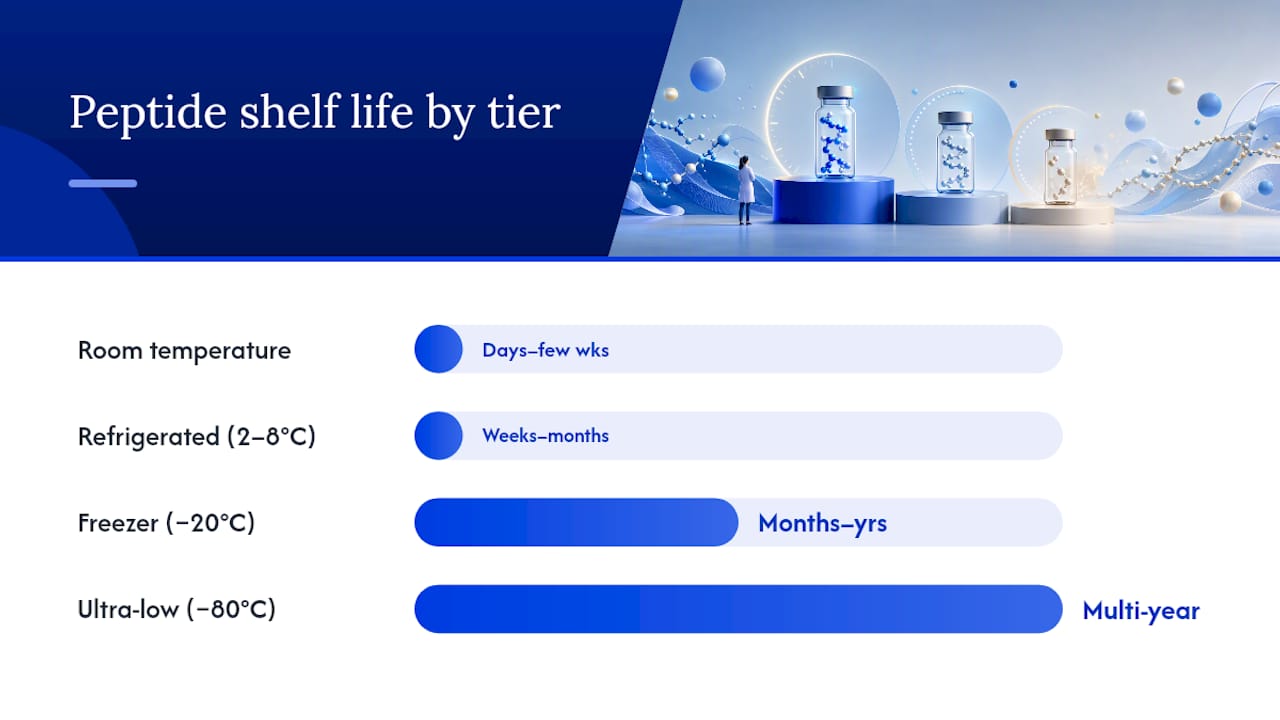
| Storage Condition |
Lyophilized (dry) |
Reconstituted (in solution) |
| Room temperature |
Days to a few weeks (short transit only) |
Hours to a few days at most |
| Refrigerated (2–8°C) |
Weeks to months |
Roughly 28 days practical limit |
| Freezer (−20°C) |
Months to multiple years |
Not recommended for original multi-dose vial |
| Ultra-low (−80°C) |
Multi-year stability documented for select vaccine peptides |
Single-use frozen aliquots only |
That 28 day figure for reconstituted material isn’t arbitrary. It traces back to the sterility limits of benzyl alcohol preservative in bacteriostatic water, not a universal chemical half-life. Some sequences hold up chemically far longer than a month; the vial still gets tossed because repeated needle punctures introduce contamination risk over time.
- Never freeze a reconstituted multi-dose vial. Ice crystal formation and preservative redistribution both degrade it.
- Treat vendor-stated shelf life as a best-case number achieved under ideal, unopened, undisturbed conditions.
Pro Tip: A vendor’s “24 months at −20°C” claim assumes an unopened vial that never left a stable freezer. The moment you open it, start your own clock.
Storing Lyophilized Peptides for Maximum Stability
Dry peptide powder is chemically forgiving because there’s almost no water available to drive hydrolysis or promote molecular mobility. Low residual moisture locks the peptide into something close to a glassy, low-reactivity state. That’s the entire reason freeze-dried material outlasts reconstituted solution by a wide margin.
Three variables matter more than any others: temperature, moisture, and light.
- Store sealed vials at −20°C for routine long-term work; reserve −80°C for peptides you won’t touch for a year or more, or sequences with known stability concerns.
- Keep desiccant packs in every storage container. Silica gel is cheap insurance against ambient humidity.
- Use a standard laboratory freezer, not a household frost-free unit. NIBSC specifically warns against frost-free freezers because automatic defrost cycles create repeated temperature swings that stress the peptide the same way freeze-thaw cycles do in solution.
- Keep vials upright and away from freezer door shelving, where temperature fluctuates most.
Watch for a collapsed or shrunken cake, a sticky residue on the vial wall, or discoloration. Any of those signs point to moisture ingress, and the safest move is to run an HPLC check before trusting that material in a critical experiment.
A peptide that looks fine in the vial can still have absorbed enough ambient moisture to shift its purity profile. Visual inspection catches the obvious failures. It won’t catch the subtle ones.
Pro Tip: Buy a stand-alone freezer thermometer with a data logger. Building freezers cycle more than researchers assume, and you won’t know until a batch fails unexpectedly.
Storing Reconstituted Peptides in Solution
Once a peptide goes into solution, the rules change completely, and the solvent you pick determines both how sterile the vial stays and how stable the peptide is chemically.
- Bacteriostatic water is the standard choice for multi-dose vials. The benzyl alcohol preservative controls microbial growth, which is exactly why the 28 day discard window exists.
- Sterile water works for single-use preparations where you don’t need a preservative, but it offers no protection against contamination across repeated draws.
- A small fraction of DMSO or DMF helps dissolve hydrophobic peptides that won’t go into aqueous solution cleanly. These solvent-heavy preparations are generally meant for immediate use, not storage, since DMSO-containing solutions don’t hold up well over time.
The hard rule across all three: never freeze the original multi-dose vial. Freezing a bacteriostatic water solution causes ice crystal damage to the peptide and can redistribute the benzyl alcohol unevenly, wrecking both potency and sterility in one move.
If you genuinely need frozen storage, aliquot into single-use sterile cryovials immediately after reconstitution rather than freezing and thawing a shared vial repeatedly.
- Use screw-cap cryovials rated for cryogenic temperatures, not standard microcentrifuge tubes.
- Minimize headspace in each aliquot to reduce oxidation exposure.
- Label every tube with reconstitution date, concentration, and solvent used.
Pro Tip: If your protocol calls for the same peptide across multiple experiment days, aliquot the entire batch on day one. It costs a few extra minutes and saves you from repeated freeze-thaw losses later.
A Step-by-Step Reconstitution Protocol That Limits Damage
Reconstitution is where a lot of avoidable degradation happens, usually from rushed technique rather than bad peptide.
- Select your solvent based on the peptide’s solubility profile and intended use window (bacteriostatic water for multi-dose, sterile water or a small DMSO fraction for hydrophobic sequences).
- Calculate the exact volume needed for your target concentration before opening the vial.
- Add solvent slowly down the vial wall and swirl gently. Never vortex; shear forces from vigorous agitation can denature or aggregate peptide chains.
- Filter through a sterile 0.22 micron filter if your protocol requires it, particularly for cell culture work.
- Check solubility and pH. Some sequences need a slightly acidic or basic solution to fully dissolve, and forcing an insoluble peptide into solution invites aggregation.
For oxidation-sensitive residues (methionine, cysteine, tryptophan), use amber vials to block light and consider briefly degassing your solvent or working under inert gas if you’re preparing solution for extended use.
The single most common documentation failure in peptide labs isn’t storage temperature. It’s forgetting to log the reconstitution date and puncture count, which leaves everyone guessing whether a vial is still inside its usable window.
Record the date and time of reconstitution, track the number of times a multi-dose vial has been punctured, and set a clear discard-by date the moment you prepare the solution, not weeks later when someone asks.
Spotting a Degraded Peptide Before It Ruins an Experiment
Peptides fail chemically through a handful of well-documented pathways: hydrolysis breaks peptide bonds in the presence of water, deamidation converts asparagine and glutamine residues, oxidation attacks methionine, cysteine, and tryptophan side chains, and aggregation clumps molecules together into inactive complexes. Adsorption to vial walls is a quieter failure mode that simply reduces your effective concentration without any visible sign.
Visual and physical red flags that warrant immediate discard:
- Turbidity or cloudiness in a solution that was previously clear
- Visible particulate matter or a resistant film on the vial surface
- A collapsed, shrunken, or discolored lyophilized cake
- Off-odors, which often signal microbial contamination
- Powder that won’t fully dissolve on reconstitution attempt
A 2020 study in the Journal of Pharmaceutical Sciences found that modest temperature excursions can cut peptide potency by roughly 30 to 60 percent within just weeks. That’s a big swing for something as simple as leaving a vial out on a bench overnight, and it’s the strongest argument for treating temperature discipline as non-negotiable rather than a nice-to-have.
Pro Tip: When in doubt, don’t rely on eyeballing it. Run an HPLC check for peak shifts or an LC–MS scan for mass loss and oxidation products before using a questionable sample in a result you plan to publish.
Inventory Systems That Protect Shelf Life at Scale
Individual storage discipline only goes so far if your inventory system doesn’t support it. Labs running multiple peptides across multiple studies need traceability built into the workflow, not bolted on afterward.
- Label every vial with batch number, a pointer to its COA, storage location, and reconstitution date if applicable.
- Track puncture counts on multi-dose vials directly on the label or in a shared log.
- Separate your working refrigerator from long-term freezer storage, and avoid shelving lyophilized powder next to frozen aliquots where condensation could reach the dry material.
- Practice first-expire-first-out ordering so older stock gets used before newer shipments.
- Buy to your study schedule rather than stockpiling. Aliquot on receipt if you know you’ll need repeated small draws.
- Maintain an audit trail linking every vial back to its original COA for research integrity and reproducibility.
Good inventory hygiene doesn’t just reduce waste. It removes the guesswork when a colleague picks up a vial six months later and needs to know exactly what condition it’s in.
Verifying Identity, Potency, and Sterility Before Critical Use
Four analytical methods answer four different questions, and knowing which one you need saves time and money.
- HPLC gives you a purity profile and flags unexpected peaks that suggest degradation products.
- LC–MS confirms molecular mass and identifies oxidation or truncation products HPLC alone might miss.
- Bioassay tests actual functional activity, which matters when chemical purity looks fine but biological potency is in question.
- Sterility testing matters most for reconstituted material used in cell culture or any application sensitive to microbial contamination.
Decision flow for testing:
- Trust a vendor’s COA for routine work with an established, reliable supplier.
- Run independent verification when switching suppliers, before a high-stakes experiment, or after any suspected temperature excursion.
- When submitting samples for outside testing, include storage condition history, volume requirements, and full documentation alongside the sample itself.
Reading a COA and Choosing the Right Storage Supplies
A Certificate of Analysis should tell you purity by HPLC, identity confirmation by mass spectrometry, moisture content for lyophilized material, and any stability notes the manufacturer has on file. If a COA is missing one of those data points, that’s worth a direct question to the supplier before you commit a study to that batch.
Before ordering from any new supplier, confirm three things: request the batch-specific COA rather than a generic specification sheet, check that their storage recommendations match the temperature guidance outlined above, and ask whether they have stability data to back their shelf-life claims if your study depends on it.
On the supply side, a few items are worth having on hand permanently: a dedicated non-cycling freezer, amber vials for light-sensitive sequences, certified cryovials rated for cryogenic storage, insulated shipping containers with cold packs or dry ice for transit, and a labeling system that survives freezer condensation. Synthrolab’s bacteriostatic water guide covers solvent-specific handling in more depth if you’re setting up a reconstitution workflow from scratch.
Pro Tip: If a supplier hesitates to provide batch-specific COA data on request, treat that as a warning sign regardless of how good their marketing looks.
What Actually Preserves Peptide Integrity in Practice
Three habits do more work than any elaborate protocol: buy only what a study schedule actually requires, aliquot immediately on receipt rather than waiting until the container has already been opened and closed a dozen times, and document every puncture on multi-dose vials without exception.
Shelf life isn’t a single expiration date stamped on a label. It’s a conditional set of rules that shift with sequence, solvent, and how consistently your freezer holds temperature. Before any experiment that matters, verify the COA rather than assuming last quarter’s batch behaves like this quarter’s.
Where to Source Verified Peptides and Storage Supplies
Everything above assumes you’re starting with material that was pure and correctly handled before it ever reached your bench. That’s where the supplier matters as much as the freezer.
Synthrolab supplies research-grade peptides with batch-specific Certificates of Analysis attached to every lot, so you’re not guessing at purity or relying on a generic spec sheet. Each batch is independently tested, and the COA data covers exactly what this article recommends checking: HPLC purity, mass confirmation, and moisture content for lyophilized material. Beyond the peptides themselves, Synthrolab also carries the reconstitution solutions and storage accessories that make the difference between a peptide surviving its stated shelf life and degrading three weeks early on a mislabeled shelf.
If you’re planning a new study, start with the Alpha Peptides catalog to browse COA-backed lots, or check the full product range for reconstitution supplies and storage accessories that match the guidance in this article.
Frequently Asked Questions
How long do peptides last once left at room temperature?
Sealed lyophilized vials generally tolerate a few days to a couple of weeks at room temperature without significant harm, which is why short shipping transit rarely causes problems. Reconstituted solutions are far less forgiving and should not sit at room temperature beyond a few hours.
What counts as a temperature excursion for peptides, and does it really matter?
A temperature excursion is any deviation from the recommended storage range, such as a freezer door left open or a shipment delayed in transit heat. Peer-reviewed data shows excursions can reduce potency by 30 to 60 percent within weeks, so even brief lapses deserve attention.
Can I refreeze a reconstituted peptide solution if I only used part of the vial?
No. Freezing a reconstituted multi-dose vial risks ice crystal damage and uneven preservative distribution. If you need frozen storage, aliquot the remaining solution into sterile single-use cryovials at the time of first reconstitution.
Does peptide expiration mean the compound is completely inactive?
Not necessarily. Expiration and discard dates for reconstituted vials are often driven by sterility risk from repeated puncture rather than complete chemical breakdown. Some sequences remain chemically intact well past the practical use window, but contamination risk makes continued use unwise.
How do I know if my peptide storage conditions actually met optimal shelf conditions?
Track your freezer’s temperature log, confirm you used a non-cycling unit, and check the vial for signs of moisture exposure or discoloration. When a critical experiment is on the line, an HPLC or LC–MS check confirms whether storage actually preserved the peptide as expected.
Sources
Recommended
 21+ verification