Insulin-like growth factor 1 (IGF-1) is a 70-amino acid anabolic peptide hormone that mediates most of growth hormone’s downstream effects on tissue growth, muscle protein synthesis, and cellular repair. If you’re researching peptide IGF-1, here’s what matters most upfront:
- Structure: Single-chain polypeptide, approximately 7.6 kDa, stabilized by three disulfide bonds
- Primary source: Liver (systemic), plus local synthesis in muscle, bone, and other tissues
- Receptor: Binds IGF-1R with high affinity, triggering PI3K/AKT/mTOR and Ras/ERK signaling cascades
- Clinical status: FDA-approved as mecasermin (Increlex) for severe pediatric IGF-1 deficiency
- IGF-1 LR3: A synthetic 83-amino acid analog with 2–3x greater potency and a 20–30 hour half-life, classified as research-grade only
- Regulatory note: WADA bans IGF-1 and all analogs under the S2 peptide hormones category; IGF-1 LR3 has no FDA approval for human therapeutic use
IGF-1 is not a fringe compound. It sits at the center of growth, metabolism, and aging biology, which is exactly why researchers and clinicians keep returning to it.
How peptide IGF-1 works at the molecular level

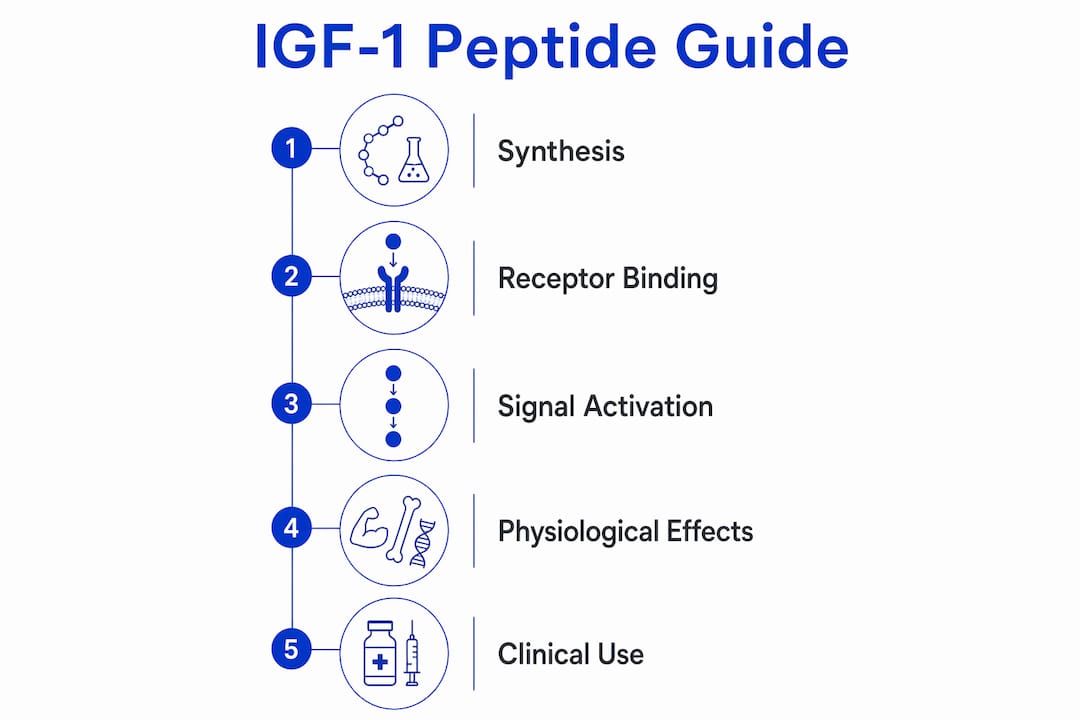
IGF-1’s 70-amino acid chain folds into four domains (A, B, C, D) connected by a C-peptide region that distinguishes it structurally from insulin. Three intramolecular disulfide bonds hold the tertiary structure together, and this geometry is what allows tight, specific binding to the IGF-1 receptor (IGF-1R).
When IGF-1 binds IGF-1R, the receptor’s intracellular tyrosine kinase domains cross-phosphorylate. That event kicks off two major downstream cascades:
- PI3K/AKT/mTOR pathway: Drives protein synthesis, cell survival, and glucose uptake; activates anabolic signaling while suppressing atrogenes that would otherwise trigger protein degradation
- Ras/ERK pathway: Promotes cell proliferation and differentiation, particularly relevant in muscle satellite cells and bone osteoblasts
One detail that often gets overlooked: most circulating IGF-1 is not free. It travels bound in ternary complexes with IGF-binding proteins (IGFBPs), primarily IGFBP-3 and the acid-labile subunit (ALS). These complexes extend IGF-1’s plasma half-life to hours, but they also limit how much IGF-1 can actually reach tissue receptors. The free fraction, which is the biologically active portion, is a small percentage of total serum IGF-1.
IGF-1 operates through two distinct production systems: hepatic synthesis driven by growth hormone (GH) produces the systemic pool, while local autocrine/paracrine synthesis in muscle and bone generates tissue-specific effects. These two pools are regulated differently and do not always move in the same direction, which complicates both research design and clinical interpretation.
Local IGF-1 production in skeletal muscle, for example, responds to mechanical loading independently of GH. This is why related anabolic signaling peptides like PEG-MGF (a splice variant of IGF-1) have drawn interest for tissue-specific repair research.
Clinical importance and diagnostic uses of IGF-1
IGF-1 serum levels serve as a reliable proxy for average GH secretion over time, which makes them far more useful clinically than GH itself. GH is pulsatile and clears quickly; IGF-1 is stable enough to measure with a single fasting blood draw.

FDA-approved therapeutic use centers on mecasermin, sold as Increlex. The FDA approved it specifically for children with severe primary IGF-1 deficiency or GH gene deletion who have developed neutralizing antibodies to GH. This is a narrow indication. Off-label use in adults for anti-aging or body composition is not FDA-sanctioned.
Key clinical conditions involving IGF-1:
- Laron syndrome: GH receptor defects cause very low IGF-1 despite high GH; Increlex is the primary treatment
- Acromegaly: Excess GH drives chronically elevated IGF-1, used diagnostically to confirm and monitor the condition
- Growth hormone deficiency (GHD): Low IGF-1 supports diagnosis; levels normalize with GH replacement therapy
- Sarcopenia: Age-related IGF-1 decline correlates with progressive muscle loss in older adults
- Metabolic syndrome: IGF-1 influences insulin sensitivity; low levels associate with increased cardiometabolic risk
IGF-1 serum reference ranges by age (approximate):
| Age group |
Typical IGF-1 range (ng/mL) |
Clinical relevance |
| Children (2–12 years) |
90–450 |
Growth monitoring, GHD screening |
| Adolescents (13–18 years) |
200–1000 |
Peak physiological levels during puberty |
| Adults (20–40 years) |
100–300 |
Baseline for GH axis assessment |
| Adults (40–60 years) |
80–240 |
Declining trend; sarcopenia risk assessment |
| Older adults |
50–170 |
Low levels linked to frailty and metabolic decline |
Interpreting IGF-1 levels requires context. Nutritional status, liver function, thyroid status, and sex all shift the reference range. A low IGF-1 in a malnourished patient does not indicate GH deficiency; it reflects the liver’s reduced synthetic capacity. Clinicians use IGF-1 alongside GH stimulation testing, not as a standalone diagnostic.
Pro Tip: When reviewing IGF-1 lab results, always confirm the assay method used. Different immunoassay platforms can produce values that differ by 20–30%, which matters when tracking longitudinal changes in a research subject.
What are the real benefits and risks of IGF-1?
IGF-1’s anabolic effects are well-documented and span multiple tissue types. The risks are equally real and scale with dose and duration.
Documented benefits:
- Skeletal muscle: IGF-1 stimulates satellite cell activation, myofibrillar protein synthesis, and inhibits muscle protein breakdown, producing net hypertrophy
- Bone: Promotes osteoblast proliferation and collagen synthesis; low IGF-1 correlates with reduced bone mineral density
- Neuroprotection: IGF-1 crosses the blood-brain barrier and supports neuronal survival, synaptic plasticity, and myelination; research links IGF-1 signaling to cognitive function and neurodegeneration protection
- Glucose metabolism: IGF-1 enhances peripheral insulin sensitivity by activating insulin receptors at high concentrations, which can lower blood glucose
- Connective tissue: Supports collagen turnover in tendons and cartilage, relevant for recovery research
Risks and adverse effects:
- Hypoglycemia: The most acute risk. IGF-1’s structural similarity to insulin means it can drive glucose into cells rapidly. The FDA boxed warning on Increlex specifically flags hypoglycemia as the primary safety concern, and this risk is amplified with analogs like IGF-1 LR3 due to their higher free bioactive fraction
- Cancer risk: Chronically elevated IGF-1 promotes cell proliferation through PI3K/AKT/mTOR. Epidemiological studies associate high-normal IGF-1 with increased risk for colorectal, prostate, and breast cancers, though causality remains under investigation
- Acromegalic features: Prolonged supraphysiological IGF-1 can cause soft tissue swelling, jaw changes, and organ enlargement
- Edema and joint pain: Common at higher doses, reflecting fluid retention driven by IGF-1’s sodium-retaining effects
- Intracranial hypertension: Reported in pediatric Increlex trials; presents as headache and papilledema
IGF-1’s biological effects are highly dose-dependent. The anabolic window where benefits outweigh risks is narrower than many assume, and the consequences of sustained supraphysiological levels are not trivial.
IGF-1 LR3 and other analogs: dosing, pharmacokinetics, and key differences
Native IGF-1 has a free peptide half-life of 12–15 minutes. Most of it binds immediately to IGFBPs in circulation, which extends its plasma residence but limits receptor access. For research applications requiring sustained IGF-1R activation, this short window is a practical problem.
IGF-1 LR3 was engineered to solve exactly that. The modifications are specific:
- A 13-amino acid extension at the N-terminus
- Substitution of glutamic acid at position 3 with arginine (Glu3Arg)
- These changes dramatically reduce IGFBP binding affinity, leaving the analog mostly free in circulation
The result: IGF-1 LR3 achieves a 20–30 hour functional half-life and roughly 2–3x greater potency than native IGF-1 at equivalent doses. Its molecular weight is approximately 9.1 kDa versus 7.6 kDa for native IGF-1.
Comparison of native IGF-1 and IGF-1 LR3:
| Feature |
Native IGF-1 |
IGF-1 LR3 |
| Amino acid length |
70 |
83 |
| Molecular weight |
~7.6 kDa |
~9.1 kDa |
| Free half-life |
12–15 minutes |
20–30 hours |
| IGFBP binding |
High |
Greatly reduced |
| Relative potency |
Baseline |
2–3x greater |
| Regulatory status |
FDA-approved (Increlex) |
Research-grade only |
| WADA classification |
Banned (S2) |
Banned (S2) |
Dosing considerations in research contexts:
- Native IGF-1 (clinical use): Increlex dosing for pediatric patients starts at 0.04–0.08 mg/kg twice daily, titrated based on response and tolerability
- IGF-1 LR3 (research use): Typical experimental protocols use microgram-range doses; the extended half-life means less frequent administration compared to native IGF-1
- Administration route: Subcutaneous injection is standard for both; intravenous use is reserved for specific clinical protocols
One persistent misconception worth addressing directly: local injection of IGF-1 LR3 into a specific muscle does not isolate the effect to that muscle. Once in circulation, the peptide acts systemically via IGF-1R receptors distributed throughout the body. Experimental designs that assume localized action are methodologically flawed.
For researchers studying related growth hormone secretagogue pathways, understanding how GH secretagogues stimulate IGF-1 production upstream provides important context for interpreting IGF-1 analog data.
IGF-1, aging, and the US regulatory picture
IGF-1 serum levels decline progressively after early adulthood. This decline correlates with the gradual loss of lean muscle mass, reduced bone density, slower tissue repair, and the metabolic shifts that characterize normal aging. Whether that decline is a cause of aging-related deterioration or simply a marker of it remains one of the central questions in longevity research.
Current research directions are pulling in two directions simultaneously. One body of work links lower IGF-1 to faster biological aging, cognitive decline, and frailty, suggesting that maintaining IGF-1 within a healthy physiological range could slow these processes. A competing line of evidence, drawn from centenarian studies and animal models, finds that reduced IGF-1 signaling associates with longer lifespan in several species. The tension between these findings reflects IGF-1’s dual role: anabolic and proliferative in the short term, potentially pro-aging through accumulated cell proliferation over decades.
What the US regulatory framework actually says:
- Increlex (mecasermin) is the only FDA-approved IGF-1 product for human use, indicated for severe primary IGF-1 deficiency in pediatric patients
- IGF-1 LR3 and other analogs carry no FDA approval for human therapeutic use; they are classified as research-grade compounds
- Possession and use of unapproved peptide hormones for human performance enhancement falls outside FDA-sanctioned use and may violate federal law depending on context
- WADA’s S2 prohibition covers IGF-1 and all analogs, making their use in competitive sport a doping violation regardless of jurisdiction
For researchers working with IGF-1 LR3 in laboratory settings, stability is a practical concern that directly affects data quality. IGF-1 LR3 is supplied as a lyophilized powder and requires acidic reconstitution. Neutral or basic pH accelerates peptide aggregation and degradation before the compound ever reaches a cell. This is not a minor handling note; degraded peptide produces unreliable dose-response data.
Pro Tip: Reconstitute lyophilized IGF-1 LR3 using 0.1% acetic acid or a dilute acidic buffer. Store reconstituted peptide at 4°C and use within the manufacturer’s recommended window. Avoid repeated freeze-thaw cycles, which accelerate structural degradation.
Longevity-focused research increasingly treats IGF-1 analogs as tools for probing the biology of aging rather than as therapeutic candidates. Understanding the PGC-1 alpha pathway alongside IGF-1 signaling gives a more complete picture of how cellular energy regulation and anabolic signaling intersect in aging tissue.
Synthrolab’s research-grade peptide catalog for serious investigators
Researchers who need reliable IGF-1 LR3 and related compounds face a real sourcing problem. Most suppliers offer inconsistent purity, no certificate of analysis, and no transparency about reconstitution specifications. That’s where Synthrolab is different.
Synthrolab supplies research-grade anabolic signaling peptides including IGF-1 LR3, manufactured to laboratory standards with documented purity. Every batch comes with a certificate of analysis, so you know exactly what you’re working with before it goes near a cell culture or an experimental protocol. Synthrolab also covers the broader signaling landscape researchers need, from lifespan extension compounds to metabolic modulators, all under one catalog built for scientific investigation rather than consumer supplementation. If you’re building a protocol around IGF-1 analogs or exploring adjacent pathways, start with the peptides beginner guide or go straight to the full product catalog to find what your research requires.
Key Takeaways
IGF-1 LR3’s dramatically reduced IGFBP binding and extended half-life make it the most pharmacokinetically relevant IGF-1 analog for sustained receptor activation research, while native IGF-1’s FDA-approved form (Increlex) remains the only legally sanctioned human therapeutic in the US.
| Point |
Details |
| IGF-1 structure and signaling |
A 70-amino acid peptide that activates PI3K/AKT/mTOR and Ras/ERK cascades via IGF-1R binding. |
| IGF-1 LR3 potency and half-life |
The analog achieves 2–3x greater potency and a 20–30 hour half-life by evading IGFBP binding. |
| Clinical and regulatory status |
Increlex is FDA-approved for pediatric IGF-1 deficiency; IGF-1 LR3 is research-grade only and WADA-banned. |
| Hypoglycemia risk |
The FDA boxed warning on Increlex flags hypoglycemia as the primary acute safety concern for all IGF-1 compounds. |
| Synthrolab for researchers |
Synthrolab supplies certificate-of-analysis-verified IGF-1 LR3 and related peptides for laboratory investigation. |
Recommended
 21+ verification