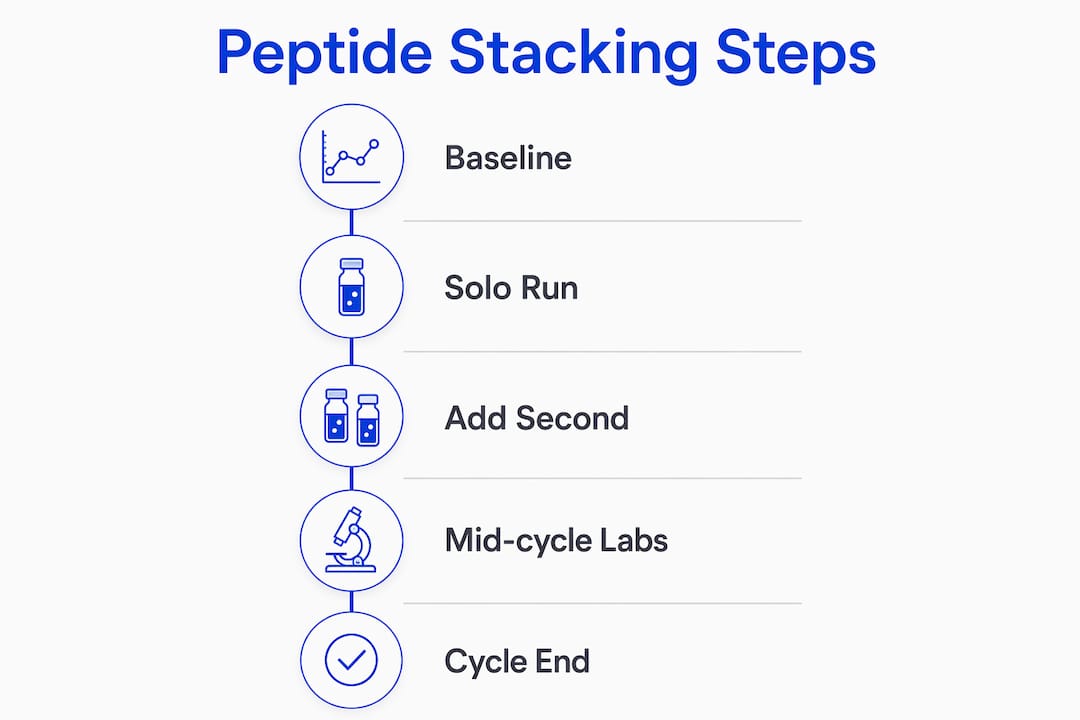
Safe peptide stacking follows a clear sequence: run baseline labs (IGF-1, fasting glucose, HbA1c, CMP, thyroid panel, CBC, hsCRP), run one peptide solo for 2–4 weeks, add a second peptide only after a clean 1–2 week observation window, cap your stack at 2–3 peptides, then recheck labs at 4–6 weeks and at cycle end. That sequence is the whole game. Everything else in this guide is about executing it without cutting corners.
The short version:
- Step 1: Get baseline labs before touching anything.
- Step 2: Run a single peptide for several weeks. Document everything.
- Step 3: Add one peptide at a time, with a short gap between additions.
- Step 4: Cap your stack at a small number of peptides total.
- Step 5: Recheck labs several weeks into the cycle and again at cycle end. Have a stop rule ready.
TL;DR safety rules:
- Choose peptides with complementary mechanisms (different receptors or pathways). Redundancy wastes doses and amplifies side effects.
- Never mix peptides into one vial. Reconstitute and store each compound separately.
- Verify every product with a Certificate of Analysis (COA) before use.
- Most multi-peptide stacks lack published human clinical trials. Treat any combination as experimental and work with a clinician.
- Stop and seek medical attention if you notice persistent glucose elevation, unusual swelling, or any symptom that does not resolve within 48 hours.
Table of Contents
What is peptide stacking, and why do researchers do it?
Peptide stacking means running two or more peptides concurrently within a single protocol, timed so their physiological effects overlap or build on each other. It is not the same as buying a pre-mixed commercial blend. A blend is a fixed-ratio formulation decided by a manufacturer; a stack is a deliberate, researcher-controlled combination chosen because each compound targets a distinct rate-limiting step in a pathway.
The core premise of stacking: one peptide addresses the bottleneck you cannot fix alone; the second addresses a different bottleneck in the same system. When both bottlenecks open simultaneously, the combined output exceeds what either compound produces solo. That is mechanistic synergy. Anything less is just redundancy with extra cost and side effects.
The outcomes researchers typically investigate fall into three categories. First, amplified GH pulses: pairing a GHRH analog like CJC-1295 with a GHRP like Ipamorelin targets two separate receptor populations on pituitary somatotrophs, producing a pulse neither compound generates alone. Second, combined tissue repair: BPC-157 drives local angiogenesis and cellular repair at the injury site while TB-500 promotes systemic actin polymerization and cell migration, covering both local and systemic repair simultaneously. Third, metabolic plus healing combinations, where a GH secretagogue stack runs alongside a healing peptide to address body composition and recovery in parallel.
What stacking does not do is multiply benefits indefinitely. Adding a third or fourth compound rarely adds proportional effect and almost always complicates troubleshooting.
Core safety principles you cannot skip
These rules exist because most peptide stacking problems trace back to one of three mistakes: starting too many compounds at once, skipping product quality checks, or ignoring the evidence gap between animal studies and human use.
The non-negotiable rules:
- Start single. Run one peptide for multiple weeks before adding anything. Sequential introduction lets you attribute any side effect to a specific compound rather than guessing across a stack.
- Introduce sequentially. Add one new peptide at a time, with a clean window of some weeks between additions.
- Cap at 2–3 peptides. Experts consistently advise limiting stacks to a practical maximum of a few compounds to simplify troubleshooting and reduce interaction risk.
- Choose complementary mechanisms. Receptor redundancy leads to saturation and wasted dosing. Two compounds on the same receptor do not double the signal; they compete for it.
- Never co-formulate. Reconstituted peptides degrade over time, and mixing them into one vial accelerates instability and compromises dosing precision. Each peptide gets its own vial.
Quality checklist before you start:
- Obtain a COA for every batch. Check potency, purity (HPLC), and endotoxin levels. Synthrolab publishes batch-level COAs for every product.
- Confirm storage requirements. Most reconstituted peptides require refrigeration at cool temperatures and should be used within about a month.
- Track lot numbers. If a side effect appears, you need to know exactly which batch was in use.
Regulatory and clinical disclaimer: The FDA’s compounding guidance places several peptides on restricted or nominated lists, and regulatory status changes. Consult a licensed clinician before starting any peptide protocol. Absolute contraindications include pregnancy, active or suspected malignancy, and uncontrolled diabetes. This article is general research information, not medical advice.
Pro Tip: Before purchasing, cross-reference the supplier’s COA against an independent third-party lab report. A COA issued by the same facility that manufactured the product is a weaker quality signal than one from an accredited external laboratory.
How to build your stack step by step
This protocol is designed for beginners and intermediate researchers who want a clinic-style sequence they can follow and document.
Phase 1: Baseline assessment
Before running any peptide, get the following labs drawn:
- Comprehensive Metabolic Panel (CMP): liver and kidney function, electrolytes
- IGF-1: your primary GH-axis marker; critical for GH secretagogue stacks
- Fasting glucose and HbA1c: GH secretagogues can shift glucose metabolism
- Thyroid panel (TSH, free T3, free T4): some peptides interact with thyroid signaling
- CBC with differential: immune and hematologic baseline
- hsCRP: systemic inflammation marker; useful for healing stack monitoring
Document your subjective baseline too: sleep quality (1–10), energy (1–10), recovery time after exercise, and any existing pain or injury sites. These numbers matter more than they sound when you are trying to decide whether a new peptide is working.
Phase 2: Solo run (weeks 1–4)
Start your first peptide at the lower end of the research-documented dose range. Log every administration using this template:
| Field |
What to record |
| Date and time |
Exact timestamp |
| Peptide and dose |
Name, mg, injection site |
| Fasted status |
Hours since last meal |
| Subjective rating |
Energy, sleep, recovery (1–10) |
| Side effects |
Any symptom, even minor |
| Notes |
Anything unusual |
Run this solo for multiple weeks. Do not add anything else. If side effects appear, you know exactly what caused them.
Phase 3: Adding the second peptide (weeks 5–8)
After a clean 1–2 week observation window with no unresolved side effects, introduce the second peptide at a lower starting dose than you would use solo. Structured logs and scheduled labs at baseline, 4–6 weeks, and cycle completion are the standard monitoring workflow. Recheck IGF-1, fasting glucose, and any marker that moved at baseline.

Phase 4: Mid-cycle labs and dose adjustment (weeks 6–8)
Pull labs several weeks into the cycle. If IGF-1 has risen sharply above range, reduce the GHRH dose before adjusting the GHRP. If fasting glucose has shifted upward, pause the GH secretagogue and recheck in two weeks before resuming. Never adjust two variables simultaneously; you will lose the ability to identify the cause.
Phase 5: Cycle end and washout
Most GH secretagogue cycles run multiple weeks, followed by a washout period of about a month. Healing peptides like BPC-157 are often run in shorter cycles lasting a few weeks. Pull a full panel at cycle end and compare against baseline before planning the next protocol.
The decision table:
| Week |
Action |
Labs |
Decision point |
| — |
Baseline labs |
Full panel |
Proceed only if no contraindications |
| 1–4 |
Solo peptide run |
None |
Continue if no unresolved side effects |
| 5 |
Add second peptide (low dose) |
None |
Pause if new side effects appear |
| 6–8 |
Mid-cycle check |
IGF-1, fasting glucose |
Adjust dose or pause based on results |
| 8 |
Complete cycle |
Full panel |
Compare to baseline; plan washout |
Pro Tip: Set a hard stop rule before you start, not during. Write down the specific lab value or symptom that will make you pause the protocol. Researchers who define their stop rule in advance are far less likely to rationalize continuing through a warning sign.
When and how to time your doses
Timing is where many researchers lose the benefit they built into a well-chosen stack. Half-life differences and insulin sensitivity windows create real differences in outcomes.
GH secretagogue timing rules:
- Dose fasted: GH secretagogues work best after a period without eating and well before the next meal. Insulin blunts GH release, so a post-meal injection undercuts the stack.
- Pre-sleep dosing captures the natural GH pulse that occurs in early slow-wave sleep. Many researchers use their primary GH secretagogue dose at bedtime.
- Pre-exercise dosing (30–45 minutes before training) is a secondary option for GH secretagogues, but only if you are training fasted or in a low-insulin state.
Concurrent vs. separated dosing:
- CJC-1295 and Ipamorelin can be drawn into the same syringe immediately before injection because they target different receptors and have compatible pH ranges. Do not pre-mix and store.
- BPC-157 and TB-500 are typically dosed separately, at different injection sites, because BPC-157 is often injected near the injury site for local effect while TB-500 is administered systemically.
- Never combine a GH secretagogue with a GLP-1 agonist in the same timing window. They compete for metabolic bandwidth and the GI side effects compound.
Quick sequencing tips:
- Morning: systemic healing peptides (TB-500), metabolic compounds
- Pre-sleep: GH secretagogues (CJC-1295 + Ipamorelin)
- Pre-exercise (fasted): GH secretagogues if not using pre-sleep dosing
- Avoid dosing GH secretagogues within 2 hours of any carbohydrate-heavy meal
Which stacks have the strongest evidence?
Not all combinations are equal. The table below ranks common stacks by evidence tier: Tier A means direct human pharmacology data exists; Tier B means mechanistic human data with limited controlled trials; Tier C means primarily animal or preclinical evidence.
| Stack |
Mechanism |
Best for |
Evidence tier |
| CJC-1295 + Ipamorelin |
GHRH receptor + ghrelin receptor; dual pituitary stimulation |
GH pulse amplification, body composition research |
Tier A |
| BPC-157 + TB-500 |
Local angiogenesis + systemic actin polymerization |
Tissue repair, recovery research |
Tier C |
| GHK-Cu + BPC-157 |
Collagen synthesis + local repair signaling |
Skin, connective tissue, wound healing |
Tier C |
| Epithalon + GHK-Cu |
Telomerase activation + antioxidant/collagen support |
Longevity, cellular aging research |
Tier C |
| CJC-1295 + Ipamorelin + BPC-157 |
GH axis + local repair |
Combined body composition and recovery |
Tier B (combination extrapolated) |
CJC-1295 + Ipamorelin is the best-documented GH-axis synergy. These two peptides act on different receptors on pituitary somatotrophs, producing a synergistic GH pulse larger than either compound alone. The GHRH analog (CJC-1295) sets the amplitude; the GHRP (Ipamorelin) amplifies the pulse and suppresses somatostatin. That is textbook receptor complementarity.
BPC-157 + TB-500 is mechanistically logical but supported primarily by animal studies. BPC-157 drives local repair and angiogenesis at the injury site; TB-500 promotes systemic cell migration via actin polymerization. They cover different phases of tissue repair without competing. Treat this combination as experimental in human research contexts.
What to avoid: Combining two GLP-1 agonists does not create metabolic synergy. They act on the same receptor class, so the result is magnified GI side effects without additional metabolic benefit. The same logic applies to stacking two GHRPs (e.g., Ipamorelin plus GHRP-6): receptor saturation limits the upside while side effects accumulate.
A practical evidence-tier system helps researchers make honest decisions about which combinations are worth the risk and which are vendor-driven marketing dressed up as science.
What to monitor, and when to stop
Monitoring is not optional. GH-axis stacks in particular can shift fasting glucose, IGF-1, and thyroid markers within weeks, and those shifts are not always symptomatic until they are significant.
Lab monitoring schedule:
- Baseline: Full panel before starting (see Phase 1 above)
- 4–6 weeks: IGF-1, fasting glucose, HbA1c, CMP
- Cycle end: Full panel, compared against baseline
Common side effects by class:
- GH secretagogues (CJC-1295, Ipamorelin): water retention, transient joint stiffness, fasting glucose elevation, increased hunger, tingling at injection site
- Healing peptides (BPC-157, TB-500): mild injection site reactions, transient nausea (BPC-157 at higher doses), fatigue in the first week of TB-500
- GLP-1 agonists: nausea, vomiting, diarrhea, reduced appetite (dose-dependent)
Red flags requiring immediate pause and medical attention:
- Fasting glucose consistently above 100 mg/dL when it was normal at baseline
- IGF-1 rising above the upper limit of the age-adjusted reference range
- Unusual or persistent swelling, especially in hands and feet
- New or worsening headaches that do not resolve within 48 hours
- Any sign of injection site infection (redness spreading beyond 1 cm, warmth, pus)
Drug interactions worth knowing: Peptides are generally not metabolized by CYP450 enzymes the way small molecules are, so direct CYP3A4 competition is minimal. The more relevant concern is metabolic interaction: GH secretagogues can reduce insulin sensitivity, which matters for anyone on metformin, insulin, or other glucose-regulating medications. Discuss any existing prescriptions with your clinician before starting a GH-axis stack.
Absolute contraindications: pregnancy, active or suspected malignancy, uncontrolled diabetes, and known hypersensitivity to any component.
How strong is the evidence, really?
The honest answer: stronger for some combinations than others, and weaker than most vendor marketing implies.
The best human pharmacology data supports GHRH + GHRP combinations for amplified GH pulses. Studies published in peer-reviewed journals confirm that combining a GHRH analog with a GHRP produces a synergistic GH response in humans. That is Tier A evidence for the mechanism. What it does not confirm is that a larger GH pulse automatically translates to better body composition outcomes in healthy adults. The strongest clinical-pharmacology evidence supports GH pulse amplification; the downstream body-composition effects are less consistently demonstrated in controlled human trials.
For healing stacks, the picture is more limited. BPC-157 and TB-500 research is largely animal-based. The mechanistic rationale is sound, but human RCT data for these combinations does not yet exist.
The evidence gap is real and worth stating plainly: most multi-peptide stacks lack published human clinical trials. The combinations discussed in this guide are supported by mechanistic logic, pharmacology data for individual compounds, and in some cases animal studies. None of that is the same as a controlled human trial demonstrating safety and efficacy for the specific combination. Researchers and clinicians should weigh that gap explicitly when designing protocols.
Limitations to keep in mind:
| Limitation |
Why it matters |
| No multi-peptide RCTs |
Cannot confirm safety or efficacy of combinations in humans |
| Vendor marketing bias |
Pre-blended stacks are often formulated for commercial reasons, not mechanistic ones |
| Chemical stability in mixed vials |
Different pH optima and degradation rates make pre-mixing risky |
| Regulatory uncertainty |
FDA compounding rules for peptides are active and evolving |
Synthrolab addresses the quality side of this gap by publishing batch-level COAs for every product, including potency (HPLC), purity, and endotoxin results. That does not substitute for clinical oversight, but it removes one major variable from the equation.
Key Takeaways
Peptide stacking produces real synergy only when each compound targets a distinct receptor or pathway; redundancy adds side effects without adding benefit.
| Point |
Details |
| Sequence before stacking |
Run one peptide solo for several weeks before adding a second; attribute side effects before compounding variables. |
| Cap at 2–3 peptides |
Limiting stacks to 2–3 compounds keeps troubleshooting manageable and reduces interaction risk. |
| Labs at three checkpoints |
Draw a full panel at baseline, at 4–6 weeks, and at cycle end; track IGF-1 and fasting glucose as primary markers. |
| Evidence tiers matter |
CJC-1295 + Ipamorelin has human pharmacology support (Tier A); BPC-157 + TB-500 is preclinical (Tier C); treat each accordingly. |
| Synthrolab for quality assurance |
Synthrolab provides research-grade peptides with batch-level COAs, removing product quality as a variable in your protocol. |
Why the “more is better” instinct gets researchers into trouble
The most common mistake in peptide stacking is not a bad peptide choice. It is adding a third or fourth compound because the first two seemed to work. That instinct makes sense emotionally and almost no sense mechanically.
Every physiological pathway has a rate-limiting step. Once you have addressed that step with the right compound, adding another compound that targets the same step does not open the pathway further. It saturates the receptor, competes for binding, and adds a new side-effect profile to manage. The researchers who get the clearest results from stacking are the ones who identify the single bottleneck in their target pathway and add only the compound that addresses it. That is the bottleneck approach, and it is the opposite of the “stack everything that might help” logic that drives most vendor marketing.
There is also a troubleshooting argument. A two-peptide stack with a side effect has two suspects. A four-peptide stack has four, plus every possible interaction between them. The practical cap of 2–3 peptides is not conservative caution; it is the minimum complexity needed to actually understand what is happening in a protocol.
Synthrolab supports your research from the start
Researchers who want to apply this protocol need one thing above everything else: compounds they can trust. Synthrolab supplies research-grade peptides with full batch-level COA verification, so potency, purity, and endotoxin results are available before you run a single injection. That removes product quality as a variable in your protocol, which matters more than most researchers realize until something goes wrong with an unverified source.
For researchers starting with GH-axis stacking, the CJC-1295 + Ipamorelin combination is available as a paired product with supporting protocol notes. For healing-focused research, the BPC-157 + TB-500 combination is documented with preclinical evidence summaries. New to peptides entirely? Synthrolab’s beginner safe-start guide walks through compound selection, quality checks, and first-protocol planning in plain language. Start there, verify your COAs, and build your stack one compound at a time.
Useful sources and further reading
The sources below underpin the evidence claims in this guide. When reading a COA, look for three things: potency confirmed by HPLC (should match the labeled amount within a tight tolerance), purity percentage (research-grade compounds typically exceed 98%), and endotoxin levels measured in EU/mg (lower is better; most research applications require below 1 EU/mg).
| Source |
What it covers |
| PubMed: GHRH + GHRP human pharmacology |
Human data on synergistic GH pulse from GHRH + GHRP combinations |
| PubMed: GH secretagogue receptor mechanisms |
Receptor-level explanation of how GHRPs amplify GH release |
| PubMed: CJC-1295 pharmacokinetics |
Human pharmacokinetic data for a GHRH analog |
| PMC: Peptide research review |
Broader review of peptide research including healing compounds |
| FDA compounding bulk substances list |
Current FDA regulatory status for compounded peptides |
| FDA safety risk guidance |
FDA guidance on bulk drug substances with potential safety concerns |
| AAMC commentary on evidence gaps |
Academic medical commentary on experimental therapeutics and evidence gaps |
| Synthrolab COA page |
Batch-level certificates of analysis for Synthrolab products |
Further reading from Synthrolab:
Recommended
 21+ verification