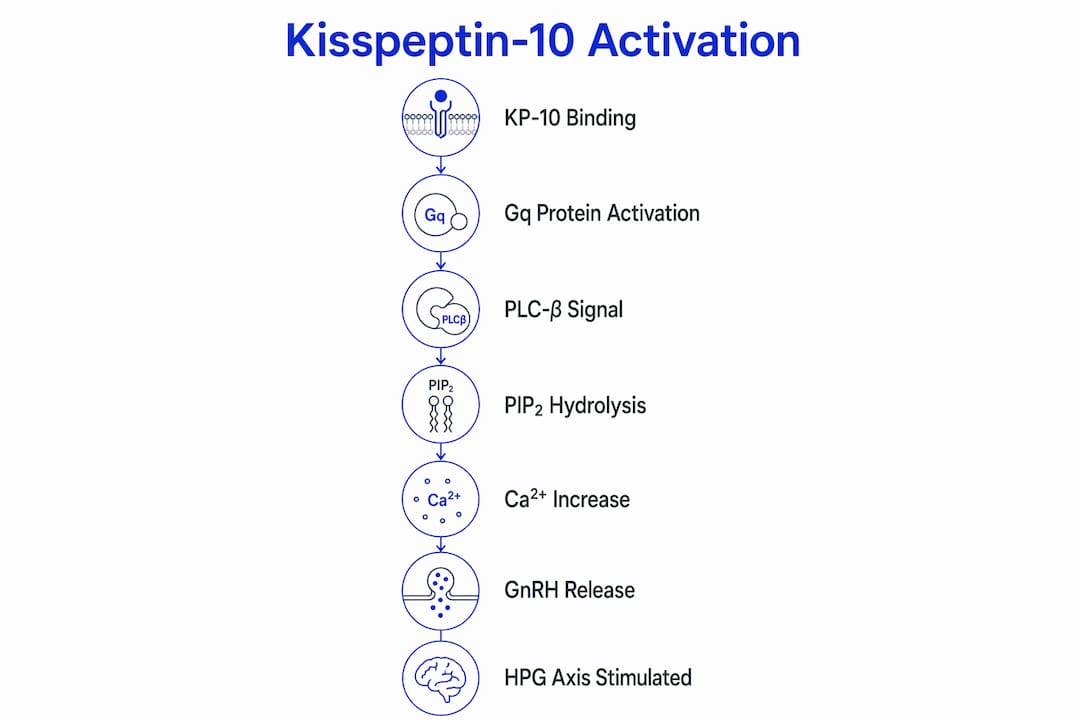
Kisspeptin-10 (KP-10) is the C-terminal decapeptide of the KISS1 gene product, carrying the sequence YNWNSFGLRF-NH2, and it is the most potent and widely used agonist of the KISS1R (GPR54) receptor in both laboratory and clinical settings. Binding KISS1R with Ki values of approximately 1.59 nM (rat) and 2.33 nM (human), KP-10 triggers Gq-mediated intracellular signaling that drives pulsatile GnRH secretion from the hypothalamus, producing measurable LH and FSH surges within minutes of administration. That mechanism makes it the primary research probe for interrogating HPG axis function and a serious translational candidate for fertility disorders.
Key facts every researcher and clinician should have at hand before working with this peptide:
- Receptor and pathway: KP-10 agonizes KISS1R/GPR54, a Gq-coupled GPCR, to stimulate GnRH pulsatility and downstream LH/FSH release.
- Affinity: Low nanomolar Ki in both rat and human receptor preparations, placing it among the highest-affinity endogenous neuropeptide agonists of the HPG axis.
- Clinical relevance: Jayasena et al. 2011 demonstrated clear sexual dimorphism in LH and FSH responses to KP-10 in humans, a finding that shapes how clinical protocols are designed for men versus women.
- Stability caveat: KP-10 is rapidly degraded in vivo by endopeptidases; its short systemic half-life demands careful attention to administration route, timing, and peptide handling.
- Regulatory status: KP-10 is a research compound in the United States; its use in humans requires IRB approval and informed consent under applicable federal regulations.
Table of Contents
How does kisspeptin-10 activate the HPG axis?
KISS1R pharmacology and intracellular signaling
KISS1R is a Gq-coupled GPCR. When KP-10 occupies the receptor, Gq activates phospholipase C-β, which hydrolyzes PIP2 to generate IP3 and diacylglycerol. IP3 mobilizes intracellular Ca2+, and diacylglycerol activates protein kinase C. Downstream, TRPC4 channel activation and inhibition of inwardly rectifying K+ channels produce sustained membrane depolarization in GnRH neurons, driving action potential firing and peptide release into the portal circulation. The cSrc tyrosine kinase arm of this pathway adds a parallel MAPK signal that modulates gene expression over longer timescales.

KNDy neurons as the pulse generator
The architecture that converts receptor activation into pulsatile GnRH output is the KNDy neuron population: hypothalamic neurons co-expressing kisspeptin, neurokinin B (NKB), and dynorphin. NKB drives synchronous KNDy firing, kisspeptin relays the excitatory signal to GnRH neurons, and dynorphin provides the inhibitory brake that terminates each pulse. The result is a self-sustaining oscillator whose frequency and amplitude are tunable by sex steroids. Estradiol and progesterone act on KNDy neurons to suppress GnRH pulse frequency (negative feedback), while the preovulatory estradiol surge switches the system to positive feedback, generating the LH surge that triggers ovulation. Testosterone exerts negative feedback in men through the same KNDy circuitry.

Sexual dimorphism in responsiveness
Men and women respond differently to the same KP-10 dose, and the mechanism is not simply receptor density. Estradiol priming in women during the late follicular phase amplifies the GnRH response, whereas luteal-phase progesterone suppresses it. Men, under steady androgen feedback, show a more consistent LH response across repeated bolus administrations. Inactivating mutations in KISS1 or KISS1R cause idiopathic hypogonadotropic hypogonadism in both sexes, which confirms that this pathway is non-redundant for puberty and fertility. Understanding that dimorphism is not optional when designing a clinical protocol: the same dose administered to a woman in the follicular phase versus the luteal phase can produce dramatically different LH amplitudes.
Pro Tip: When planning a KP-10 challenge study in women, document cycle day and measure baseline LH, FSH, and estradiol before administration. A luteal-phase recruit will blunt your LH response and confound between-subject comparisons.
What do human clinical trials show about kisspeptin-10?
Trial evidence and sexual dimorphism
The landmark Jayasena et al. 2011 study published in PLOS ONE (PMC3232613) remains the most cited human experiment directly comparing KP-10 effects across sexes. It showed that intravenous KP-10 produced robust LH and FSH increases in healthy men, while women in the follicular phase showed a blunted LH response relative to men despite equivalent plasma KP-10 levels. That dissociation between circulating peptide and gonadotropin output is the clearest human evidence for sex-steroid-dependent gating of KISS1R signaling at the hypothalamic level.
Dose, route, and timeline to effect
In human studies, KP-10 has been administered as an IV bolus (typically a low nanomolar dose range), a subcutaneous bolus, or a continuous IV infusion. LH peaks typically occur within about an hour of an IV bolus, with FSH rising more slowly and returning to baseline over 2–4 hours. Prolonged IV infusion in men has produced sustained LH elevation and measurable increases in serum testosterone, consistent with maintained GnRH pulsatility rather than receptor desensitization at the doses studied. Subcutaneous administration produces a slower, lower peak but extends the window of detectable hormone response, which has practical implications for outpatient fertility protocols.
Clinical data summary
| Population |
Dose and route |
Primary outcome |
Adverse events |
| Healthy men |
a low nanomolar dose range IV bolus |
Robust LH and FSH rise; peak within an hour |
Mild injection-site reactions; transient flushing |
| Healthy women (follicular) |
1–10 nmol/kg IV bolus |
Blunted LH response vs. men; FSH rise modest |
Mild injection-site reactions |
| Healthy women (luteal) |
1–10 nmol/kg IV bolus |
Suppressed LH response; progesterone-mediated |
Minimal reported |
| Men (prolonged infusion) |
Continuous IV infusion |
Sustained LH elevation; testosterone increase |
Transient endocrine shifts; no serious adverse events |
| PCOS and fertility cohorts |
Exploratory doses, IV/SC |
Investigational; LH pulse modulation studied |
Under active investigation |
Statistic callout: KP-10 binds KISS1R with a Ki of approximately 1.59 nM in rat and 2.33 nM in human receptor preparations — affinity comparable to the tightest endogenous neuropeptide-receptor pairs in the HPG axis.
Adverse events and monitoring
Human trials have reported a reassuringly limited adverse event profile. The most common findings are transient injection-site reactions (redness, mild pain with SC administration) and brief endocrine shifts that resolve without intervention. No serious adverse events attributable to KP-10 have been reported in published phase I/II studies. That said, monitoring recommendations for clinical research include serial LH and FSH sampling at 15–30 minute intervals for at least 2 hours post-dose, vital signs at baseline and 30-minute intervals, and pre-specified stopping criteria for any participant showing an LH surge exceeding a defined threshold or experiencing symptomatic events such as pelvic pain or vasovagal responses.
What preclinical studies established about KP-10 biology
The foundational animal work came before the human trials and shaped every clinical hypothesis that followed. Kotani et al. 2001 identified the KISS1 gene product and its receptor, establishing the ligand-receptor pair that would become the central focus of reproductive neuroendocrinology for the next two decades. Subsequent rodent and ovine studies confirmed that central or peripheral administration of KP-10 stimulates GnRH and LH across species, with the magnitude of response dependent on steroid milieu and administration route.
Key preclinical findings that directly inform translational work:
- Species-conserved GnRH stimulation: IV and intracerebroventricular KP-10 reliably stimulates LH in rats, mice, sheep, and non-human primates, establishing cross-species validity for the mechanism.
- Anti-metastatic origins: KISS1 was originally identified as a metastasis suppressor in human melanoma cell lines in 1996, and extra-reproductive roles including metabolic regulation and anti-tumor activity in preclinical models continue to expand the research scope beyond fertility.
- Cardiac and collagen findings: Some animal studies have reported effects on collagen content and cardiac parameters, though these findings remain mechanistically uncharacterized and have not been replicated in human trials.
- KP-10 vs. KP-54 potency: In direct animal comparisons, KP-54 shows greater systemic stability and longer duration of LH stimulation than KP-10, but KP-10’s defined sequence and commercial availability make it the preferred probe for mechanistic work. The KISS1 precursor yields KP-54, KP-14, KP-13, and KP-10; KP-54 is the dominant circulating form.
- Desensitization with chronic dosing: Continuous or high-frequency administration in rodents produces receptor desensitization and paradoxical suppression of the HPG axis, a finding that has directly informed the pulsatile rather than continuous dosing strategies used in human fertility protocols.
The preclinical data also established that blocking GnRH receptors with a GnRH-R antagonist abolishes the LH response to KP-10, confirming that the peptide acts upstream of the pituitary and not directly on gonadotropes in vivo.
KP-10 pharmacokinetics and what they mean for study design
KP-10 is rapidly degraded by endopeptidases in plasma and tissue, giving it a systemic half-life measured in minutes rather than hours. KP-54, by contrast, is more abundant in circulation and considerably more stable, which is why plasma kisspeptin measurements in clinical samples predominantly reflect the longer form. For researchers, this means that the dose of KP-10 reaching central KISS1R after peripheral administration is a fraction of what is injected, and the duration of receptor occupancy is brief unless a continuous infusion is used.
Binding affinity versus systemic persistence
The apparent paradox of KP-10 is that it binds KISS1R with low nanomolar affinity yet clears from the systemic circulation within minutes. High receptor affinity means that even transient exposure can produce a measurable LH pulse, which is why a single IV bolus generates a detectable hormone response. But it also means that sustained GnRH pulsatility requires either repeated bolus dosing at physiologically appropriate intervals (approximately every 60–90 minutes to mimic endogenous pulse frequency) or a continuous infusion titrated to maintain a steady receptor-occupancy level.
Implications for protocol design
- Bolus dosing is appropriate for acute challenge studies measuring peak LH and FSH responses; sample at 0, 15, 30, 45, 60, 90, and 120 minutes post-injection.
- Continuous infusion is required when the experimental endpoint is sustained testosterone elevation or follicular development; infusion rates must be empirically validated for the target species and route.
- Subcutaneous bolus offers a practical middle ground for outpatient settings, with a slower absorption curve that extends the LH response window at the cost of peak amplitude.
Analog strategies to extend half-life
PEGylation, lipidation, and cyclization have all been explored in preclinical models as strategies to extend KP-10 half-life and reduce dosing frequency. These approaches are experimental and have not reached clinical application; they are relevant context for researchers designing next-generation kisspeptin analogs rather than for those working with native KP-10 today. Extending peptide half-life through structural modification is a general strategy across the peptide research field, and the lessons from growth hormone secretagogues and other neuropeptides apply here.
Pro Tip: For in vitro receptor binding or cell-based signaling assays, add a protease inhibitor cocktail to your incubation buffer. KP-10 degrades quickly in serum-containing media, and a 30-minute incubation without protection can reduce effective peptide concentration by more than half before the assay reads.
Practical experimental protocols for KP-10 research
Reconstitution and storage
- Dissolve lyophilized KP-10 in sterile water or 0.1% acetic acid (10–100 µg/mL working stock), then dilute to the target concentration in sterile saline or PBS immediately before use.
- Prepare fresh solutions on the day of the experiment; do not store reconstituted peptide for more than 24 hours even at 4°C.
- Store lyophilized stock at −20°C in a desiccated container, protected from light and moisture. For long-term storage beyond 6 months, −80°C is preferable.
- Aliquot the stock into single-use volumes before freezing to avoid repeated freeze-thaw cycles, which accelerate degradation.
- Use low-binding polypropylene tubes and pipette tips; KP-10 adsorbs to glass and standard polystyrene surfaces, which can reduce effective concentration by a measurable amount at low working concentrations.
Dosing and administration in animal and human studies
- Rodent IV bolus: 1–100 nmol/kg via tail vein or jugular catheter; collect blood at 0, 10, 20, 30, and 60 minutes for LH/FSH.
- Rodent SC bolus: 10–100 nmol/kg; LH peak is delayed 15–30 minutes versus IV; extend sampling to 90 minutes.
- Human IV bolus: a low nanomolar dose range over 1 minute; LH sampling at 15-minute intervals for 2 hours minimum.
- Human continuous IV infusion: Titrated to target plasma concentration; pump-controlled; LH pulsatility sampling every 10 minutes for 8–12 hours to characterize pulse frequency and amplitude.
- Human SC bolus: Dose range as for IV bolus; absorption is slower and peak LH is lower; useful for outpatient challenge studies.
Sampling strategy for LH pulsatility
Characterizing LH pulsatility requires frequent sampling: every 10 minutes for at least 8 hours is the standard used in most published human studies. Pulse analysis software (such as Cluster or Deconvolution) requires a minimum of 24–48 samples to reliably distinguish pulses from assay noise. Assay sensitivity matters: use a validated chemiluminescent or electrochemiluminescent LH immunoassay with a functional sensitivity of 0.1 IU/L or better. Samples should be centrifuged promptly, plasma separated, and aliquots stored at −80°C until batch analysis to minimize freeze-thaw variability.
Pro Tip: Spike a known concentration of KP-10 into your vehicle control tube and run it through the same handling steps as your experimental samples. If the recovery is below 80%, your preparation or handling protocol is losing peptide before it reaches the receptor. Fix the handling before you run the experiment.
KP-10 sequence, chemistry, and analytical quality standards
The primary sequence of human KP-10 is YNWNSFGLRF, with a mandatory C-terminal amide modification (YNWNSFGLRF-NH2). The amide is not cosmetic: non-amidated variants fail to activate KISS1R, producing false-negative results in any functional assay. This is the single most common source of silent experimental failure when researchers use peptide from an unverified source.
Key chemical and analytical parameters:
- Molecular weight: ~1302.45 Da, confirmed by high-resolution mass spectrometry.
- HPLC purity: ≥95% by reverse-phase HPLC is the minimum acceptable standard for research-grade material; anything below this threshold introduces uncharacterized side products that can confound receptor binding and cell-based assays.
- Mass spectrometry confirmation: The COA should show the observed [M+H]+ or [M+2H]2+ ion matching the theoretical mass within 0.1 Da; a mass shift of even 1 Da indicates a sequence error or modification artifact.
- Endotoxin testing: Limulus amebocyte lysate (LAL) assay result should be stated on the COA; for in vivo use, endotoxin must be below 1 EU/mg to avoid confounding LH responses through inflammatory pathways.
- Water and solvent residuals: Residual TFA (from HPLC purification) should be reported; high TFA content can affect cell viability in culture assays.
Synthesis cautions
Racemization at tryptophan (W) residues is the primary synthesis risk for KP-10, given the two Trp residues in the sequence (positions 2 and 5). Racemization produces diastereomers that co-elute with the target peptide on standard HPLC columns but show reduced receptor affinity. Chiral HPLC or amino acid analysis is the only reliable way to detect this. For researchers evaluating a new batch, requesting the synthesis report alongside the standard COA is worth the ask.
Pro Tip: Request the raw HPLC chromatogram, not just the reported purity percentage. A single peak at ≥95% area is what you want; a chromatogram showing a broad shoulder or multiple small peaks near the main peak suggests incomplete purification or racemization, regardless of what the summary number says.
Safety, adverse effects, and regulatory considerations for KP-10 research
Documented adverse events in human studies
Published human trials report a limited and manageable adverse event profile. The most common findings are:
- Transient injection-site reactions (erythema, mild pain) with SC administration, resolving within hours.
- Brief endocrine shifts, including LH surges above the normal range, that return to baseline without intervention.
- Occasional vasovagal responses during blood sampling, attributable to the frequent venipuncture protocol rather than the peptide itself.
- No serious adverse events (anaphylaxis, sustained hormonal dysregulation, or organ toxicity) have been reported in published phase I/II human studies to date.
Monitoring recommendations for clinical research
Serial LH and FSH measurements at 15–30 minute intervals for at least 2 hours post-dose are standard. Vital signs should be recorded at baseline and every 30 minutes. Pre-specified stopping criteria should include any LH surge exceeding a protocol-defined threshold, symptomatic pelvic pain, or vasovagal syncope. For prolonged infusion studies, daily hormone monitoring and weekly safety labs (complete metabolic panel, CBC) are appropriate given the sustained HPG axis stimulation.
Ethical and IRB considerations
Any first-in-human or early translational study using KP-10 requires IRB approval under 21 CFR Part 50 and 56 in the United States, and an IND application to the FDA if the study meets the definition of a clinical investigation of a drug. Informed consent must address the reproductive effects of the peptide explicitly: participants should understand that KP-10 will transiently alter LH, FSH, and potentially sex steroid levels, and that the long-term effects of repeated administration are not fully characterized.
Contraindications and special populations
| Population |
Consideration |
| Pregnant individuals |
Kisspeptin levels rise dramatically during pregnancy; exogenous KP-10 effects on placental function are not fully characterized. Exclude from research protocols. |
| Breastfeeding individuals |
Potential effects on oxytocin and prolactin release; exclude pending further data. |
| Individuals planning conception |
Discuss potential transient HPG axis perturbation; document in consent. |
| Individuals with known KISS1R mutations |
May show attenuated or absent response; relevant for mechanistic studies but requires additional consent considerations. |
This article provides general scientific information for research planning purposes only. Researchers and clinicians should consult current FDA guidance, their institutional IRB, and qualified regulatory advisors before initiating any human study involving KP-10.
How to source research-grade KP-10 and what to check on a COA
Sourcing is where many KP-10 studies go wrong before the first injection. The peptide market includes suppliers ranging from fully validated manufacturers with peer-reviewed citations to operations with no analytical infrastructure. The COA is your primary filter.
COA checklist: what to require from any supplier
- Sequence confirmation: MS data showing the correct molecular ion for YNWNSFGLRF-NH2 (~1302.45 Da).
- HPLC purity: ≥95% by reverse-phase HPLC with the raw chromatogram available on request.
- C-terminal amidation confirmed: Either stated explicitly in the synthesis report or confirmed by MS fragmentation showing the amidated C-terminus.
- Endotoxin result: LAL assay value in EU/mg; must be below 1 EU/mg for in vivo use.
- Water content: Karl Fischer titration result; high water content reduces actual peptide mass per vial.
- Residual solvents: TFA or acetonitrile residuals from purification.
- Batch number and expiry: Traceable batch ID linked to the COA; expiry date consistent with stated storage conditions.
- Storage and shipping conditions: Lyophilized at −20°C; cold chain documentation for shipment.
Evaluating vendor credibility
Peer-reviewed publications citing a vendor’s material are the strongest credibility signal available. Check whether the supplier’s product appears in the methods section of published studies in journals such as Journal of Clinical Endocrinology and Metabolism or Endocrinology. Accessible COAs on the product page (not “available on request” with no follow-through) and transparent QC testing documentation are baseline expectations. Established suppliers such as Sigma-Aldrich/Merck, Tocris/Bio-Techne, Bachem, and APExBIO all offer KP-10 with documented QC and U.S. availability; their COAs typically include MS confirmation, HPLC purity, and endotoxin data. Reviewing peptide quality standards across suppliers before committing to a batch is time well spent.
Shipping and storage logistics
Lyophilized KP-10 should ship on dry ice or with cold packs; room-temperature shipping for lyophilized peptide is acceptable for short transit times (under 48 hours) but should be confirmed with the supplier. Upon receipt, inspect the vial for any sign of moisture (clumping, discoloration) before accepting the batch. Aliquot immediately after reconstitution and return unused lyophilized stock to −20°C desiccated storage.
Pro Tip: Before running your first experiment with a new batch, run a parallel receptor binding or cell-based KISS1R activation assay alongside a reference batch of known activity. A new COA does not guarantee bioactivity; a functional verification step catches degraded or mis-synthesized material before it wastes animal or human study resources.
What research gaps remain for kisspeptin-10?
KP-10 biology is well established at the mechanistic level, but several translational gaps remain that limit its clinical development:
- Sex differences in responsiveness: The molecular basis of sexual dimorphism in KP-10-induced LH release is incompletely understood. Whether the difference is primarily at the level of KNDy neuron sensitivity, GnRH neuron responsiveness, or pituitary gating remains an open question requiring targeted electrophysiology and imaging studies in humans.
- PK/PD bridging studies: Robust pharmacokinetic data linking plasma KP-10 concentration to GnRH pulse parameters are lacking for most administration routes in humans. Without these data, dose selection for clinical protocols remains empirical rather than model-driven.
- Extended-action analogs in controlled settings: PEGylated and lipidated KP-10 analogs have shown promise in preclinical models, but no controlled human PK/PD study has characterized their safety and efficacy profile. This is the most obvious near-term clinical development gap.
- Extra-reproductive roles: Metabolic and anti-metastatic effects documented in preclinical models have not been systematically investigated in humans. Whether kisspeptin signaling influences insulin sensitivity, body weight, or tumor biology in clinical populations is genuinely unknown.
- Methodological standardization: LH pulsatility protocols vary substantially across published studies in sampling frequency, assay platform, and pulse-detection algorithm. Cross-platform assay harmonization and agreed reporting standards for peptide quality (purity, endotoxin, amidation confirmation) would accelerate meta-analytic synthesis and regulatory review.
- Chronic dosing safety: The long-term effects of repeated KP-10 administration on KISS1R expression, GnRH neuron morphology, and reproductive outcomes have not been characterized in humans. This is a prerequisite for any therapeutic application beyond acute challenge studies.
The KNDy neuron circuitry that generates GnRH pulsatility is also incompletely mapped in humans; translating rodent optogenetic findings to human neuroscience remains a methodological challenge that limits mechanistic interpretation of clinical KP-10 data.
Key Takeaways
Kisspeptin-10 is the minimal KISS1R agonist that reliably stimulates pulsatile GnRH release, but its rapid in vivo degradation and sex-steroid-dependent responsiveness make protocol design and peptide quality the two variables that most determine experimental success.
| Point |
Details |
| Confirm amidation before use |
Non-amidated KP-10 fails to activate KISS1R; always verify C-terminal amide by MS on the COA. |
| Match route to endpoint |
IV bolus suits acute LH challenge studies; continuous infusion is required for sustained testosterone or follicular endpoints. |
| Design sampling for pulsatility |
LH pulsatility studies require 10-minute sampling for at least 8 hours and a validated assay with ≤0.1 IU/L functional sensitivity. |
| Account for sexual dimorphism |
Follicular-phase women show blunted LH responses vs. men at equivalent doses; document cycle day and baseline steroids in every protocol. |
| Synthrolab for research-grade supply |
Synthrolab provides research-grade peptides with accessible COAs, supporting the QC verification steps this guide recommends. |
The part of KP-10 research that most protocols get wrong
The scientific community has spent considerable energy debating KP-10 dose and route, but the more consequential variable is almost always the one that gets the least attention: peptide integrity at the moment of administration. A researcher can design a flawless sampling protocol with 10-minute LH draws, validated immunoassays, and careful cycle-day matching, and still generate uninterpretable data because the peptide degraded during reconstitution or adsorbed onto the syringe before injection.
The sexual dimorphism finding from Jayasena et al. 2011 is genuinely important, but it has also created a tendency to attribute blunted LH responses to biology when the more parsimonious explanation is often a handling artifact. A luteal-phase woman with a flat LH curve after KP-10 administration is not necessarily demonstrating progesterone-mediated suppression; she may have received a fraction of the intended dose. Running a functional verification assay on every new batch, and spiking a recovery control into every experimental run, is not excessive caution. It is the minimum standard for data you can actually publish.
The translational potential for fertility applications is real. KP-10 can manipulate the HPG axis without supplying exogenous sex steroids, which is a meaningful clinical advantage for populations where steroid administration is contraindicated or undesirable. But that potential will only be realized if the field builds on clean, reproducible preclinical and phase I data, and that starts with taking peptide QC as seriously as the endocrine assays downstream of it.
Synthrolab supports your KP-10 research from COA to protocol
Researchers working with KP-10 need more than a peptide vial. They need documented purity, confirmed amidation, endotoxin data, and a supplier whose QC process holds up to the scrutiny of peer review. Synthrolab supplies research-grade peptides with accessible Certificates of Analysis, giving you the sequence confirmation, HPLC purity, and batch traceability this guide identifies as non-negotiable before any experiment begins.
Synthrolab’s catalog covers compounds relevant to cellular signaling, metabolic research, and reproductive neuroendocrinology, with COA documentation available at synthrolab.com/coa. This is not clinical advice; all compounds are supplied for laboratory research use only, and any human study requires appropriate regulatory and ethical approvals. If you are building a KP-10 protocol and need a supplier whose documentation will survive methods-section review, check Synthrolab’s current catalog and COA resources before your next order.
Useful sources
- Jayasena et al. 2011: Sexual dimorphism in KP-10 effects on LH/FSH in humans (PMC3232613) — primary human trial data; Ki values and LH response data cited throughout this guide.
- Genetic and clinical relationships of kisspeptin signaling to reproductive disorders (PMC3725344) — KISS1/KISS1R loss-of-function mutations and hypogonadotropic hypogonadism.
- Hypothalamic kisspeptin neurons and homeostasis control (PMC8758343) — TRPC4 channel activation and intracellular signaling mechanisms.
- KNDy neurons and GnRH pulsatility (PMC6693042) — pulse generator architecture and translational relevance.
- Comprehensive review on kisspeptin and reproductive disorders (PMC4508256) — kisspeptin family peptides, KP-54 vs. KP-10 comparison.
- Peptide stability and handling considerations (PubMed 19934405) — enzymatic degradation, storage, and reconstitution guidance.
- Extra-reproductive roles of kisspeptin: metabolic and anti-metastatic findings (PMC8720660) — non-reproductive research directions and translational implications.
- Kisspeptin-10 (human) product page, Bio-Techne/Tocris — sequence, molecular weight (~1302.45 Da), and HPLC purity specifications.
- Kisspeptin sequence and amidation notes — C-terminal amidation requirement for KISS1R activation.
- The role of kisspeptin in female reproduction (PMC5702467) — comprehensive review of kisspeptin biology in reproductive physiology.
- Kisspeptin signaling and its roles in humans (PMC4678402) — clinical signaling review covering central and peripheral administration data.
Recommended